

Industry: Desalination | Process: Brine_Disposal
A 38,000 m³/day (10 MGD) seawater reverse osmosis (SWRO) plant—typical of many sea‑water RO installations—was priced with an intake/outfall line at roughly $200 million, about one‑third of total project cost (processdesign.mccormick.northwestern.edu). That kind of sticker shock is pushing developers to rethink how they get rid of brine.
The conventional answer—an offshore pipeline capped by a multiport diffuser—works. But with pipeline costs scaling with brine flow and the distance to suitable offshore waters (IntechOpen; processdesign.mccormick.northwestern.edu), utilities are eyeing cheaper options: blending brine into power‑plant cooling‑water effluent, or sending it deep underground into saline aquifers.
Marine outfall pipelines and diffusers
The standard play is a buried subsea pipe—often high‑density polyethylene (HDPE; cost ∝ diameter)—ending in a diffuser engineered to entrain seawater at high velocity. That jet entrainment rapidly dilutes salts and contaminants, protecting benthic life (IntechOpen; ResearchGate). In deep water on sloping beds, single inclined jets are effective; in shallow or mild‑current environments, multiport diffusers are needed to achieve sufficient mixing (IntechOpen; IntechOpen). Designers optimize depth and buoyancy to meet “mixing zone” criteria—typically that salinity at the plume edge not exceed background by more than a small amount.
The costs are real. Quantitatively, a typical outfall pipe might run $5–10 million per km (plus installation), and even ignoring pumps, civil works like trenching and anchoring can push large projects into the hundreds of millions (IntechOpen; processdesign.mccormick.northwestern.edu). Pump electricity is modest by comparison—on the order of ~$0.0005–0.001 per m³—but pumping cost scales with flow×head (IntechOpen), and capital recovery dominates over the life of the plant.
There are environmental hurdles too. Subsea construction “may represent substantial costs” and can harm coral reefs during installation, Maliva et al. report (ResearchGate). Regulators frequently require stringent environmental reviews; in Indonesia, desalination brine is explicitly classified as a wastewater (limbah), so discharges must satisfy national water‑quality standards such as PP 82/2001 and related ministerial rules (text-id.123dok.com). That typically means modeling to show salinity and contaminants at the mixing‑zone edge meet permissible marine limits—and a permitting process that can be lengthy where coral reefs or fisheries might be affected.
Cooling‑water co‑disposal strategy
One widely cited workaround is to blend desalination brine with a nearby power plant’s condenser cooling‑water (CW) effluent and discharge through a single outfall. Shrivastava et al. note that one diffuser can serve both streams, “eliminating the need for two separate outfalls” (IntechOpen). In practice, many thermal plants already discharge large volumes of seawater (e.g., once‑through cooling water), so adding brine is essentially “free” in civil‑works terms.
The dilution can be dramatic. A 2,000 MW thermal plant might withdraw ~2.5 million m³/day of ocean water for condensers and purge ~5% as blowdown (~125,000 m³/day) even with recirculating cooling, while a comparable SWRO plant (capacity ~100,000 m³/day) generates only ~25,000 m³/day of brine (ebin.pub). Shrivastava confirms “the flow rate of condenser cooling water from power plants is usually quite high compared to the brine” (IntechOpen), meaning the blended plume has lower salinity and milder density stratification. Warmer CW can also reduce required jet velocity for a given dilution, trimming pump energy.
The biggest benefit is capital savings: no new long diffuser or separate pump station. The Northwestern design team explicitly flagged using an existing industrial cooling discharge to “significantly drive down capital costs” (processdesign.mccormick.northwestern.edu). In other words, invest in a mixing manifold and controls instead of kilometers of pipe.
There are technical and regulatory caveats. The mixed discharge carries both higher salinity and elevated temperature, and once‑through systems must already meet thermal limits (in Indonesia, PermenLH 8/2009 caps effluent at 45 °C). Any blended stream must hit marine standards for all parameters. If the power plant’s flows are intermittent—say, during outages—dilution ratios fluctuate, and suction or booster pumps may be needed to merge streams on demand. Administratively, introducing brine into an existing outfall may require permit amendments or a new Environmental Impact Assessment; in Indonesia, brine is “wastewater,” so a power plant’s permit would likely need to add total dissolved solids and brine‑specific pollutants (text-id.123dok.com). On the plus side, when combined mixing models show compliance, one diffuser—meeting the strictest part of either discharge’s permit—suffices (IntechOpen).
Deep‑well injection constraints
Another alternative is to inject concentrate into deep, confined saline aquifers, well below freshwater zones. This has a minimal surface footprint and, if hydrogeology permits, “avoids most (if not all) of the environmental concerns” of surface discharge (ResearchGate). Maliva and Missimer argue underground disposal is often the least expensive option when conditions are favorable, eliminating dredging and diffusers (ResearchGate).
Feasibility is highly site‑specific. The bottleneck is geological capacity: a deep, porous formation and a reliable confining layer. Maliva et al. caution injection “usually is not viable for large‑capacity (≥38,000 m³/d) SW desalination systems,” because few aquifers can accept such high‑rate concentrated flows (ResearchGate). Smaller brackish‑water plants—common in brackish‑water RO—are better candidates.
On costs, a recent technical review calculated disposal at $0.54–2.65 per m³ of concentrated brine via deep wells (ebin.pub). One design study for a 100,000 m³/day RO plant (with 25,000 m³/day brine) contemplated 12 deep wells ~800 m deep, each 150 mm diameter (ebin.pub; ebin.pub). The same authors noted injection remains “relatively costly as compared to other alternatives” on a per‑volume basis (ebin.pub)—but that is counterbalanced by the absence of large marine civil‑works outlays. In effect, developers trade pipe‑and‑diffuser expense for drilling cost; multiple deep wells may total only tens of millions (e.g., 10–20 M€ each).
Operationally, injection uses high‑pressure pumps but generally modest energy; the bigger bill is up front. The risks are technical: aquifer contamination and overpressure. Studies—including on the Nile Delta—show injecting concentrated brine can exacerbate inland salinization via induced flow (ScienceDirect; ResearchGate). Best practice demands thorough hydrogeological investigation: tracer tests, pore‑pressure monitoring, and crystalline or clay seals above the injection zone.
Cost ranges and energy inputs
Stacked against each other, the economics are stark. Offshore outfalls carry very high capital—often tens of millions per km of pipe—with examples like ~$200 million on a ~$600 million project (processdesign.mccormick.northwestern.edu). Pumping energy is relatively small, but pumping cost rises with flow×head (IntechOpen).
Co‑disposal typically slashes capital by removing the second outfall. Shrivastava et al. emphasize it “reduces total outfall cost” (IntechOpen), leveraging an existing diffuser and high‑flow CW as diluent. In many designs, the marginal spend is a mixing manifold and control valves rather than marine trenching.
Deep‑well injection can be competitive on a per‑volume basis—on the order of $1/m³ of brine—if geology cooperates (ebin.pub). Yet availability of suitable formations (especially along volcanic or fractured coasts) is the swing factor. When viable, developers budget for multiple wells and long‑term hydrogeologic monitoring at the RO plant scale. For context on plant scale, see general RO system capacities referenced in design studies.
Regulatory pathways and permitting
Every pathway triggers a different permit stack. Outfalls need marine discharge permits, mixing‑zone approval, and environmental impact assessments, often under coastal‑zone and marine‑protected‑area reviews. Designers must target strict limits on temperature, chlorine (from antiscalant/product disinfection), and salinity near the mixing‑zone edge. Where antiscalant programs are in use, the chemistry is often managed alongside consumables like membrane antiscalants.
Co‑disposal must align with thermal‑effluent permits. In Indonesia, any TDS increase would be a new parameter in a power plant’s LB (Laporan Baku Mutu) under Permen LH 8/2009; the plant’s AMDAL may require amendment. The upside: one diffuser meeting the strictest combined limits can suffice when models show compliance (IntechOpen).
Injection is treated as underground waste disposal. It typically requires special licensing akin to oilfield injection wells, with hydrogeological modeling, monitoring stations, and contingency plans. In Indonesia, permits fall under groundwater protection rules (e.g., PP 82/2001 and water law), often within the AMDAL framework. Any exceedance of water‑table standards could halt operations.
What works where: site‑specific choice
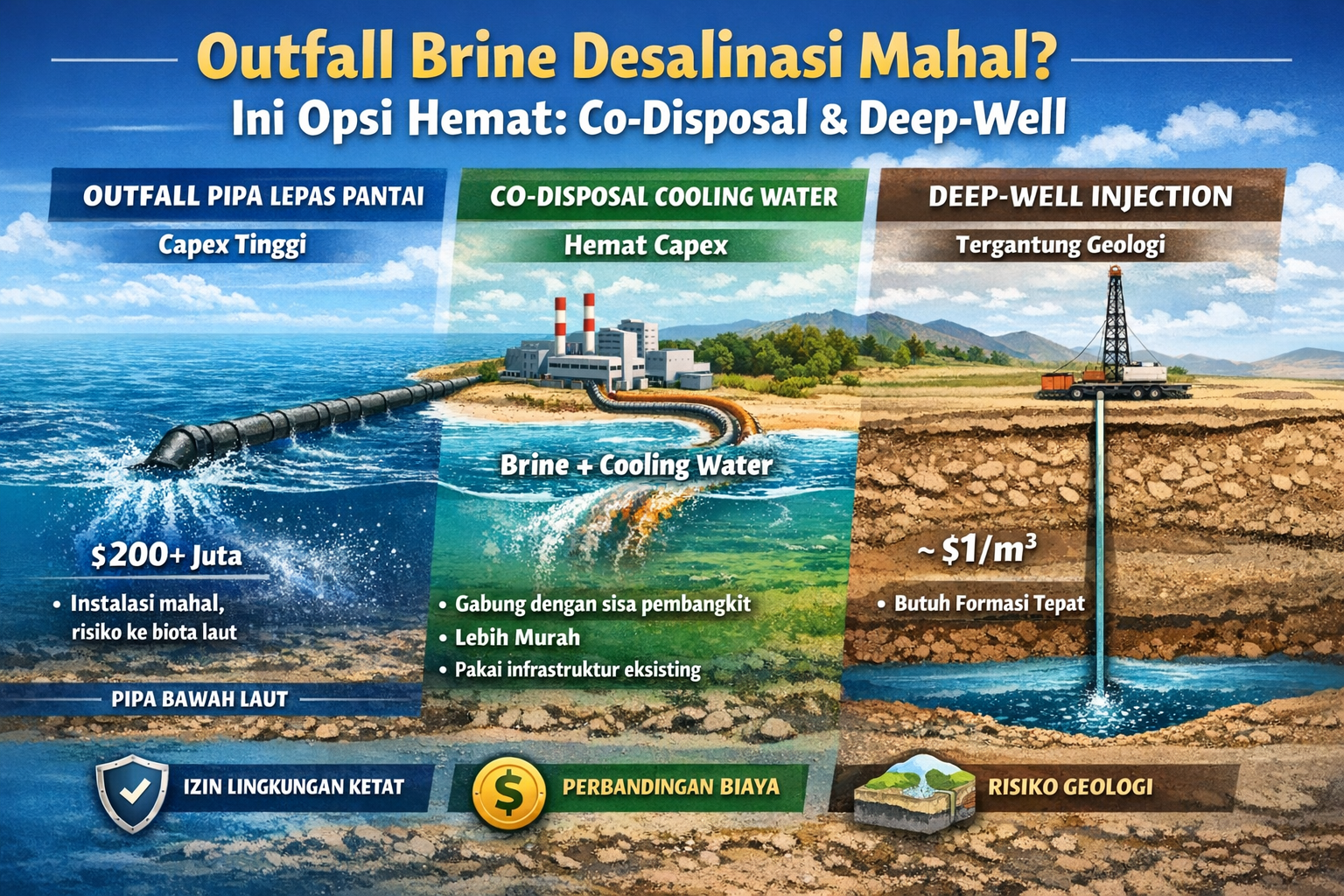
The optimal choice is project‑specific. For remote islands without a nearby power station, an offshore diffuser may be the only feasible route despite cost. Where a power plant exists—or can be sited—at a windy shoreline, co‑disposal is attractive and widely used in practice (as seen in some Middle Eastern and U.S. projects). Deep injection is most attractive for inland or brackish plants, where pipelines can be avoided; for big coastal RO projects, it is relatively rare.
Across studies, alternative disposal—co‑disposal, injection, or concentrate recovery—is pursued to reduce overall project cost and environmental impact. Bench‑marking by Arafat and Ziolkowska reports injection disposal at $0.5–2.6/m³ and finds it can be cheaper than elaborate outfalls when feasible (ebin.pub). Data‑driven analyses show pre‑dilution with cooling water or treated wastewater lowers outfall costs (IntechOpen; IntechOpen). For context on seawater capacity mixes—SWRO brine volumes around 25% of feed at plant scale—see the examples tied to SWRO systems.
In short: offshore discharge via pipeline and diffuser is proven. But co‑disposal and injection offer compelling cost advantages under the right conditions. Quantitative evaluations consistently show that pre‑dilution lowers outfall costs (IntechOpen; IntechOpen), and deep‑well injection can cost on the order of $1/m³ of brine (ebin.pub). The remaining task is matching each site’s geology, co‑location options, and permit comfort to the disposal pathway—starting from the brine streams created by core RO trains like industrial RO systems.
Sources: Data and findings are drawn from peer‑reviewed and industry literature. Shrivastava et al. (2021) detail outfall cost optimization and co‑disposal benefits (IntechOpen; IntechOpen; IntechOpen; IntechOpen). Maliva & Missimer review injection options and environmental considerations (ResearchGate; ResearchGate). Unit‑cost and design examples for deep wells are reported in recent analyses (ebin.pub; ebin.pub). Indonesian environmental regulations (PP 82/2001, Permen LH 5/2014, 8/2009) apply to such discharges; PermenLH 8/2009 explicitly defines desalination brine as wastewater (limbah), implying it must meet prescribed effluent standards (text-id.123dok.com). Near‑field mixing and ecological protection trade‑offs are detailed in diffuser design literature (IntechOpen; IntechOpen). For the notable capital example, see Northwestern’s design case (processdesign.mccormick.northwestern.edu). Inland aquifer response to injection is reviewed in Nile Delta studies (ScienceDirect).