

Industry: Brewery | Process: Wastewater_Treatment
Brewing makes strong wastewater. Typical brewery effluent runs high BOD/COD (biochemical/chemical oxygen demand, measures of organics) and carries nutrients from raw materials and cleaning agents. Phosphorus — largely from cleaning agents — “is usually found in concentrations ranging from 30 to 100 mg/L” (pmc.ncbi.nlm.nih.gov). Nitrogen (from yeast, malt, and cleaning acids) is also significant. Discharged untreated, these loads drive eutrophication.
Regulators have noticed. Many set single-digit mg/L nutrient caps; one recent study cites a total phosphorus (TP) limit of 5 mg/L (pmc.ncbi.nlm.nih.gov), with broader standards for total nitrogen (TN) as low as 20–40 mg/L. Another country’s discharge criteria listed 80/30/20 mg/L for TKN/NH₄/NO₃ (pmc.ncbi.nlm.nih.gov), and many rivers require P < 0.1–1 mg/L.
Those numbers matter. Conventional activated sludge excels on organics but often undershoots P goals. In Ethiopia, a full‑scale brewery WWTP cut raw TP from 33.2 mg/L to 16.8 mg/L — roughly ~50% removal and still above a 5 mg/L target (pmc.ncbi.nlm.nih.gov). Choice of technology is dictated by these limits.
BNR configurations and outcomes
Biological nutrient removal (BNR, integrated nitrification/denitrification for N and biological P uptake) bolts onto standard aeration. In practice, that means anoxic/anaerobic zones or sequencing — think UASB + aeration (UASB: upflow anaerobic sludge blanket) or A2O/SBR cycles. One lab‑scale cyclic SBR (sequencing batch reactor) treating brewery wastewater reported ~69% NH₃‑N and 60% TN removal at 18 h HRT (hydraulic retention time) and 5–7 day SRT (solids retention time) (researchgate.net). A Heineken plant case noted TN ~17 mg/L in effluent (≈58% removal) under oxyanoxic activated sludge (pmc.ncbi.nlm.nih.gov).
Biological P removal by assimilation typically lands in the 30–70% range in brewery systems. The SBR study found ~69% PO₄‑P removal, often leaving 10–20 mg/L in the effluent (researchgate.net). A hydroponic Typha bioreactor logged 51–70% soluble P removal (pmc.ncbi.nlm.nih.gov), similar to many real plants’ ~50% results.
Enhanced Biological Phosphorus Removal (EBPR) — anaerobic/aerobic cycling to enrich PAOs (polyphosphate-accumulating organisms) — can push lower. EBPR thrives with high VFAs (volatile fatty acids) or COD:P ratios, ideally >25:1 (wwdmag.com), which brewery wastewater often provides. Well‑run EBPR has delivered effluent P in the 1–2 mg/L range without chemicals (wwdmag.com). It requires careful process control (fermentation stages, long sludge ages), and the SBR work recommended balancing the C:N:P ratio to optimize BNR (researchgate.net).
Typical outcomes line up: lab SBR tests show 69% P and 69% NH₃‑N removal (researchgate.net). In full scale, Heineken Ethiopia achieved ~97% COD/BOD removal but ~50% TP removal (pmc.ncbi.nlm.nih.gov). Phytoremediation trials posted 54–80% TKN and 51–70% PO₄‑P removal (pmc.ncbi.nlm.nih.gov). In short: BNR handles organics and N effectively (often >90% COD removal in practice) while P reduction is moderate, design‑dependent (pmc.ncbi.nlm.nih.gov).
On the equipment side, breweries commonly implement SBRs to cycle aerobic and anoxic phases. Where anaerobic front‑ends are installed, packaged biological digestion systems help convert organics before BNR polishing. For higher effluent quality or reuse, some plants pair BNR with membrane bioreactors (MBR), which combine biology with ultrafiltration.
Chemical phosphorus precipitation performance
Chemical methods dose metal salts — alum (aluminum sulfate), ferric chloride, ferrous sulfate, or pre‑hydrolyzed polyaluminum coagulants (PAC) — to precipitate phosphate. Municipal and industrial plants routinely see very high P removal, often >90% (researchgate.net). A recent brewery trial used PAC plus a flocculant (ZETAG 4139). At ~675 mg/L PAC, total P removal hit 95.5% and orthophosphate removal 99.6% (mdpi.com).
The tradeoffs are predictable. Organics removal was modest: BOD₅ fell ~34% and COD ~26% in that test (mdpi.com), since much COD is soluble. Nitrogen dropped 51.8% (N_tot) via particulate capture, but the chemistry does not target inorganic N (mdpi.com). Sludge volumes are significant: the PAC pretreatment produced ~4.5–5% dry matter sludge, about 1.01 kg dry sludge per kg COD removed (mdpi.com).
On the upside, chemically polished effluent P can be extremely low — effectively sub‑mg/L when influent is ~20 mg/L — given the 99.6% orthophosphate removal reported (mdpi.com). That performance is far beyond biological assimilation alone (contrast with ~17 mg/L P after conventional biology in the Ethiopian example, pmc.ncbi.nlm.nih.gov). As a cost‑and‑footprint note, 1 kg of P precipitated (as alum or iron phosphate) is on the order of 1–3 € of chemicals and generates ~5–10 kg wet sludge.
In practice, breweries deploy industrial PAC via reliable dosing pumps and pair it with polymer flocculants for settleability. The solids are removed in compact settlers — a lamella settler or a conventional clarifier — or floated in a DAF (dissolved air flotation) unit. Specifying the coagulant (for example, PAC) becomes a tuning exercise once the biological stage is stable.
Comparative metrics and footprint
Phosphorus removal: BNR (assimilation or EBPR) often achieves 50–70% P removal in brewery systems (researchgate.net; pmc.ncbi.nlm.nih.gov), typically leaving double‑digit mg/L P. Chemical precipitation routinely hits ~95–99% removal (mdpi.com), in the low mg/L or sub‑mg/L range.
Nitrogen removal: Biological nitrification/denitrification removes 60–90% of NH₄‑N and TN depending on design (researchgate.net; pmc.ncbi.nlm.nih.gov). Coagulation does not target N; it may remove organic N (about 50% in the cited trial) but leaves much inorganic N (mdpi.com).
Organics: Aerobic BNR is highly effective on COD (often >90% removal, as observed in practice, pmc.ncbi.nlm.nih.gov). Chemical pretreatment alone removes only a fraction of soluble organics — roughly 25–35% BOD (mdpi.com).
Footprint and cost: BNR needs reactor volume and control but few consumables; it yields biomass rich in N/P, not metal‑laden sludge. Chemical dosing is retrofit‑friendly but adds reagent cost and sludge handling. A practical marker: ~1–3 € chemicals per kg P precipitated and ~5–10 kg wet sludge per kg P.
Where plants are space‑constrained, compact systems such as nutrient‑removal packages and MBRs can help hit tighter limits; facilities with more headroom often combine conventional aeration with tertiary chemical polishing.
Regulatory context and design targets
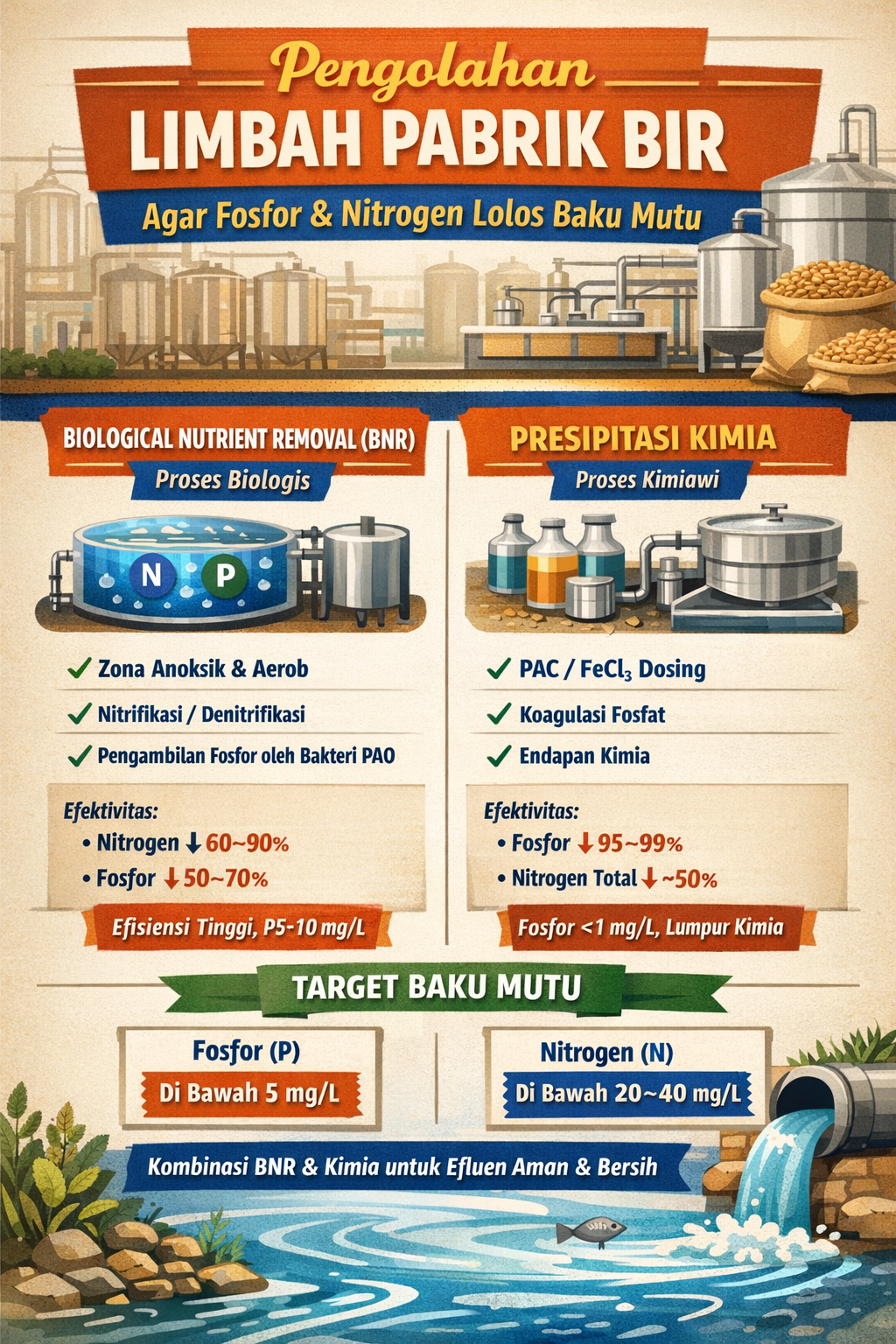
Site limits set the strategy. Brewery wastewater commonly starts at 30–100 mg/L P (pmc.ncbi.nlm.nih.gov), while regulators may demand 5 mg/L TP (pmc.ncbi.nlm.nih.gov) or even P < 0.1–1 mg/L in sensitive rivers. TN limits can be 20–40 mg/L; in one country: 80/30/20 mg/L for TKN/NH₄/NO₃ (pmc.ncbi.nlm.nih.gov). Meeting these limits drives technology choices: conventional activated sludge can remove organics robustly but often falls short on P; the Ethiopian full‑scale case left 16.8 mg/L TP after treatment (~50% removal) against a 5 mg/L aim (pmc.ncbi.nlm.nih.gov).
Characterization is step one. Plants compare their data to local permits and receiving water needs (including local policies such as Indonesia’s Permen LHK). The data then align with options: biological selectors for N and moderate P, chemical polishing for low‑mg/L P.
Pretreatment can stabilize the front end. Simple measures like primary physical separation reduce debris and oil, protecting downstream BNR and chemistry.
Treatment trains brewers deploy
The common train is secondary BNR with optional tertiary chemical phosphorus removal. An aerobic/anoxic system — extended aeration, A2O, or an SBR — strips ~90% of BOD and 50–80% of N and P. When limits are strict, a small chemical stage polishes P before discharge. For example, if biology achieves ~70% P removal, a low alum/PAC dose can trim from ~9 mg/L to ~1 mg/L.
Where anaerobic digestion is installed upstream, the remaining BNR can focus on nutrient polishing; some Canadian breweries run anaerobic digesters with aerobic polishing to meet sewer limits while capturing biogas (xylem.com). The Heineken Ethiopia plant’s oxidation tanks left 16.8 mg/L P, prompting optimization suggestions such as chemical P‑removal or enhanced EBPR (pmc.ncbi.nlm.nih.gov). Conversely, a lab reactor on Nigerian brewery wastewater showed that a single SBR with brief anaerobic phases can reach ~69% removal of both P and NH₃ (researchgate.net).
Targets can be framed with the math. If influent P is 50 mg/L and the limit 5 mg/L, the total removal needs to be ≥90%. BNR may contribute ~70%; a PAC/alum polish finishes the job. On nitrogen, if a TKN discharge limit is 30 mg/L and raw brewery TKN is ~50 mg/L, a nitrification/anoxic stage can meet it — one case saw TN drop from ~40 to 17 mg/L (pmc.ncbi.nlm.nih.gov).
Operations matter. Plants track effluent N & P with online analyzers or periodic lab tests, maintain sludge age ≥10–15 days for nitrifiers, and keep an appropriate C:N:P — ~100:5:1 cited for EBPR. Adding fermentation (hydrolysis of brew wastes to VFAs) can boost BNR performance, as highlighted in enhanced BNR discussions (wwdmag.com).
For moderate nutrient reduction where space is available, constructed wetland or phytoremediation polishing has documented 50–70% P removal and 54–80% TKN removal (pmc.ncbi.nlm.nih.gov). Where limits tighten — a global trend noted in industry reports (wwdmag.com) — tertiary chemistry becomes standard.
Across these choices, hardware selection mirrors the process: compact nutrient‑removal modules for tight footprints, MBR when reuse quality is desired, and robust chemical trains configured with dosing pumps and polymers polishing behind stable biology.
These data points — lab SBR tests (researchgate.net), pilot/industrial coagulation trials (mdpi.com), full‑plant evaluations (pmc.ncbi.nlm.nih.gov), and regulatory discussions (wwdmag.com) — translate permits into design. If effluent TP must be <2 mg/L, expect chemistry or EBPR; if only moderate P trimming is required, improved BNR (or constructed‑wetland polishing) may suffice (phyto reports 50–70% P removal, pmc.ncbi.nlm.nih.gov). Verification with on‑site sampling remains essential, alongside local effluent standards (e.g., Indonesia’s Permen LHK) and receiving water needs.