

Industry: Brewery | Process: Packaging
Brewing is water‑intensive, and the ratios are sobering. Industry leaders now target water:beer ratios near 3:1—AB InBev cites ~3.2 L water per L beer (3.2:1) (via viravix.com), while many large breweries are still around ~5–6:1 (viravix.com).
Packaging halls alone can consume ~25% of a brewery’s total water, according to Campden BRI (campdenbri.co.uk). Craft Brew Alliance (CBA) reported a 4.73 L/L ratio (California brewery: 4.07:1) and cut water use 3.7% in one year (packagingdigest.com). Talbot & Talbot (brewery wastewater specialists) note that shipping water ratios under 2.2:1 are only feasible by recycling ~65% of effluent (filtsep.com), and a 1.5 Mhl/yr brewery at 7:1 uses as much water as 35,700 people (filtsep.com).
High‑efficiency rinsing nozzles and controls
Modern rinsers use focused jets—high‑pressure/low‑flow or rotary spray heads—to maintain cleaning with less water. Reprogramming bottle washers and optimizing rinse cycles (nozzle flow, spray patterns, pressures) can deliver up to 30% water savings (solenis.com). Campden BRI also emphasizes automatic shut‑offs so spray jets stop when no bottles are present—turning off pre‑wash when a run stops and re‑using final rinse water in the first rinse (campdenbri.co.uk).
Case in point: Warsteiner installed KHS’s “LESS” (Liquid Efficiency Spraying) on a 66,000 bph bottle washer and achieved ~120 mL of rinse water per bottle—about 0.36 L water per L beer—with “considerable” water and energy savings and no loss in cleaning quality (khs.com; khs.com).
Even ancillary equipment matters. Replacing water‑lubricated conveyor chains with a dry lubricant system saved CBA ~420 m³ (111,000 gal) per year and cut water use on that line by 60% (packagingdigest.com; packagingdigest.com).
Closed‑loop bottle rinsing and ozonation
The biggest step change comes from capturing spent rinser water, treating it, and feeding it back. Fourage‑CTI’s ozonated closed‑loop rinser on a 6,000–7,000 bph line—normally 9–15 L/min (≈4–7 m³ per 8‑hr day)—reduced fresh water demand by ~95% to roughly one tankful, ~0.2–0.35 m³/day (sival-innovation.com). As the company puts it, “the equivalent volume of a recovery tank is used… at least 20 times less!” (sival-innovation.com).
Ozonation both kills microbes and neutralizes “industrial flavorings” on glass, keeping the rinser sanitized without separate chemical cycles (sival-innovation.com; sival-innovation.com). Small bottling units also deploy recirculating rinsers; TCW’s MiniMax routes run‑off through a replaceable 5 μm filter back into the rinse bath (tcwequipment.com). In short, closed‑loop rinsers can slash fresh water use by an order of magnitude or more.
Treatment train for recycled rinse water
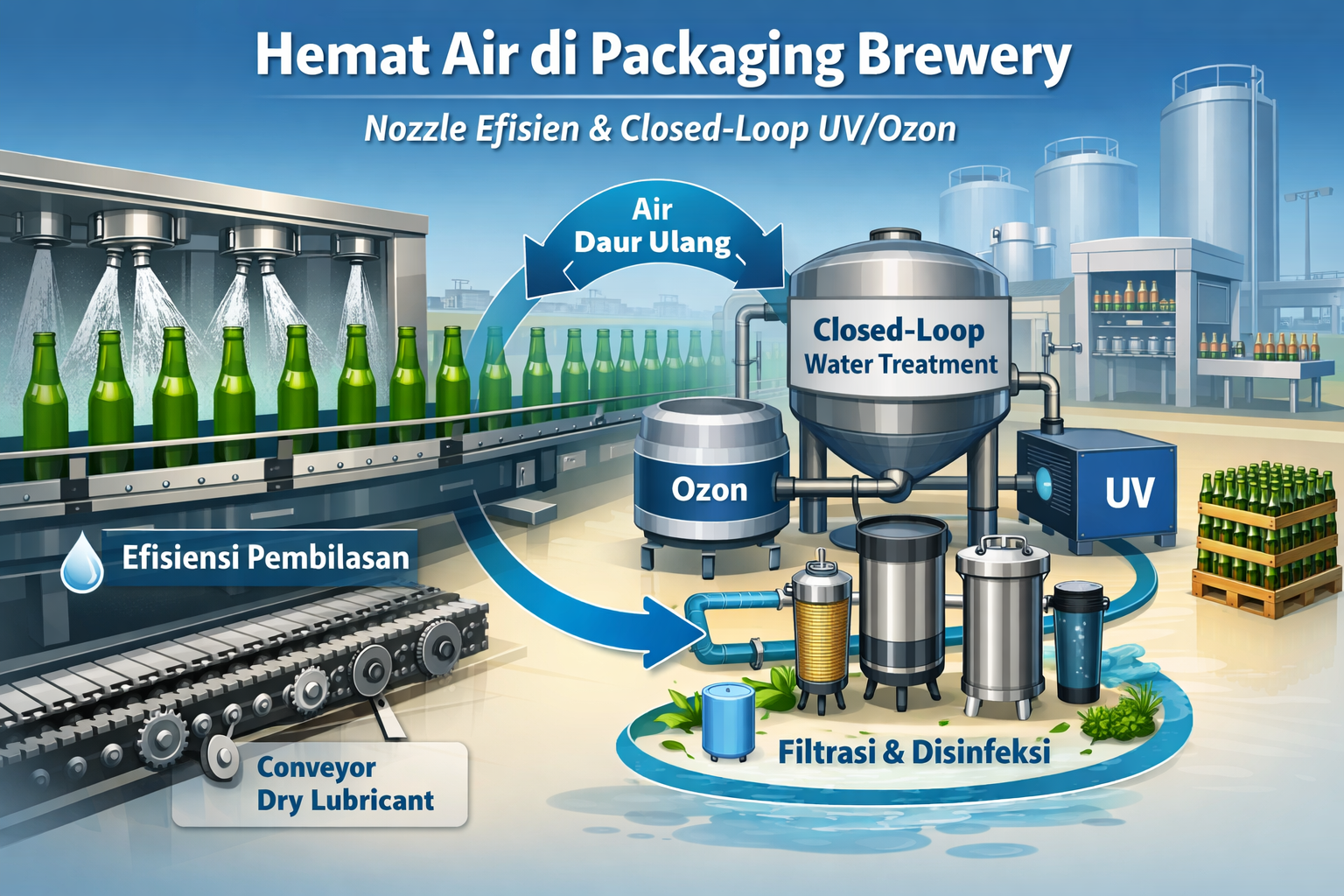
Recycled rinse water must be cleaned and disinfected before reuse. A typical sequence includes the following steps, with equipment terms explained on first mention:
Coarse filtration removes glass chips and debris, often with stainless screens or bag filters; many breweries also deploy sand media prefilters to protect downstream units, where a compact sand bed such as a sand/silica filter provides 5–10 μm capture. Cartridge filters in the ~5–50 μm range polish the stream before finer barriers; a cartridge filter in a rinse loop mirrors the 5 μm media approach used by TCW’s MiniMax (tcwequipment.com).
Fine filtration and membranes tighten control. Microfiltration/ultrafiltration (UF) membranes at roughly 0.1–1 μm can strip out bacteria, yeast, and suspended organics; for rinse reuse, a microfilter or UF usually suffices (filtsep.com). As a pretreatment or standalone barrier, an ultrafiltration module is common. Some wastewater systems even use nanofiltration (NF) or reverse osmosis (RO); options include nano‑filtration for hardness reduction at lower pressure and brackish‑water RO for tighter total dissolved solids control. Where plants standardize across platforms, bundled membrane systems spanning RO/NF/UF can be configured for industrial water reuse.
Adsorption (optional) via activated carbon or biofiltration removes residual organics and odors—useful if detergents or fluorinated rinse agents are present (filtsep.com). A modular activated carbon unit can be inserted before disinfection.
Disinfection is critical. Ozone (O₃) oxidizes organics and kills microbes, then reverts to O₂ with no harmful residue (evoqua.com; evoqua.com). Ozonation is already proven in rinser loops—one system uses ~0.8 ppm ozone to sterilize bottles in ~5 s (wassertec.co.za)—and Fourage’s design “eliminates chemical sterilization cycles” (sival-innovation.com). UV irradiation at 254 nm provides an independent barrier, inactivating ≥99.9% of bacteria, viruses and protozoa in passing water (evoqua.com); a compact UV reactor adds this step without chemicals. Combined UV+ozone creates a multi‑barrier setup where any ozone residue is then removed by UV (evoqua.com). Notably, UV/ozone are chemical‑free and leave no taste or by‑products.
Quality benchmarks and compliance
Together, these steps ensure recycled rinse water meets hygiene requirements—clear and pathogen‑free, on par with municipal potable water. In practice, operators verify key parameters akin to bottled‑water standards: turbidity <5 NTU (nephelometric turbidity units), CRT (a clarity metric) <0.5 NTU, and <1 CFU/mL (colony‑forming units per milliliter) coliform. For example, Indonesian rules for drinking/bottled water—Minister of Health Reg. 492/2010 and SNI 01‑3556—require monitoring pH, TDS, turbidity, and zero coliforms/E. coli (water.co.id). A reuse loop should be validated to stay within those limits, with rigorous segregation of sanitary sewers vs. process effluent.
Impact and brewery economics
Beyond water savings, these upgrades cut energy, chemicals, and wastewater fees. CBA reports sustainability investments—including water reuse—saved $600,000 in one year (packagingdigest.com), while its dry‑lube conveyor reduced line‑area water use by 60% (packagingdigest.com). Fourage’s ozonated loop removed most of the ~5–7 m³ daily rinse consumption and eliminated separate sterilant cycles (sival-innovation.com; sival-innovation.com). At scale, breweries can halve water intake by recycling ~65% of effluent (filtsep.com).
The upshot: packaging line water can be cut dramatically by combining high‑efficiency spray nozzles and smart controls with a closed‑loop rinser. Multiple case studies document 30–95% reductions in bottle rinsing (and 60% cuts on lubricated conveyors) through better equipment and recirculation (solenis.com; sival-innovation.com). A typical implementation uses coarse + fine filtration followed by UV/ozone disinfection (tcwequipment.com; evoqua.com). With these upgrades, breweries can reliably recycle rinse water without quality loss, meeting health standards while cutting costs—an attractive ROI where water is both expensive and scarce.
Sources: Industry case studies and technical references (Solenis, PackagingDigest, Fourage/CTI SIVAL, Evoqua, KHS, TCW, Campden, etc.) provide the figures above (campdenbri.co.uk; campdenbri.co.uk; sival-innovation.com; solenis.com; packagingdigest.com; khs.com; tcwequipment.com; evoqua.com; water.co.id). All data are from recent (2021–2025) publications and reports.