
In beer, dissolved oxygen is the enemy. Breweries are racing to build deaerated water systems that strip O₂ to parts per billion—by vacuum, membranes, or nitrogen—because shelf life and flavor stability depend on it.
Modern beer is made in a near-oxygen vacuum—figuratively, and in the case of process water, literally. Even trace dissolved oxygen (DO) accelerates staling, notably via trans-2-nonenal, and shortens shelf life, according to peer‑reviewed research (academic.oup.com) and instrumentation experts (wiki.anton-paar.com). In practice, breweries push water DO to ≪0.1 mg/L—often below 0.05 mg/L—to avoid oxidizing beer during blending, filtration, gravity adjustment, and transfers (bbt.corosys.com). Pentair puts it plainly: “increased quality requirements are placing higher demands on residual oxygen content,” because inadequately deaerated water triggers foaming issues, poor carbonation, and off-flavors (foodandbeverage.pentair.com).
There’s a stark regulatory contrast worth noting: Indonesian packaged drinking-water standards actually require added oxygen—SNI 6241:2015 mandates ≥20 mg/L DO in oxygenated demineralized water (ro.scribd.com). Brewing is the exception: the process demands near‑zero DO, not more.
Deaeration technologies and operating principles
All removal strategies pursue the same physics: maximize surface area and contact time while minimizing the oxygen partial pressure to drive O₂ out of solution (bbt.corosys.com). Combining measures—vacuum plus heat plus an inert‑gas counterflow—delivers the deepest cuts. A rotor–stator mixer study using both vacuum and N₂ reported ~97% DO removal (η≈97.3%), significantly outpacing either vacuum or nitrogen alone (www.mdpi.com).
Vacuum deaeration (spray/trickling columns). Water is sprayed or trickled over packing under strong vacuum (often <50 mbar) to boil off gases, frequently with a small CO₂ or N₂ bleed to carry out dissolved O₂ (interupgrade.com). “CO₂ or N₂ can be used as a stripping gas. Nitrogen is more effective…[and] is not absorbed by the water…CO₂ is…of choice for carbonated beverages,” notes Inter‑Upgrade (www.interupgrade.com). Well‑designed systems routinely hit residual DO below 0.02 mg/L (20 μg/L) (www.interupgrade.com; interupgrade.com).
Membrane degassing (hollow‑fiber modules). Water flows on one side of a porous fiber bundle while a vacuum or sweep gas (often CO₂) pulls O₂ across on the other, creating a strong concentration gradient. With sufficient membrane area, residual DO below 0.02 mg/L is achievable (bbt.corosys.com). These units are compact and energy‑efficient for small/mid flows—but large capacities need many modules, raising capex, and membranes tolerate only limited CIP (clean‑in‑place) regimes and temperature (<80 °C) (bbt.corosys.com).
Gas‑stripping columns (inert‑gas counterflow). At (near) atmospheric pressure, water cascades down a packed column while nitrogen or CO₂ bubbles up from the bottom. Cold columns at ambient temperature can yield <0.05 ppm O₂; properly sized designs can approach ~0.02 mg/L (www.interupgrade.com; bbt.corosys.com). Nitrogen is not absorbed, leaving water essentially N₂‑saturated; CO₂ would carbonate the water. Typical consumption is ~0.22 kg N₂ per hectoliter (hl; one hectoliter equals 100 liters), with ~5% gas loss (www.interupgrade.com). Pentair’s Water Deaeration System (WDS) uses CO₂ in counterflow packing, offered in “hot” or “cold” versions (foodandbeverage.pentair.com). Hot columns pasteurize the water (adding ~8 °C) and improve hygiene; cold systems rely on downstream UV or CIP (www.interupgrade.com; www.interupgrade.com).
Spray (atmospheric) degassing. Spraying water into open air causes O₂ release but is insufficient for ppb targets unless combined with inert gas. Chemical scavengers (e.g., sodium sulfite) exist but are generally avoided in food production.
Performance metrics and scale economics
Residual DO targets. State‑of‑the‑art brewery systems aim for <0.02 mg/L (20 μg/L) DO (bbt.corosys.com; www.interupgrade.com). Cold stripping columns deliver <0.05 mg/L reliably, while multi‑stage vacuum units reach ≤0.02 mg/L (bbt.corosys.com; www.interupgrade.com). Untreated water at 10–15 °C contains ~8–10 mg/L O₂, so this is a >99.9% reduction (bbt.corosys.com).
Throughput and scale. Stripping and vacuum columns scale large; Inter‑Upgrade quotes up to 860 hl/h (Type 125) (www.interupgrade.com). At that size, standard configurations yield ~0.05 ppm DO, with optional packing to hit 0.02 ppm. Membrane modules often handle ≪50 hl/h each; large breweries need many in parallel (bbt.corosys.com).
Gas and steam consumption. Cold N₂ stripping uses ~0.22 kg N₂/hl (www.interupgrade.com). Hot‑vacuum designs using CO₂ report ~0.10 kg CO₂/hl (www.interupgrade.com). Steam for hot operation is ~1.2–1.3 kg steel‑pipe steam/hl; for example, a Type 50 unit uses ~151 kg/h steam at 120 hl/h (www.interupgrade.com). Cold stripping uses no heat but must still chill water after.
Energy and maintenance. Vacuum systems need pumps/blowers; hot columns need steam. Membrane degassers typically have the lowest electrical demand (a vacuum pump) but have stricter cleaning/temperature limits; packed columns and vacuum towers are broadly CIP‑able. Hot designs often self‑sanitize on startup, while cold systems rely on routine CIP or UV (www.interupgrade.com).
Quality outcomes. One brewery reports a cold column “reliably supplies water with significantly <0.05 ppm O₂ and ≈2.0 g/L CO₂” for gravity adjustments and blending (bbt.corosys.com). Nitrogen‑purged water (CO₂‑free) suits still‑beer processes; CO₂‑saturated water fits carbonation stages. Studies affirm ppm‑level DO in beer yields pronounced freshness loss (academic.oup.com; wiki.anton-paar.com).
Market trend. The global food & beverage deaerator market is projected to grow ~6.1%/yr, from ~$360 M in 2024 to ~$614 M by 2033 (www.marketdataforecast.com), as brands chase shelf life and flavor by minimizing oxygen exposure (www.marketdataforecast.com).
DAW system design and pretreatment train
A typical DAW (deaerated water) system starts with clean water at ~10–15 °C, filtered and possibly softened/RO’d, before degassing. Removing chlorine, organics, and taste/odor upstream with an activated carbon filter is common hygiene and flavor practice.
For hardness control ahead of membranes, many plants deploy a softener, while high‑TDS sources route through brackish-water RO. Where surface waters are involved, an ultrafiltration skid provides pretreatment to RO and drinking water clarity.
Degasser unit selection. In a vacuum deaerator, water enters a multi‑stage vacuum column (sprayers and packed sections), with vacuum ejectors/pumps drawing out gases; a small CO₂ or N₂ feed is often bled into the inlet and swept out countercurrently (interupgrade.com; www.interupgrade.com). “Hot” operation raises water to ~70–80 °C to lift most O₂ and pasteurize, followed by cooling; “cold” operation runs near ambient, then relies on UV or CIP for sterility (www.interupgrade.com). Three‑column vacuum rigs are used to reach <20 ppb DO when demanded (interupgrade.com; www.interupgrade.com).
Alternatively, a nitrogen stripping column sends water down a packed tower and high‑purity N₂ up from the bottom; a 2–3 m tower can deliver <0.05 mg/L with sufficient gas, and larger/multi‑stage designs achieve ~0.02 mg/L. It’s a simple, quiet stainless device (stripped N₂ is vented), and since N₂ isn’t absorbed, the water exits essentially N₂‑saturated; ongoing cost hinges on gas supply, often low if N₂ is generated onsite (www.interupgrade.com).
CO₂ buffering (optional). Many breweries introduce a small CO₂ charge after degassing to “buffer” the water and suppress re‑dissolution; Pentair recommends this (brought up in [5] and [27]). An example cold‑column output is ≈2.0 g/L CO₂, which also primes water for carbonation (bbt.corosys.com).
Storage and distribution. Deaerated water is collected in a closed buffer tank under a slight CO₂ or N₂ blanket, then pumped to points of use: filter precoats and pump flushes, carbonation tanks or inline carbonators, blending/mixing for final gravity or high‑gravity beer, and purging/pushing beer to the filler (bbt.corosys.com). For hygienic filtration steps, breweries favor 316L stainless cartridge housings in food‑grade service. Automated manifolds (e.g., Pentair/Südmo) route DAW safely under PLC control (foodandbeverage.pentair.com).
Instrumentation and control. Plants monitor UV performance, flow, pressures, and vacuum; a central panel sequences water, steam valves (hot mode), and N₂ flow. In [27], a Siemens S7 PLC managed blending and DAW routing. Cold systems commonly integrate UV sterilization downstream. CIP ports allow sterilization; hot columns often need less frequent cleaning due to pasteurization (www.interupgrade.com). For spare parts and skids, brewers tap supporting equipment for water treatment.
Flow diagram (conceptual): Clean Water → (Preheater/Steam Exch) → Degasser (Vacuum or N₂ column) → CO₂ Infusion (if used) → Buffer Tank → Distribution Pump → Blending Port / Filter / Filler.
Vacuum vs nitrogen stripping trade‑offs
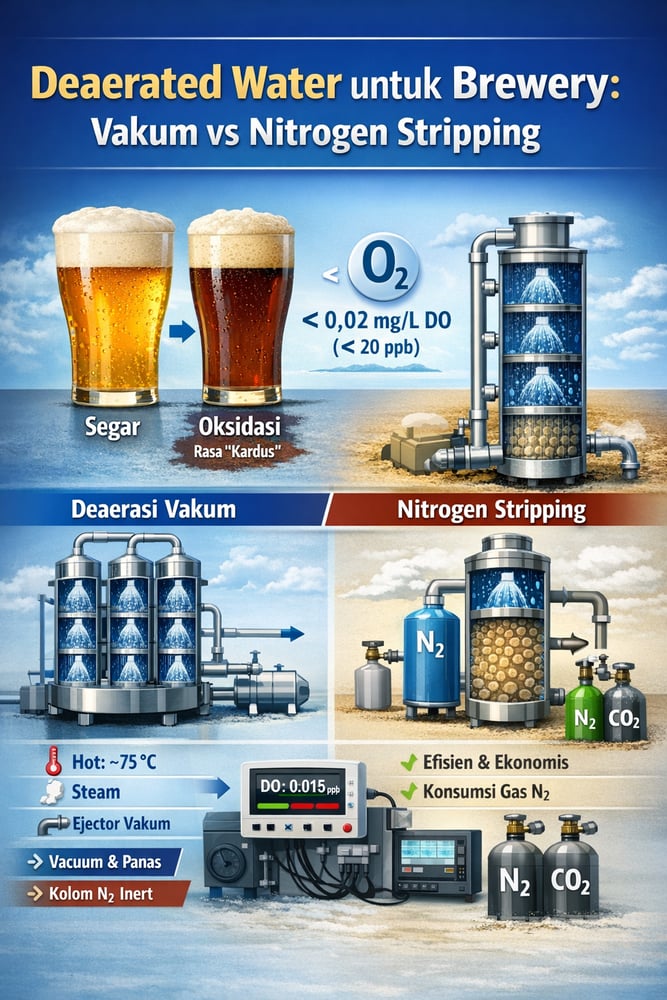
Degree of removal. Both reach low DO; multi‑stage vacuum designs often post the absolute lowest (≪0.02 mg/L). N₂ columns can also hit <20 μg/L when sized appropriately; some membrane degassers apply vacuum on the permeate side, blending the approaches (www.interupgrade.com).
Footprint and capex. Vacuum systems are taller and more complex (multiple chambers, nozzles, vacuum pumps/ejectors) and can be capital‑intensive; market analysts cite high upfront cost as a restraint (www.marketdataforecast.com). N₂ columns are simpler stainless towers with lower upfront cost but require a steady gas supply. Retrofitting a stripping column is often cheaper where space is tight.
Operating cost. Vacuum units draw electrical power and may use a small CO₂ bleed; N₂ columns consume nitrogen. Where N₂ is generated onsite (via membrane or PSA, pressure swing adsorption), cost per kg is low. Inter‑Upgrade lists ~0.22 kg N₂/hl vs ~0.10 kg CO₂/hl for vacuum operation (www.interupgrade.com; www.interupgrade.com). Hot columns consume significant steam (~1.3 kg steam/hl); cold systems skip that (www.interupgrade.com).
Maintenance and hygiene. Packed towers and vacuum columns are generally CIP‑able, though vacuum nozzles complicate rigging. Hot columns often self‑sanitize on startup (www.interupgrade.com). N₂ columns are robust “dumb” devices; membranes require careful cleaning. Heavy‑duty breweries often prefer vacuum rigs for CIP ease, while craft startups may opt for N₂ columns for simplicity.
In practice, nitrogen stripping is often preferred for cost‑sensitive, still‑beverage use (since N₂ does not dissolve), while vacuum deaeration excels when the lowest possible DO is required at large scale. Engineers weigh the O₂ target (e.g., <0.05 mg/L), capacity (e.g., 50–500 hl/h), and whether pasteurization is desired; lower residual O₂ demands exponentially more equipment/energy unless a stripping gas is used (Figs. 1–3 in [3]).
Monitoring and control of DO in DAW
Inline DO sensors. Breweries install dedicated dissolved‑oxygen meters on DAW lines or buffer tanks. Optical (luminescent) DO sensors are favored because they are stable, low‑drift, and do not consume oxygen or require stirring; they read low‑ppb reliably (0–0.5 mg/L ranges) (wiki.anton-paar.com).
Calibration and QA. Standard two‑point calibration is used: zero‑oxygen (100% N₂‑purged water) and air‑saturated water at current temperature. Atlas Scientific warns brewers to “be sure to calibrate the DO probe to 0 ppm before measuring” (atlas-scientific.com). A QC target might be DO <0.05 mg/L; if readings drift upward, it flags issues (leaks, pump failure, fouling). Some plants periodically validate via Winkler titration (ASTM D888‑2019).
Sampling regime. Measure DAW exit continuously or at frequent intervals. Absent a permanent sensor, manual sampling in a closed, N₂‑blanketed bottle with a portable meter each shift can suffice. The beer require e.g. ~0.05 mg/L DO or less (atlas-scientific.com). Monitor upstream raw water (~8 mg/L at 10–15 °C) to quantify improvement (bbt.corosys.com). At packaging, “total package oxygen” practice checks both DO and headspace O₂ to diagnose ingress (wiki.anton-paar.com).
Controls. Tie the DO sensor into the PLC so a high‑DO alarm auto‑shuts DAW feed and alerts operators. Gas flow meters on N₂ lines provide a sanity check (unexpected low flow suggests a leak). Keep the buffer tank under a CO₂ or N₂ headspace (a few psi) to prevent air ingress.
Anton Paar sums up the stakes: monitoring DO “provides great insight into water quality” and is as central as pH (wiki.anton-paar.com). Trending DO data supports compliance; for example, Indonesian breweries under BPOM might need to show “zero detectable O₂” in top‑up water for beer.
Business case and implementation outlook
A DAW system—vacuum or N₂ stripping, sized to throughput—feeding a sealed buffer and automated distribution can reliably deliver ultra‑low DO (≪0.1 mg/L) to protect beer quality. Industry sources show well‑designed systems achieving <0.02 mg/L (www.interupgrade.com; bbt.corosys.com) with modest CO₂/N₂ and energy inputs. The ROI shows up in longer shelf life, more consistent flavor, and less waste, and the market is growing at ~6.1% CAGR through 2033 (www.marketdataforecast.com).
Small craft plants may accept a 0.05 mg/L spec via a simpler N₂ column, while multinationals invest in vacuum systems to hit 0.02 mg/L for premium lines. Field data—DO drops in ppm and slower rise of staling markers—plus inline DO trends guide the final design. With robust controls, every decoction or draft meets the oxygen‑free standard essential for top‑quality beer (bbt.corosys.com; foodandbeverage.pentair.com).
Sources: Industry engineering articles and equipment data (Corosys/Inter‑Upgrade/Brauindustrie) on brewery water deaeration (bbt.corosys.com; www.interupgrade.com; interupgrade.com); beer‑oxidation research (academic.oup.com); process technology journals (www.mdpi.com); instrumentation wikis (Anton Paar) (wiki.anton-paar.com; wiki.anton-paar.com); market reports (www.marketdataforecast.com); and Indonesian standards (SNI 6241) (ro.scribd.com).
