

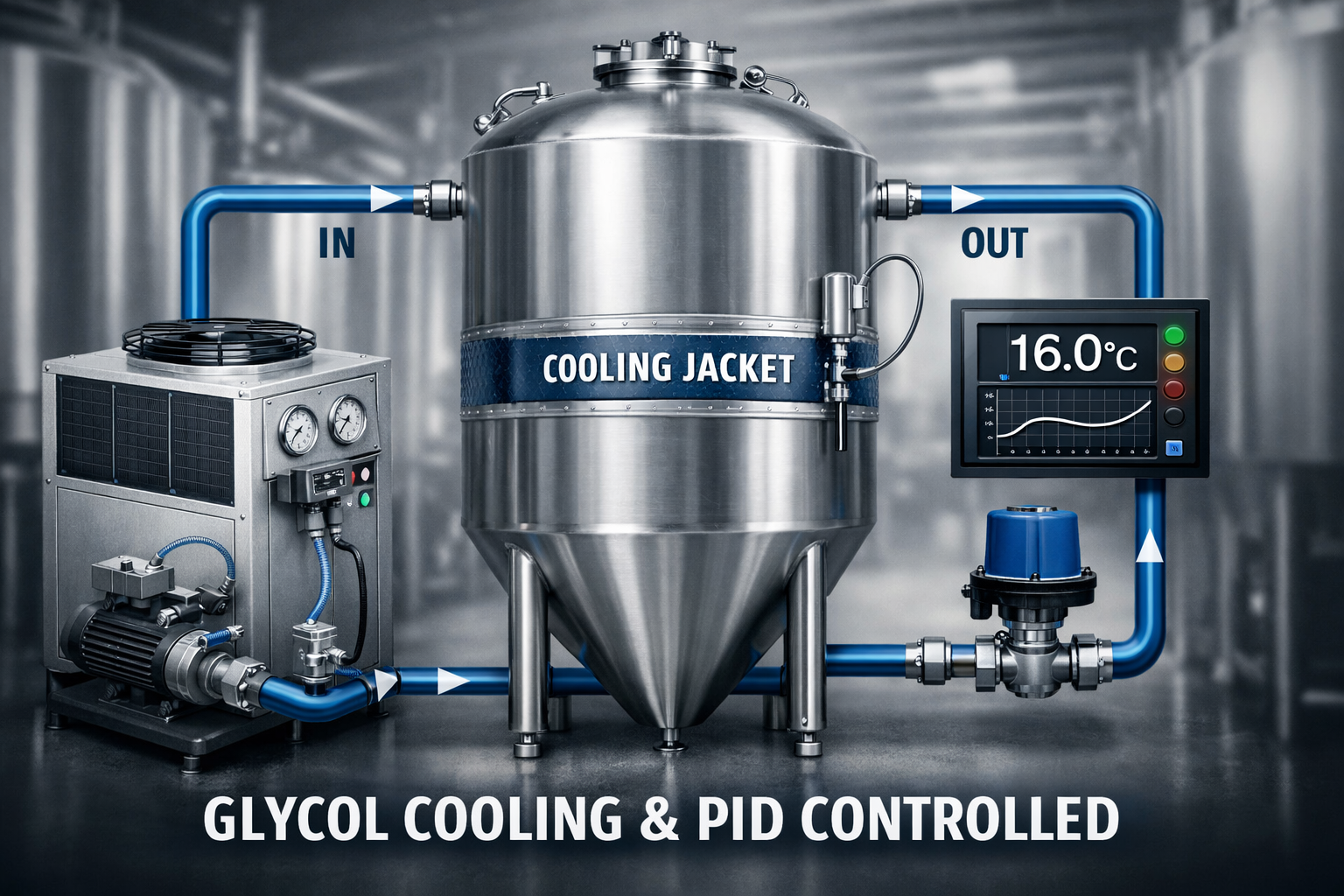
From dimpled wall jackets to fuzzy‑logic controllers holding Guinness at 16 °C, the tech behind fermentation is getting sharper—and in some cases 30–40% more energy‑efficient. The catch: water chemistry can make or break a glycol loop.
Industry: Brewery | Process: Fermentation
In beer, temperature is destiny. Modern fermenters keep it on a tight leash with welded wall jackets, glycol loops, and automated controls that execute time‑based fermentation profiles. The hardware choice isn’t trivial: one widely cited review reports direct ammonia chilling can save roughly 30–40% energy versus glycol systems, while many small breweries still haven’t automated temperature holds (one report said ~83% of 3–15 hL breweries were not fully automated) (Brewiki; yolongbrewtech.com).
On the ground, that shift to precision looks like Omron EC5 PID (proportional–integral–derivative) controllers opening jacket valves at Sambrooks Brewery in London, and a fuzzy‑logic loop maintaining Guinness fermentation at exactly 16 °C in Nigeria (axiscontrols.co.uk; ResearchGate).
Wall jackets and sensor‑based loops
Most fermenters are cooled by external wall jackets or plates; internal coils—spiral heat‑exchanger tubing inside the tank—are rare because of limited surface area and cleaning difficulty. External options include dimple (half‑pipe) jackets and full or multi‑zoned jackets. Dimpled or half‑pipe jackets (shaped metal sheets welded to the tank wall) provide turbulent flow and strength, whereas segmented or full‑face jackets offer higher surface area. Cooling plates (flat panels bolted to the tank) are another variant in some designs (Brewiki).
Wall‑jacket type often tracks refrigerant choice. Brewiki notes dimple jackets are typically used with “isothermal” refrigerants (e.g., direct ammonia or CO₂ systems), while half‑pipe jackets suit glycol brines (Brewiki). Many fermenters use stainless steel wall jackets insulated by an outer shell; their surface‑area‑to‑volume ratio runs ~0.25–0.35 m²/L for typical cylindroconicals (Brewiki).
Temperature sensors—RTDs (resistance temperature detectors) or thermocouples—sit inside the beer at multiple points and feed a PLC (programmable logic controller) or PID controller that modulates jacket flow. In one London craft brewery example, Omron EC5 PID controllers opened and closed solenoid valves on nine fermenters to hold setpoints (axiscontrols.co.uk). Many breweries integrate these controls into SCADA (supervisory control and data acquisition) systems or brewery software for batch recipes and alarms. Reviews summarize it plainly: fermenters are “cooled by coils or cooling jackets” with thermometers feeding automatic control loops (ResearchGate; Brewiki).
Glycol loops versus direct refrigerants
Most craft operations run glycol–water recirculation for fermenter cooling. Alternatives include direct refrigerant cooling (e.g., ammonia) and chilled water loops. The glycol advantage is freeze protection below 0 °C in a simple closed loop; the trade‑off is lower heat capacity and added pump/compressor work. A key data point: direct ammonia chilling avoids an intermediate brine loop, lets compressors operate at higher evaporation temperatures, and yields ~30–40% energy savings over glycol systems, according to Gerlach (1995) as cited by Brewiki (Brewiki).
The system effects are tangible. Ammonia/natural‑refrigerant systems use smaller condensers and pump motors than secondary glycol loops for the same duty. The Lawrence Berkeley Lab’s brewery analysis adds that medium‑large breweries often install engine‑driven or absorption chillers; direct‑drive systems can save 2–4 kBtu/barrel (~0.5–1 kWh/hL) versus older designs (ResearchGate; Brewiki).
Quantitatively, glycol systems typically circulate 30–40% propylene glycol (by volume), which lowers coolant specific heat to ~0.88 kJ/kg·K for 30% glycol versus ~4.18 for water, requiring about 2–3× the flow rate of pure water for the same heat removal. A ~–35 °C freeze point for 30% PG is crucial for cold‑crashing (info.kellerheartt.com). In cold climates, older breweries sometimes used ice‑bank or direct water cooling, but refrigerated glycol has largely supplanted them for precision. The bottom line: glycol systems tend to consume more electricity due to pumping and heat‑exchanger losses, but offer safety and flexibility; direct systems can reduce chiller energy use by about one‑third (Brewiki).
Programmable fermentation profiles
Automation programs time‑based temperature setpoints to steer flavor—lower temps suppress esters; late‑stage warmups (a diacetyl rest) clean up off‑flavors. Research emphasizes temperature as the dominant parameter; a fuzzy‑logic controller was tuned to hold exactly 16 °C for Guinness Nigeria (ResearchGate). In practice, brewers run multi‑step profiles (e.g., 12 °C primary, then 18 °C) executed via PLC/PID‑controlled valves; Sambrooks’ integrated panel used Omron EC5 units to “maintain accurate temperature control of [nine] fermentation tanks” (axiscontrols.co.uk).
The benefits are consistency and labor savings. One report claimed ~83% of 3–15 hL breweries lacked full automation, underscoring adoption runway (yolongbrewtech.com). Fermentation science indicates tight control (±0.1–0.5 °C) reduces batch variation; stable loops avoid overshoot during peak CO₂ evolution, preventing stuck fermentations and off‑flavors. Monitoring tools (CO₂ sensors, hydrometers) can feed back to adjust cooling; multi‑tank scheduling allows blending streams via automated ramps (ResearchGate).
Glycol loop water chemistry and fouling control
Closed‑loop glycol chillers depend on water treatment to prevent corrosion, scale, and biofouling. Best practice starts with make‑up water quality—use demineralized or softened water to keep conductivity low. Many breweries meet that requirement with a softener when hardness control is the primary concern.
Where low ionic content is critical, plants source DI water; continuous DI production can be achieved with electrodeionization (EDI) to supply filtered deionized water to the loop.
Chemically, a food‑compatible corrosion inhibitor package (nitrites, phosphates, azoles, etc.) is added to raise pH and passivate metals, with typical targets around pH ~9.0–9.5 alongside reserve alkalinity and inhibitor monitoring. Closed systems are kept slightly pressurized (to suppress oxygen), and biocide may be applied intermittently to kill microbes (nchasia.com). Accurate chemical feed is commonly handled by a dosing pump to hold those pH and inhibitor setpoints steady.
Case results show why it matters. A large Asian brewery using NCH’s proprietary inhibitor (Chem‑Aqua 54766) stabilized pH, alkalinity, and phosphate in the loop, which “improved operational safety” and dramatically extended equipment life; proactive treatment “stabilized the glycol system, avoided massive replacement costs” and saved 500,000 L of make‑up water and 38,000 gal (143 m³) of propylene glycol by reducing bleed‑and‑replace (nchasia.com; nchasia.com).
Programmatically, breweries deploy corrosion inhibitors tailored to mixed‑metal loops and combine them with biocides to suppress biofilm that can foul heat exchangers.
Demineralized supply can also come from a demineralizer when selecting between cation/anion exchange approaches rather than DI by membrane.
Regulatory and sourcing notes
Regulators often require brewery water—including chiller make‑up—to meet potable standards. In Indonesia, any propylene glycol (PG) added as a food‑contact additive is tightly controlled; BPOM mandates ethylene glycol/diethylene glycol (EG/DEG) contamination below 0.1% in food‑grade PG (food.chemlinked.com). Environmentally, discharge of spent glycol or heavy‑metal‑laden water is restricted by local laws, so systems are run closed to minimize blowdown. In sum, best practice is to run a glycol chiller on filtered deionized water with a tailored organic corrosion inhibitor and occasional reclamation to ensure minimal fouling/corrosion and stable long‑term performance (nchasia.com; nchasia.com).
Sourcing and citations
The jacket and control summaries draw on brewing technology reviews and case studies (Brewiki; ResearchGate). A 2025 water‑treatment case study documents exact savings from glycol‑system inhibitor use (500,000 L make‑up water; 38,000 gal/143 m³ PG), with pH/alkalinity/phosphate stabilization improving operational safety (nchasia.com; nchasia.com). Peer‑reviewed fermentation‑control research highlights temperature management and the 16 °C fuzzy‑logic controller example (ResearchGate), and vendor guides confirm typical glycol ratios (~60/40 PG/water) and their freeze points alongside the 30–40% PG practices noted above (info.kellerheartt.com). Indonesian BPOM notices define allowable contaminants in food‑grade PG (EG/DEG <0.1%) (food.chemlinked.com).
References: See inline citations for source details.