
Breweries generate roughly 20 kg of spent grain per 100 L of beer and must move it fast before it spoils. The real choice is operational: sell wet to nearby farms for little or no revenue, or invest in drying to unlock a higher-value, stable product—then engineer conveyors that clear the lauter tun without a shovel in sight.
Call it the beer industry’s biggest open secret: lautering throws off vast amounts of brewer’s spent grain (BSG), and it has to go somewhere—quickly. About 20–31% of the original malt ends up as BSG, which works out to roughly 20 kg of spent grain per 100 L of beer produced (ScienceDirect). Globally, breweries generate some 40 million tonnes of BSG annually (Tetra Pak).
The challenge is water. BSG typically carries 70–80% moisture (often 80–85%), so the bulk product spoils rapidly—usually within 7–10 days at ambient temperatures—unless it’s preserved (ResearchGate) (MDPI). On a dry‑matter (DM) basis (i.e., excluding water), BSG carries ~20–30% protein and ~60–70% fiber (ScienceDirect) (ResearchGate). Unused, wet BSG would be an organic waste subject to disposal costs—on the order of ~$16 per metric ton per 8 km transported (ResearchGate)—and environmental regulation.
Wet feed route and logistics
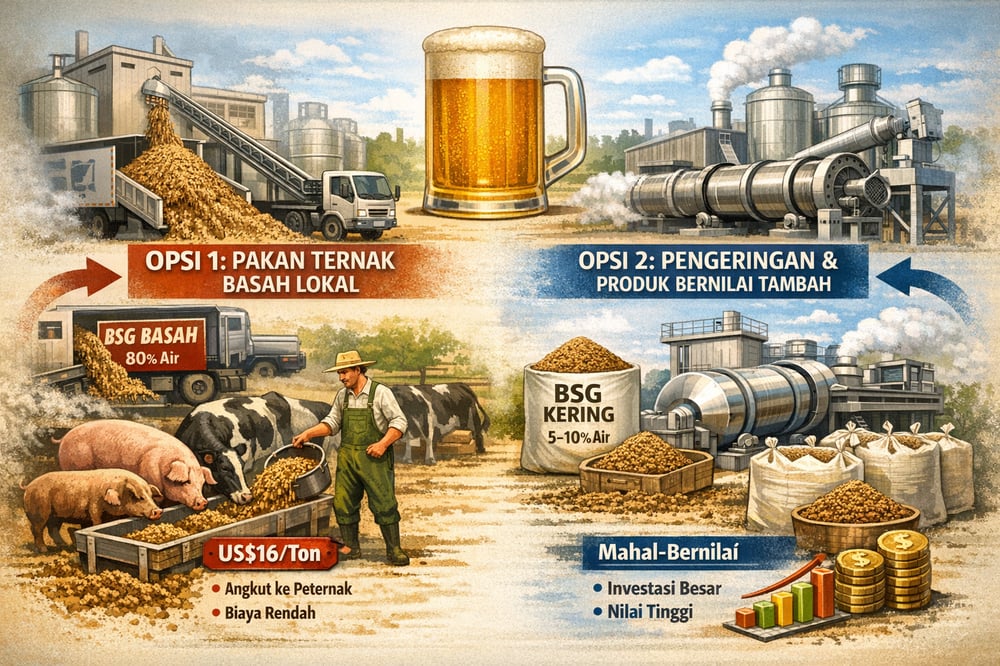
The default play is local. Breweries give or sell wet BSG—often 80–85% water—directly to nearby livestock farmers. No drying, no major capital: farmers typically pick up daily and feed it to cattle or pigs. The nutrient profile—~20–30% crude protein (DM) and ~60–70% fiber—fits ruminant diets, and research shows inclusion at 25–30% of a dairy ration (DM basis) can improve intake and milk yield (ScienceDirect) (ResearchGate).
It is usually a goodwill economy: breweries avoid disposal costs and farmers displace pricier concentrates, but there is essentially no revenue—most breweries charge nothing or a nominal fee for the grain (ResearchGate). The catch is distance and time. Because the material is heavy and bulky, farms “within a few tens of kilometers” tend to be the only viable partners; pickup must be daily or every few days. In warm conditions, aerobic spoilage is fast: at 30 °C, wet brewer’s grain can lose ~10% dry matter in one day, with reported dry‑matter losses of ~1–2% per day in some cases (ResearchGate).
Market context favors the practice. Reusing BSG as feed is widespread and growing; dried BSG is described as “a staple of the animal feed industry” (Future Market Insights), and brewers often treat BSG as a “core by‑product, not a waste” (ResearchGate). A 2014 U.S. FDA proposal would have required treatment or drying of BSG before farm use (Time), though it faced strong pushback. In Indonesia, there is no known ban and national initiatives broadly encourage agro‑waste use in feeds to reduce import reliance (Kontan press release).
Drying route and market access
Drying changes the math. Bringing moisture down to ~5–10% stabilizes the material for months, concentrates nutrients by removing water, and opens new markets (pellets, meal, flour) across cattle, poultry, swine, pet food, organic fertilizer, and emerging “upcycled” human‑food ingredients. The dried BSG market is projected to grow at ~4.7% CAGR to 2035 (Future Market Insights); major brewers are investing in extraction of protein and fiber for human food applications (Financial Times). Drying also “decreases transportation and storage costs” (ResearchGate).
The trade‑off is capital and energy. Rotary drum, belt, or fluidized‑bed dryers can run to tens or hundreds of thousands of USD, and drying 1 kg of 80%‑moisture BSG down to ~10% moisture requires energy on the order of vaporizing ~0.7 kg of water—about 2–3 MJ—so “energy costs associated with drying” are high (ResearchGate). “Most craft breweries do not have drying facilities” (ResearchGate).
Still, there are cases where it pencils out. One analysis assumed dried BSG flour selling at $2.70–3.60/kg and ~6.6 t/month dried output with ~$3–4k monthly expenses. With a ~$90,000 capital outlay, the authors found a positive net present value, a five‑year internal rate of return of ~12.7%, and a payback at about four years (MDPI) (MDPI) (MDPI). The caveat: those returns depend on sufficient scale, affordable energy, and reliable buyers.
Unit economics and energy
Here’s the back‑of‑the‑envelope: 1 metric ton of wet BSG at ~80% moisture contains ~200 kg of dry solids. Sold wet for free, the brewery avoids an estimated ~$16 disposal cost per 8 km of transport (ResearchGate). Dried, that ton yields ~200 kg dry; at $3/kg, revenue is $600.
Drying 800 kg of water from that ton would require on the order of 2–3 MJ per kg of water removed, which the analysis frames as ~50 m³ of natural gas (about $25–$50) plus electricity—easily >$50 of fuel. An MDPI study estimated monthly operating costs of ~$3,500 to dry ~6,600 kg/month, implying ~$0.53/kg of dried product cost even before capital (MDPI). Bottom line: selling wet is virtually free but low‑return; drying is costly but can create $/kg revenue, with many analyses and brewer anecdotes agreeing it is economical at larger volumes or higher price points (e.g., 3–5 years payback) (MDPI).
Regulatory and sustainability notes
Policy winds matter. The EU promotes “upcycling” BSG into food ingredients, and Indonesia’s sustainability policies broadly favor waste valorization (e.g., government support for local feedstocks) (Kontan press release). Meanwhile, a 2014 U.S. FDA proposal to require treatment/drying of BSG before farm use drew strong pushback (Time).
Not valorizing has its own cost. Transporting wet BSG is fuel‑intensive, landfilling organic waste is increasingly discouraged, and research suggests on‑farm utilization of wet spent grain “reduces the environmental impact” versus disposal (ResearchGate).
Conveying design and cleanout
Whether the grain is headed to a farm or a dryer, the first operational task is the same: get wet BSG out of the brewhouse cleanly and quickly. Because high‑moisture solids behave like a viscous cake, systems must be robust and easy to clean.
Under‑tun screw or auger conveyors are common. A screw conveyor or sloped trough mounted directly under the lauter tun’s false bottom continuously pushes spent grain into a receiving hopper as the mash is emptied, slashing manual shoveling and improving completeness of removal. IndPro’s “iExpel” mounts a variable‑pitch screw under the tun and integrates a sieve to pre‑drain liquid; the unit can tie into a pressurized pneumatic line downstream (IndPro).
For longer runs, pneumatic plug conveying combines a feed screw with compressed‑air injection to push plugs of grain through a pipeline to a remote receiver or silo. Commercial systems move material up to ~200 m and up grades, with “no‑back” safety valves to prevent overpressure (making.com). IndPro cites a 22 kW motor and capacities around ~20 tonnes/hour for its units (IndPro).
Short‑distance options include belt conveyors or flexible‑screw conveyors. A flexible screw (a single auger inside a plastic tube) is low‑maintenance and easy to clean, moving grain gently up moderate inclines (Spiroflow). Many layouts add a buffer hopper under the tun to hold a batch and feed downstream equipment steadily, then discharge to a silo, truck, or bins (IndPro).
Sanitary details matter: smooth internals to prevent hang‑ups, corrosion‑resistant materials (stainless steel or food‑grade coatings), sealed conveying to prevent dust and pests, and clean‑in‑place (CIP) or washdown capability to avoid odor or spoilage. Some modern systems add sensors or visual ports to detect bridging early (DataCalculus). Where CIP and washdown tie into plant utilities, supporting water treatment equipment can be part of the package, such as supporting equipment for water treatment or upstream debris control via an automatic screen.
Decision point for brewers
Given the data, the status quo remains rational: give wet grain to nearby farmers and avoid disposal fees (around US$16 per tonne per 8 km) with minimal capex (ResearchGate). Drying becomes attractive when throughput is high, markets are secure (e.g., feed flours, pet foods, upcycled ingredients), and energy is affordable—conditions under which analyses show positive NPV, ~12.7% five‑year IRR, and roughly four‑year payback on a ~$90k system at ~$2.70–3.60/kg selling prices for dried flour with ~6.6 t/month output and ~$3–4k monthly expenses (MDPI) (MDPI).
Either way, engineering the exit matters. The combination of an under‑tun auger and downstream transfer—pneumatic or mechanical—scaled to peak brew rates (suppliers advertise up to ~20 t/h) clears the lauter tun between batches without labor‑intensive shoveling (IndPro). In practice, that choice often determines whether BSG is a logistical headache—or a steady by‑product stream ready for the next buyer.
