
Modern skids now capture, wash, compress, and polish fermenter CO₂ into food‑grade gas. The result: 50–80% recovery, >99.9% purity, and paybacks often measured in a few years.
Brewers have a CO₂ problem most industries would envy: they make more of it than they need. Yeast throws off roughly 3–6 kg of CO₂ per hectoliter (hL; one hectoliter is 100 liters) of beer — about 30–60 g per liter — and breweries typically only need ~3 kg/hL to carbonate and package, according to Atlas Copco and a technical study (ResearchGate). In other words, breweries often generate more CO₂ than they consume — even a 20 L homebrew can evolve ~1.3 kg (~60 g/L) (HomebrewTalk).
That waste is now a resource. State‑of‑the‑art systems routinely recover ~2–2.5 kg/hL from ~4.2 kg/hL evolved — about half to three‑quarters — with advanced multi‑stage refrigeration pushing recovery to ~3.5 kg/hL. In practice, capture efficiencies land around 50–80% of fermenter CO₂, often enough to match or exceed on‑site demand (ResearchGate; Atlas Copco).
The pitch is straightforward: install a closed‑loop to capture fermenter CO₂, wash out moisture and early off‑flavors, compress and dry it, then strip flavor‑active compounds on activated carbon to food‑grade purity — and stop buying as much CO₂ from outside suppliers. Vendors and case studies say returns typically fall in the 1–5 year range (Atlas Copco; Craft Brewing Business; Hypro).
Fermentation off‑gas profile and timing
CO₂ comes fast in the first days of fermentation — precisely when volatile impurities are highest. Early yeast activity emits alcohols, sulfides and other volatiles that impair reuse, so capture strategies account for that (TPI/Matter of Gas). After roughly 24 hours, the gas typically exceeds 95% CO₂, but still needs scrubbing to hit beverage‑grade (TPI/Matter of Gas; ResearchGate).
Many plants begin recovery immediately as fermentation starts to boost yields, but they either vent or separately handle the first 24–48 hours, when gas purity is “poor” and off‑flavors peak (often flared). Attempting to recover too early drops purity dramatically, one study noted (ResearchGate; TPI/Matter of Gas).
Collection hardware and pre‑treatment
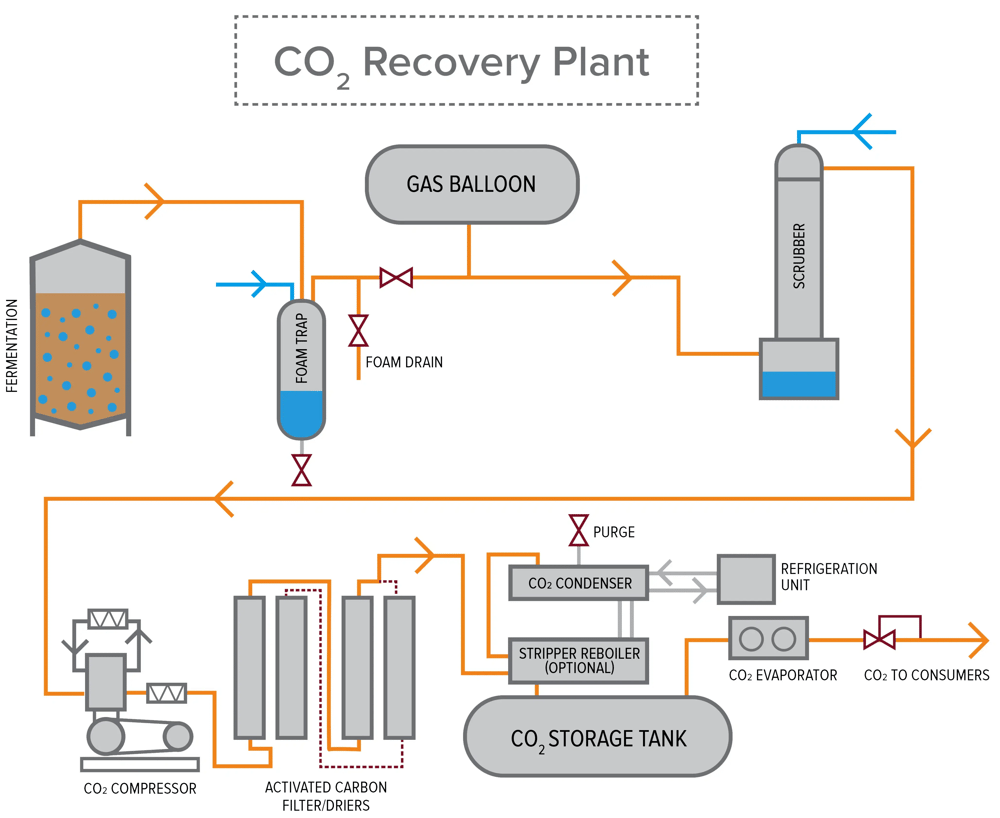
Modern recovery connects each fermenter’s gas port to a sealed recovery circuit. Tanks are fitted with gas‑tight outlets and foam condensers/demisters so evolved CO₂ is routed to recovery piping rather than vented (CNC Cryogenic; TPI/Matter of Gas).
First‑line cleaning removes gross impurities. A water wash or dehumidifier knocks down moisture and water‑soluble alcohols by bubbling gas through cold water or across refrigerated coils; systems also incorporate water traps to drain condensate (CNC Cryogenic). TPI’s “Early Recovery” builds in a foam/scrubbing tower to strip soluble contaminants and entrained foam before compression (TPI/Matter of Gas).
Compression and refrigeration stages
Next comes multi‑stage compression. Oil‑free compressors raise pressure to ~7–10 bar (bar is a unit of pressure) in a low‑pressure stage, with intercooling, then onward to ~50–70 bar or more in a high‑pressure stage, reducing gas volume and enabling drying and eventual liquefaction (Atlas Copco). CO₂ compression trains in food applications are oil‑free and corrosion‑resistant because CO₂ with hydrocarbons forms carbonic acid (Atlas Copco).
Many systems also chill gas pre‑compression to condense water and heavier volatiles; advanced designs sub‑cool to around −50 °C (Celsius) to boost capture rates, with one study achieving ~3.5 kg/hL recovery (ResearchGate; ResearchGate). Pentair underscores the beverage‑grade target — bottle‑grade with <5 ppm O₂ (parts per million) — for its compact brewery skids (Pentair).
Purification and activated‑carbon polishing
After compression and cooling, trace organics and sulfur compounds remain — notably hydrogen sulfide (H₂S), dimethyl sulfide (DMS), mercaptans, acetaldehyde, and heavier alcohols/esters. These “flavor‑actives” must be stripped to avoid tainting beer (Norit).
The workhorse is adsorption on activated carbon. Norit specifies grades targeted at brewing CO₂ to remove H₂S, DMS and mercaptans at very low concentrations; beds are sized to flow, often in parallel towers so one can be regenerated (Norit). Residual O₂/N₂ (oxygen/nitrogen) can be further reduced by cryogenic condensation or molecular sieves; studies describe vacuum distillation steps that flash off non‑condensables on the way to final specs (ResearchGate; ResearchGate). TPI’s design uses twin desiccant dryers and regenerable carbon towers as its polishing stage (TPI/Matter of Gas).
Performance is extreme: vendors guarantee ≥99.9% CO₂, with real‑world results at 99.99–99.998% and O₂ as low as 5 mg/kg. Dalum specifies at least 99.9% purity with no risk of benzene/methanol/hydrocarbon contamination (only yeast‑derived gases), while a peer‑reviewed device reached ~99.998% purity and ~5 ppm O₂ in final product (Dalum; ResearchGate; TPI/Matter of Gas). Norit notes its carbons can be regenerated in place by steam purge across loading cycles (Norit).
Downstream liquefaction condenses the gas to liquid for storage, often followed by a cold “stripper” column that freezes out non‑CO₂ — the final polish before the tank (CNC Cryogenic; TPI/Matter of Gas; TPI/Matter of Gas).
Process flow summary (plant sequence)
- Capture: sealed fermenter outlets with foam traps/demisters route CO₂ to recovery piping (CNC Cryogenic; TPI/Matter of Gas).
- Water wash: condensers/towers remove moisture and water‑soluble volatiles (CNC Cryogenic; TPI/Matter of Gas).
- Compression: oil‑free two‑ or three‑stage compressors bring gas to intermediate pressure.
- Drying: twin‑tower desiccant dryers dehydrate CO₂ for continuous operation (TPI/Matter of Gas).
- Filtration/adsorption: high‑pressure absorbers and activated‑carbon beds strip sulfur compounds and organics (CNC Cryogenic; TPI/Matter of Gas).
- Liquefaction: compression/refrigeration condenses CO₂ to liquid (CNC Cryogenic).
- Polishing (optional): cold stripper/freezer column removes non‑CO₂ to ultra‑pure specs (TPI/Matter of Gas; TPI/Matter of Gas).
- Storage: liquid CO₂ is stored in insulated, pressurized tanks for reuse or sale (CNC Cryogenic; TPI/Matter of Gas).
System performance and output specs
Skids are sized by CO₂ rate. Pentair’s containerized CO₂mpactBrew recovers 25–160 kg/hour and fits in a 40‑ft container (Pentair). Maui Brewing has run ~100 lbs/hour (~45 kg/h), capturing ~20,000 lbs/month (~9,000 kg) (Craft Brewing Business). A 50 hL brewery produces ~200–300 kg CO₂ per batch; multi‑batch facilities can generate 10,000–100,000 kg/year to capture.
Purity out of well‑designed plants clears beverage standards handily: >99.9% CO₂ is typical, with documented outcomes at 99.998% and O₂ at ~5 mg/kg. Comparable systems claim “at least 99.9%” purity with the advantage of eliminating risks associated with trucked‑in industrial gas (ResearchGate; TPI/Matter of Gas; Dalum).
Plants incorporate gas safety: back‑pressure controls prevent fermenter overpressure and automation watches flow, pressure and purity. Many designs auto‑switch beds and regenerate desiccants via hot CO₂ or steam, which is why water and utilities planning matters (Norit). Dalum notes designs that eliminate disposable filters altogether (Dalum).
Economic and operational factors
Capital costs for packaged recovery at craft scale sit around $100,000–$200,000 installed. Earthly Labs’ “CiCi” craft unit has been quoted at ~\$100k (Grey Sail Brewing), with fully installed systems up to ~$150k; modular plants can start at \$50k+ and rise to several hundred thousand for industrial setups (Craft Brewing Business; Shunbeer; Dalum). Ancillary work includes fermenter piping, foam traps, electricals, and cryogenic storage.
Operating costs are dominated by electricity for compressors/refrigeration — a few kW to tens of kW while running, translating to a few MWh per year for many breweries. Water use rises if water‑scrubbing or steam regeneration is employed; consumables include desiccant and activated carbon (often 6–12 month intervals), although some designs avoid disposable filters entirely (CNC Cryogenic; Dalum).
CO₂ supply savings vary with market volatility. Bulk beverage CO₂ often runs ~$100–$300 per tonne in normal conditions, but 2019–2022 saw spikes and shortages. A 10,000 hL/year brewery produces ~50 tons of ferment CO₂; capturing 80% yields ~40 tons/year “free,” worth ~$8,000/year at \$200/ton — or more in tight markets. Maui’s 600,000 lb/year (≈272 ton) capture implies tens of thousands of dollars in annual offset (Craft Brewing Business; Shunbeer).
ROI ranges widely but is often attractive. Atlas Copco cites ~2‑year average payback; Grey Sail Brewing estimated ~5 years on a \$100k system; Hypro markets 1–2 years in high‑price regions and >40% savings on CO₂ usage with “counter pressure recovery” — vendor claims that can accelerate returns depending on local pricing (Atlas Copco; Craft Brewing Business; Hypro; Hypro).
A worked example: a 20,000 hL/year brewery makes ~80 tons CO₂. If 70% (~56 t) is captured, that replaces ~$11k/year at \$200/ton — a \$150k system would take ~14 years. At \$400/ton (shortage pricing), the same capture saves ~$22k/year, ~7 years to repay. Add any energy recovery or incentives (e.g., alignment with Indonesia’s carbon pricing under Presidential Regulation No. 98/2021), and the timeline can shorten (Hypro).
Operational benefits and quality outcomes
Breweries that install recovery report reduced purchases and stronger supply security, particularly in regions with limited suppliers or where deliveries have failed. Maui Brewing, on an island with constrained supply, invested to avoid disruptions; Tröegs also moved to install recovery after a supplier failed to deliver (Craft Brewing Business; Craft Brewing Business).
Recovered gas is also consistent. Vendors note no sensory impact once properly cleaned, and compliance with strict purity traditions and certifications (Reinheitsgebot, kosher) is feasible. Svaneke Bryghus in Denmark is reportedly 100% self‑sufficient and even bottles surplus recovered CO₂ (Dalum).
There’s a carbon angle too: capturing fermentative CO₂ avoids venting roughly 1 ton per ~2,000 liters — about 15 g per beer — adding up to dozens of tons annually for medium breweries, which supports “green” positioning (Shunbeer; Craft Brewing Business).
Regulatory and market context
While there’s no brewery‑specific mandate in Indonesia, investment aligns with national climate policy and carbon pricing (Presidential Regulation No. 98/2021), and could interface with incentives or credits (Hypro). Europe’s widely reported food‑CO₂ shortages in 2019/2020 showed the operational risk of total dependence on external CO₂ — a lesson not lost on beverage producers (Craft Brewing Business).
Bottom line for brewery owners
CO₂ recovery plants turn vent gas into food‑grade utility. The steps are standardized — foam traps and water scrubbing, multi‑stage compression, drying, adsorption on activated carbon, then liquefaction and storage — and deliver >99.9% purity with final oxygen as low as ~5 mg/kg (≈5 ppm) in advanced cases (CNC Cryogenic; Norit; ResearchGate). Typical plants save up to tens of thousands of dollars annually at medium scale, with reported paybacks in 1–5 years depending on local CO₂ pricing and throughput (Hypro; Craft Brewing Business). For breweries producing on the order of 1,000–20,000 hL/year or more, the combination of supply security, emissions reduction, and quality control makes a compelling case (Dalum).
Sources: industry and technical publications on brewery CO₂ recovery (Norit; Atlas Copco; ResearchGate; CNC Cryogenic; ResearchGate), case studies of breweries (Craft Brewing Business; Pentair), and vendor data on system performance (Dalum; Hypro).
