

Industry: Textile | Process: Scouring_&_Bleaching
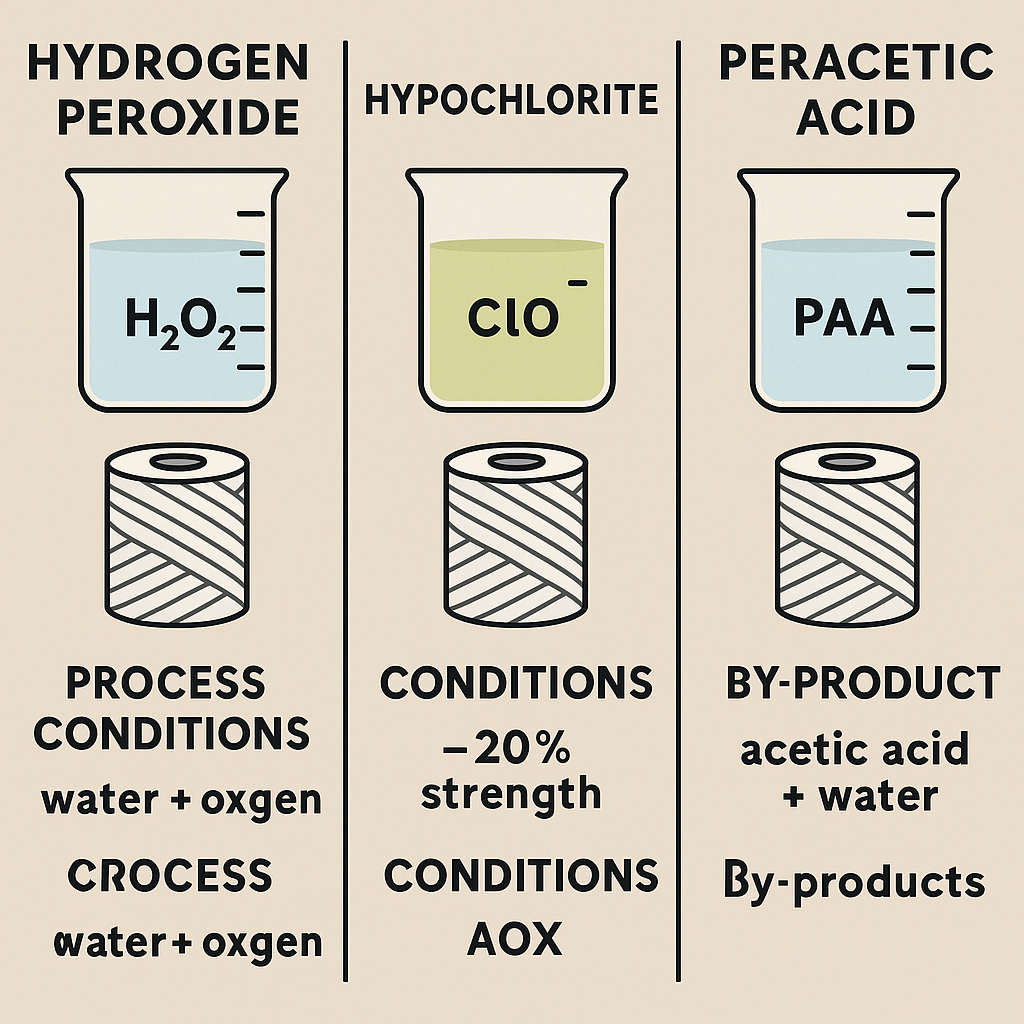
Textile bleaching has a new normal: hydrogen peroxide (H₂O₂) has become the cornerstone, commanding more than 70% of global use because it can deliver high whiteness while breaking down into water and oxygen, according to link.springer.com. In cotton, that translates to a CIE WI (Commission Internationale de l’Eclairage Whiteness Index, a standard whiteness metric) of roughly 85–95 (link.springer.com) under the classic recipe: strongly alkaline media (pH≈10–11) at around 80–100 °C (link.springer.com) (link.springer.com).
Chlorine-based bleaches like sodium or calcium hypochlorite, once dominant, are now rarely used in cotton. The reason is simple and stark: aggressive cellulose damage and toxic byproducts. Calcium hypochlorite can produce AOX (adsorbable organic halides, regulated pollutant precursors) above 1 mg/L and cut cotton tensile strength by about 20% (link.springer.com)—with policies like EU REACH reported as forbidding such AOX levels (link.springer.com).
An emerging alternative, peracetic acid (PAA), can hit cotton whiteness comparable to H₂O₂ (CIE WI >85) but at lower temperature (50–70 °C) and near-neutral pH (6–8), yielding acetic acid and water—biodegradable byproducts that simplify effluent handling (link.springer.com) (link.springer.com). PAA still faces cost and handling constraints (link.springer.com), while ozone and enzymatic routes (e.g., laccases, peroxidases) are in play for specialty or wool applications. Standards mirror this pivot: Indonesian and global sustainable textile schemes favor H₂O₂/PAA. GOTS (Global Organic Textile Standard) certification mandates H₂O₂ or PAA at pH 6–11 and below 100 °C, effectively sidelining NaOCl to minimize environmental impact (link.springer.com).
Oxidative agents and fiber outcomes
Bleaching is necessarily oxidative, meaning some cellulose degradation is inescapable. Under control, H₂O₂ keeps it modest: less than 5–10% strength loss is typical. One study measured cotton’s peak tensile force as ≈412 N after conventional H₂O₂ bleaching versus 431 N unbleached—about a 4% drop (pmc.ncbi.nlm.nih.gov). Prolonged exposure to sodium hypochlorite, by contrast, can carve away roughly 15–20% of tensile strength (link.springer.com) (link.springer.com).
Excessive H₂O₂ also bites: at 10–15 g/L, strength cuts of ~10–15% and microfibril damage show up in SEM (scanning electron microscopy) images (link.springer.com). There are mitigations. Magnesium sulfate (MgSO₄) stabilizers and low-temperature activators have been reported to preserve fabric strength; enzyme-assisted bleaching (cellulase/pectinase) reduced fiber damage by ~40% versus typical chemical bleach while still reaching ~85–90 CIE whiteness (link.springer.com). Micrographs back it up: one study observed “almost no damage” on enzyme-bleached cotton yarn, while conventional peroxide/alkali bleaching left visible fiber opening and hairiness (www.mdpi.com).
Bleach bath control: concentration, temperature, time
In practice, whiteness gains move in lockstep with risk to fiber, so mills choreograph concentration, temperature, and residence time.
Concentration: On cotton at 95 °C for 30 minutes, CIE WI rose from about 62.5 to about 73.3 as H₂O₂ dosing increased from 2.5 to 10 mL/L (www.mdpi.com). Traditional alkaline H₂O₂ bleaching—around 6 g/L H₂O₂ with 2.5% NaOH—produced WI≈78.7 (www.mdpi.com). Beyond roughly 7–10 g/L, returns fade (80.5 at 10 g/L vs 78.7 at 6 g/L), while cellulose oxidation accumulates, prompting mills to set the minimum dose to hit the target WI.
Temperature: Warming the bath from 55 °C to 95 °C (10 mL/L H₂O₂, 30 min) lifted WI from roughly 53 to roughly 73 (www.mdpi.com) (www.mdpi.com). Conventional lines therefore run near 90–100 °C. Low-temperature “boilerless” routes use activators—TAED (tetraacetylethylenediamine) or glycerol triacetate—to make peracids in situ, enabling 60–80 °C with comparable whiteness (pmc.ncbi.nlm.nih.gov) (pmc.ncbi.nlm.nih.gov). But excess heat (>100 °C) can hydrolyze cellulose, reducing DP (degree of polymerization, an average chain length indicator) by ~5–10% (link.springer.com).
Time (residence): Extending from 30 to 45 minutes at 95 °C and 10 mL/L H₂O₂ raised WI from 73.3 to 77.2—a 5% gain for 50% more time (www.mdpi.com). A 2–3% WI improvement (often barely visible) can cost disproportionate exposure. That is why mills increasingly prefer shorter, high-temperature or activated cycles; one report achieved WI≈61 (Berger scale, an alternative whiteness metric) in 30 minutes at 80 °C by adding activators (triacetin, peracetic acid) (pmc.ncbi.nlm.nih.gov).
pH and stabilizers: For H₂O₂, pH around 10–11 (set with NaOH or Na₂CO₃) is critical because the perhydroxyl anion (the active bleaching species) forms in alkali (link.springer.com). Too much alkalinity, however, accelerates cellulose hydrolysis. Modern recipes limit caustic and use stabilizers—sodium silicate, phosphonates, Mg²⁺ salts—to prolong H₂O₂ action and protect fibers (link.springer.com) (journals.sagepub.com), with gluconates or phosphonates reported to trim chemical use by ~10–15% and mitigate fiber loss (link.springer.com). Hypochlorite is typically run at pH ~9–10 and 30–50 °C to temper oxidation, and real-time pH control is essential to avoid runaway breakdown (link.springer.com) (link.springer.com). Automated dosing—via accurate systems such as a dosing pump—and in-line monitors are the anchor of this control regime.
Targets, trade-offs, and standards
In the real world, a target whiteness sets the endpoint. Many cotton programs aim for CIE WI around ~80 (perceptually “good white”), accepting a small ~2–5% strength reduction. Pushing beyond ~80–85 WI yields smaller visible gains as fiber peeling accelerates. One well-documented style—about 6 g/L H₂O₂, 2.5% NaOH, 90–95 °C, 60–90 minutes—routinely delivers WI≈79–81 with roughly 4% strength loss (www.mdpi.com) (pmc.ncbi.nlm.nih.gov). Tweaks bump risk quickly: adding 10 °C or 20% more H₂O₂ can push whiteness higher but drive 10–15% strength loss (link.springer.com) (link.springer.com).
A figure/trend example makes the trade-offs vivid: at 95 °C, WI climbed from about 63 to 76 as H₂O₂ increased from 2.5 to 10 mL/L over 30 minutes (www.mdpi.com), but at fixed 10 mL/L, stretching time from 30 to 45 minutes added only ~4 WI points (73→77) (www.mdpi.com). Modern process control—automated dosing, including through a dosing pump, plus in-line pH/temperature meters—keeps each variable locked down, aligning with global standards (ZDHC, the Zero Discharge of Hazardous Chemicals framework; REACH; and Indonesian green industry norms) that effectively mandate peroxide-based bleaching with minimal excess chemicals.
Agent-by-agent snapshot
Hydrogen peroxide: dominant agent (>70% use), high whiteness (CIE WI ~85–95), run at pH≈10–11 and ~80–100 °C; controlled use generally limits strength loss to <5–10% (link.springer.com) (pmc.ncbi.nlm.nih.gov).
Hypochlorite (sodium/calcium): seldom used for cotton today due to cellulose damage and toxic byproducts; AOX>1 mg/L observed with calcium hypochlorite; tensile loss can reach ~15–20% under prolonged exposure; typically run at pH ~9–10 and 30–50 °C with tight pH control (link.springer.com) (link.springer.com) (link.springer.com) (link.springer.com).
Peracetic acid (PAA): comparable whiteness (CIE WI >85) at 50–70 °C and pH 6–8; biodegrades to acetic acid and water, simplifying effluent treatment; adoption limited by cost and handling (link.springer.com) (link.springer.com).
Sources and references
Uğur et al. measured CIE whiteness and damage for traditional vs. enzymatic bleaching on cotton yarn (www.mdpi.com) (www.mdpi.com). Küster et al. reported ≈4% tensile loss for conventional H₂O₂-bleached cotton (pmc.ncbi.nlm.nih.gov). Hashem et al. compared agents, noting NaOCl’s damage (~15–20% loss) and peroxide’s high WI with minimal damage, and detailed stabilizer roles and process limits (link.springer.com) (link.springer.com) (link.springer.com). These and other sources underscore that carefully controlled H₂O₂ (or PAA) bleaching can achieve required whiteness with acceptable (single-digit) fiber loss, but overdose of chlorine or peroxide rapidly degrades cotton (link.springer.com) (link.springer.com). (All citations above contain full source metadata.)