
Aquaculture ponds can smother in algae. Copper-based algaecides knock blooms down fast—often by more than 90%—but they carry collateral risks that biological and physical tools try to avoid.
In pond aquaculture, harmful algae can spiral from nuisance to crisis in a week. Chemical shots like copper sulfate (CuSO₄·5H₂O) collapse blooms quickly—>90% reductions in days—but they can also hammer non‑targets and drain oxygen as dead algae decay (ResearchGate) (Global Seafood Alliance). Biological add‑ons and aeration‑mixing routines steer pond ecology more gently—slower and often partial, but with fewer side effects.
Across case studies, that’s the trade: speed versus system stability. And the details matter—from alkalinity to Secchi depth to whether you apply at dawn.
Chemical algaecides and water chemistry
Copper sulfate (CuSO₄·5H₂O) dissolves readily and kills algae at low doses (0.5–2.0 g/m³ or 0.5–2.0 ppm, ~0.1–0.4 mg/L Cu²⁺), often applied weekly or as needed (ResearchGate) (Global Seafood Alliance). Trials report >90% phytoplankton biomass reduction within 1–2 weeks (ResearchGate). Riley et al. (2021) measured >94–96% chlorophyll‑a drop in 10–14 days and ~98% cyanobacteria decline relative to controls (ResearchGate) (chlorophyll‑a is a proxy pigment for algal biomass).
Chelated copper (e.g., copper ethanolamine) can be more soluble or longer‑acting and, in lab tests, less toxic to fish than raw CuSO₄ (fathead minnow 48‑h LC₅₀—median lethal concentration over 48 hours—~0.9 mg/L Cu²⁺ for chelate vs. ~0.3 mg/L for a formulation with surfactant), though additives like corn starch or surfactants can dramatically raise non‑target toxicity (ResearchGate).
Copper performance hinges on water chemistry. High pH and hardness precipitate free Cu²⁺, reducing algicidal potency but also fish toxicity (Global Seafood Alliance) (Global Seafood Alliance). A practical rule: dose (g CuSO₄/m³) ≈ total alkalinity (TA, mg/L as CaCO₃)/100. Example: TA = 50 mg/L ⇒ ~0.5 g/m³ CuSO₄ (Global Seafood Alliance). In practice, minimum ~0.8–1.0 g/m³ is often needed for bloom knockdown; very turbid green water (Secchi depth <15 cm) may require 1.5–2.0 g/m³; and early‑day application (pH low, more free Cu²⁺) improves efficacy (Global Seafood Alliance) (Global Seafood Alliance) (Global Seafood Alliance).
Copper kills broadly. Field trials that rapidly collapsed phytoplankton also saw a persistent zooplankton crash in copper‑treated ponds versus hydrogen peroxide or other algaecides, raising oxygen‑depletion risk during die‑off (ResearchGate) (Global Seafood Alliance).
Other oxidizing algaecides—hydrogen peroxide or peracetic acid (strong oxidizers that lyse algal cells)—act quickly and break down to water and oxygen. Buley et al. (2021) found fast cyanobacteria reductions with little carryover toxicity to zooplankton, but blooms often re‑emerged after a few weeks; concentrated oxidizers require careful handling (ResearchGate) (ResearchGate).
Bottom line on outcomes: chemical algaecides achieve the fastest bloom suppression—copper treatments consistently >90% within days—while biological and physical methods are slower or partial (ResearchGate). Regulatory note: in aquaculture, only a few algaecides are approved (in the US, only CuSO₄·5H₂O and diuron for taste compounds) (ResearchGate); ASEAN guidelines list copper sulfate as approved (malachite green banned) (Doczz). Indonesian practice generally allows CuSO₄ use in shrimp and fish ponds under controlled dosing; farmers must follow local guidelines and withdrawal times to avoid residue issues.
Biological controls and ecosystem steering
Biomanipulation via filter‑feeding fish can graze down plankton. Silver carp (Hypophthalmichthys molitrix) and bighead carp removed 90–95% of >10 µm phytoplankton (net‑plankton chlorophyll‑a) in Laws and Weisburd (1990), but smaller phytoplankton (<10 µm) escaped and total chlorophyll rose ~40–86% from blooms of tiny algae (Taylor & Francis). Confining fish behind net barriers mitigated this trade‑off: large phytoplankton still fell ~90% with only ~20% rise in nanoplankton (Taylor & Francis). Field work shows silver carp can nearly eliminate Microcystis colonies (a common cyanobacterium), though single‑cell algae (<5 µm) often persist and dominate afterwards (ResearchGate).
Microbial and probiotic add‑ons (e.g., Bacillus spp., nitrifiers) aim to compete for nutrients or secrete algicidal compounds. Certain Bacillus strains inhibited algae in lab work (Lv et al. 2010; An et al. 2018). A “microbial modified clay” (Bacillus amyloliquefaciens immobilized on clay) removed >90% of the toxic alga Heterosigma akashiwo at 0.1 g/L (Frontiers). In farm ponds, probiotics are commonly mixed at ~10⁷–10⁸ CFU/L (CFU/L: colony‑forming units per liter). One study found EM and Bacillus treatments (1×10⁸ CFU/L) suppressed the filamentous alga Cladophora by 10–30% over several days; effects are slow and field evidence is mixed (ResearchGate).
Allelopathy via straw or plant extracts is a low‑input option. Rotting barley straw at ~25–50 g/m³, or rice/bean straw at ~10–30 g/m³, can inhibit algal growth, with treated ponds showing lower phytoplankton and reduced cyanobacteria dominance; latency is weeks, so this is preventative and typically reduces growth by ~20–50% over a season (Springer). Duckweed cover provides shading and nutrient uptake; snails, aquatic plants, and promoting rotifers have limited application for plankton blooms in intensive systems.
Net effect: biological methods are greener, integrate with ecological aquaculture, and can lower peaks (~20–50%), but are slower and situation‑specific. Silver carp can push net‑plankton chlorophyll down ~90% while total plankton rises 20–40% (Taylor & Francis).
Physical controls and pond hydraulics
Aeration and mixing—paddlewheels or diffusers that oxygenate and break stratification—shift pond conditions away from large, toxin‑producing blooms. In an experiment, increasing depth to 1.8 m and aerating both surface and bottom (vs. 1.2 m with only surface aeration) suppressed cyanobacteria and increased phytoplankton diversity by 30–137%; nitrogen, ammonia, phosphorus, and reactive phosphate were significantly lower through the season (ResearchGate) (ResearchGate). Reports from freshwater prawn farms indicate dual‑layer aeration reduces Microcystis and improves overall water quality versus single aeration (ResearchGate). Continuous aeration also distributes chemical treatments evenly.
Other physical practices: maintain moderate depth (deeper ponds are cooler, less cyanobacteria‑prone), install shade screens or dye to reduce light ~30–50%, exchange water to flush nutrients, mechanically remove floating mats, and dredge bottoms or remove sludge before stocking. Benthic feeders (e.g., tilapia) can stir sediments and affect nutrients. In recirculating systems, routing water through constructed biofilters or algal raceways removes nitrogen and phosphate downstream. In practice, aeration and mixing can cut bloom severity by ~20–50% and avoid fish kills from oxygen crashes; none of these will eliminate an established bloom quickly.
Algaecide dosing and timing (CuSO₄)
Measure total alkalinity (TA), pH, and hardness before dosing. Use: dose (g CuSO₄/m³) ≈ TA (mg/L as CaCO₃)/100. For TA = 80 mg/L, ≈0.8 g/m³ CuSO₄ (0.8 g/m³ = 0.8 ppm CuSO₄, ~0.2 ppm Cu²⁺). This formula often underestimates for bloom kill; common practice is a minimum ~0.8–1.0 g/m³ for cyanobacteria control. In low‑alkalinity ponds, ~0.5 g/m³ may be safe but may not suppress hard blooms; highly turbid ponds (Secchi <0.15 m) likely require ≥1.5–2.0 g/m³ (Global Seafood Alliance) (Global Seafood Alliance).
Timing: apply early morning (pH lowest, more free Cu²⁺) and dilute–broadcast evenly while running aerators; avoid concentrated “slug” doses (Global Seafood Alliance). For repeatability and even distribution, many farms fit an accurate dosing pump into the application routine.
Precautions and post‑treatment handling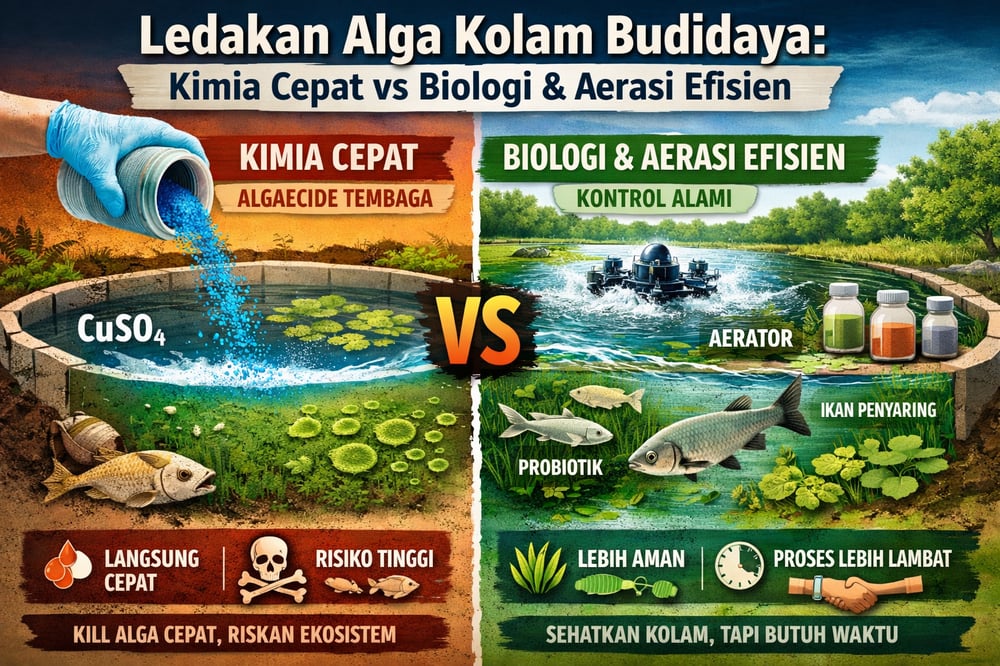
Trial first: treat a small enclosed area to observe fish reaction. Species sensitivity varies; many warmwater fish tolerate Cu²⁺ only up to ~0.3–0.7 mg/L, and in soft/low‑alkalinity water even ~0.2 mg/L can be lethal to sensitive species (ResearchGate) (ResearchGate). Do not feed 24 h before and after treatment to reduce oxygen demand. Run aeration high during and after application because decaying algae can crash dissolved oxygen; do not use copper if DO is already low (<4 mg/L) or if heavy rains will shortly dilute the pond (which could remobilize copper from sediments unexpectedly) (Global Seafood Alliance).
After treatment, minimize effluent discharge for 2–3 weeks while copper binds to organics and sediments (Global Seafood Alliance) (ResearchGate). Boyd et al. (2007) found total copper in treated catfish ponds fell to background within 48 h and seldom exceeded the EPA chronic criterion (0.013 mg Cu/L) (ResearchGate). Drawing off water (e.g., during seining) can flush solids with attached copper; retain water and allow sediments to settle, or route discharge through settling tanks or filter screens—farms often use a compact clarifier or an automatic screen as primary barriers, alongside broader physical separation in effluent lines.
Rotation, resistance, and compliance
Repeat copper sparingly. Chronic exposure can select for copper‑tolerant cyanobacterial mutants within a few generations (Global Seafood Alliance) (Global Seafood Alliance). Rotating methods—alternating copper with peroxide or with periods of aeration/nutrient reduction—can delay resistance. Document each application (dose, date, weather conditions) and ensure producer and market tolerances are met. According to ASEAN and Indonesian guidelines, CuSO₄ is permitted for pond use (typically registered as an aquatic chemical); indiscriminate or off‑label use can be penalized (Doczz).
Operational summary for safe use
Dose CuSO₄ as TA/100 (g/m³), not less than ~0.8 g/m³ for blooms; apply in the morning with mixing; don’t feed around treatment; aerate vigorously after; watch for stress (gasping) and stop copper if observed; wait 2–3 weeks before draining; follow local withholding rules (Global Seafood Alliance).
