

Industry: Aquaculture | Process: Water_Source_&_Intake_Treatment
In aquaculture, “almost clean” isn’t clean enough. Mechanical filtration can knock out the bulk of suspended solids and more than 90% of microbial cells, yet the surviving 10% can still cause disease (pmc.ncbi.nlm.nih.gov) (pmc.ncbi.nlm.nih.gov). That’s why intake systems are moving to multi‑barrier designs: coarse screening and fine filtration first, then ozone (O₃) as a primary barrier and UV‑C (ultraviolet light at ~254 nm) as a secondary kill step (waterworld.com).
The goal is clear. Farms must remove bacteria, viruses, algae, and protozoa while cutting turbidity and organic load. In practice, drum or disc filters down to 5–50 μm do the heavy lifting upfront; conventional pretreatments such as coagulation/flocculation and sedimentation typically eliminate roughly 90% of bacteria and protozoa by mass, and well‑designed sand or membrane filters can remove on the order of 90% of bacterial cells (pmc.ncbi.nlm.nih.gov) (pmc.ncbi.nlm.nih.gov). But filtration alone is not fully safe; residual microbes can still seed outbreaks (pmc.ncbi.nlm.nih.gov).
Facilities commonly start with mechanical screening — for example, an automatic screen for continuous debris removal — then polish with dual‑media beds such as sand‑silica filters. Where finer cuts are needed ahead of disinfection, operators add pressure membranes like ultrafiltration or place a cartridge filter as final protection. Coagulant dosing (using a dosing pump) supports floc formation before clarification when raw intakes are turbid.
Mechanical pretreatment and turbidity control
Mechanical filtration reduces particulate “shielding,” which otherwise protects pathogens during downstream disinfection. Evidence shows screens, drum or disc filters at 5–50 μm can strip most suspended solids and >90% of microbial cells; coagulation/flocculation and sedimentation deliver ~90% removal of bacteria and protozoa by mass, and sand or membrane filters similarly remove on the order of 90% of bacterial cells (pmc.ncbi.nlm.nih.gov) (pmc.ncbi.nlm.nih.gov). Yet remaining microbes — even at “only” 10% of the original count — still matter (pmc.ncbi.nlm.nih.gov), reinforcing the case for the second and third barriers.
Ozone disinfection: concentration–time control
Ozone (O₃) is a strong oxidant and first chemical barrier after filtration. It inactivates bacteria, viruses, and parasites by oxidizing cell walls and nucleic acids, while also destroying dissolved organics and turbidity via oxidation and micro‑flocculation (waterworld.com). In seawater trials, maintaining only 0.16 mg/L total residual ozone (TRO; the measurable ozone remaining after demand is satisfied) for 2 h dropped bacterial counts from 7.7×10³ CFU/mL (colony‑forming units per milliliter) to <10 CFU/mL, a >99.9% reduction (researchgate.net). Treating equipment or fertilized eggs with 0.5 mg/L O₃ for 10–30 min likewise achieved ~99.9% bacterial kill (researchgate.net), implying a steady ozone residual of ~0.2–0.5 mg/L with adequate contact time can drive multi‑log reductions in aquaculture contexts.
For protozoan parasites such as Cryptosporidium oocysts, dose–time matters. Lab tests showed 1.11 mg/L ozone for 6 min completely eliminated infectivity at 10⁴ oocysts/mL, while 2.27 mg/L for 8 min was required at 5×10⁵ oocysts/mL (pubmed.ncbi.nlm.nih.gov) (pubmed.ncbi.nlm.nih.gov). Regulatory CT (concentration×time, expressed as mg·min/L) tables back this up: at 20°C, 1‑log (~90%) Cryptosporidium inactivation requires CT ≈2.5 mg·min/L (e.g., 0.5 mg/L for 5 min), and 2‑log (~99%) ≈4.9 mg·min/L (law.lis.virginia.gov). In practice, an ozone contactor with ~5–10 min retention and ~0.5–1.0 mg/L ozone can achieve multiple‑log (2–3 log) protozoan kill under moderate temperatures; for example, 10 min at 1.0 mg/L yields CT=10 mg·min/L (~3‑log credit), and 5 min at 0.5 mg/L yields CT=2.5 mg·min/L (≈1‑log credit) (law.lis.virginia.gov).
Sizing is linear: ozone generator output (g/h) ≈ flow Q (m³/h) × target dissolved ozone C (mg/L). A farm drawing 100 m³/h with a 0.5 mg/L dose needs ~50 g/h (100×0.5) (pubmed.ncbi.nlm.nih.gov). Designs include degassing (off‑gas destruction) to strip excess ozone before tanks, and monitoring to maintain ~0.1–0.2 mg/L residual post‑contact. Many recirculating systems operate at ~0.2–0.8 mg/L continuously to keep TRO below ~0.3–0.5 mg/L while achieving >3‑log bacterial reductions (researchgate.net) (researchgate.net).
UV sterilization: dose and UV transmittance
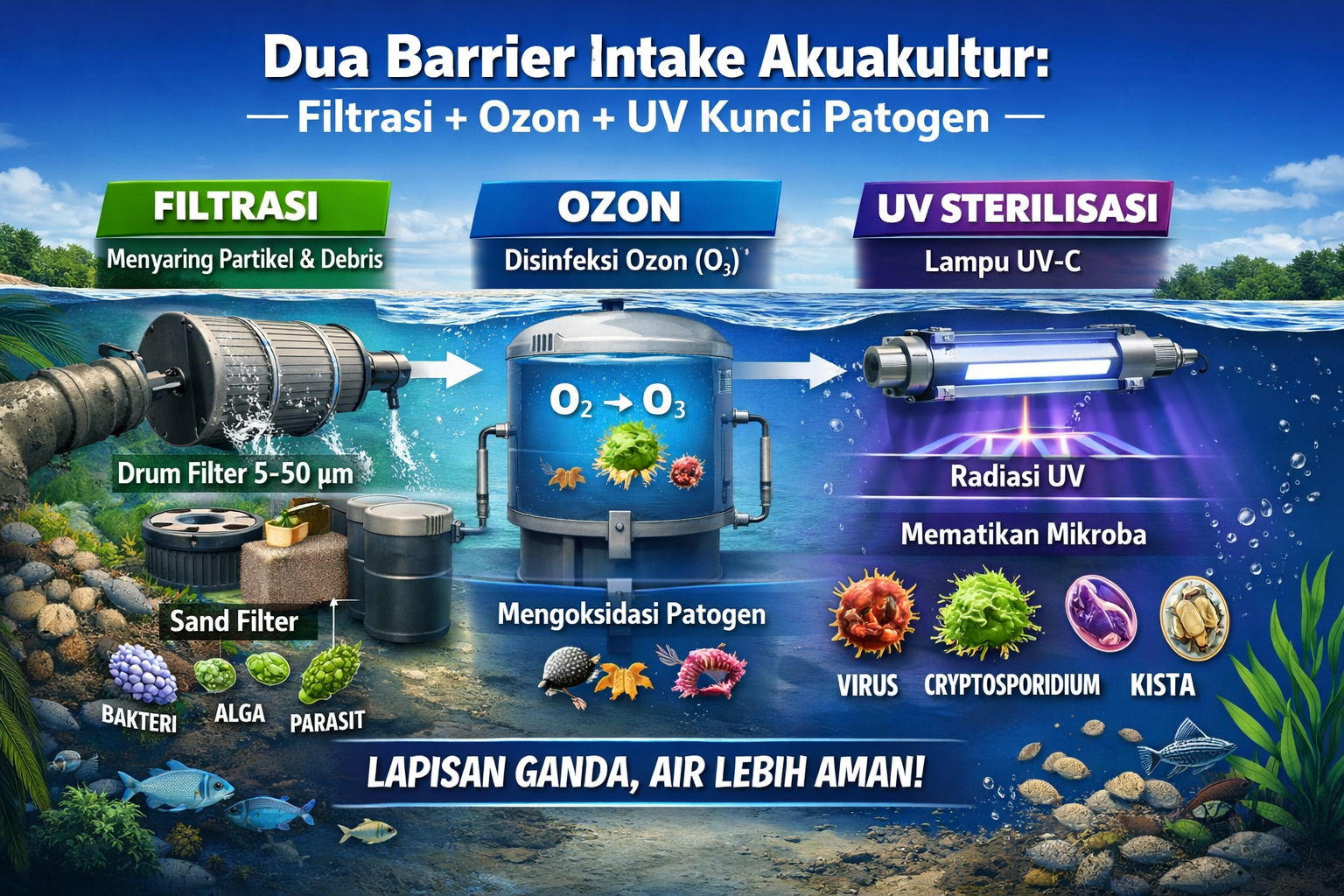
UV‑C sterilization attacks DNA/RNA directly and leaves no chemical residual or byproducts (waterworld.com). It is particularly valuable against chlorine‑resistant microbes. Cryptosporidium resists chlorination but “responded well” to high UV doses in trials, while Giardia cysts are much easier to inactivate (pmc.ncbi.nlm.nih.gov). CDC guidance for recreational water specifically recommends UV or ozone when Cryptosporidium is a concern (waterworld.com) (waterworld.com).
Quantitatively, Giardia viability fell to ~0% at ~20 mJ/cm², while one analysis showed <3% of Cryptosporidium remained viable after 83.2 mJ/cm² (pmc.ncbi.nlm.nih.gov). A 2002 AEM study reported a 2‑log infectivity reduction of C. parvum at ~1.0 mWs/cm² (≈10 mJ/cm²), though complete excystation inhibition required ~230 mJ/cm² (pmc.ncbi.nlm.nih.gov). In design, that translates to sizing UV systems at ≥40 mJ/cm² for general microbial control and up to 80–100 mJ/cm² for tougher protozoa like Cryptosporidium (pmc.ncbi.nlm.nih.gov) (alfaauv.com).
UV’s Achilles’ heel is water quality. High turbidity or low UV transmittance (UVT; a measure of how much UV light passes through water) reduces dose. Upstream filtration should deliver turbidity below ~5 NTU — ideally <1 NTU — to ensure penetration. Manufacturers typically rate systems at a given UVT; as a rule of thumb drawn from drinking‑water practice, ~40–45 mJ/cm² is common (alfaauv.com). For pathogen‑heavy intakes, targeting ≥50–60 mJ/cm² provides a safety margin; for Cryptosporidium, 80–100 mJ/cm² is prudent (pmc.ncbi.nlm.nih.gov) (alfaauv.com).
Product selection reflects these constraints. A closed‑vessel reactor such as an ultraviolet system is typically sized to deliver the design dose at peak flow and minimum expected UVT; if UVT dips, flow is throttled or lamp power increased.
Why two barriers are better than one
Redundancy is the point. Ozone is a broad‑spectrum oxidant that also reduces organics, while UV delivers a point‑in‑time physical kill — and both are effective against chlorine‑resistant parasites like Cryptosporidium (waterworld.com) (waterworld.com). Particle shielding can blunt ozone; UV cleans up what slips through. Turbidity can erode UV dose; ozone helps clarify upstream. In aquaculture settings, relying on a single method can leave gaps, whereas combining them closes those gaps (aquaanalytic.ae).
Log reductions add. If ozone delivers ~2‑log removal of Cryptosporidium and UV adds another ~2‑log, the net inactivation is ~4‑log. That resilience is critical for diverse exposures and variable raw water.
Sizing by flow and water quality
Ozone: start with disinfection goals (e.g., 2–3 log Cryptosporidium and common bacteria), then use CT tables at the intake temperature. At 20°C, CT ≈2.5 mg·min/L per log for Cryptosporidium (≈1‑log at 2.5; ≈2‑log at 4.9) (law.lis.virginia.gov). Choose C and T to meet CT. For example, 1.0 mg/L for ~5 min achieves CT≈5; a 10‑min contactor needs only ~0.5 mg/L. Production rate (g/h) ≈ Q × C. At 100 m³/h and 0.5 mg/L, output is ~50 g/h (pubmed.ncbi.nlm.nih.gov). High COD/TSS increases demand; designs provision 10–20% excess capacity and verify with TRO readings. Many systems dose ~0.2–0.8 mg/L continuously, maintaining <0.3–0.5 mg/L TRO and achieving >3‑log bacterial reductions (researchgate.net) (researchgate.net).
UV: select a target dose (mJ/cm²) by pathogen. For general bacteria/viruses, design ~40–60 mJ/cm²; for cysts, ~80–100 mJ/cm² (pmc.ncbi.nlm.nih.gov) (alfaauv.com). Measure UVT; lower UVT means either reduced flow or more lamp power. The governing relationship is Dose = lamp intensity × exposure time (reactor volume ÷ flow). Vendors publish “nominal dose” at given UVT and flow. For illustration, Alfa UV cites ~40–45 mJ/cm² for drinking water; a 500 m³/day (~21 m³/h) stream at ~92% UVT leads to a UV unit rated for ~21 m³/h at 40 mJ (alfaauv.com). If UVT drops to ~85%, two reactors or higher‑power lamps keep dose ≥40 mJ.
Example sizing: a 100 m³/h intake at UVT ~90%. Ozone for CT≈5 mg·min/L (≈2‑log Cryptosporidium at ~20°C) can be 0.5 mg/L for 10 min or 1.0 mg/L for 5 min; a 10‑min contact volume is ~16.7 m³ (100 m³/h × 10 min), and ozone production is ~50 g/h (100×0.5). For UV at ~80 mJ/cm², one option is two 6‑lamp reactors in series, each rated ~60 m³/h at 90% UVT; each would provide ~40 mJ so the pair delivers ~80 mJ. If actual UVT drops, flow is throttled or lamps upgraded.
Operational validation and monitoring
The design rules are simple: ozone mg/L and UV mJ/cm² scale with flow and inversely with water quality. High flows or poor UVT/turbidity drive higher ozone output or more UV lamps; clear intakes allow leaner designs. Operators validate using TRO or ORP (oxidation‑reduction potential) for ozone, UV intensity sensors for reactors, and periodic microbial log‑reduction checks — then adjust as conditions shift.
Bottom line: combining robust filtration with ozone plus UV yields additive log removal across viruses, bacteria, algae, and chlorine‑resistant parasites. That dual‑barrier scheme raises biosecurity by several orders of magnitude when sized and maintained to deliver ≥2–3 log reductions per barrier (waterworld.com) (pmc.ncbi.nlm.nih.gov).
Sources and underpinning data
Key principles are drawn from water treatment guides and aquaculture research: pretreatment steps remove ~90% of bacteria and protozoa by mass and can remove on the order of 90% of bacterial cells (pmc.ncbi.nlm.nih.gov) (pmc.ncbi.nlm.nih.gov); ozone CT values for Cryptosporidium are ≈2.5–4.9 mg·min/L per log at 20°C (law.lis.virginia.gov); aquaculture trials report >99.9% bacterial kill at <0.5 mg/L O₃ (researchgate.net) (researchgate.net); and UV literature shows Giardia is <1% viable above ~20 mJ/cm² while Cryptosporidium often requires ~80–100 mJ/cm² for ≥99% inactivation (pmc.ncbi.nlm.nih.gov) (pmc.ncbi.nlm.nih.gov). CDC‑aligned sources emphasize UV/ozone for chlorine‑resistant pathogens (waterworld.com) (waterworld.com).