

Industry: Brewery | Process: Fermentation_&_Maturation
In brewing, attenuation (the share of wort sugars yeast convert to alcohol and CO₂) lives and dies by what’s in the wort and how the yeast are treated. Peer‑reviewed work shows the fermentable‑carbohydrate mix dictates what’s even possible to finish (pubmed.ncbi.nlm.nih.gov; journals.asm.org), and even “exhaustive” ferments top out where dextrins (unfermentable carbohydrates) dominate: ≈80–90% depending on wort composition (journals.asm.org).
That ceiling is exactly why some brewers now add glucoamylase/amyloglucosidase in the fermenter to hydrolyze α‑1,4 and α‑1,6 bonds and free glucose after primary, a tactic that drives real degree of fermentation (RDF) beyond what the mash alone allows—think the ultra‑dry profile of Brut IPA (iff.com).
Wort fermentability and dextrin load
Wort—the sugar‑rich liquid from mashing—arrives carrying its own limit. In typical all‑malt wort at 18°P (degrees Plato, sugar concentration), total sugars are ≈121 g/L with fermentables ≈67% of that; the rest are dextrins (journals.asm.org). Contrast that with a 25°P high‑gravity wort spiked with adjunct syrups at ≈193–198 g/L sugars and a higher fermentable fraction (≈78%) (journals.asm.org; researchgate.net).
The upshot: unfermentable dextrins cap “limit attenuation,” with one study’s exhaustive fermentations landing at ≈80–90% depending on composition (journals.asm.org). Scale‑up and malt quality swing outcomes too: one analysis estimated barley variety accounts for ~58% and malting process ~32% of final attenuation (mdpi.com). In practice, all‑malt worts usually ferment to ≥81.5% attenuation (e.g., FG ~1.012 from OG 1.060) (mdpi.com), while high‑temperature mashes or high‑dextrin grists leave more dextrin and finish higher (lower %RDF).
Nutrient supply and FAN thresholds
Beyond sugar types, yeast need nutrients. Free amino nitrogen (FAN, the amino nitrogen pool available to yeast) and minerals power complete fermentations. Industry targets ~130 mg/L FAN (100–140 mg/L) for normal‑strength worts; below ~100 mg/L, fermentations slow or stall (mdpi.com). FAN tracks with malt protein and adjuncts: unmalted adjuncts like rice or maize lower FAN, and sugar adjuncts add none (mdpi.com).
One brewery study measured an all‑malt 18°P wort at ≈227 mg/L FAN, while high‑gravity adjunct worts reached ≈374–390 mg/L FAN (journals.asm.org). FAN below that still meets minimum, but any further dip—via cereal adjuncts or poor malt—risks incomplete attenuation. Yeast oxygenation at pitching also matters for sterol synthesis; inadequate O₂ or sterol precursors can slow fermentations and raise final gravity (mdpi.com).
Yeast strain, pitch rate, and stress
Strain choice sets the range: Saccharomyces cerevisiae (ale) and S. pastorianus (lager) come with inherent attenuation bands (e.g., 65–85% for ales). Low‑attenuating or early‑flocculating strains leave residual sugars. Under‑pitching or pitching low‑viability cells likewise drives stress and incomplete fermentations. High‑gravity worts add osmotic stress: many industrial yeasts struggle above ~18–20°P, showing very slow or incomplete fermentations unless pitch rates or adaptation are increased (journals.asm.org).
Fermentation temperature tightens the window. Too cold (<10°C for lagers) or abrupt chilling of ales can stall, while >25°C can trigger off‑flavors or kill sensitive yeast; stalls typically appear as elevated final gravity. Equipment and chemistry matter too: pressure in closed tanks and pH shifts can suppress metabolism; pH below ~4.0 greatly slows yeast (journals.asm.org).
Operational signals of a stuck batch
On the floor, under‑attenuation shows up as sluggish early gravity drop, a pinhead krausen, and final gravities several degrees Plato above target—e.g., OG 1.060 → FG 1.018, ~70% attenuation instead of ~75–80%. Microbiological hazards can contribute; bacterial infections or pesticide residues (well documented in winemaking) can arrest brewing fermentations. Standard practice is rigorous yeast handling and nutrient management to limit these stresses (mdpi.com; journals.asm.org).
Glucoamylase in‑tank for extra dryness
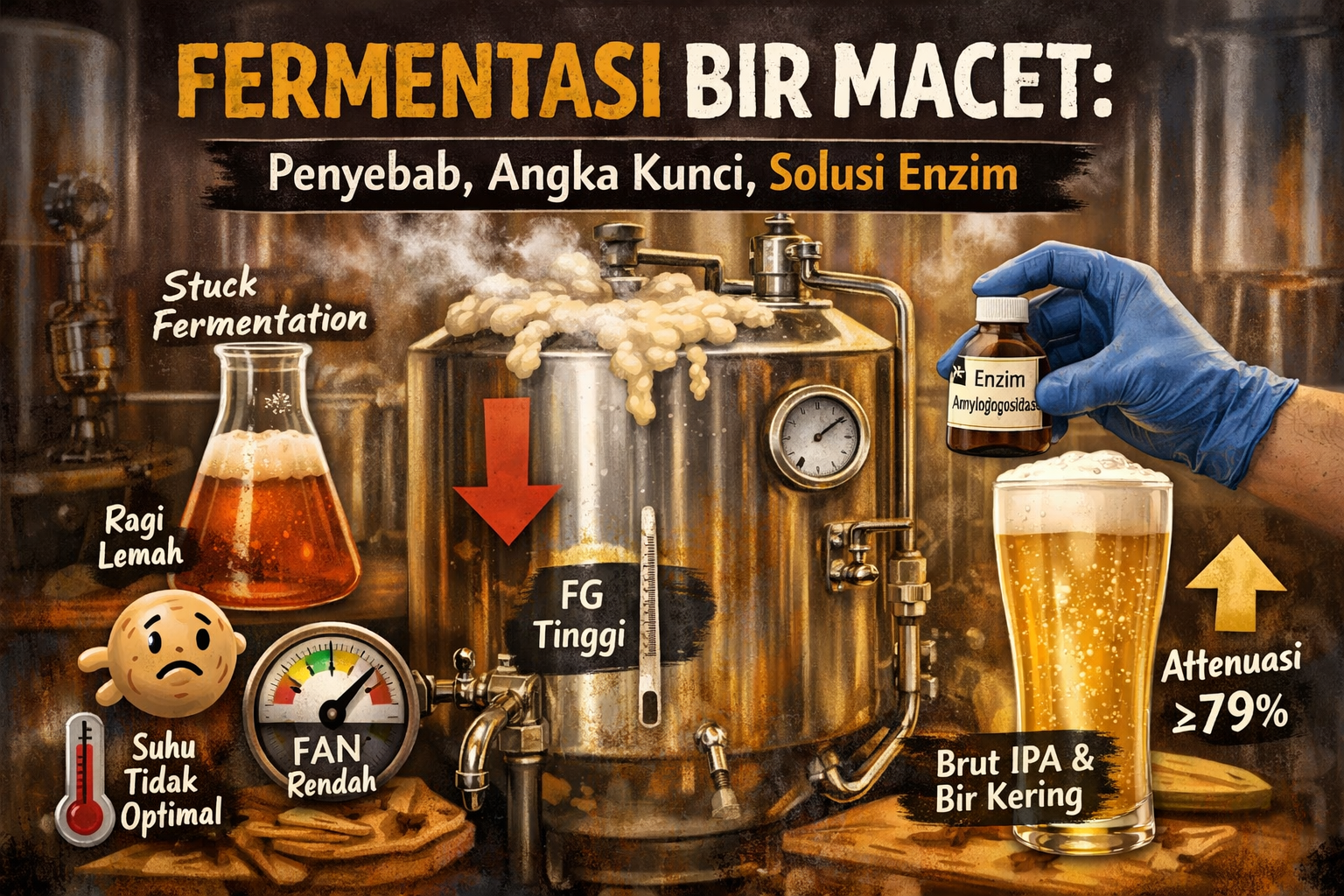
For intentional ultra‑dry finishes, brewers dose glucoamylase/amyloglucosidase in the fermenter. The enzyme hydrolyzes long‑chain dextrins to glucose after primary, letting yeast ferment sugars they otherwise cannot—how true Brut IPAs became possible. Industry guidance notes regular beers without enzyme seldom exceed ~70% RDF (real degree of fermentation), whereas a “Brut” target is ≥79% RDF, often yielding FG near 1.000 from an OG of 1.060 (iff.com). In practice, a moderate dose can add ~10+ points of apparent attenuation; one all‑malt Brut IPA trial finished near 1.000 versus ~1.005–1.010 without enzyme, producing an extremely dry beer, along with sharper body, increased effervescence, and often improved filterability and shelf stability (fewer residual sugars remain) (iff.com).
Industrially, enzymes such as IFF’s DIAZYME glucoamylase are dosed in fermenters or finishing tanks. Usage sits inside regulatory norms: Indonesian standards define beer as 0.5–8% ABV (alcohol by volume) from fermentation, with malt and hops primary, and explicitly permit adjuncts like rice, corn, sugar, and tapioca (id.scribd.com). By extension, treating the ferment with an enzyme preparation is generally considered a processing aid (not a labeled “ingredient”) under these definitions. Best practice is to document enzyme additions and final ABV, since extra fermentation slightly raises alcohol. Implementation is gravity‑led: after primary stalls, enzyme is added—often at 20–30°C for optimal activity—and gravity typically falls further over 1–3 days, delivering lower FG and higher ABV, e.g., ≈78–85% attenuation versus ~68–75% without enzyme (iff.com).
Benchmarks and guardrails
The data converge: under‑attenuation or stuck ferments stem from low wort fermentability (high dextrin or low enzymes), impaired yeast (poor pitch/nutrients/health), or adverse conditions (temperature, pressure, pH) (pubmed.ncbi.nlm.nih.gov; journals.asm.org). Actionable thresholds from practice: keep FAN ≳130 mg/L, maintain proper pitching at ≈1M cells/mL/°P, and hold fermenter parameters in range (mdpi.com). For ultra‑dry targets, amyloglucosidase reliably raises RDF from ~70% to ~79+% (iff.com).
These conclusions align with brewing datasets (see Table 1: journals.asm.org; journals.asm.org) and are reflected in regulation (BPOM No. 5/2021 permits adjuncts and processing to achieve the desired ABV/dryness: id.scribd.com).