

Industry: Landfill | Process: Leachate_Pre
Landfill leachate is not just concentrated—it is volatile in every sense. Reviews put chemical oxygen demand (COD, a measure of oxidizable organics) in the “hundreds to tens of thousands of mg/L,” even reaching ~70,000 mg/L in extreme cases (sciencedirect.com). Ammonium (NH₄⁺) can run up to ~2,200 mg/L, with total Kjeldahl nitrogen (TKN) reported in the tens of thousands mg/L (same source). One peer‑reviewed line puts it starkly: “the amount of pollutants in one ton of leachate is equivalent to the amount of pollutants found in 100 tons of urban wastewater” (pmc.ncbi.nlm.nih.gov).
The hydraulic picture is just as unruly. EPA guidance notes that “leachate generation (flow) varies greatly… daily fluctuations … can have a significant impact on design,” and that continuous systems “normally require some form of flow equalization” (nepis.epa.gov). Hong Kong’s SENT leachate facility sized for 1,500 m³/day added 22,000 m³ of buffering—about 15 days (~14.7 days) of retention—to absorb extreme wet‑season peaks (epd.gov.hk). In that catchment, flows ranged from ~23 to 1,500 m³/d, a ~65× swing (same source).
Influent variability and pollutant loads
Beyond dissolved contaminants, raw leachate can arrive with a heavy solids burden. Typical total suspended solids (TSS) run on the order of 10²–10³ mg/L; a documented case showed TSS ≈1,670 mg/L in the influent, with pipe scaling/clogging observed during conveyance (docslib.org). This mix of large debris, high TSS, and shock loads underscores why pretreatment has to be designed around mass load and flow variation.
Coarse debris screening equipment
The first line of defense is a coarse screen (bar or mesh) that intercepts trash, wood, rags, plastics, and other “literally garbage fragments” before they reach pumps or downstream units. Industry practice recognizes screening as “crucial … to remove objects such as rags, paper, plastics, and metals” (waterandwastewater.com).
Plants picking simple, rugged devices often lean on a manual screen to capture debris >1 mm where operations can tolerate raking. For continuous removal and fewer operator interventions, an automatic screen provides steady protection as part of the site’s physical separation train. Either way, capturing screenable material up front reduces wear and downtime and can lop off a substantial fraction of TSS.
Equalization volume and process control
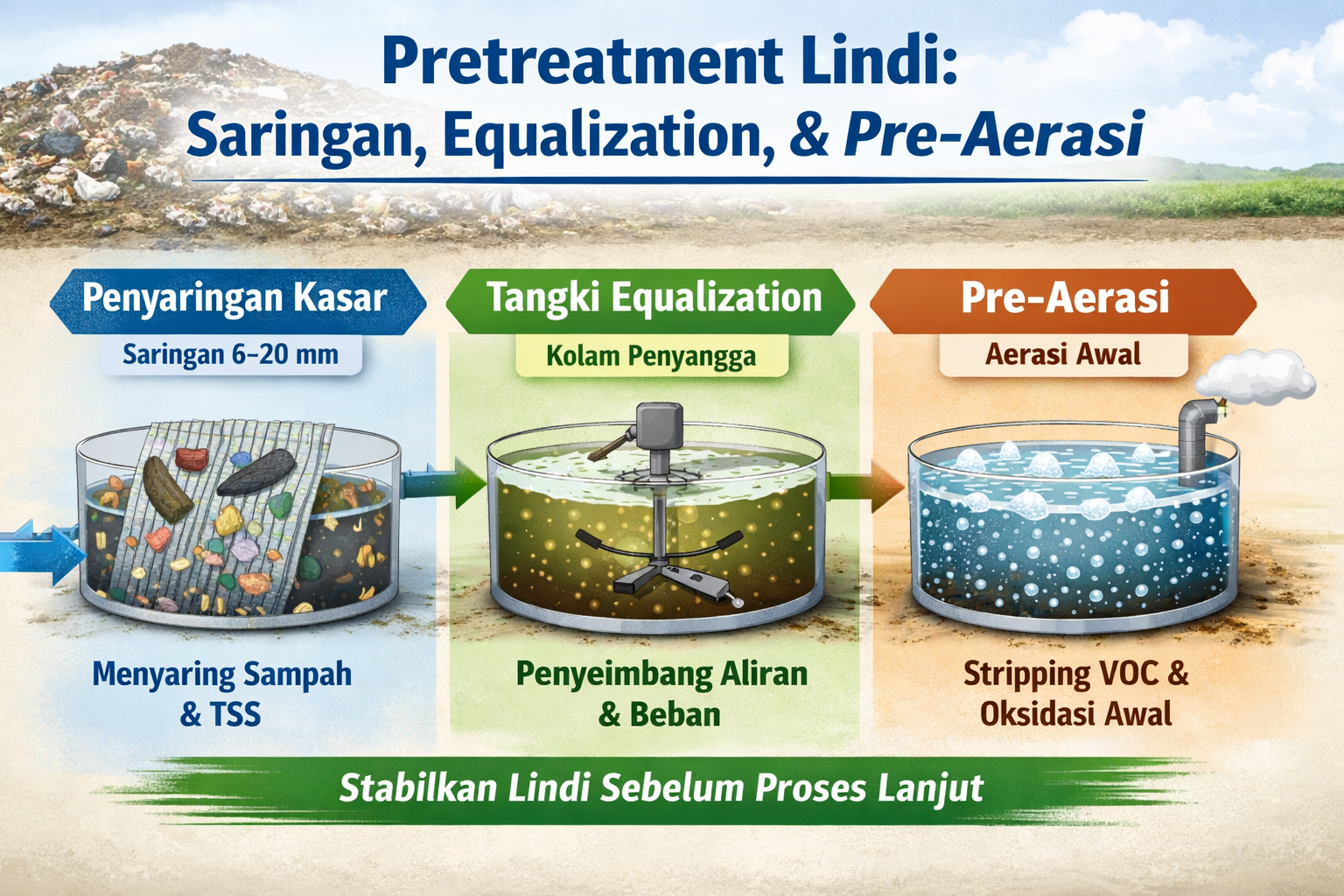
After screening, an equalization (EQ) tank with mixing averages the spikes in flow and composition so downstream biology sees a steady diet. The EPA’s call for equalization—“normally require some form of flow equalization”—is rooted in this stability dividend (nepis.epa.gov). Real‑world designs scale the buffer to local rainfall and generation patterns; at SENT, that meant 22,000 m³ against a nominal 1,500 m³/day, yielding roughly 15 days (~14.7 days) of storage to flatten a ~65× flow swing from ~23 to 1,500 m³/d (epd.gov.hk).
Equalization also creates a controlled environment for blending and chemistry. Facilities commonly meter acids/bases or nutrients into the EQ to temper pH excursions or balance carbon‑nitrogen ratios; a dosing pump can deliver these reagents accurately at variable tank levels. Practical features include a mixer and level control—site wastewater ancillaries that keep solids suspended and protect pumps—along with aeration where odor control is required to suppress anaerobic conditions.
Pre‑aeration for VOC stripping and biostimulation
A dedicated pre‑aeration step—often by aerating the EQ tank—pays off in two ways. First, aeration strips volatile organic compounds (VOCs, easily volatilized organics) and odorous reduced gases. Surveys show landfill leachate carries BTEX (benzene, toluene, ethylbenzene, xylenes) and other monoaromatics; their removal “increased with an increase in Henry’s constant” (a volatility indicator) during treatment (pubmed.ncbi.nlm.nih.gov). Because volatilized contaminants exit with the air, tanks should be covered or vented to a scrubber or biofilter to manage off‑gas.
Second, pre‑aeration raises dissolved oxygen and starts biological oxidation. In lab work on raw leachate (COD ~38,600 mg/L; BOD₅, or five‑day biochemical oxygen demand, ~24,000 mg/L), intensive aeration achieved 73% COD and 98% BOD₅ removal in 30 days (pmc.ncbi.nlm.nih.gov). Full‑scale gains are lower, but even short aeration knocks down readily biodegradable BOD and oxidizes reduced species: ferrous iron precipitates as Fe(OH)₃, sulfides are oxidized, and CO₂ stripping nudges pH upward. Some ammonia (NH₃) loss can occur if pH drifts up, though significant air stripping is limited without intentional pH adjustment.
Regulatory targets and design summary
Indonesia’s standards often set treated leachate limits at COD ≤300 mg/L and BOD ≤150 mg/L (legalcentric.com). Meeting those numbers reliably starts with pretreatment that is engineered for worst‑case days, not averages.
The resulting train is straightforward and data‑driven: (1) a coarse screen to strip debris and large particulates; (2) an equalization tank sized to site variability—Hong Kong’s 22,000 m³ buffer at 1,500 m³/day offers a useful benchmark for extreme wet‑season dynamics (epd.gov.hk)—with mixing, level control, and optional aeration; and (3) a pre‑aeration step to volatilize VOCs/H₂S and start biological oxidation. The combination protects equipment, smooths hydraulic and organic shocks, and reduces VOC/BOD load before the main treatment (pmc.ncbi.nlm.nih.gov; nepis.epa.gov; epd.gov.hk; pubmed.ncbi.nlm.nih.gov; pmc.ncbi.nlm.nih.gov; docslib.org).