

Industry: Nickel_Mining | Process: Extraction
On a busy nickel pit, unpaved haul roads can turn into particulate factories. The fine fraction—PM₂.₅ and PM₁₀ (particulate matter with aerodynamic diameters under 2.5 and 10 micrometers)—spikes fast with traffic. Water trucks and sprinklers still dominate the response, but their control window is fleeting: roads often need re-wetting every 30–60 minutes under heavy use (researchgate.net), and 60% or more of sprayed water can vanish to evaporation or runoff in hot, arid conditions (e-mj.com).
By contrast, chemical suppressants that bind or humidify road fines deliver longer, deeper cuts in dust—with documented water and maintenance savings. One large operation cut water trucks from 13 to 3 by adding chemical enhancement, saving about 400 m³ per day (e-mj.com). And upstream of it all, mines are testing water infusion—pre-wetting the ore body—where studies report 50–75% lower respirable dust on coal longwalls and about 75% reduction in open‑pit blasting plumes, pointing to source-level prevention (mdpi.com; researchgate.net).
Haul road watering cycles and efficiency
Plain-water sprays offer immediate control but short-lived impact. Field data peg re-wet intervals at roughly 30–60 minutes for surface-mine haul roads (researchgate.net). In hot, dry climates, 60%+ of that water can be lost to evaporation or runoff (e-mj.com), with typical removal on the order of 30–50% of airborne dust before the effect fades.
Chemical programs flip the equation. Hygroscopic chlorides like magnesium chloride (MgCl₂) and calcium chloride (CaCl₂) absorb ambient moisture and lock down fines; organic polymers and lignosulfonate (a binder from pulping) crust the surface. In controlled tests, MgCl₂ brine achieved ≈94–100% dust reductions (researchgate.net), while polymer surfactant solutions (7% polyethylene glycol, or copolymers) cut PM₁₀ by 87–91% versus deionized water (mdpi.com). Organized industry reports note 70–85% reductions on treated roads using polymer sprays in practice, with polymer crusts lasting about 7–14 days and lignosulfonate binding for 2–4 weeks (environusa.id).
The trade-offs are familiar: salts and lignos can corrode equipment or harm vegetation; many polymers (often biopolymers) are biodegradable. Life-cycle benefits can be significant—one site reported a wheel‑loader maintenance cost reduction of 40% and an ROI (return on investment) within ~5 months when switching to a polymer program (environusa.id). Several operations now combine methods—periodic chemical crusting supplemented by occasional watering—to balance efficiency and resource use.
Vendors align solutions to these regimes; for example, mines deploy hauling road dust suppressant to extend time between water passes and deepen PM control, rather than scaling up water truck fleets.
Chemical dosing and on-road application ranges
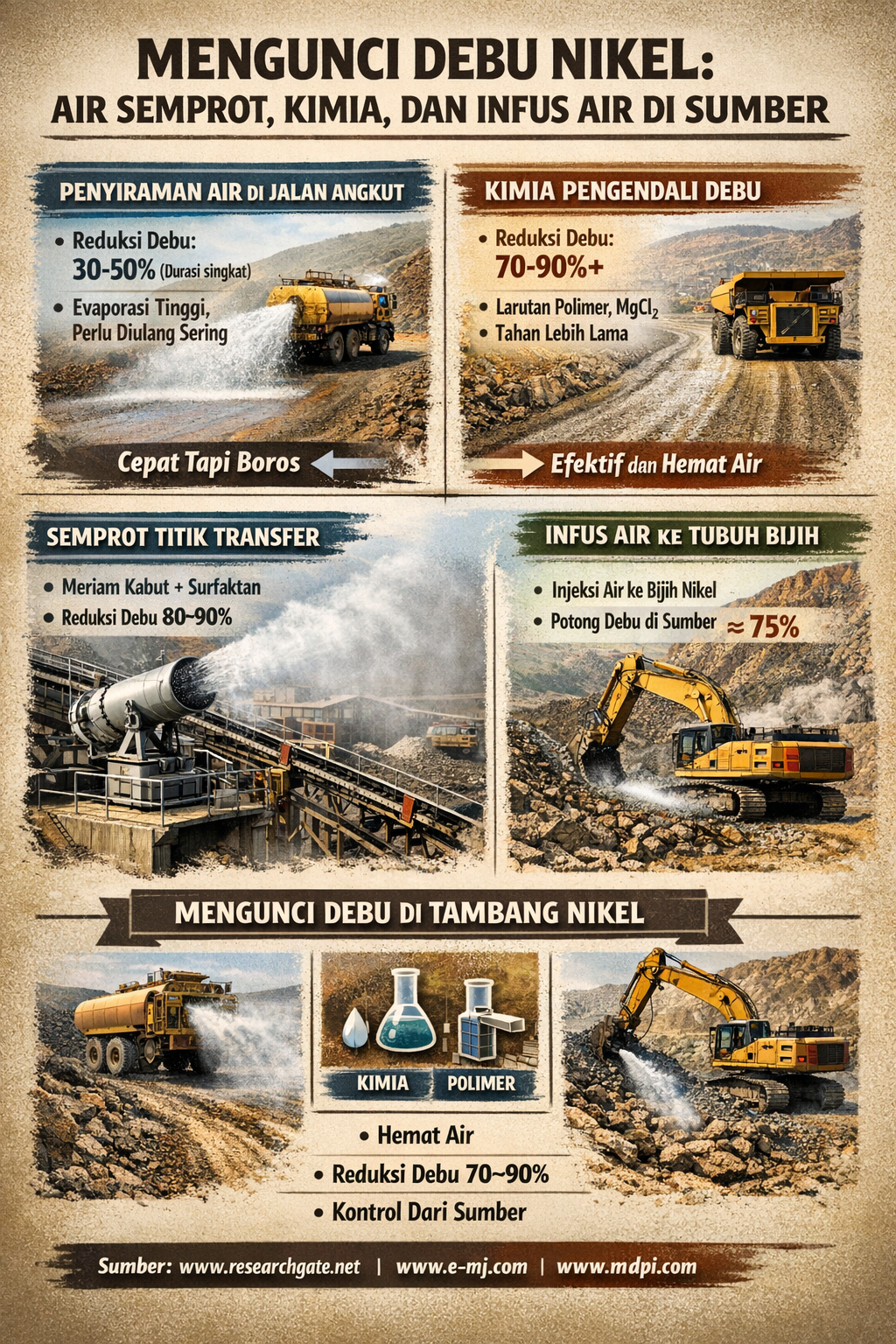
Application rates in the field sit in low single digits: operations report 0.5–2% MgCl₂ or 0.5–3% polymer mixes to achieve multi-day effectiveness and 80–90%+ capture potential (mdpi.com). In organized industry reporting, treated roads using polymer sprays delivered 70–85% dust reductions, polymer crusts of ~7–14 days, and lignosulfonate binding for 2–4 weeks, with the maintenance and ROI outcomes noted above (environusa.id). Where mines standardize chemical programs, some have reduced water trucks by ~77% (13→3), saving ~400 m³/d in one example (e-mj.com).
Procurement typically runs through mining chemical lines that include chloride salts, lignos, and polymers; operators consolidate these under a chemicals for mining applications program to align dosing, reapplication intervals, and corrosion management.
Transfer-point spray systems and surfactants
At conveyors, crusher feeds, and stacker drops, dust is localized and fast-moving. High‑pressure water sprays or fog cannons, often with surfactants or foam agents, remain standard because they can be tightly aimed and switched off to avoid runoff. Surfactant-enhanced sprays create smaller droplets and deeper penetration into the falling stream, so less water achieves the same control—Ecolab reports this effect in the field (e-mj.com). Well-aimed canons with chemical additives can capture 80–90% of dust at a transfer point (figures vary with design), and documented water savings of ~40–60% have been recorded when surfactants are used (e-mj.com).
Many fixed or portable fog systems now include moisture/humidity sensors to trigger sprays only during high-emission conditions (rain or no rain). Chemical suppressants are less common directly on moving material; instead, transfer points often rely on hoods and baghouses (dust collection units). In constrained areas, operators sometimes stabilize static surfaces—such as stockpiles or conveyor tails—with sprays containing MgCl₂ or lignosulfonate. One coal‑loading terminal reported ~89% capture at the loading chute using an MgCl₂ sprinkler array (environusa.id).
To control chemical ratios at sprays, sites standardize metering hardware such as dosing pumps—useful both for surfactants at transfer points and for chloride/polymer binders used in surface stabilization.
Water infusion of ore bodies (pre‑wetting)
An upstream tactic—water infusion—aims to prevent dust at its source by injecting water (with or without surfactant) into the ore body, blast holes, or coal seam before mining. By saturating pores and cracks, the broken rock emits much less dust. Early U.S. coal‑mine research reported 50–75% lower respirable dust at longwall faces under infusion (mdpi.com), and an open‑pit trial at Haerwusu coal used a “water bag” placed in drill holes to achieve about 75% dust reduction in blasting fumes (researchgate.net).
CFD (computational fluid dynamics) simulations and camera monitoring in that study confirmed that the surface plume dropped significantly when water was infused above the blast zone (researchgate.net). Translating to hard‑rock nickel mines, analogous pre‑blasting wetting could suppress drill‑and‑blast dust at source; simply spraying down bench walls or injecting water into blast mantles may limit fugitive dust. No large‑scale nickel case studies exist, but where dust control is critical, infusion is a candidate—studies report 75%+ gains and “tens of percent” reductions are plausible in similar conditions (mdpi.com; researchgate.net).
Comparative outcomes and adoption metrics
Across the case data, enhanced wetting outperforms plain water. Haul‑road spraying alone often yields only 30–50% PM reduction and must be repeated every hour (researchgate.net). Polymer or crusting methods achieve 70–90%+ per application in trials and field use (environusa.id; mdpi.com), while automated chemical systems have slashed water use—one operation cut water trucks by ~77% (13→3), saving ~400 m³/d (e-mj.com). MgCl₂ can approach complete control in lab testing (researchgate.net), though it will wash out in rain. In one Indonesian nickel mine trial, a biodegradable polymer spray lasting ~2 weeks per coat delivered a measured 72% reduction in airborne dust and reduced loader maintenance by 40% (environusa.id).
At transfer points, surfactant‑assisted sprays routinely capture 80–90% of dust, with water savings of ~40–60% when surfactants are used (e-mj.com). Overall, the evidence is consistent: enhanced wetting—via chemical agents or infusion—is far more effective than plain water at cutting fugitive dust (e-mj.com; researchgate.net; mdpi.com), a conclusion underpinning investment in chemical or infusion systems where water is scarce or health impacts are critical.
Many nickel operations are now moving to rigorous suppressant adoption—and even sensor‑driven dosing—to meet emission limits and protect workers. In practice, that means coupling targeted sprays and stabilization with programmatic chemical supply and metering (for instance, integrating dosing pumps into spray lines) and selecting binders from established mining portfolios (chemicals for mining applications) matched to road materials and rainfall.