

Industry: Aquaculture | Process: Wastewater_Treatment
Final effluent disinfection in aquaculture is a last gatekeeper against bacteria, viruses, and parasites — and it determines what gets discharged or reused. Chlorination with dechlorination, ultraviolet (UV) irradiation, and ozonation dominate the options. The contrasts are sharp: chlorine at 5–10 mg/L with roughly 15–30 minutes of contact can reach ≥4‑log (99.99%) virus inactivation (paperzz.com), while UV at 30–140 mJ/cm² (millijoules per square centimeter) typically delivers ~3–4‑log kill for bacteria and parasites but only ~1–3‑log for viruses (paperzz.com). Ozone at 0.5–2 mg/L with ~5–10 minutes contact often achieves ~3–4‑log virus and protozoa reduction (paperzz.com).
Those differences — plus capital, O&M (operations and maintenance), and byproducts — drive technology choice. The calculus shifts with flow rate (m³/d), water quality (turbidity, UV transmittance, ammonia, salinity), and local permits.
Chlorination and dechlorination performance
Mechanism and dosing: Chlorination (Cl₂ gas or NaOCl solution) forms hypochlorous acid (HOCl) in water, which oxidizes cell membranes and DNA (fao.org). Typical effluent doses span 5–40 mg/L Cl₂, driven by ammonia and chlorine demand; ≈2–8 mg/L often suffices after good biological treatment, while amine‑laden or septic waters can need up to 40 mg/L (fao.org). Contact time of ≥15 minutes (often ~30 minutes) is standard to reach “breakpoint” (oxidizing ammonia to establish a free chlorine residual) (fao.org) (fao.org). After breakpoint, even 0.2–1 mg/L free Cl₂ is commonly maintained (fao.org).
Effectiveness: At 5 mg/L for 10–15 minutes, chlorine can kill >99.99% of viruses (~4‑log) and Giardia cysts (paperzz.com). Organics and ammonia, however, consume chlorine and form chloramines (weaker disinfectants) (fao.org). Chlorine is less effective on tough protozoa (e.g., Cryptosporidium) without high dose/time. Residual chlorine >0.2 mg/L is harmful to fish; residual Cl₂ has been identified as a main toxicant reducing downstream fish diversity (fao.org). Many jurisdictions cap residual Cl₂ at <0.5–1 mg/L for discharge (fao.org), making dechlorination standard practice.
Costs: Capital is low (simple contact tanks), energy needs are minimal, and chemical dosing is straightforward with an accurate dosing pump. Gas chlorine is cheapest: treating 1 MGD (~3,785 m³/d) at 1 mg/L costs about $2,818/year (≈$2.04/kg Cl₂) (hydroinstruments.com). Hypochlorite solutions run 2–3× more per unit Cl₂ (hydroinstruments.com). On a per‑m³ basis, large plants can see ≈$0.02/m³ at 5 mg/L (paperzz.com), while small flows (<100 m³/d) can jump to tens of cents per m³ — e.g., ~$0.75/m³ at ~90 m³/d and ~$0.68/m³ at ~100 m³/d for a 5 mg/L dose (paperzz.com). Dechlorination (e.g., sodium bisulfite) adds cost if residuals are forbidden.
Byproducts and hazards: Chlorination creates disinfection byproducts (DBPs) — trihalomethanes (THMs), chloramines, haloacetonitriles — when reacting with organics and ammonia. DBPs can be toxic to aquatic life, and chronic exposure to chlorinated effluents has been linked to fish kills and reduced biodiversity (fao.org). Handling chlorine entails gas toxicity and corrosion risks. For compliance, a dechlorination agent is typically applied to meet residual limits.
UV sterilization dose and clarity constraints
Mechanism and dosing: UV disinfection (254 nm) inactivates microbes by damaging DNA/RNA as water passes the reactor; there is no holding time requirement. Recirculating aquaculture systems (RAS) commonly apply 30–50 mJ/cm². For bacteria and protozoa, ~40 mJ/cm² often yields >3‑log kill of Giardia/Cryptosporidium; adenovirus and other hardier viruses can require ~140 mJ/cm² for ~3‑log inactivation (paperzz.com). Water clarity is critical: high UV transmittance (>90%T at 254 nm) is ideal, so pre‑filtration to remove shielding solids is standard.
Effectiveness: UV reliably inactivates bacteria, algae, and chlorine‑resistant parasites, without interactions from pH or ammonia. It leaves no residual — meaning no downstream protection and a potential for re‑contamination unless water is used immediately or re‑chlorinated. Efficacy hinges on turbidity; pre‑clearing with media such as sand filters and activated carbon is commonplace (paperzz.com). One practitioner in Indonesia noted that integrating a sand filter with UV “maximizes effectiveness” (blueseavn.net). Fine debris ahead of UV is often captured by an automatic screen to stabilize clarity.
Costs: UV reactors carry higher capex (housing, ballasts, controls) but low chemical O&M. Lamp power for low‑pressure units is commonly ~30–50 W at small flows. At ~100 m³/d and 40 mJ/cm², costs are about $0.05/m³; at ~6,814 m³/d, UV runs ~$0.01–0.03/m³ (paperzz.com) (paperzz.com). Lamps are replaced roughly every ~9,000 hours; quartz sleeve cleaning is an ongoing task. Lifecycle cost is often lower than chlorine at small scales, with added benefits from avoiding hazardous chemical handling (waterworld.com) (paperzz.com).
Environmental and safety: UV produces no chemical DBPs and leaves no residual, making discharge and reuse straightforward for receiving waters (waterworld.com). Lamps contain mercury and must be disposed properly. For equipment context, aquaculture sites often specify reactors like those under ultraviolet systems to meet dose targets.
Ozonation oxidation strength and bromate risk
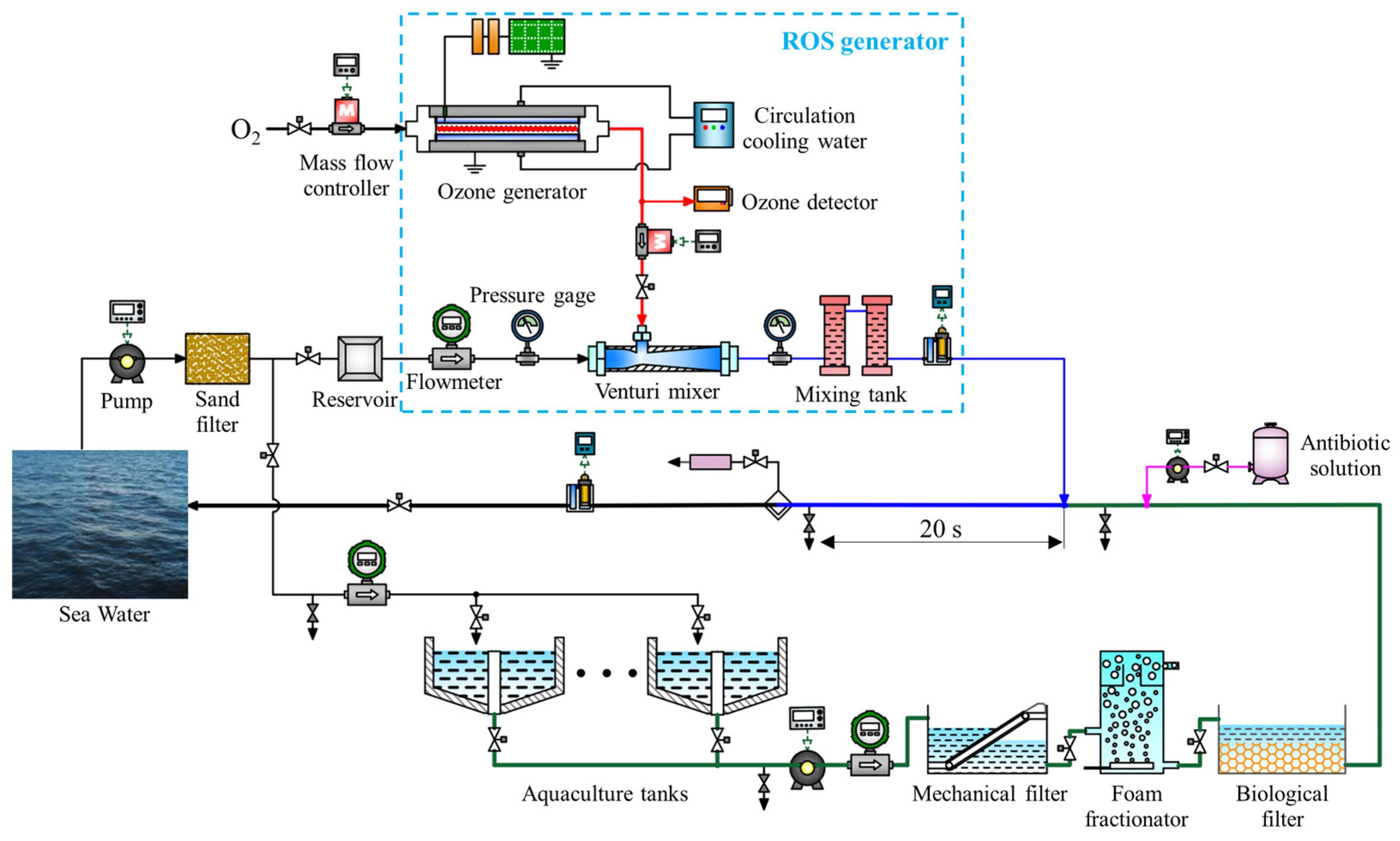
Mechanism and dosing: Ozone (O₃) is generated on‑site (corona discharge from oxygen/air) and injected into water to rupture cell walls and oxidize organics. Typical dosing is 0.5–2 mg/L with ≥5–10 minutes contact; even 1 mg·min/L (mg/L × minutes) can deliver >4‑log virus and ~3‑log Giardia inactivation (paperzz.com). Disinfection is largely unaffected by ammonia or pH, though high organics consume ozone. Ozone can oxidize ammonia to nitrate and reduce odors and color (fao.org).
Effectiveness: Broad‑spectrum kill spans bacteria, protozoa, viruses, and resilient phages, with successful use in RAS to reduce pathogen loads, odor, and biofouling (researchgate.net). Efficient gas diffusion and mixing are essential. Over‑dosing is dangerous: dissolved ozone can off‑gas and damage fish gills unless degassed or quenched (e.g., with activated carbon).
Costs: Ozone systems carry the highest capital and energy use of the three. Generators and oxygen concentrators are costly, with energy roughly ~1–10 kW per gO₃/h depending on design. At ~100 m³/d and 1 mg/L, disinfection has been estimated at $0.07/m³) at that scale (paperzz.com). Large plants can gain some economy but ozone generally remains costlier. A positive: ozone decomposes to oxygen, raising dissolved O₂ (beneficial for receiving waters) (fao.org).$0.84/m³ — higher than chlorine ($0.68/m³) and UV (
Environmental and safety: In brackish/sea water rich in bromide, ozonation forms bromate (BrO₃⁻) and bromoforms — bromate is a regulated carcinogen in drinking water, though aquatic toxicity is generally low except at high doses (researchgate.net) (researchgate.net) (researchgate.net). Dose/pH control is used to limit bromate (often ≤0.5 mg/L BrO₃⁻ minimizes risk) (researchgate.net), and toxic byproducts can accumulate if residence time is long (researchgate.net) (researchgate.net). At normal aquaculture doses these remain trace but warrant monitoring. Ozone off‑gassing is explosive, so reactors are closed and excess ozone is destroyed (e.g., catalytic destructor) before air release.
Comparative metrics and selection factors
- Chlorination: Costs can be ~$0.02/m³ at large scale and ~$0.5–0.8/m³ at small scale; at ~100 m³/d and 5 mg/L, ~$0.68/m³ is cited (paperzz.com). Log‑kill: often >4 for bacteria and viruses at 5–10 mg/L; limited on protozoa (paperzz.com). Byproducts: THMs, chloramines; residual Cl₂ must be removed due to aquatic toxicity (fao.org).
- UV sterilization: Costs ~ $0.01–0.07/m³ depending on scale (e.g., ~100 m³/d ~ $0.05–0.07/m³ at 40 mJ/cm²; ~6,814 m³/d ~ $0.01–0.03/m³) (paperzz.com) (paperzz.com). Log‑kill: ~3–4 for bacteria/Giardia; ~0.5–3 for viruses, dose‑dependent (paperzz.com). Byproducts: none; sensitive to turbidity; no residual.
- Ozonation: Costs roughly ~$0.3–0.8/m³ depending on scale, e.g., ~$0.84/m³ at 100 m³/d for ~1 mg/L (paperzz.com). Log‑kill: ~3–4 for viruses/Giardia (paperzz.com). Byproducts: bromate/bromoforms in saline/brackish waters; raises O₂; dissolved O₃ is dangerous to fish if not quenched (researchgate.net).
Operational drivers: flow, quality, and permits
Flow rate and scale: For small farms (<100 m³/d), UV often wins on cost‑effectiveness and simplicity (paperzz.com). At larger flows (>1,000 m³/d), chlorine’s economics strengthen substantially (paperzz.com). Ozone seldom wins on cost alone but is justified for superior oxidation (e.g., heavy organics or reuse).
Water quality: High turbidity/TSS or color undermines UV and demands pre‑treatment to improve UV transmittance, commonly via media filtration and clarification. Many facilities employ a clarifier or DAF unit upstream before UV. Chlorination and ozonation tolerate particulates better, though both see higher demand in dirty water. High organics favor ozone (oxidizes COD), while chlorine’s DBPs increase with organics. Ammonia pushes chlorine toward chloramine formation (weaker), while ozone can oxidize ammonia to nitrate. In saline/brackish waters with bromide, ozone drives bromate formation (see above); chlorine converts bromide to bromine bleach with different implications.
Regulatory requirements: In Indonesia, general wastewater standards (e.g., Permen LH) emphasize low BOD, COD, TSS and may require coliform/E. coli below threshold (often <1000 CFU/100 mL for class C or similar) and no toxic chlorine residual. Many jurisdictions explicitly forbid detectable chlorine in discharge. UV and ozone readily meet strict biological criteria (no disinfectant residuals), while chlorination requires effective dechlorination to meet typical <0.5–1 mg/L residual limits (fao.org). For reuse (e.g., irrigation or pond refill), UV/ozone align with non‑chemical goals and “zero liquid discharge” approaches (waterworld.com) (blueseavn.net).
Operational considerations: If skilled maintenance is limited, UV’s automated operation and lack of bulk chemicals are advantages (waterworld.com). Chlorine requires careful storage and dosing; hypochlorite degrades with heat. Ozone demands robust controls, monitors, and safe degassing. UV and ozone both require continuous power; backup generation is advisable. Pathogen profile matters: UV is strong against protozoa (e.g., Cryptosporidium) that challenge chlorine; chlorine excels on viruses; ozone is broad‑spectrum but requires careful gas transfer.
Guide to technology choice and hybrid trains
- Low flow, high biosecurity: UV is often favored for small RAS or hatcheries (tens of m³/d), avoiding chemicals while achieving high pathogen kill; ensure pre‑filtration and lamp maintenance. Systems like those under ultraviolet are commonly specified.
- Large flow, low cost priority: Chlorination plus dechlorination can meet basic coliform limits at low $/m³ (paperzz.com) (fao.org). Gas chlorine is far cheaper than hypochlorite (hydroinstruments.com). Accurate dosing via a dosing pump and residual removal with a dechlorination agent are standard practice.
- Sensitive receiving waters or reuse: UV or ozone avoid toxic residuals entirely, protecting downstream life and supporting reuse (fao.org) (waterworld.com).
- High organic/algal loads: Consider ozone, potentially paired with UV. Ozone oxidizes organics and improves clarity, enhancing subsequent UV. Bromide content must be checked to limit bromate formation.
- Regulatory strictness: If permits require no detectable chlorine and stringent pathogen limits (e.g., near public intakes), UV/ozone are preferable. If general disinfection and allowed chlorine residuals with dechlorination suffice, chlorine remains viable.
Hybrid examples are common: upstream media like sand filtration to reduce turbidity, then a UV pass, and a low‑dose chlorine or ozone polish before discharge. For fine polishing ahead of UV, some operators add a cartridge filter to capture remaining particulates.
Trendlines and next steps
Globally, aquaculture is trending toward non‑chemical disinfection. Indonesian shrimp farms report shifting from chlorine to UV for “enhanced biosecurity” and lower long‑term cost — “the total cost of using chlorine…in his two farming cycles is nearly equal to the initial investment in the UV system” (blueseavn.net). Research groups such as Nofima/CtrlAQUA are refining dose‑control methods to cut UV energy use (thefishsite.com). Yet chlorination remains prevalent in many regions due to familiarity and capital constraints.
Bottom line: selection depends on scale, water chemistry, and permits. Small, high‑value operations lean to UV (or UV plus ozone); large, cost‑sensitive facilities often opt for chlorination with careful dechlorination. Ozonation fits niche needs around high COD and organics control or ultra‑clean effluent. A pilot trial and lifecycle cost analysis — tuned to local turbidity, ammonia, salinity, and required log‑kills — are recommended before committing (paperzz.com) (blueseavn.net).