

Industry: Coal_Mining | Process: Dust_Suppression_Systems
In underground coal mines, the first line against respirable dust (fine particles small enough to reach deep into the lungs) is simple: wet it at the source and sweep it away. Field trials show that relocating and tuning water sprays on mining equipment can slash operator exposures by 40–60%, while higher, well‑directed ventilation velocities continue to dilute what’s left (cdc.gov) (cdc.gov).
The conveyor gallery and the longwall face—once notorious dust hotspots—are now yielding to straightforward controls: low‑pressure, high‑flow sprays where coal fractures, enclosure and exhaust at transfer points, and intake air that actually keeps up with modern cutting rates (toxicdocs.org) (researchgate.net).
Continuous miner spray configuration
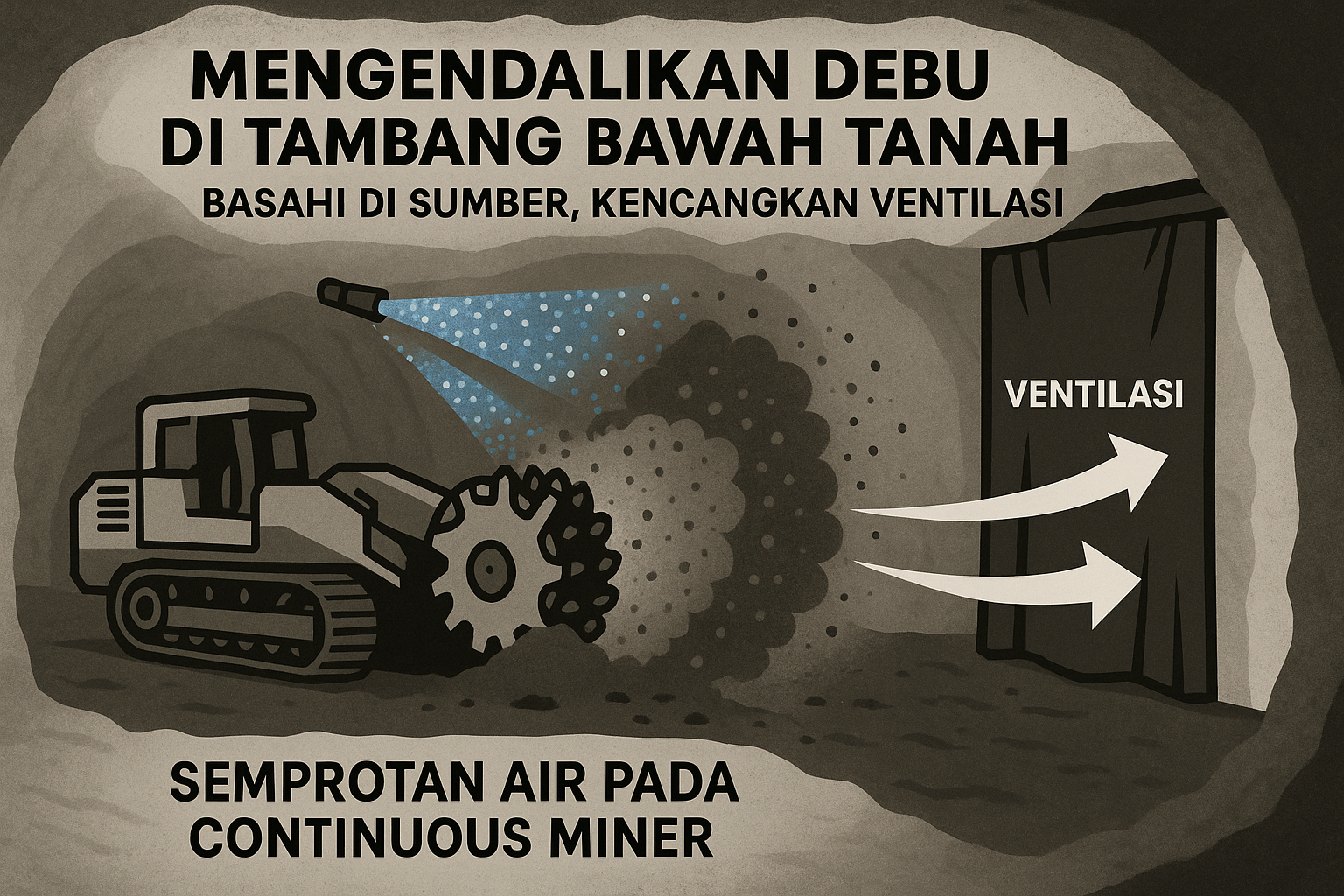
At the mining face, equipment‑mounted sprays do the heavy lifting. On continuous miners, moving flat‑fan nozzles to the boom top and adding low‑pressure, high‑flow “deluge” sprays under the boom—about 7 psi (pounds per square inch) and 5 gpm (gallons per minute) each—reduced the operator’s respirable dust by roughly 40% versus factory setups (cdc.gov).
Adding high‑pressure (~100 psi) sprays at the miner’s rear corner—on the side away from the main ventilation curtain—helped sweep under‑boom dust back into the return airway (the exhaust side of face ventilation) and further cut respirable dust by ~60%, virtually eliminating quartz exposures (cdc.gov). By contrast, newer “wet‑head” miners that spray only at the cutting drum have so far shown no consistent improvement in dust levels (cdc.gov), likely because most dust is liberated when coal fractures, not simply from drum passage.
Spray reliability matters in harsh headings; projects often specify supporting equipment around spray circuits, including water treatment ancillaries to keep flow and pressure stable in industrial conditions.
Longwall shearer spray strategy
On longwalls, the shearer generates more than 50% of face dust, so drum‑level wetting is essential (cdc.gov). Full‑cone sprays inside the rotating drum apply water directly at coal fracture; NIOSH recommends modest pressure of ~80–100 psi for these sprays (cdc.gov).
Above 100 psi, the high‑velocity mist actually raised operator dust by ~25% in tests (cdc.gov). A “shearer‑clearer” bank of downwind‑oriented sprays mounted on the shearer body augmented face airflow and cut the operator’s dust by ~50% when cutting crosswise to the face ventilation, and by ≥30% in normal cutting (cdc.gov). Across both miner types, flat‑fan or solid‑cone nozzles with large orifices—high water flow at moderate pressure—wet and capture dust without entraining excess air (cdc.gov) (cdc.gov).
Where spray manifolds run at sustained pressures, engineers commonly pick robust hardware such as steel filter housings to protect nozzles and maintain consistent spray patterns.
Conveyor transfer‑point controls
Conveyor transfer points (where coal drops between belts or chutes) are prolific dust sources. Best practice is contain and suppress: enclose the transfer and exhaust its air. Design guidelines suggest extracting roughly 350–500 scfm (standard cubic feet per minute, meaning flow measured at standard conditions) per foot of belt width, with hood/duct velocities of ~400–500 ft/min, which stabilizes a control velocity inside the hood of ~100–150 ft/min (toxicdocs.org).
In practice, engineers often oversize extraction (4–5× old “rule‑of‑thumb” values) so coal‑induced airflow is fully exhausted upstream rather than spilling into the gallery (toxicdocs.org). Water sprays or water curtains at the drop knock down dust before it escapes, but sprays should be low‑pressure, high‑flow and aligned to wet the falling cloud—misaligned high‑pressure sprays can shatter lumps into more fines. Handbooks emphasize that control is fundamentally about wetting: most shearer‑generated dust adheres to the cut coal surface and will only become airborne if not wetted (researchgate.net). Vanderbilt tests showed that wetting coal at Stage Loaders captured far more dust than using high‑pressure sprays in open air (researchgate.net).
In sum, effective transfer‑point control in underground mines typically combines enclosure plus extraction—at least ~400 ft/min of airflow—with strategic spray wetting, a combination that often cuts fugitive dust by 50–80% when properly applied (toxicdocs.org).
Longwall face ventilation and dilution
Once dust is generated, ventilation—directed air movement for dilution—does the rest. On longwall faces, historical minimum air velocities of ~400–450 ft/min carry dust down the face; under ideal moisture, ~700–900 ft/min further improves wetting and dilution (cdc.gov). NIOSH surveys of modern faces show an average intake of ≈67,000 cfm (cubic feet per minute; ≈665 ft/min velocity) across the longwall—about a 65% increase over flows typical in the 1990s—and experiments found that pushing speeds up to ~1200 ft/min continued to reduce respirable dust (cdc.gov) (cdc.gov).
The takeaway is to maximize fresh air at the face while ensuring well‑directed flow (often a sweeping intake curtain toward the face). Higher velocities confine dust near the gob (the caved area behind the face) and improve dilution, provided the coal is properly wetted to prevent re‑entrainment (cdc.gov).
Room‑and‑pillar ventilation layouts
In room‑and‑pillar workings with continuous miners, ventilation layout drives exposure. “Blowing” ventilation (fresh air sent onto the face from behind a brattice curtain, a temporary partition used to direct airflow) tends to sweep dust and methane from the face more effectively than “exhausting” ventilation (pmc.ncbi.nlm.nih.gov).
Blowing schemes must be paired with good on‑board dust collection (mechanical scrubbers and sprays), because otherwise dust can bypass the scrubber and escape into the return airway (pmc.ncbi.nlm.nih.gov). Exhausting ventilation can concentrate contaminants near the operator if not all air is captured, and studies found higher operator exposures when misoriented crosscuts caused intake to bypass the scrubber or reverse airflow (pmc.ncbi.nlm.nih.gov) (pmc.ncbi.nlm.nih.gov). Practically, operators align ventilation, favor blowing where possible, and ensure sufficient flow—MSHA typically requires ≥6,000 cfm to each continuous miner face (pmc.ncbi.nlm.nih.gov).
Mine‑wide airflow and monitoring
Downstream of the face, general mine ventilation—fans, regulators, stoppings, and airflow balance—further dilutes residual dust. Primary fans must meet both methane and dust targets; many designs specify dozens of air changes per hour or minimum velocities in intake entries (typically 100–200 ft/min) to keep concentrations low.
Automated monitoring is increasingly common. Continuous personal dust monitors alert in real time; if a monitor alarms, ventilation can be adjusted (by throttling regulators or diverting air) and sprays turned up automatically to restore conditions.
Regulatory thresholds and business impact
Regulatory limits set the bar. In Indonesia, Ministry of Manpower Regulation Permenaker 13/2011 sets an occupational limit of 10 mg/m³ for general (inhalable) dust that does not contain significant silica or asbestos (spn.or.id). Underground coal regulations typically adhere to much lower respirable limits—many countries cap respirable coal dust at ~1.5–2.0 mg/m³, with a separate 0.1–0.05 mg/m³ limit for crystalline silica—so meeting these levels requires aggressive engineering controls.
For decision‑makers, the reductions are quantifiable: a single continuous miner spray layout change cut exposures ~40–60% (cdc.gov), and multi‑nozzle longwall systems achieved 30–50% reductions (cdc.gov). These halving of exposures can be the difference between compliance and costly citations or health liabilities.
Across the face, the conveyor, and the mine’s entries, the playbook is consistent: water at the fracture point, enclosure plus extraction at transfer points, and airflow that actually carries dust away. When spray circuits are part of the plan, specifying accurate feed and protection hardware—dosing and filtration included—remains standard practice in industrial water systems, from dosing pumps to filtration components that keep nozzles on‑spec.
Sources: NIOSH’s engineering controls database for coal mining (continuous miner and longwall face systems) (cdc.gov) (cdc.gov) (cdc.gov); field studies of mining operations (pmc.ncbi.nlm.nih.gov) (researchgate.net); ventilation design literature (toxicdocs.org) (toxicdocs.org). All citations above correspond to the evidence on spray/ventilation performance, airflow targets, and dust reductions presented here.