

Industry: Aquaculture | Process: Feeding_Systems
Feed is the biggest line item in aquaculture — typically 50–60% of total production cost (scielo.br). So when stronger pellets translate into better feed conversion ratios (FCR), the math moves fast. In classic shrimp trials, diets with robust binders posted FCR as low as 1.46:1 versus 2.12:1 for less‑stable formulations — roughly a 30% improvement, or nearly one‑third less feed per kilogram of growth (researchgate.net).
Return on investment can be startlingly simple: one study’s least expensive binder cost $4.41 per tonne of feed (researchgate.net). For a farm using 1,000 tonnes a year at $500/tonne, spending $5,000 on binder can unlock a 10% FCR gain worth $50,000 in saved feed. And the wins do not stop at feed silos; tougher pellets also drive down oxygen demand and sludge in the water column, with knock‑on savings in aeration and clean‑outs (globalseafood.org).
Binder and coating chemistries
Specialty aquafeed binders (materials added to keep pellets intact) and coatings (edible layers that can act as moisture barriers and carry attractants) target water stability and mechanical durability — the pellet’s resistance to softening, break‑up, or abrasion. The toolbox spans natural starches and gums (corn, tapioca, potato starch; wheat gluten; guar gum; gelatin; carrageenans; alginates; chitosan) and synthetic polymers (polyacrylamides, polyvinyl alcohol, carboxymethylcellulose, lignosulfonates) (openknowledge.fao.org).
Coatings often layer lipids or proteins with appetitive additives — fish oil, protein hydrolysates, amino acids, betaine — to boost palatability. Reviews note common use of attractants like free amino acids, nucleotides, betaine, and organic acids to enhance taste/smell and drive intake (edis.ifas.ufl.edu). In practice, mills trial 0.5–5% inclusion of binders/coatings during extrusion or pelleting to hit target pellet strength.
Pellet integrity and nutrient leaching
Trials are clear: high‑performance binders reduce pellet disintegration and nutrient leaching. In shrimp feed, 5% sodium alginate or 5% wheat gluten delivered the best water stability and the lowest protein leaching (onlinelibrary.wiley.com). A comparative four‑hour immersion of 12 commercial binders showed urea–formaldehyde binders (Compact‑PBX, Maxi‑Bond) and hydrophilic natural polymers (Hydro‑Gard) yielding the highest protein retention in soaked pellets (researchgate.net), with top performers such as Agrimer Mix and Maxi‑Bond H₂O far outpacing controls in maintaining pellet structure (researchgate.net) (“PBX were the only two … diets containing binders, compared to”).
Even simple polysaccharides work: experiments with 2% pectin or chitosan reported “best water stability” in crayfish feed (researchgate.net) (see also onlinelibrary.wiley.com).
Quantitative stability gains
High‑grade binders can more than halve pellet breakage and fines. A 2% chitosan coating cut the pellet water‑solubility index (share of pellet mass dissolving during immersion) from about 27% down to about 10% — roughly 60% less dry material lost — while dropping the vitamin C diffusion coefficient in seawater from 1.10×10⁻¹⁰ to 1.20×10⁻¹¹ m²/s (researchgate.net) (researchgate.net).
One Malaysian study reported that adding 20% maltose binder raised initial 15‑minute water stability to about 90% versus 94.7% in control; more importantly, it markedly reduced protein and lipid leaching over time (researchgate.net) (researchgate.net). In summary across studies, high‑performance binders/coatings can boost short‑term pellet stability (15–60 minutes) from roughly 80–85% up to 90–95% retention, and keep more than 90% of proteins and lipids in the pellet versus 70–80% without binders.
Without adequate binding, pellets can crumble in minutes, generating fines and dust, wasting feed, and releasing ammonia and phosphate into the water. Control pellets (no binder) showed significantly more nutrient leaching than binder‑treated pellets in Dominy et al., with the best binders retaining significantly more protein over four hours of soaking (exact retention rates for control vs. binder were not reported, but trends were clear) (researchgate.net).
Palatability and intake drivers
Coatings also improve palatability. Adding attractants — fish or shrimp hydrolysates, amino acids, betaine, organic acids — helps mask the blandness of plant‑heavy diets and stimulates feeding (edis.ifas.ufl.edu). As summarized by Roda et al. (2024), attractant use “incorporates attractive chemical molecules into [the] feed, enhancing voluntary feed intake, weight gain, and nutrient absorption” (edis.ifas.ufl.edu).
Quantified lifts vary by species, but tilapia diets coated with amino‑acid attractants have shown significantly higher consumption and daily weight gains versus uncoated feed, typically around a 5–15% lift (edis.ifas.ufl.edu). Weaners and juveniles tend to respond strongly, which indirectly improves FCR (“increased intake results in a faster growth rate and improved survival” in culture animals) (edis.ifas.ufl.edu).
Economics and water‑treatment load
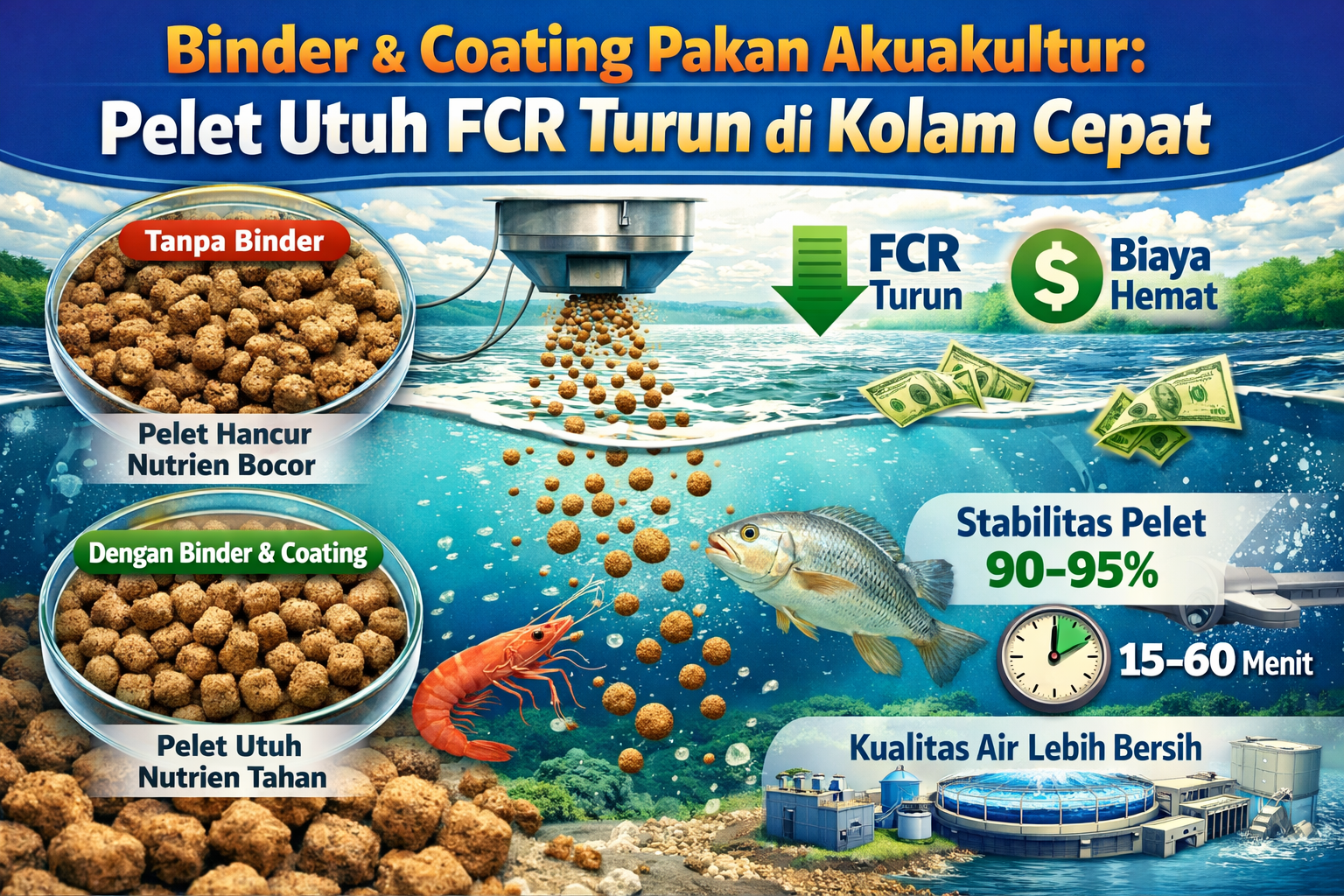
With feed at 50–60% of total cost (scielo.br), even modest FCR gains from better pellet quality move the P&L. The 1.46:1 vs 2.12:1 FCR reported by Dominy et al. (2003) underscores the scale of potential savings (researchgate.net). If feed is 60% of costs, trimming FCR by ~0.5 can cut total costs by roughly 15–20%.
There is also a water‑quality dividend. Each tonne of production imposes oxygen demand of about 1.1–1.5 tonnes (1,100–1,500 kg) as wastes are broken down (globalseafood.org). By stabilizing feed, binders lower that waste load. In ponds, less feed spoilage means lower ammonia/nitrate buildup and reduced sludge — saving power for aerators and expenses for clean‑outs or water exchange. In intensive shrimp farms, better feed stability often allows lower aeration rates or feeding densities while maintaining water quality.
Manufacturing and QA parameters
Implementation is straightforward. Mills can trial binder levels and run standardized assays such as Pellet Durability Index (PDI, a measure of mechanical strength) and water‑stability tests to hit benchmarks like PDI >90% and pellet disintegration <5% in 30–60 minutes. Effective inclusion levels often fall around ~2–5% (e.g., ~2% alginate or gluten, or 0.5–2% commercial polymer) (onlinelibrary.wiley.com) (researchgate.net).
Coatings that carry attractants — lipid blends, marine hydrolysates, amino‑acid mixes — are typically applied post‑extrusion; many mills use precision liquid application equipment such as a dosing pump to control rates and uniformity. For economics, manufacturers and farm managers track FCR before/after binder adoption and factor in the ~60% feed‑cost share — even 5–10% FCR gains tend to cover a few dollars per tonne in additive cost (scielo.br). On farm, monitoring ammonia and turbidity helps document reduced treatment inputs as feed stability improves.
Source notes and scope
Comparative trials and reviews — Argüello‑Guevara et al., 2013 (onlinelibrary.wiley.com); Dominy et al., 2003 (researchgate.net) (researchgate.net); global reviews (edis.ifas.ufl.edu) (researchgate.net); FAO/industry data on binder classes (openknowledge.fao.org); cost shares (scielo.br); and effluent oxygen demand (globalseafood.org) — collectively show that modern binders/coatings boost pellet quality and reduce nutrient loss, yielding measurable improvements in FCR and pond management.