

Industry: Semiconductor | Process: Wafer_Cleaning_&_Etching
Advanced logic and memory flows now pack in hundreds of cleaning steps—200+ in leading-edge fabs—to remove photoresist residues and etch byproducts, all while preserving ultra-delicate 3D structures (siliconsemiconductor.net). At these geometries, “a contaminant of just a few nanometers won’t show up on standard in‑line metrology”—but it can still kill yield—so inspection has to go offline to SEM or TEM when necessary (semiengineering.com).
The stakes are brutal. Industry studies estimate ~75% of yield detractors come from particles (sst.semiconductor-digest.com). On a 90 nm node, 0.17–0.33 µm particles sit in the critical regime; at 3 nm, a 1 nm particle is now “a killer” on a fin (sst.semiconductor-digest.com; siliconsemiconductor.net).
RCA wet cleans and oxide choreography
Standard “RCA cleans” remain the workhorse. The alkaline SC‑1 clean (ammonia/peroxide, NH₄OH:H₂O₂:H₂O) is a particle slayer, oxidizing about ~6 Å (angstrom, 1×10⁻¹⁰ m) of silicon and dissolving the oxide in the process (researchgate.net). But at pH ≥ 11 it can also etch Si: a 10‑minute 1:8:64 SC‑1 at 65 °C consumed ~25–30 Å of Si (researchgate.net). Practically, fabs maintain a thin sacrificial oxide to protect device structures while SC‑1 does its job.
That is typically followed by an HF dip (for example, 15:1 H₂O:HF) to strip oxides and leave a hydrophobic, H‑terminated Si surface (researchgate.net). On the metals front, SC‑2 (HCl:H₂O₂:H₂O) targets metal contaminants and is significantly less aggressive to silicon—one study notes “SC2… does not etch the substrate” (researchgate.net). After a standard SC‑1, typical metal residues can remain at ~10¹⁰–10¹¹ atoms/cm² (e.g., Al ≈ 1×10¹¹, Zn ≈ 1×10¹¹, Fe ≈ 2×10¹⁰), requiring SC‑2 or additives (fr.scribd.com).
In recent years, SC‑1 has been tweaked with chelating agents (e.g., CDTA). Data show such additives can extend bath life and enable SC‑1 to remove metals almost as well as SC‑2, potentially eliminating a separate SC‑2 step for all but the most stubborn cases (researchgate.net). Modern implementations still rely on hot H₂O₂ solutions as in traditional RCA cleans (researchgate.net), alongside alternative oxidants such as UV/ozone or vapor‑phase approaches to break down organics (researchgate.net). These alternatives include ultraviolet methods (ultraviolet) and gas‑phase strategies discussed in literature (see also A. Lawing, MIT PhD Thesis, 1997: studylib.net).
HF, piranha, and the fine print on etch
“Piranha” (H₂SO₄/H₂O₂) remains a hammer for heavy organics; it is exothermic and chemically aggressive. Dilute HF (wet or vapor) removes native oxide entirely, leaving H‑termination. HF is gentle on Si itself (etch rate ~1–2 nm/min at room temperature) but strips all SiO₂, with risks of microloading or HF‑induced defects on topography edges. Single‑wafer spray‑HF or buffered HF sequences are used to control uniformity (researchgate.net).
Megasonics, cryo jets, and single‑wafer tools
Physical assist is now mandatory. Megasonic agitation (MHz‑frequency ultrasonic) in SC‑1 or pure DI (deionized) water boosts particle removal. Lab tests show >99% removal for ~0.1–0.3 µm particles in a standard SC‑1 clean; for example, 0.1–0.3 µm SiO₂ particles were removed at ≈99% efficiency by an 80 °C SC‑1 spray clean (researchgate.net).
There’s a damage trade‑off. IMEC reported that aggressive megasonic cleaning—needed to remove ≈30 nm particles—induced defectivity on 70–150 nm poly lines, causing yield penalties; lowering power reduced damage at the cost of particle removal (sensorprod.com; sensorprod.com; sensorprod.com).
Dry momentum cleaning is gaining attention: a CO₂ “CryoKinetic” process removed >95% of 64 nm particles and >99% of 206 nm particles without wet chemistry (researchgate.net). And across the line, fabs are replacing large dip tanks with single‑wafer spray systems that combine chemical flow and megasonics, a shift documented across advanced nodes (semiengineering.com; researchgate.net).
Surface impact and roughness control
Wet cleans inherently grow and dissolve a thin oxide and can slightly roughen Si unless carefully dialed in. Reducing the NH₄OH:H₂O₂ ratio (diluting SC‑1) is a common tweak to minimize roughening while retaining particle removal (researchgate.net). Optimized SC‑1/SC‑2 sequences typically leave RMS roughness in the sub‑nm range—often just a few angstroms—preserving a mirror finish. Over‑aggressive conditions (excess temperature, too high alkaline concentration, or long time) can etch tungsten lines, amplify edge rafts, or create hillocks; HF and SC‑1 must be sequenced so that sacrificial oxides protect sensitive layers.
With shrinking features, chemical selection becomes a balancing act: high‑ammonia SC‑1 aggressively strips particles, but dilute SC‑1—or even single‑wafer APM detergent—may be chosen for ultra‑thin oxide surfaces, especially as a 1 nm particle can threaten a 3 nm fin (siliconsemiconductor.net). This tightening margin is a recurring theme in tool vendor analyses (semiengineering.com).
Parameters, sequencing, and dosing precision
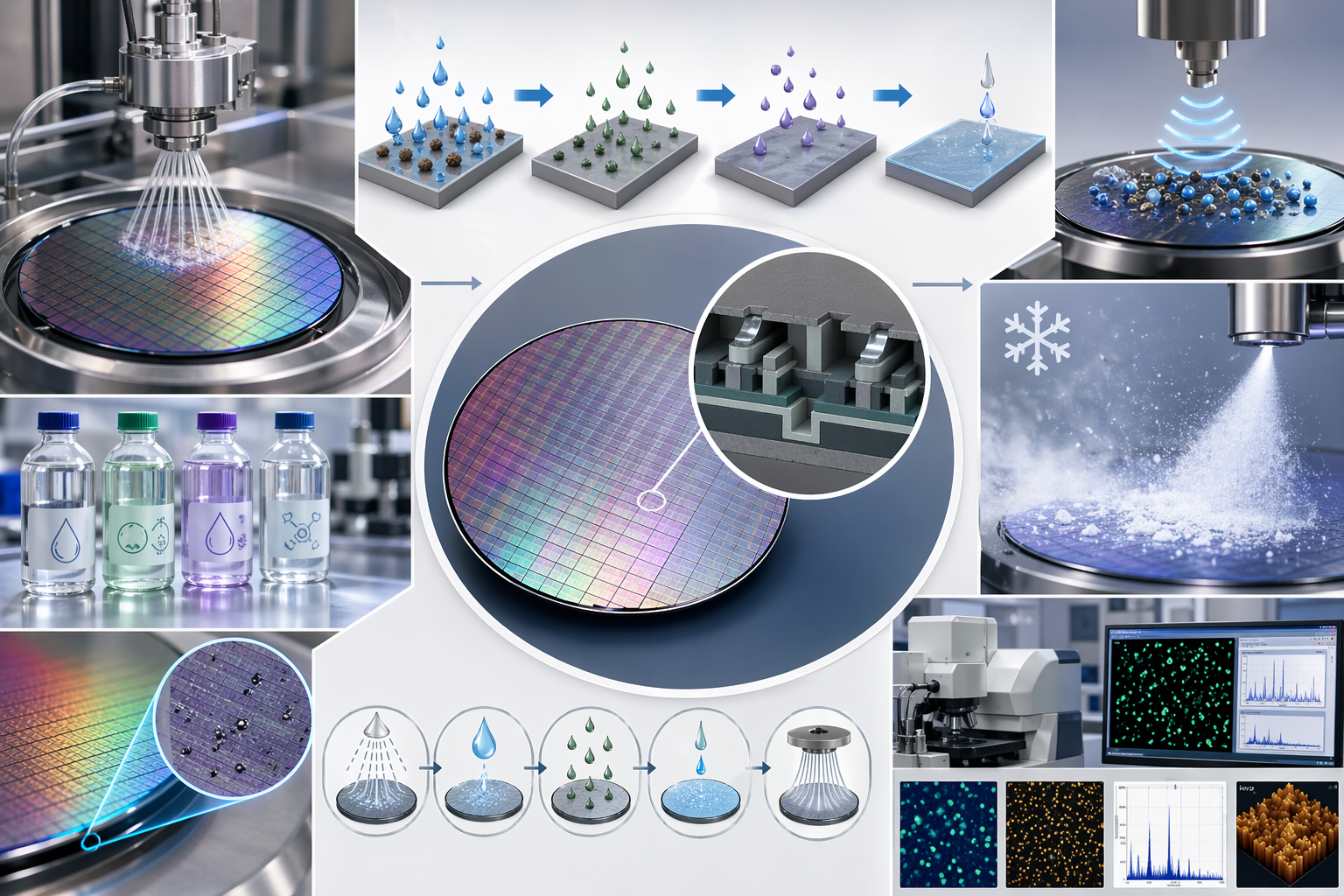
Key variables—reagent concentrations, temperature, time, flow, and mechanical action—decide outcomes. Standard RCA uses 1:1:5 NH₄OH:H₂O₂:H₂O at ~75 °C, but one fab switched to a more dilute 1:8:64 at 65 °C, extending bath life and minimizing surface erosion (researchgate.net; researchgate.net). Longer rinses and multiple megasonic passes can remove finer particles, at the cost of cycle time and possible surface charging. In‑line monitors—pH, DI resistivity, particle counters—and post‑clean analysis guide data‑driven adjustments.
Executing those recipes hinges on concentration control and delivery uniformity; precise additions of oxidizer, base, and HF benefit from accurate chemical dosing when tight windows separate cleaning from damage.
Match chemistry to contamination
Contamination dictates chemistry. Organic residues (photoresist burn‑in or adhesives) call for oxidizers (H₂SO₄/H₂O₂, O₃, UV/O₃), while metallic ions (Cu, Fe, Na, etc.) need complexing acids or amphoteric baths (HCl‑based, or SC‑1 with chelators) (researchgate.net; researchgate.net). CMP (chemical‑mechanical polishing) residues often need dual‑action (oxidizer + mild base). Materials matter too: Al‑containing metallization demands SC chemistries that do not dissolve or redeposit Al; SC‑1 can deposit Al unless chelated (researchgate.net).
Yield versus damage on advanced nodes
Particle removal targets are unforgiving: fabs aim to push particle counts to <100/cm² for >90% yield (sst.semiconductor-digest.com; researchgate.net). But over‑aggressive cleaning introduces risks: wafer warpage, “pattern collapse,” and subtle damage in implants or low‑k films. Process engineers therefore tune megasonic power to avoid erosion and avoid aggressive spray pressure that could fracture fine fins and deep‑aspect‑ratio features (sensorprod.com; siliconsemiconductor.net).
Hazardous effluent and B3 compliance
Cleaning chemistries are corrosive (strong acids/bases, oxidizers) and generate hazardous effluent. In Indonesia, such wastes are regulated as B3 (hazardous/toxic) waste; the Ministry of Environment’s Regulation 6/2021 governs storage, neutralization, and disposal of corrosive chemical waste (pslb3.menlhk.go.id; beta.co.id). In practice, fabs install bulk neutralization (e.g., limestone) and double‑rinse protocols to minimize discharge, and end‑of‑line ozone cleans—producing only O₂—are being promoted to reduce B3 burden (siliconsemiconductor.net). Ancillary systems for compliance and uptime (instrumentation, containment, and neutralization accessories) fall under supporting equipment for water treatment.
Metrology: from particles to chemistry
Verifying cleanliness spans particles, chemistry, and topography. Optical particle counters (e.g., KLA‑Tencor SP1) map 0.05–1.0 µm defects; SP1 can count 0.1–0.3 µm “killer” particles, and one study saw a surfactant added to SC‑1 reduce 0.12–0.14 µm particles by ~50 counts/wafer (fr.scribd.com). Yet “a contaminant of just a few nanometers won’t show up on standard in‑line metrology,” pushing some checks off‑line (semiengineering.com).
Chemical and elemental analysis fill that gap. FTIR or grazing‑angle reflectance (FT‑IRRAS) can reveal sub‑nm organic films; a laser IR tool has detected <0.01 nm of hydrocarbon film (fr.scribd.com). XPS/AES (X‑ray photoelectron spectroscopy/Auger) probes the top ~1–10 nm; in one process a post‑strip clean showed no detectable carbon peak, confirming organic removal (patents.google.com). For trace metals, TXRF (Total‑Reflection X‑Ray Fluorescence) and VPD‑ICPMS are standards: modern TXRF can quantitate ~10¹⁰ atoms/cm² on smooth wafers; on rough/patterned wafers sensitivity degrades, but calibration studies report reliability down to ~10¹² atoms/cm² (link.springer.com). XPS is less sensitive (~10¹²–10¹³ atoms/cm²) but yields speciation, while SIMS can depth‑profile species at ~10¹³–10¹⁵/cm² resolution (link.springer.com).
Topography metrics close the loop. AFM (atomic force microscopy) or optical profilometry verifies that properly cleaned silicon keeps RMS roughness <0.2 nm; a rise above ~1 nm flags etch damage. Ellipsometry tracks film thickness, including the ~6–10 Å oxide grown/dissolved by SC‑1 (researchgate.net). Contact‑angle wettability offers a quick check of termination: hydrophilic after SC cleans vs. hydrophobic after HF.
Putting it all together for yield
The recipe for high‑precision yield is explicit in the data: drive SC‑1 residual metals to <10¹⁰/cm² (via chelated SC‑1 + HF) and particle counts to <100/cm² for >90% yield (researchgate.net; fr.scribd.com; sst.semiconductor-digest.com; researchgate.net). Engineers tune concentrations, time, and agitation—supported by in‑line monitors—until metrology (particle maps, XPS, TXRF, AFM) confirms the wafer is “chemically and physically clean” without over‑etching (semiengineering.com). As devices continue to shrink, margins tighten and the role of advanced analysis (TXRF, SEM, spectroscopy) only grows (siliconsemiconductor.net).