

Industry: Aquaculture | Process: Water_Source_&_Intake_Treatment
Global aquaculture is now a 90‑million‑tonne‑a‑year business, and raw water is the first choke point in that growth story (FAO). Farms pulling from rivers, lakes, or coastal intakes are drawing in clay, silt, algae, and organic debris — the stuff that clogs screens, abrades pumps, and starves UV systems of performance.
The practical fix is not one technology but a train: gravity sedimentation (settling ponds or engineered clarifiers), chemical coagulation–flocculation (using specialized polymers), and a polishing step that matches the solids load and the spec for final clarity. This guide — built for design engineers and purchasing managers — sticks to what the data say about how each unit process works, what it removes, and what it costs, with source links embedded throughout.
Gravity sedimentation design parameters
Settling basins (earthen ponds run quiescent) and mechanical clarifiers rely on gravity to remove coarse mineral solids. The physics is unforgiving for fines: mineral particles smaller than 0.01–0.02 mm can take many hours to fall one meter under still conditions (Global Aquaculture Advocate). Example: a 0.008 mm particle has a settling velocity (Vs) of about 5.9×10^–5 m/s, needing ~4.7 hours to descend 1 m; coarse sand at 0.06 mm falls much faster (Global Aquaculture Advocate).
Design starts with hydraulic retention time, HRT (hydraulic retention time = basin volume / Q, the flow rate). A short HRT (<1 hour) skims off only the largest clumps; multi‑hour HRT and/or large surface area is needed to capture smaller fines (Global Aquaculture Advocate). Claude E. Boyd’s worked example: to remove ≥0.008 mm solids from a max flow of 0.25 m³/s (15 m³/min), a 1‑m‑deep basin needs ~4,237 m² of area (≈0.42 ha). At 1.7 m depth, area drops to ~2,491 m² (Global Aquaculture Advocate). Targeting even smaller particles (e.g., 0.006 mm) or running higher flow demands proportionally more area or depth.
The math follows Stokes’ law (settling velocity scales with diameter squared). Boyd reports Vs ≈3.3×10^–5 m/s for 0.006 mm particles (8.4 hours per meter) and about 3.0 hours per meter for 0.010 mm (Global Aquaculture Advocate). Under ideal hydraulics, the fraction removed is the fraction with settling time ≤ HRT (Global Aquaculture Advocate). In real basins without chemical aid, single‑stage gravity typically removes ~76–82% of total suspended solids, TSS (total suspended solids), with sub‑10 µm organics (e.g., plankton) largely passing through (Ebeling et al., Aquacultural Eng.; Global Aquaculture Advocate).
Extended detention changes the picture. With ~24 hours of HRT, “very fine solids and nutrients” can also be captured: phosphates adsorb to sediments, some ammonia is nitrified, and additional solids settle in anaerobic zones (Global Aquaculture Advocate).
Where space is tight, engineered clarifiers (vertical‑flow or stacked) bring compactness and sludge removal. A properly sized clarifier follows the same surface‑overflow logic (e.g., 8–20 m³/m²·h) and is often designed to retain solids down to ~15–20 µm; designers frequently add baffles to reduce short‑circuiting (Global Aquaculture Advocate). Lamella and tube modules can simulate large settling area in a small footprint — a role well served by a lamella settler.
Design guidance from the field: use sedimentation to target ≥10 µm solids; for 0.01 mm at Q=0.25 m³/s and 1 m depth, plan on ~3,000–4,000 m² of area. If land allows, add depth (>1 m) and baffles. Expect at most ~80% removal by gravity and plan a chemical step for fines (Global Aquaculture Advocate; Global Aquaculture Advocate; Global Aquaculture Advocate).
Chemical coagulation and flocculation
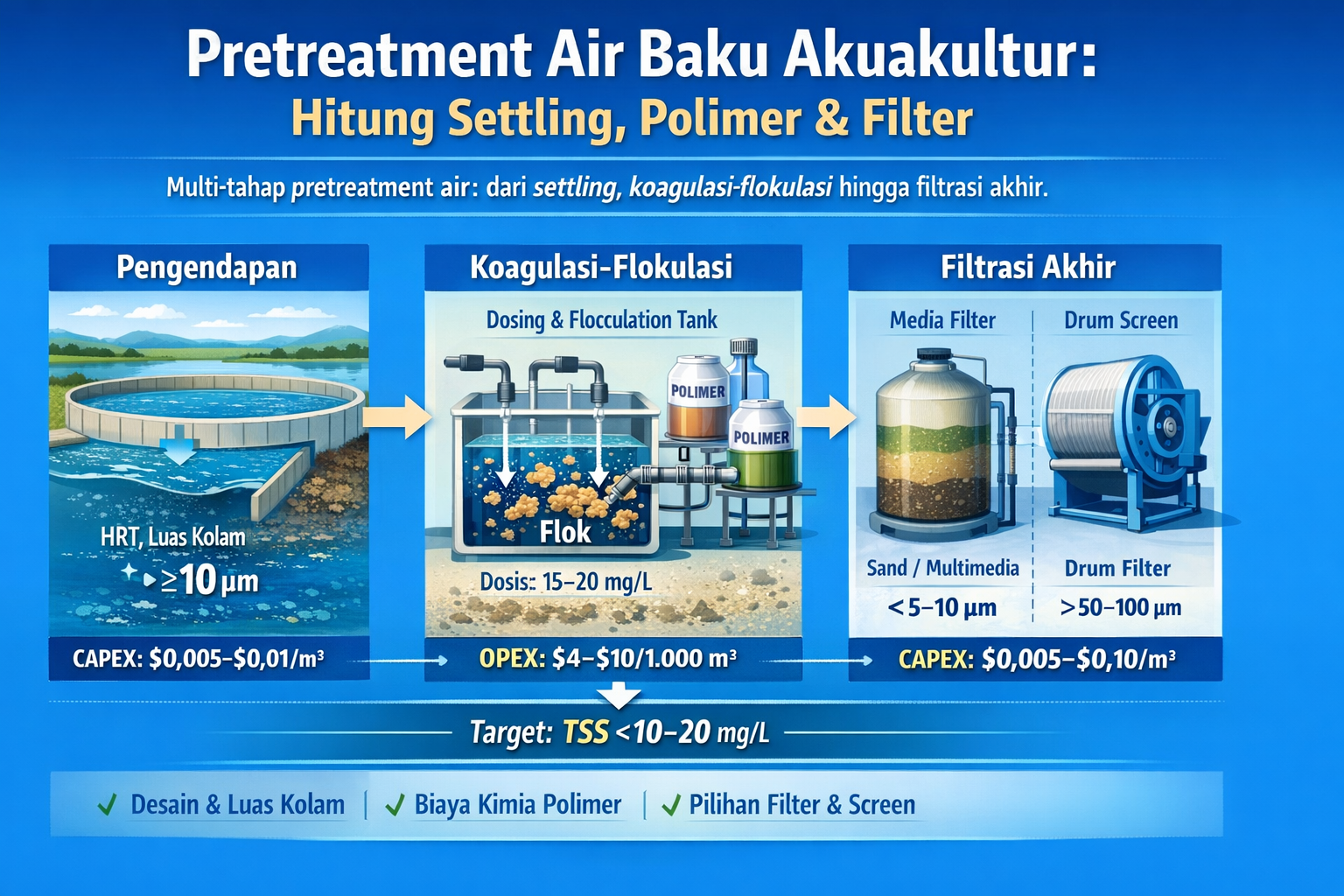
Coagulation–flocculation is the workhorse for fine colloids (clays, organic particles) that resist gravity settling. Specialized polymer flocculants — typically high‑molecular‑weight, high‑charge materials — are dosed to bridge particles into larger flocs. Jar tests determine optimum dose. In Ebeling et al. (2005), 15–20 mg/L polymer gave near‑maximal flocculation on aquaculture microscreen effluent, cutting TSS by ~99% with final TSS 10–17 mg/L (Aquacultural Eng.). Those trials focused on microscreen backwash, but the same mechanism applies at intake: fine clays and algae can be flocculated to reach roughly ~10 mg/L TSS.
Typical doses run ~10–30 mg/L; Ebeling broadly recommends ~15–20 mg/L (0.015–0.020 g per liter) for aquaculture solids (Aquacultural Eng.). The economics are modest: benchmarked against feed, flocculant cost lands around $4.38–13.08 per metric tonne of fish feed and on the order of $0.005–0.015 per m³ of production (depending on feed conversion) (Aquacultural Eng.). For a plant at 100 m³/h dosing 20 mg/L, that’s 2 kg/h of polymer; at $2–5/kg, treatment cost ≈$4–10 per 1000 m³.
The nutrient upside is material: reactive phosphorus fell ~92–95% in Ebeling’s trials because most P is solids‑bound (Aquacultural Eng.). Other studies similarly confirm that alum, iron salts, or polymer flocculants can remove >90% of orthophosphate and turbidity when properly dosed (Aquacultural Eng.; Aquacultural Eng.).
Implementation is conventional: a rapid‑mix tank disperses a coagulant (e.g., alum or ferric chloride) followed by a polymer flocculant, mixed at ~50–150 rpm for ~1–5 minutes, then gently agitated at ~30–50 rpm for several minutes before flow to a secondary settling zone or clarifier. Field performance routinely achieves >90% floc capture; jar‑test optimization in the literature included fast mixing at ~125 rpm followed by ~39–60 minutes of settling (Journal of Water Process Engineering). A polymer feed skid with an accurate dosing pump is standard practice.
Design guidance: specify a chemical stage ahead of polishing. For heavy silt loads, size around ~20 mg/L of cationic PAM (polyacrylamide), then verify by jar tests to minimize dose. Plan a small clarifier or a compact lamella unit downstream of the floc tank to separate flocs, and consider commodity coagulants in tandem with high‑charge flocculants to hit turbidity and P targets. Expect effluent TSS ≈10–20 mg/L and polymer usage of about $0.005–0.01/m³ treated (sources as above).
Polishing filtration comparison
Granular media filters (sand/multimedia). Depth filtration forces water through a bed — often a graded stack with sand at the bottom (e.g., 0.4–0.6 mm) and anthracite on top (e.g., 1.5–3.0 mm). Typical design velocities are 5–15 m/h. With consistent backwash, media filters polish turbidity to <1 NTU (Nephelometric Turbidity Units) and TSS to single‑digit mg/L. Extension studies note “sand‑glass filters” carry very low operating and total cost and are frequently chosen for pond or irrigation withdrawals (GPN). Backwash typically uses 5–10% of throughput. Specifying the media matters — a sand media bed paired with an upper layer of anthracite is a common configuration.
Mechanical screen filters (drums/discs). Woven or sintered screens at 50–500 µm remove particles larger than the aperture by straining. They win on simplicity, compactness, and capex: one greenhouse study put depreciated capital at $0.02–$0.12 per 1,000 gallons ($0.005–$0.03 per m³) (GPN). The trade‑off is fine capture: soft/slimy organics deform and slip through or foul the mesh (Irrigation Tutorials). In aquaculture, drum screens (~50–100 µm) and disc filters often run as coarse polishers. An automatic screen is typical when flows fluctuate and cleaning needs to be continuous.
Performance and maintenance. Screens remove only what is larger than the mesh — residual turbidity often remains. Media filters capture much smaller particulates; final TSS after media is typically <5 mg/L. Screens handle high flow per unit area with low head loss; media filters trade footprint for finer capture. Maintenance differs: screens may backwash frequently under high loads (manufacturer data show backwash flows expressed as 0.2–1.5% of throughput, with spent backwash around ~1,000 mg/L TSS), while media filters use ~5–10% water per backwash and must not be allowed to choke (Aquacultural Eng.).
Capital and OPEX considerations
On capital alone, screens are hard to beat. The greenhouse analysis above estimated $0.02–$0.12 per 1,000 gallons (~$0.005–$0.03/m³) in depreciated capital for screen filters (GPN). Sand/media filters require larger vessels and thus higher capex (often tens of thousands of dollars for large flows), but total cost per volume is low at scale; “sand‑glass filters” scored very low operating and total cost in those trials (GPN).
Operating costs track the mechanics. Screens sip power (mostly valve actuations) and waste a small fraction of water in short cleaning bursts. Media filters draw pump power for backwash and use 5–15% extra wash water, with media replacement only every few years. Polymer adds a chemical line item — typically a few cents per m³, as above. Across the train, maintenance labor is modest relative to feed and fuel expenses.
Multi‑stage economics routinely win: a low‑cost screen up front → coagulation/flocculation → a right‑sized media filter. The greenhouse cost work recommended this approach to minimize the size and consumables of fine filters (GPN). For aquaculture intakes, a first‑stage drum or static screen (100–200 μm) protects the high‑efficiency media filter from rapid fouling. Where pressure vessels are required, a corrosion‑resistant FRP filter housing is a common choice.
Footprint and infrastructure are not rounding errors. Settling basins consume land. Clarifiers and filters need concrete pads and pressure piping; flocculation mixers and polymer feed skids add instrumentation cost but are typically modest (<$10K). Budgeting ballpark (order‑of‑magnitude) for 100–500 m³/h systems: ~$20k–$100k for screen filtration, ~$50k–$200k for media filtration, with media often 1.5–3× the capital of screens for equivalent flow (vendor‑dependent). Controls, valves, and spares sit in “ancillaries,” often cataloged under water treatment ancillaries.
Procurement benchmarks and selection
Specification flows from the water‑quality target. High‑biomass or recirculating systems should weight finer capture; for modest ponds supplied by relatively clean rivers, a simpler screen plus polymer clarifier may achieve the goal. As a practical pricing compass, use the published benchmarks to interrogate quotes: for ~1,000 m³/h, a sand filter around ~$60–80k versus a comparable drum filter at ~$30–40k, plus ~10% of that for the clarifier and polymer system (sources as above). Verify manufacturer capacity (m³/h) against target flow and match screen mesh or media gradation to the expected solids spectrum.
If the downstream process includes UV (ultraviolet disinfection), polishing clarity matters; media filtration is the usual partner ahead of a UV system. In all cases, align the selection in $/m³ treated: the extension data suggest screens at a few cents per m³ and sand/media at comparable sub‑$0.10/m³ levels (GPN; GPN).