

Industry: Landfill | Process: Gas_Collection_&_Flaring
Landfills make landfill gas (LFG) as waste decays without oxygen. It’s roughly 50% methane (CH₄) and 50% CO₂ by volume, with small amounts of many odorous organics (lcdi-indonesia.id). Trace hydrogen sulfide (H₂S) and other reduced sulfur compounds dominate what noses notice; H₂S has a “rotten egg” smell with a median human odor threshold around 0.008 μL/L (~8 ppb) (nepis.epa.gov), and it is regulated as an air toxic. Other malodors arise from volatile organic compounds (VOCs), amines, and ammonia.
In practice, strong LFG odors indicate high organics; as Indonesia’s environment ministry (LHK) notes, “if a landfill smells bad, it has a lot of organic waste…” while inert landfills (e.g., mostly ash) may be odorless (www.antaranews.com). Indonesia has ~531 landfills disposing ~19 million t/yr of municipal waste, ~41% organics (www.antaranews.com). Because methane is a potent greenhouse gas (28–36× CO₂ on a 100‑year basis) (lcdi-indonesia.id), capturing LFG serves both odor control and climate goals. As Fang et al. note, odorant profiles can vary significantly with site conditions (www.waste360.com).
Gas collection system design and performance
A well‑designed gas collection system (GCCS) is the cornerstone of odor control. Vertical and horizontal wells, trenches, and piping pull gas from beneath the cover before it migrates upward; active systems use blowers/vacuum to maintain negative pressure, while passive vents are limited to low‑production sites. Typical collection efficiencies are 40–60% of generated methane for ordinary systems, and up to ~90% in best‑practice designs with engineered liners and covered cells (www.climate-policy-watcher.org). Using geomembranes and compacted soil covers greatly increases capture efficiency (www.climate-policy-watcher.org).
With less than 100% capture, remaining LFG diffuses out through cracks or openings, carrying pungent compounds to the surface. In one documented U.S. case, stringent use of daily soil cover plus active gas control cut odor complaints to only 1 per year (www.atsdr.cdc.gov). Therefore, regulations in many countries (e.g., the EU Landfill Directive) mandate gas collection and flaring or recovery for active landfills.
Flaring and energy recovery combustion efficiency
Flaring or energy recovery destroys collected gas before release. High‑temperature flares oxidize methane and trace pollutants to mostly CO₂ and H₂O, dramatically cutting odor. Modern enclosed flares achieve ~90%+ combustion efficiency, whereas simple open flares may only reach ~50% (www.mdpi.com). Using LFG for energy or clean flaring “significantly reduces…odors” (and GHGs and explosion risk) (c.coek.info). In Indonesia, the environment ministry now expects all large TPAs to utilize methane by 2050 (www.antaranews.com), reflecting this principle.
Odor‑neutralizing chemicals as supplemental control
Chemical “odor neutralizers” are supplemental and often short‑term. Masking or reactive agents—such as bleach (sodium hypochlorite reacting with H₂S), alkali salts (sodium or ammonium bicarbonate, caustic soda), and proprietary amine‑based products—are sprayed or misted on waste surfaces or around the perimeter (nepis.epa.gov). Operators use hand‑held sprayers, foggers, or vapor‑diffusion systems to apply these solutions to the active face or boundary (nepis.epa.gov), and a spray of bicarbonate solution can temporarily raise pH and suppress H₂S emissions. Many sites meter these solutions using a dosing pump tied to foggers for more consistent application.
Best‑management‑practice guidance stresses these are temporary measures that do not stop odor generation at its source (nepis.epa.gov). Large or persistent odors require removing the waste or gas pathway causing them; if particular incoming loads are especially odorous, they should be isolated, immediately covered, or diverted (www.scsengineers.com). Overuse of chemicals also incurs costs and potential safety (corrosion) issues.
Carbon adsorption and biological filtration polishing
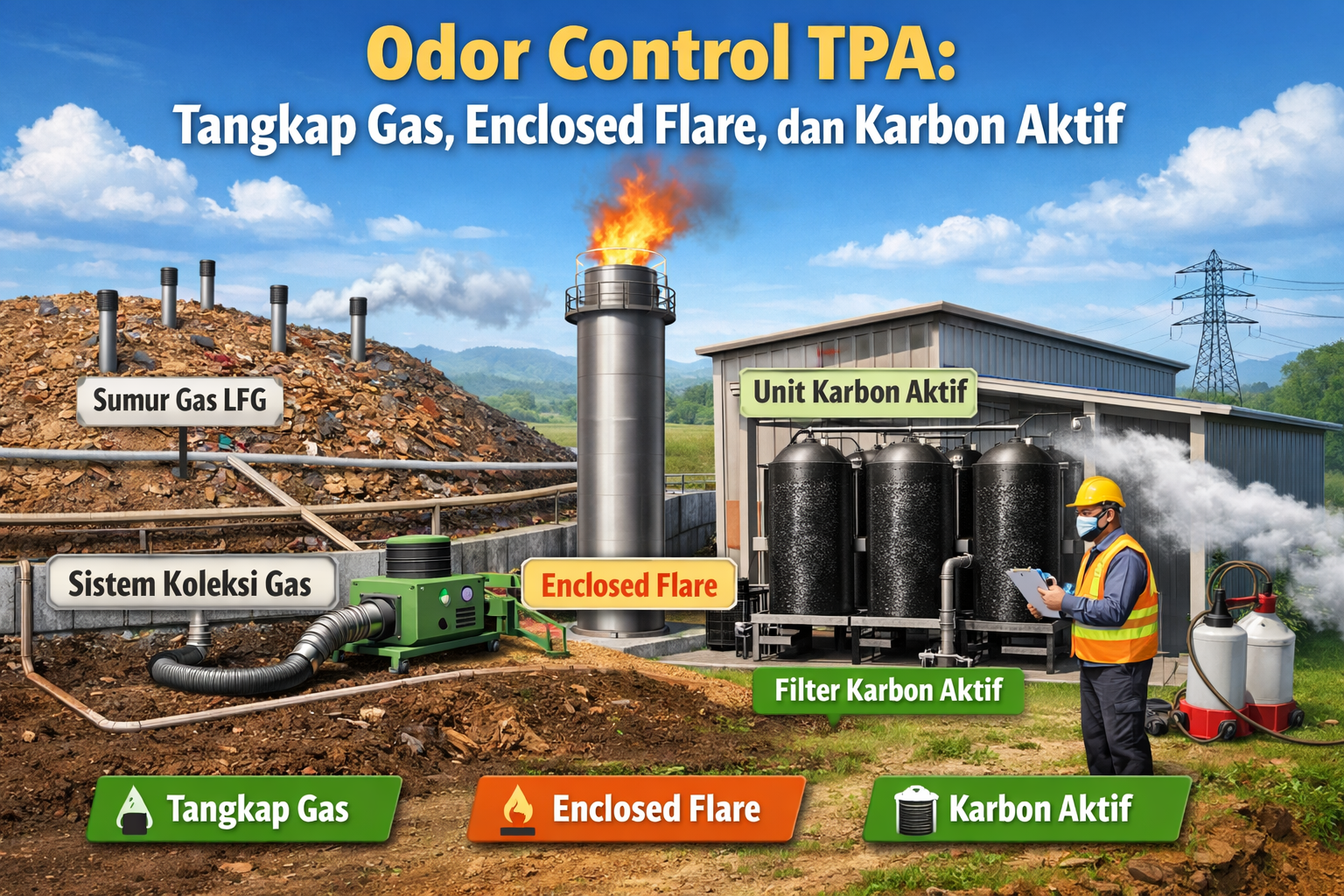
For collected gas streams or small vent emissions, adsorption or biofiltration can polish residual odorants. Although flaring largely destroys organics, any bypassed or uncombusted gases (and condensate hydrocarbons) might be passed through scrubbers or filters. A biological filter (biofilter—often wood chips or compost medium colonized by sulfur‑oxidizing bacteria) can oxidize H₂S to sulfate; passive LFG vents have been equipped with layers of woodchips or biomedia, removing much of the odor before discharge (nepis.epa.gov). Lab studies show such biofilters can remove 80–90% or more of low‑level H₂S under ideal conditions (performance depends on temperature, moisture, and pH).
Activated carbon is another option for adsorbing H₂S and VOCs. Granular activated carbon—often impregnated with metal oxides—has a high affinity for sulfur compounds; in bench tests, KOH‑ or Zn‑acetate‑impregnated carbons have adsorbed on the order of 1–2 mg H₂S per gram of carbon before breakthrough (pmc.ncbi.nlm.nih.gov). For context, 1 g of H₂S corresponds to about 1.4 L at STP, an immense odor load. Treating even small vent streams therefore requires large carbon beds or frequent replacement, so packed towers or canisters are typically sized as a polishing step—often after a wet scrubber—with spent carbon regenerated or disposed. For this duty, operators commonly select activated carbon media designed to target sulfur compounds.
Measured outcomes and sector trends
Experience shows combination approaches yield the best results. Designing a landfill with a bottom liner and early‑cap covers plus an active GCCS can cut fugitive emissions by over half. Studies suggest uncollected LFG can account for a majority of landfill methane—losing ~50% of early gas if no system (c.coek.info)—so capturing it prevents both odor and GHG. Real‑world projects report large reductions in odor complaints after control installation; one qualitatively documented case noted “only one odor complaint in 1995” after strict cover management and flaring were put in place (www.atsdr.cdc.gov).
The U.S. EPA reports 500+ landfills with active LFG‑to‑energy projects and another ~500 candidates for capture (nepis.epa.gov). Where strict odor or H₂S limits exist, operators commonly layer controls: an active gas system plus misting stations with bicarbonate spray around the boundary, with odors monitored continuously by portable sensors or “sniff” teams.
Indonesia’s deployment and operational standards
In Indonesia, the Environment Ministry’s goal that all TPAs utilize methane by 2050 implies widespread gas capture deployment (www.antaranews.com). Some Indonesian sites (e.g., Semarang’s TPA) already pipe LFG to power plants or clean gas networks. In parallel, landfill standards (SNI) and local regulations increasingly require daily cover and post‑closure sealing, which inherently reduce odors. As Wang et al. note, when landfills are properly engineered and maintained, “miners can avoid” releasing fugitive gas and odors (c.coek.info).
What works, in sequence
Effective odor control combines engineering and treatment. The data strongly favor investing in a robust gas collection system—with good vacuum, well spacing, and cover integrity—so that as much volatile gas as possible is captured. Flaring or energy recovery then neutralizes the bulk of the odorants (with ~90%+ efficiency under good flaring conditions versus ~50% for simple open flares, www.mdpi.com). Any remaining odor plumes can be blunted with targeted chemical misting, and discrete vent streams can be polished by biofilters or activated carbon. Decision‑makers should therefore prioritize source controls (collection/cover) for sustainable odor mitigation, using chemical neutralizers or adsorption only as supplementary tactics (nepis.epa.gov; www.atsdr.cdc.gov).
Source notes: peer‑reviewed and government references include EPA landfill guidelines and studies, such as Fang et al. on odorant profiles (www.waste360.com); U.S. EPA Landfill Methane Outreach data (nepis.epa.gov); engineering texts on gas capture (c.coek.info; www.climate-policy-watcher.org); and Indonesian regulatory/analysis reports (www.antaranews.com; lcdi-indonesia.id). All data‑driven statements are cited above.