

Industry: Nickel_Mining | Process: Wastewater_Treatment
Nickel ore mining — notably in Indonesia — pushes immense volumes of process water containing heavy metals and fine solids that must be treated before discharge. A peer‑reviewed review of non‑ferrous mineral processing wastewater describes “large amounts of various heavy metal ions, fine suspended solids, and organic chemicals,” requiring multi‑stage treatment (e.g., precipitation, filtration, adsorption, oxidation) (www.mdpi.com).
Regulators have tightened the screws: Indonesia’s MoE Regulation No. 9/2006 sets wastewater quality limits for nickel ore mining, and the 2022 MoEF Regulation No. 5/2022 requires constructed‑wetland treatment with continuous monitoring and maintenance (vale.com) (www.iea.org). Scale makes reliability non‑negotiable: Vale Indonesia reported ~7.56 million m³ of water use in 2023 (about 107 m³ per tonne of Ni, an 11% reduction from 2022) (vale.com).
Every hour of downtime or treatment failure exposes the mine to compliance risk and lost production. One industry analysis tied a 3.3% year‑on‑year drop in mine output to downtime and power outages (www.miningweekly.com). Another source pegs a single halted dump truck at roughly $1,000 per hour (www.miningweekly.com).
Regulatory limits and contaminant profile
Non‑ferrous mining wastewater typically blends metals, suspended solids, and organics that demand multiple barriers, from precipitation to oxidation (www.mdpi.com). Filtration steps are central to this train and often rely on granular media; mines commonly deploy sand/silica filtration to capture 5–10 micron particles within a compact footprint.
Adsorption plays a complementary role in polishing, with activated carbon used to remove chlorine and organics. Primary settling remains a backbone stage in hard‑service plants; specifying a robust clarifier with appropriate detention time helps remove suspended solids before downstream units see abrasive duty.
Heavy‑duty equipment selection for uptime
Reliability begins with industrial‑grade equipment built for continuous operation in abrasive, corrosive service. High‑reliability pumps and motors — centrifugal or submersible with rugged seals, variable frequency drives (VFDs, for speed control), and corrosion‑resistant materials — extend uptime. In mining, rigorous maintenance has delivered over 25,000 hours of service on haul‑truck wheel assemblies; similar pump/motor packages can run tens of thousands of hours before major overhaul (www.miningweekly.com).
As one industry review notes, the “quality and reliability of the equipment itself” outweigh short‑term cost savings for mine viability (www.miningweekly.com). Modern OEM machines with high horsepower, advanced hydraulics, and rugged frames increase mean time between failures (MTBF, the average operating time between breakdowns) and lower total cost of ownership (www.miningweekly.com).
Design for harsh service matters. Lining pipes and clarifier gates with slurry liners, specifying HDPE (high‑density polyethylene) or urethane coatings, and selecting gearboxes rated for observed ore loads prevent premature wear. The difference is not academic: a conveyor gearbox that was undersized for current loads repeatedly failed until it was upsized after root‑cause analysis — and the recurrences stopped (www.miningweekly.com).
Redundancy, modularity, and maintenance access
Duplicating critical units creates breathing room: at least two duty pumps at major sumps let one run while the other is serviced. Modular or skid‑mounted packages with quick‑connect utilities shorten outage windows and simplify swaps. For chemical addition, specifying a resilient dosing pump for pH and coagulant control reduces nuisance failures.
Ease of maintenance is a selection criterion. Bolt‑on pump foundations, crane‑opening valves, and accessible filters enable fast, safe work — the kind of “timeous and effortless maintenance routines” linked to more production time (www.miningweekly.com). Specifying a maintainable cartridge filter, adequate lighting, ladders, and built‑in work platforms pays back when the clock is ticking.
Proven vendor support is part of resiliency. Favor suppliers with mining track records and shared MTBF data; pilot critical units in situ where possible. The opportunity cost of a stop is steep — “Equipment manufacturer Cummins has estimated” a single dump truck halt near $1,000 per hour (www.miningweekly.com).
SCADA/IoT automation and remote control
Automation compresses response time and cuts manual rounds. Integrating SCADA (supervisory control and data acquisition) with IoT (internet of things) sensors allows remote visibility of flow, tank levels, pressure, pH, turbidity, and dissolved gases, plus the ability to actuate valves and pumps (moerkwater.com.au) (www.mining-technology.com). Modern sensors continuously log turbidity and pH; software alerts operators before values approach permit limits.
That early warning matters because it “allows problems to be flagged before they become expensive or too catastrophic to repair” (moerkwater.com.au). Continuous monitoring has also shortened maintenance cycles in practice; teams move from hourly or daily rounds to trend‑based attention (iotusecase.com).
Instrument the essentials: turbidity meters, conductivity sensors for salt levels, dissolved oxygen (DO) probes for aeration systems, flowmeters, and pressure transducers feeding a centralized on‑site or cloud dashboard 24/7. Where raw water is especially turbid, upstream membrane pretreatment can be specified; ultrafiltration is often used as a fine solids barrier ahead of polishing steps.
Automated control closes the loop. Tie alarms to logic in a PLC (programmable logic controller) to modulate pumps, chemical feeders, and clear‑well levels. Valves and emergency stops can be triggered remotely, allowing immediate shutdown if a tank overflows — even from an off‑site control room or via satellite links in remote mines (moerkwater.com.au).
Predictive analytics and adoption trends
Historical data becomes a health monitor. Vibration or energy‑use anomalies on blowers and pumps can indicate emerging faults; one case identified clogged air filters by tracking energy usage, prompting replacement before a pump overload occurred (iotusecase.com). Continuous condition monitoring “extends the service life of the plant and reduces maintenance costs” by catching wear early (iotusecase.com).
Adoption is accelerating. Surveys indicate ~50–53% of miners are deploying or trialling IoT for environmental monitoring of water and tailings systems, with about 43% already reporting emission reductions and environmental performance gains (www.mining-technology.com) (www.mining-technology.com).
Results are concrete: a German wastewater case saw continuous monitoring detect faults early, shorten outages, and even enable teams to “order spare parts early” instead of scrambling reactively (iotusecase.com). Similar visibility in mine‑water assets increases compliance by avoiding bypasses and overflows while reducing labor dependence.
Critical spare parts and consumables strategy
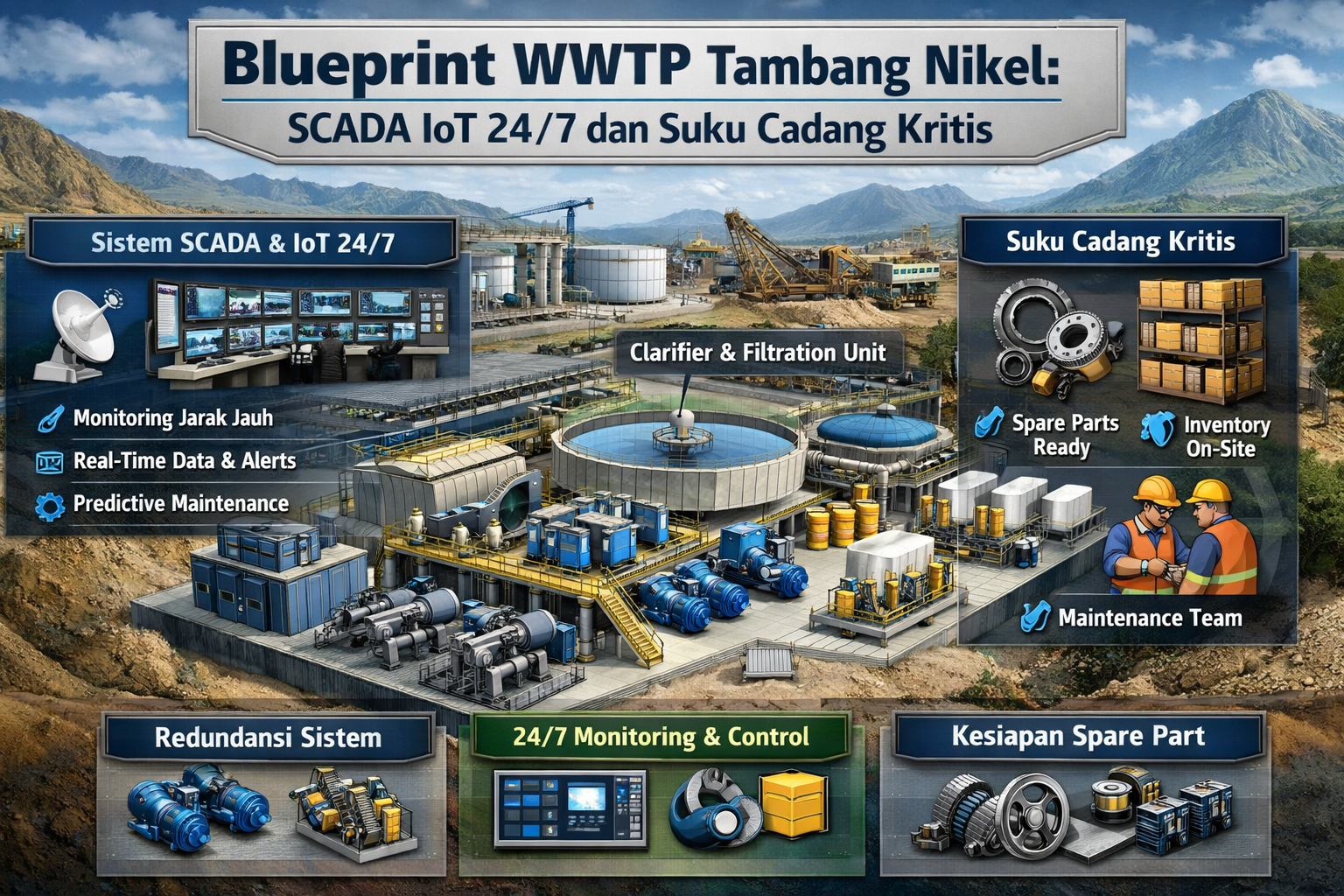
Even the best‑built plants eventually need parts. Define “critical spares” — components whose failure halts operations — and keep them on site. A Pareto analysis (often ~80/20) of failure history usually surfaces the culprits: pump seals, bearings, PLC boards, and chemical dosing pumps, among others. Stocking these and common parts and consumables prevents small failures from becoming long outages.
Lead times decide what stays on the shelf. Items with long procurement cycles — a specialty mining pump or a custom membrane — should be stocked because replacements can take weeks or months. For generic membrane assemblies, standardizing on serviceable membrane systems can simplify sourcing and spares planning.
Manage inventory dynamically to avoid both stockouts and dead stock. One gold mine found millions in working capital tied up in obsolete parts due to poor planning; switching to data‑driven tracking cut waste and aligned stock with actual needs (lidd.com). Conversely, another mine suffered repeated stockouts of essential items until a tracking system was implemented, after which machinery downtime dropped significantly (lidd.com).
Balancing cost and risk usually favors holding the part. A rail haul truck can carry six wheels at $50,000 each (lidd.com); one wheel failure without a spare could idle a $6–7 million truck and cost $1,000+ per hour (www.miningweekly.com). In mining, any unplanned downtime “can escalate exponentially” in cost (lidd.com).
Operations and maintenance plan design
A comprehensive O&M plan turns good design into enduring performance. Start with scheduled preventive maintenance: calibrate pH meters weekly, check pump lubricant levels monthly, and clean clarifier sludge lines quarterly, assigning each task to trained personnel. One guideline notes 60–70% of a typical plant’s energy costs come from pumps and blowers, so timely filter changes and maintenance on these assets both cut failures and operating costs (iotusecase.com).
Go beyond the calendar with condition monitoring and diagnostics. Use real‑time data to trigger work orders — for example, inspect a mixer when vibration crosses a threshold — and automate alerts via digital monitoring (iotusecase.com). Root‑cause failure analysis is essential; instead of fixing symptoms, examine whether load, corrosion, or operator error drove the breakdown (www.miningweekly.com).
Plans should adapt. “Even the best made plans will encounter some bumps. An adaptive management plan (often structured as if/then decision trees) outlines how to respond to specific situations,” notes Monique Simair in a mine water best‑practices summary (www.canadianminingjournal.com). For example, if effluent pH drifts above the limit (e.g., pH > 9.0), add acid dosing and verify inlet valve settings per the predefined playbook, using a robust suite of ancillaries to execute the adjustment.
Quality assurance and documentation close the loop. Implement checklists, logs, and a CMMS (computerized maintenance management system) to track all work. Regulators require traceability: Indonesian mining operations must “monitor the operations of the processing facilities” and report against standards (www.iea.org), making thorough records essential.
Training and spare allocation are part of O&M. Cross‑train teams and certify operators on plant equipment so that knowledge isn’t a single point of failure. Integrate spare‑part usage with the CMMS so installing a part automatically decrements inventory and triggers reorder of critical items for the clarifier, pumps, and other process units.
In practice, digital monitoring has been shown to extend component life and cut maintenance costs (iotusecase.com). Mines that distinguish scheduled versus unscheduled downtime and target root causes achieve higher availability, steering toward “maximal reliability or minimal costs” by linking maintenance policy to equipment degradation models (www.miningweekly.com).
Outcomes and reliability at scale
Put together, durable hardware, automation, a strategic spare‑parts cache, and a data‑driven O&M plan reinforce one another. Operators using real‑time monitoring now often detect issues days in advance, shrinking downtime to hours and turning multi‑million‑dollar potential losses into routine maintenance windows (iotusecase.com) (www.miningweekly.com).
In nickel operations where millions of cubic meters must meet strict discharge standards — including constructed wetlands with continuous monitoring and maintenance as per MoEF Regulation No. 5/2022 (vale.com) (www.iea.org) — the resilient plant is the one that keeps running. Upstream filtration backed by UF pretreatment, robust settling in a clarifier, chemical control via a dosing pump, and well‑managed spares turn that principle into practice.
Sources: Peer‑reviewed journals, industry reports, and regulations underpin the guidance above, including an MDPI review (www.mdpi.com), mining sector analyses (www.miningweekly.com) (www.miningweekly.com), automation and remote monitoring case studies (moerkwater.com.au) (iotusecase.com) and spares management insights (lidd.com) (www.canadianminingjournal.com).