

Pengolahan leachate landfill menghasilkan sludge dengan kandungan air lebih dari 90%, dapat membawa jejak logam berat beracun, dan bahkan dapat menyerap 30–100% dari total biaya pengolahan. Solusinya adalah dewatering mekanis. Namun, pemilihan peralatan serta penentuan ke mana cake sludge akan dibuang harus didasarkan pada karakter kimia sludge dan perhitungan biaya yang tepat.
Industry: Landfill | Process: Wastewater_Treatment
Landfill leachate — the liquid percolating through waste — is laced with ammonia, organics, and heavy metals. When plants treat it, they generate a concentrated sludge made of precipitated metal hydroxides (from coagulants/alkali) and biological solids. It’s typically more than 90% water, may contain toxic trace metals, and if mismanaged can pollute soil and groundwater (data and URLs throughout: nepis.epa.gov).
Here’s the kicker: sludge disposal alone can account for 30–100% of wastewater treatment costs (nepis.epa.gov), and solids disposal now eats roughly 10–30% of a modern wastewater utility’s annual budget (www.wwdmag.com). The business case for squeezing water out is obvious.
Leachate sludge chemistry and volumes
Conventional leachate treatment using iron or aluminum coagulants removes more than 90% of Fe and Al, leaving Cd, Pb, Hg, Ni, Zn and others bound in the solids (nepis.epa.gov). Plants typically dose coagulants at this stage to drive precipitation and aggregation.
As treatment intensity grows, sludge volumes balloon: primary treatment produces about 2,500–3,000 gallons of sludge per 1 MG (million gallons) of influent, but adding activated sludge multiplies that by roughly 6–8× to 15,000–20,000 gal/MG (nepis.epa.gov). Primary settling tanks (clarifiers) are a typical source of this baseline sludge, and utilities often lean on equipment such as a clarifier to remove suspended solids.
Mechanical dewatering options and trade‑offs
Screw/volute press: a slow-turning screw pushes sludge through a narrowing screen, or a volute of fixed/moving plates, separating water at low torque. In practice, power draw is very low — on the order of 20 Wh per kg of dry solids (kgDS), about 10× less energy than a standard decanter centrifuge that can exceed 200 Wh/kg (www.mivalt.cz). One case saw 2% solids feed concentrated to ~18% solids — about an 88% volume reduction (www.mivalt.cz). Modern units often reach cake solids in the mid-teens to ~20%.
Volute presses use fixed/moving plates rather than a screen, reducing wash-water needs (www.wwdmag.com). Advantages cited include minimal noise/vibration — roughly 60–70 dB (comparable to typical factory noise) versus 100+ dB for centrifuges — extremely low power, simple continuous operation, enclosed design for odor control, and low maintenance burdens (www.mivalt.cz). With tight footprints and straightforward servicing, well-maintained presses can run 10+ years (12–15,000 h) without major rebuilds (www.mivalt.cz).
Centrifuge (decanter): a high-speed rotating bowl produces strong G‑forces to separate solids. Centrifuges can deliver slightly drier cake — roughly 20–25% solids versus ~18% for screws — and in the same 2% feed example achieved ~20% dry solids (~90% volume reduction) (www.mivalt.cz). That extra 2% can carry a power penalty: modern units often consume 60–80 Wh/kg versus ~20 Wh/kg for screws, and standard decanters can exceed 200 Wh/kg (www.mivalt.cz). Centrifuges typically need chemical conditioning (polymers), regular skilled maintenance, and heavier infrastructure; wearing parts often face a ~1‑year interval before major overhaul, with off‑site replacement costs around 7–15% of new equipment per rebuild. They’re also loud — up to 100–120 dB — and vibratory, though they excel at high throughput (www.mivalt.cz). Plants commonly meter polymers via flocculants to improve capture.
Belt filter press: rollers and dual belts squeeze sludge in continuous mode similar to screws, but demand more wash water and belt maintenance. Cakes typically land near ~15–20% solids — moderate dryness.
Filter press (plate press): a batch system pumping sludge into cloth-lined chambers under hydraulic pressure. It can reach very dry cakes (up to ~30% solids), but cycles with frequent bypass, requires labor for cake unloading, and uses high-pressure pumps; footprint is larger and energy usage moderate to high.
Across technologies, solids capture typically exceeds 95% (www.wwdmag.com). Choice turns on sludge type, space, energy prices, and O&M capacity; high-volume stable sludges often suit centrifuges or belts, while smaller or odor-sensitive sites increasingly prefer screw or volute presses for efficiency and low touch.
Capture rates and a real‑world example
Starting from 2% solids, a screw press delivered ~18% solids (≈88% volume reduction), versus a centrifuge’s ~20% solids (≈90% volume reduction) (www.mivalt.cz). In raw terms, reducing sludge from 98% water to ~80% water — around a 5× concentration — cuts landfill volume by ~85–90%.
Cost, energy, and disposal math
Every point of dryness matters: raising cake from 15% to 20% solids can nearly halve haulage. With solids disposal at roughly 10–30% of budgets (www.wwdmag.com), the leverage is direct. For a 10 MGD (million gallons per day) plant, secondary treatment might run about $0.20–$0.25 per 1,000 gallons, while sludge disposal alone can cost 30–100% of that — even matching or exceeding treatment costs (nepis.epa.gov).
Dewatering can slash sludge weight and save ~50–90% on disposal fees. One plant reported a ~60% cut in annual disposal costs by moving from wet sludge disposal to centrifuge dewatering. With typical disposal at ~$200–$300 per dry tonne, a 5× volume cut is significant. On energy, screw presses often use ~20 Wh/kgDS versus centrifuges around ~200 Wh/kg (www.mivalt.cz). For a 10 tDS/d (tonnes of dry solids per day) facility, that’s ~200 kWh/d vs. ~2000 kWh/d — potentially $50–$100/day in savings at market rates.
Beneficial use via composting and land application
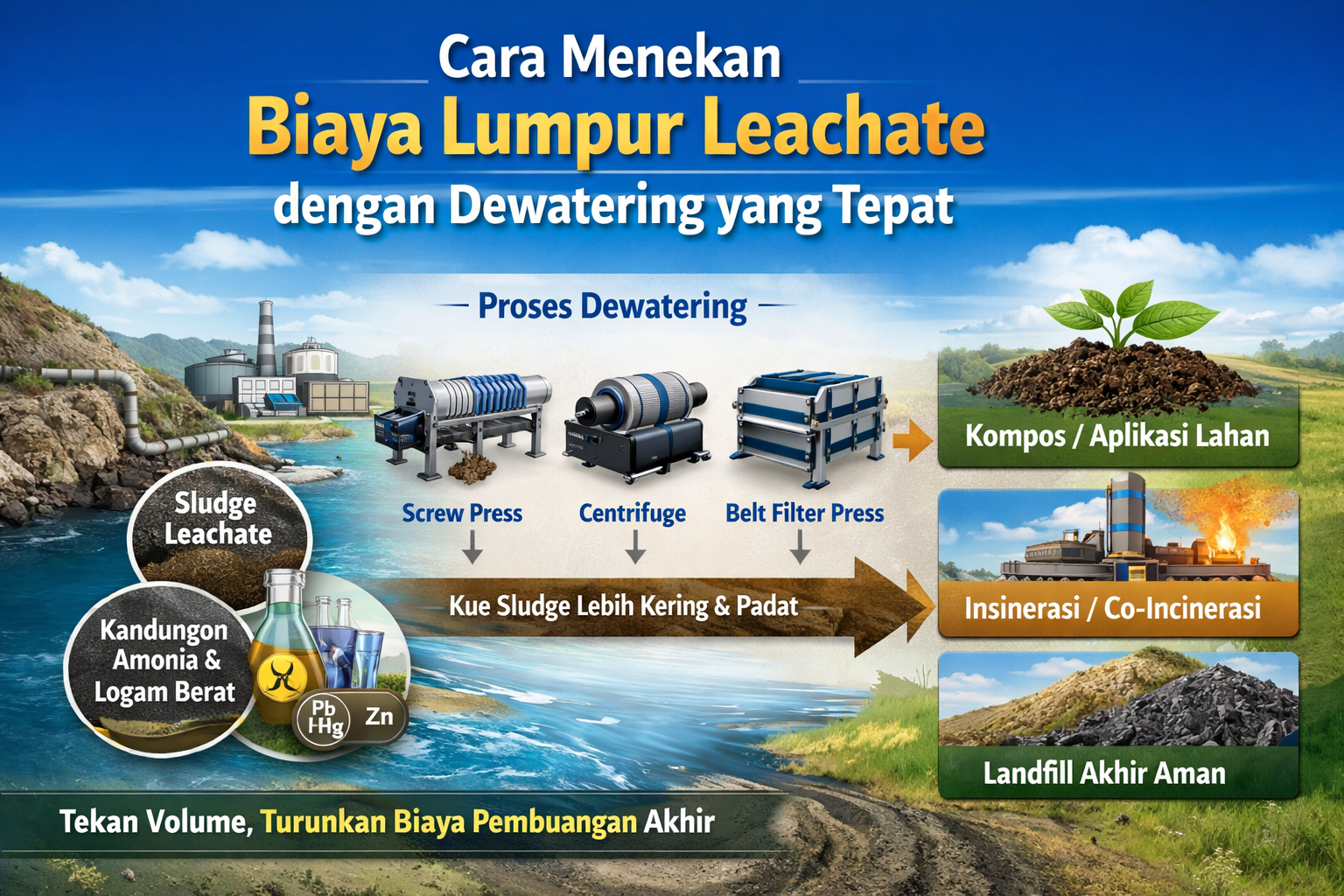
Where chemical content is relatively benign (low toxic metals) and organics/nutrients are present, dewatered leachate sludge can be co‑composted or land‑applied. An Indonesian study blending 25% leachate sludge with mature compost found that after 21 days the product met Indonesian compost standards SNI 19‑7030‑2004, with organic carbon ~18%, C:N ~10, and very low heavy metals (Cd ~2.5 mg/kg, Hg <0.1 mg/kg) (jels.ub.ac.id). Safe agricultural use requires meeting strict limits (Indonesian SNI and EU guidelines cap Cd, Pb, Hg, etc.).
Thermal treatment and cement kiln co‑processing
Sludges high in toxics often need thermal disposal. Co‑incineration in cement kilns (>1200 °C) or power plants destroys organics and pathogens; studies report ~100% removal of non‑volatile metals (As, Cr, Cu, Ni, Zn, etc.) by trapping them in clinker, though volatile metals like Hg may escape unless scrubbed (www.mdpi.com). Residual ash of about ~10–20% of original mass concentrates metals and must be managed (monofills or construction reuse if safe). Sludge must be sufficiently dried first, adding cost, and emissions need tight control; where classified as hazardous under Indonesian and EU definitions, high‑temperature treatment may be required.
Landfilling, monofills, and operational controls
If not chemically hazardous, the simplest route is to landfill the dewatered cake. Modern sanitary landfills use liners, leachate collection, and gas control. Converting 1 m³ of 2% sludge to a 20% solids cake cuts disposal volume by ~90% (to ~0.1 m³). Sludge is commonly mixed with or layered into municipal solid waste; monofilling (dedicated sludge cells) can be used for hazardous sludges to limit metal leaching. Leftover moisture can generate leachate and organics can enhance gas, so sites sometimes require additional cover or stabilizers.
Chemical stabilization and solidification
For heavy‑metal sludges, cement or other pozzolanic binders can immobilize contaminants, transforming sludge into a cemented mass for landfill or potential aggregate use. Cement‑based stabilization can reduce metal leachability dramatically. In practice, plants may mix dewatered sludge with cement or fly ash and cure to form inert blocks. The process is energy‑ and material‑intensive but can render a hazardous sludge Class A (non‑hazardous).
Regulatory anchors and compost limits
Routes to disposal hinge on regulation. In Indonesia, any sludge containing B3 (hazardous) pollutant levels must follow hazardous waste rules (PermenLH); non‑hazardous sludge defaults to solid waste rules. SNI 19‑7030‑2004 for compost sets maximum heavy metals (e.g., Cd ≤ 3 mg/kg, Pb ≤ 75 mg/kg). Internationally, U.S. EPA (40 CFR 503) and EU directives set limits for land application and incineration.
Design choices: dryness versus O&M
Effective sludge management pairs robust dewatering with a disposal plan tailored to chemistry. Screw and centrifuge systems both reach roughly ~15–25% cake solids (www.mivalt.cz; www.wwdmag.com), but screw presses do it with far less energy and maintenance (www.mivalt.cz; www.mivalt.cz). After dewatering, organic‑rich sludges can be composted or land‑applied if metal limits are met (jels.ub.ac.id); sludges high in heavy metals or toxins should be incinerated/co‑incinerated or stabilized to prevent environmental release (www.mdpi.com). Data‑backed design — testing sludge content, piloting dewatering, and life‑cycle cost analysis — is essential. Each decision point should be quantified; for instance, a 2% gain in cake solids may cost 5× the energy (www.mivalt.cz; www.mivalt.cz), so cheaper volume reduction may be more valuable overall.
Sources: Peer‑reviewed and industry literature on sludge dewatering and disposal (www.mivalt.cz; www.mivalt.cz; www.wwdmag.com; www.wwdmag.com; nepis.epa.gov; nepis.epa.gov; jels.ub.ac.id; www.mdpi.com; www.mivalt.cz; www.mivalt.cz). All cited.