

Industry: Nickel_Mining | Process: Tailings_Thickening_&_Disposal
Nickel plants in Indonesia are under pressure to turn murky tailings into clear water — fast. The rules are blunt: total suspended solids (TSS, total particles left after filtration) must be ≤200 mg/L, and even 100 mg/L for processing plants, while nickel (Ni) must be ≤0.5 mg/L in discharge, per Permen LHK No. 09/2006 (nikel.co.id) (nikel.co.id). That makes high‑performance flocculants — chemicals that bind fine particles into heavier flocs — a frontline tool for recovering water and meeting single‑digit NTU (nephelometric turbidity units, a clarity measure) in overflows.
It’s not a trivial challenge. Laterite operations generate clay‑rich slurries (kaolinite/halloysite, iron oxides) that resist settling. But with the right polymer type, molecular weight, and dose, mines can lift settling rates by orders of magnitude and dewater underflows more effectively, lab and pilot data show (mdpi.com) (911metallurgist) (tailings.info).
Regulatory limits and water targets
Indonesia’s Permen LHK No. 09/2006 sets hard edges: TSS ≤200 mg/L (and often 100 mg/L for processing plants) and Ni ≤0.5 mg/L at discharge (nikel.co.id) (nikel.co.id). Overflow clarity targets often chase single‑digit NTU for reuse. Flocculants need to aggregate fines rapidly while enabling high underflow solids so water can be recycled back to the plant.
Polymer families and charge mechanisms
The workhorses are synthetic polyacrylamide (PAM) and related polyelectrolytes: anionic (APAM), cationic (CPAM), and nonionic (e.g., polyethylene oxide, PEO). APAM — typically acrylamide with ≤30% sodium acrylate — carries negative charge and is widely used on alkaline, clay‑rich tailings; it adsorbs via hydrogen bonds and particle bridging to form large flocs (mdpi.com). CPAM (e.g., DADMAC copolymers) neutralizes negatively charged minerals at neutral‑to‑alkaline pH and can yield denser flocs. Nonionic polymers rely on long‑chain hydrogen‑bonded bridging and often need higher dose (mdpi.com).
Comparative data is blunt: in complex mine slurries, only very high‑MW, medium‑charge anionic PAMs reliably flocculated, while even large cationic or nonionic PAMs failed in analogous oil‑sands tailings tests (researchgate.net). Yet clarity can favor cationics: kaolinite flocculated with CPAM produced much lower overflow turbidity than APAM, with anionic systems retaining high negative zeta potential and trapping more fines (mdpi.com). In practice, polymer choice hinges on charge compatibility: cationics for strongly negative silicates, anionics for positive or neutral oxide surfaces, and nonionics where surfaces are mostly neutral (mdpi.com).
Compared with inorganic coagulants (alum/iron salts), polymer flocculants form three‑dimensional bridges and sweep flocs through the fluid (mdpi.com) (mdpi.com). APAM “adsorbs well onto suspended particles… leading to an increased settling rate” in fine minerals (mdpi.com). Dual‑polymer sequences can outperform single reagents: a two‑stage scheme — first cationic, then anionic — on feldspar fines captured ~98.6% floc, hit ≈2700 mm/min settling velocity, and ≈6.1 NTU (~3–5 mg/L) final turbidity (researchgate.net). For sourcing, polymer packages similar to those studied are available as mining‑grade flocculants.
Molecular weight and dose sweet spots
Molecular weight (MW) controls bridge length and floc size. Higher‑MW polymers tend to deliver larger flocs and faster settling in low shear; for example, ∼5×10^6 Da PAM at 2 mg/L produced substantial flocs in hematite tailings tests (mdpi.com). Increasing MW shifts the settling curve left — larger, faster flocs — until gains plateau (mdpi.com).
Beyond a threshold (≫10–20 ×10^6 Da), chain entanglement and coiling can reduce adsorption and flocculant activity; as Lee and Schlautman (2015) note, further MW increases “may lead to lower adsorption capacity and flocculant activity” (sciencedirect.com). Composition matters too: in high‑sodium tailings, moderate‑high MW PAMs were optimal, enhancing bridging and water release, while in high‑Ca2+ slurries a somewhat lower‑MW polymer dewatered better under low shear — a result of divalent cations forming denser aggregates that smaller polymers can penetrate (sciencedirect.com).
Settling rate and overflow clarity metrics
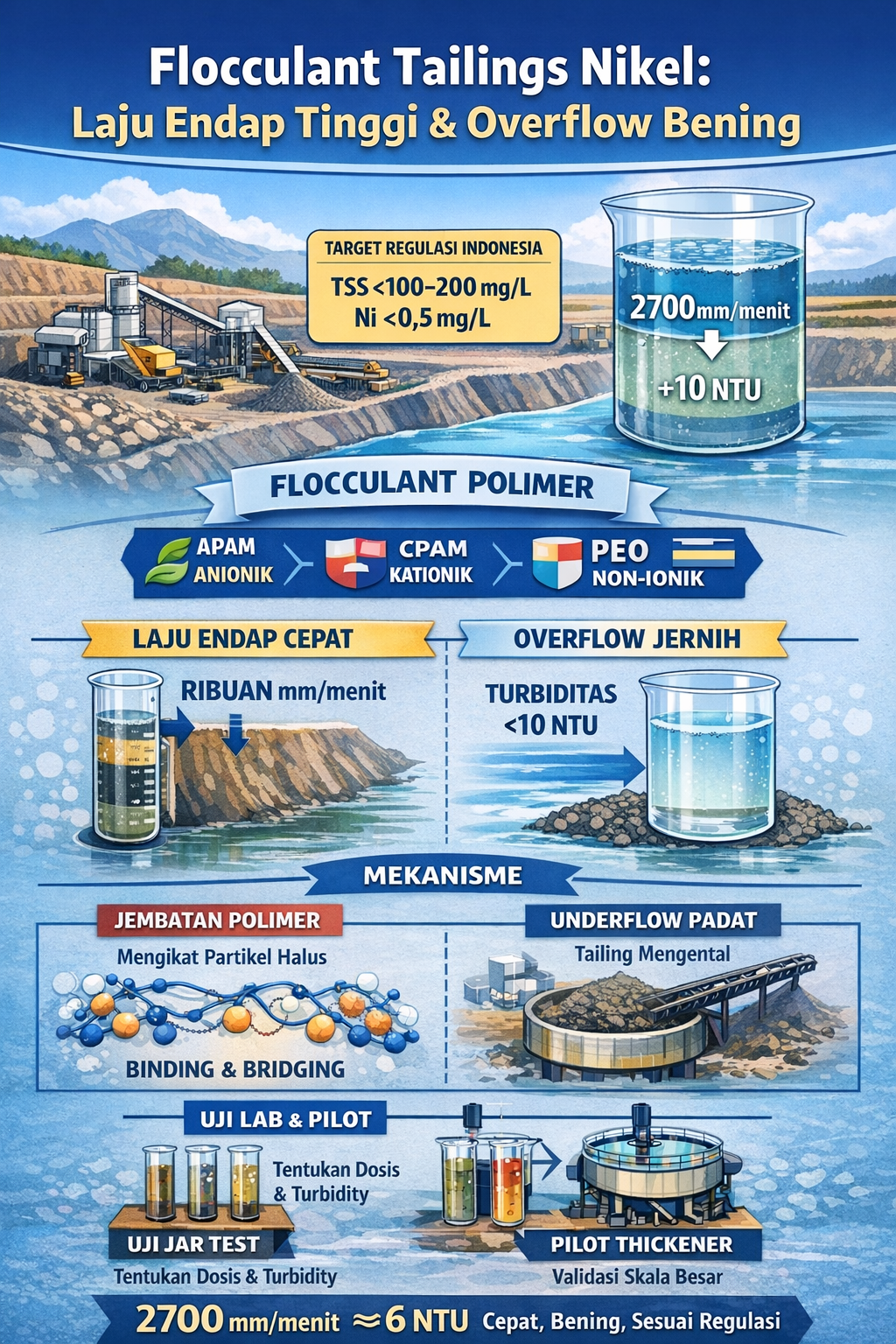
Settling performance is measured as the descent of the mudline interface, often in mm/min. High‑performing systems can reach initial velocities on the order of 10^3 mm/min for coarser suspensions; in very fine tailings, tens to hundreds of mm/min are typical. The dual‑polymer feldspar study reported ≈2700 mm/min (researchgate.net). Without flocculant, a silty suspension might drift at ~1–10 mm/min. Dose curves often follow a power law C = k·t^–m, used for thickener design (911metallurgist).
Clarity is tracked by overflow turbidity (NTU) or TSS (mg/L). In synthetic clay/quartz tests at 10% solids with 25 g/t of high‑MW APAM, overflow turbidity varied sharply: coarse quartz‑rich mixes produced the highest turbidity, while shifting to seawater (high ionic strength) cut turbidity dramatically because salt compressed the electrical double layer and let more fines aggregate (mdpi.com) (mdpi.com). Multiple studies observed that medium‑charge cationic flocs often leave the clearest water (e.g., Nasser & James) (mdpi.com). Targets should align with Indonesian TSS <100–200 mg/L compliance (nikel.co.id).
Bench‑scale selection protocol
Jar tests (graduated cylinders, e.g., 1 L) are the starting line: prepare representative tailings at ~5–20% solids, add a measured polymer dose dissolved in water, then mix rapidly for 30–60 s before gently stirring at ~100–200 rpm to form flocs. Stop and record interface height over time; sample the supernatant at 10, 15, 30, and 60+ minutes for turbidity/TSS, and use a clarity wedge for rapid visual checks (911metallurgist) (911metallurgist). Screen anionic, cationic, and nonionic options in parallel across ~1–50 g/t. Accurate chemical delivery supports reproducibility; plants typically standardize this step with dedicated equipment such as a dosing pump.
Bench‑top thickeners (e.g., Superflo or Vietti) help simulate continuous operation and assess underflow concentration and effluent turbidity under controlled feed conditions. These tests refine the polymer dose and flocculation time and allow pH adjustment and coagulant aids — e.g., 10–50 mg/L Al3+ or Fe3+ — which can dramatically alter floc structure (tailings.info) (researchgate.net). When coagulant aids are being considered, product families akin to alum/iron packages are represented by coagulants.
Water release and sludge handling get quantified through capillary suction time (CST), where lower CST means more permeable, more dewaterable flocs, and through rheology — yield stress and viscosity via rheometer or Bostwick cone — to gauge network strength. The target profile is minimum CST with moderate yield stress (strong enough to settle quickly, not so stiff it traps water) (patents.google.com) (patents.google.com).
Track settling velocity (mm/min), underflow solids (%), and overflow turbidity across doses to find the optimum. Include a blank control (no polymer). In practice, top performers often emerge in the 5–30 g/t range for fine tailings, though very fine slurries may need more; for example, clay/quartz tests used 25 g/t of APAM (mdpi.com).
Pilot thickener validation and scaling
Promising chemistries move to pilot thickeners (≈1–5 ton/day) to validate performance under continuous feed and to size full‑scale equipment (tailings.info). Test with actual plant tailings, inject the selected polymer at the optimized dose, and mimic feedwell mixing and dilution. Monitor underflow density, overflow turbidity, and polymer usage in kg/t over time. Well‑flocculated paste thickeners commonly target 50–60% underflow solids and clear overflows meeting <50–100 mg/L TSS where required, with ≤10 NTU ideal for reuse (nikel.co.id).
Optimization typically explores single versus staged dosing, dual‑polymer sequences, feed dilution, and mixing intensity. Plant KPIs include underflow % solids versus dilution, overflow TSS versus polymer dose, water recovery fraction, and rake torque/power — poor flocculation can increase torque via fibrous slimes (tailings.info). Concurrent pipe‑loop transport and beach deposition trials can assess rheology and drainage, although the pilot’s core output is thickening and water quality performance.
Reality checks matter: lab wins at 10 g/t may translate to 20–30 g/t in continuous service to hit clarity, so pilot validation is non‑negotiable. Equipment selection (high‑rate, high‑compression, deep‑cone) should reflect the tailings’ compressibility and shear sensitivity observed in pilot runs (911metallurgist) (tailings.info).
Summary of key findings
-
Settling rate: high‑performance polymers can raise settling by orders of magnitude; hundreds of mm/min are common in fine clays, and multi‑thousand mm/min has been achieved in coarser suspensions (e.g., ≈2700 mm/min in dual‑polymer feldspar trials) (researchgate.net). Rates decrease with higher clay content and very fine feeds, and increase with dose up to an optimum (mdpi.com).
-
Clarity: single‑digit NTU is routinely attainable. In synthetic systems, coarse/quartz‑rich slurries at 2.5% solids produced 3–4× higher turbidity than clayier mixes, but seawater (ionic strength) reduced turbidity by >20% by compressing the double layer (mdpi.com). Cationic polymers often deliver the clearest overflow (e.g., Nasser & James). Indonesian regulation ν (TSS <100–200 mg/L, compliance per nikel.co.id) should set the clarity target.
-
Polymer choice: empirical screening is essential. For nickel‑type tailings, high‑MW anionic PAM (∼10–20 ×10^6 Da) is a logical start, but if turbidity or settling disappoints, cationic or dual systems should be evaluated. Bracket MW — e.g., 5–15 ×10^6 Da — and tune by test. Record brand/designation and dose in g/t; these become process specs (mdpi.com) (mdpi.com) (911metallurgist) (tailings.info).
Across the lab‑to‑pilot sequence, the through‑line is measurement: settling velocity, overflow NTU/TSS, underflow % solids, CST, and rheology — all benchmarked against business and regulatory targets. Where coagulant aids are in scope, integrate them with controlled dosing and mixing, as the upstream choices dictate how well the thickener will run downstream (researchgate.net) (911metallurgist). The selection of a “high‑performance” polymer is ultimately a data exercise — and the most reliable route to nickel tailings that settle faster and clear cleaner.