

Industry: Landfill | Process: Stormwater_Management
Landfill stormwater ponds are built to catch runoff, settle out sediments and pollutants, and release water at controlled rates. They’re classed as BMPs (Best Management Practices: standard engineered measures to reduce pollution). But there’s a catch: if not maintained, they can become sources of pollution as trapped sediments are re‑suspended during storms (nepis.epa.gov) (iwaponline.com).
Stormwater operation and maintenance is routine, not optional: inspections, debris control, outlet checks, and sediment removal keep storage volume intact and pollutants contained (stormwaterbook.safl.umn.edu) (megamanual.geosyntec.com). Debris control is fundamentally a physical separation step — in practice, this is akin to a trash rack or a simple mechanical screen, the same idea represented by a manual screen in a treatment train.
Routine inspection and debris control
Agencies recommend inspecting ponds at least annually (often twice per year) and checking outlet structures for clogging after large storms (stormwaterbook.safl.umn.edu) (megamanual.geosyntec.com). Outlet pipes and weirs should be cleared of trash and roots to ensure proper drainage. Berms, side slopes, and embankments must be kept stable and vegetated (to limit erosion) while ensuring emergency spillways remain unobstructed.
Where facilities standardize this task, automated debris control is a direct analogue to an automatic screen. More broadly, these steps embody primary treatment by physical separation, the same family of unit processes as cataloged under screens and primary treatment.
Sediment accumulation and scheduled removal
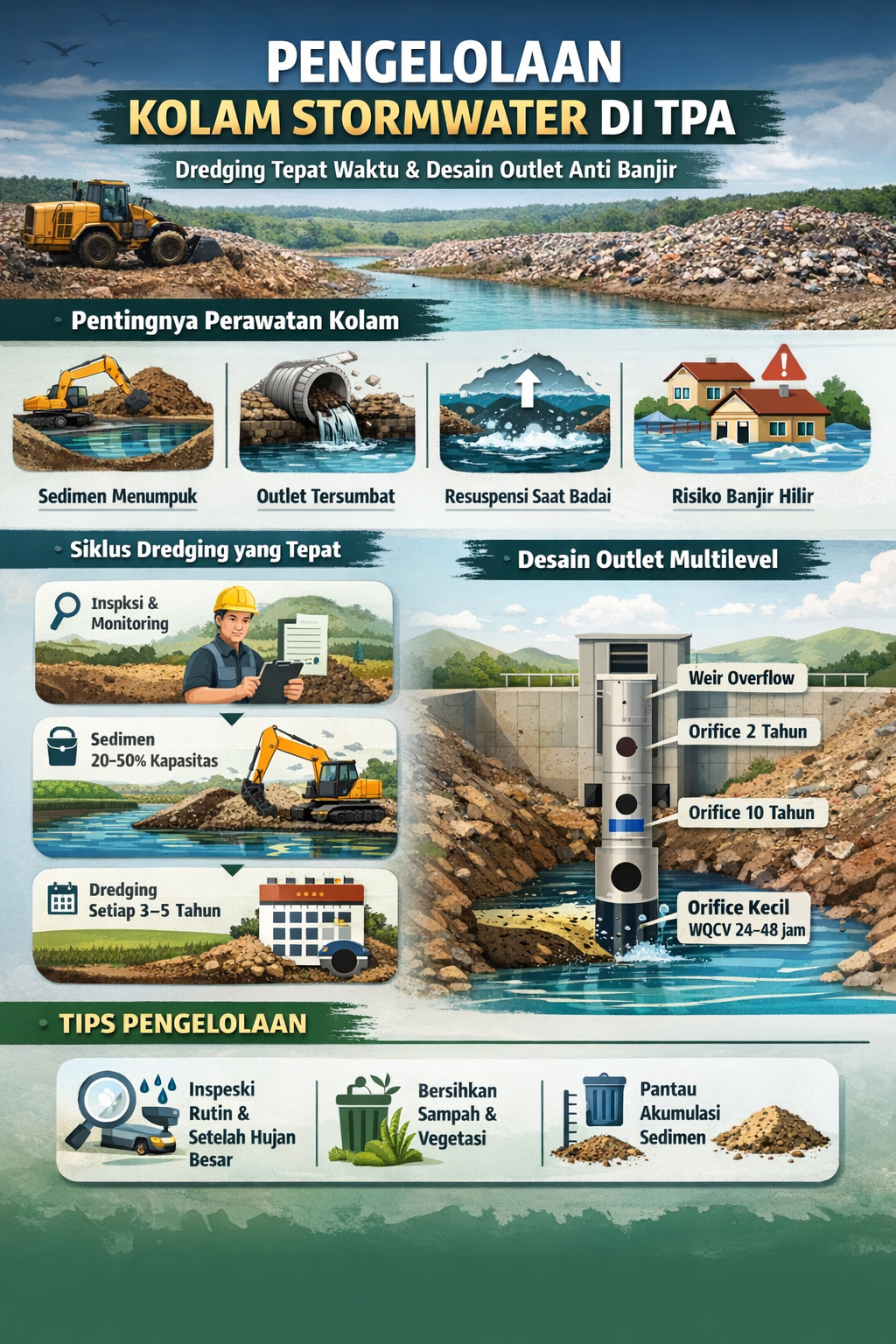
Suspended solids settle in the pond’s permanent pool over time, gradually filling storage. When sediment occupies a large fraction of the pool, the pond’s capacity for capturing new stormwater drops precipitously (jdmlm.ub.ac.id) (stormwaterbook.safl.umn.edu). Guidance is blunt: if a pond’s sediment storage is “nearly exhausted” the accumulated solids must be removed to restore capacity (stormwaterbook.safl.umn.edu).
Field data underscore the risk. In Palembang, Indonesia, retention ponds saw extremely high sedimentation rates — 227–398 mm/year — that reduced usable storage by 44–61%. At those rates, pond dead storage filled in as little as ~2–6 years, shortening effective lifespan and flood control dramatically (jdmlm.ub.ac.id).
Typical practice is to dredge sediment every few years; for instance, the Massachusetts Stormwater Handbook advises sediment removal at least once every 5 years (megamanual.geosyntec.com). In the field, ponds may be cleaned when accumulated sediment reaches 20–50% of the pool depth. The settling and detention principles here mirror tank-based solids removal in a clarifier, but at basin scale.
Performance matters: a well‑maintained pond might continue to trap >50% of incoming TSS (total suspended solids: the mass of particles suspended in water), whereas a sediment‑clogged pond performs far worse (megamanual.geosyntec.com) (jdmlm.ub.ac.id). Because pond sediments often concentrate heavy metals and organics, periodic removal (and proper disposal) prevents these pollutants from re‑entering the environment; reviews report markedly elevated heavy‑metal concentrations in pond muck compared to natural soils (researchgate.net) (researchgate.net). Stormwater experts put it plainly: “retention ponds without sediment management” can incur “unexpected costs and reduced effectiveness over time,” making “regular monitoring and maintenance” crucial (iwaponline.com).
Outlet structure design and staging
The outlet structure — an orifice (a calibrated opening) and a weir (an overflow crest) — is the throttle for discharging stormwater and preventing downstream flooding. Design aims typically require that a pond release runoff no faster than pre‑development (natural) peak flows. Standard criteria attenuate 2‑, 10‑, and 100‑year storm peaks to undeveloped levels (help-innovyze.atlassian.net).
In practice, a multi‑stage outlet is used. A bottom orifice controls smaller flows, while an elevated weir handles large storms. A typical “stacked outlet system” works like this: a small‑diameter orifice at lowest depth slowly drains the permanent pool (capturing first‑flush pollutants), larger orifices at higher elevation handle moderate storms, and an upper overflow weir engages only during extreme events (help-innovyze.atlassian.net) (help-innovyze.atlassian.net). One design example illustrates it explicitly: Orifice 1 alone drains the water‑quality capture volume (WQCV: the portion of runoff targeted for quality treatment), Orifices 1+2 control the 2‑year storm, Orifices 1–3 handle the 10‑year storm, and all orifices plus the overflow weir discharge the 100‑year flood (help-innovyze.atlassian.net).
Key parameters are orifice area and weir crest height. The outlet is sized so the water surface under the design storm rises to the target detention depth and flows out at a controlled rate. Many handbooks require the WQCV to drain in ~24–48 hours to allow solids to settle; the orifice is sized (via standard orifice‑flow equations) to meet this drawdown time (help-innovyze.atlassian.net). If tailwater conditions exist downstream, the outlet may need extension (risers or flared end pipes) to maintain head. In all cases, include a trash rack or anti‑vortex baffle to prevent clogging, plus an emergency spillway for backup (help-innovyze.atlassian.net).
Measured flood control outcomes
When properly designed and operated, ponds reduce downstream flooding measurably. In West Java, newly built retention ponds at Dayeuhkolot (Bandung) cut floodwater levels roughly in half: peak floods of 1–2 m before construction were reduced to ~0.5 m after pond activation (iwaponline.com). Analyses characterize retention basins as “extraordinarily cost‑effective” for flood protection, provided sediment buildup is accounted for (iwaponline.com).
The flip side is also documented: if outlets are undersized or sediment not removed, ponds can spill more often or exacerbate flooding by sudden failures. Operators should verify outlet performance through post‑storm drawdown tests and adjust if flows exceed design (iwaponline.com).
Key practices and data points
- Inspect pond outlet/structure ≥1×/year (often 2×/yr) and after major storms; remove debris and check for clogging (megamanual.geosyntec.com) (stormwaterbook.safl.umn.edu).
- Remove sediment when it occupies a large fraction of the pool (empirical targets: ~20–50% of volume) or at least every 3–5 years (megamanual.geosyntec.com) (stormwaterbook.safl.umn.edu).
- Outlet orifice(s) sized to drain design WQCV over ~24–48 h; peak flows of design storms limited to pre‑development rates (help-innovyze.atlassian.net) (help-innovyze.atlassian.net).
- Multi‑stage outlets (multiple orifices + spillway) are used to stage‑control outflows (help-innovyze.atlassian.net).
- Monitoring shows sediment rates (e.g., ~0.23–0.40 m/year) can quickly fill ponds, so maintenance is data‑backed (jdmlm.ub.ac.id).
- Flood studies confirm retention ponds halve downstream flood elevations (e.g., from ~1–2 m to ~0.5 m) (iwaponline.com).
Operating as an active system
The throughline is simple: landfill stormwater ponds must be run as active systems. Inspect and clear outlets regularly, remove trash and debris, and dredge accumulated sediment on a scheduled cycle. Doing so preserves design storage and water‑quality function, keeping peak discharges within limits and buffering downstream waters from floods and pollution (jdmlm.ub.ac.id) (iwaponline.com). For teams aligning parts and tools, these are supported by standard water treatment ancillaries common to drainage structures.
Source base and manuals
This guide draws on authoritative manuals and studies on stormwater pond design and maintenance, including EPA stormwater management guides (nepis.epa.gov) and modeling/design examples (help-innovyze.atlassian.net), university/industry compendia (stormwaterbook.safl.umn.edu) (megamanual.geosyntec.com), and recent research from Indonesia and elsewhere (jdmlm.ub.ac.id) (iwaponline.com) (iwaponline.com). All cited materials provide data‑driven recommendations and outcomes relevant to landfill stormwater ponds.