

Industry: Brewery | Process: Milling
In brewing, the crush isn’t just a mechanical prelude; it’s a control point that shapes extraction, filtrability, and consistency. Breweries use roller mills to crack malt kernels so water can access the endosperm while the husk (the grain’s outer envelope that aids filtration) remains largely intact. The mill architecture—two, four, or six rollers—determines how precisely a brewery can sculpt that crush profile, how well husks are preserved, and how uniform the grist becomes (crispmalt.com) (crispmalt.com).
Quantitatively, mills aim to deliver three key fractions—intact husk pieces, coarse grits (broken endosperm), and fine flour—in proportions tuned to a brewery’s lauter system and target efficiency. Guides point to a crush with roughly half the grist as coarse husk pieces and grits, and only a small flour fraction, to balance ease of lautering against extraction (brewingforward.com).
Roller architectures and crush control
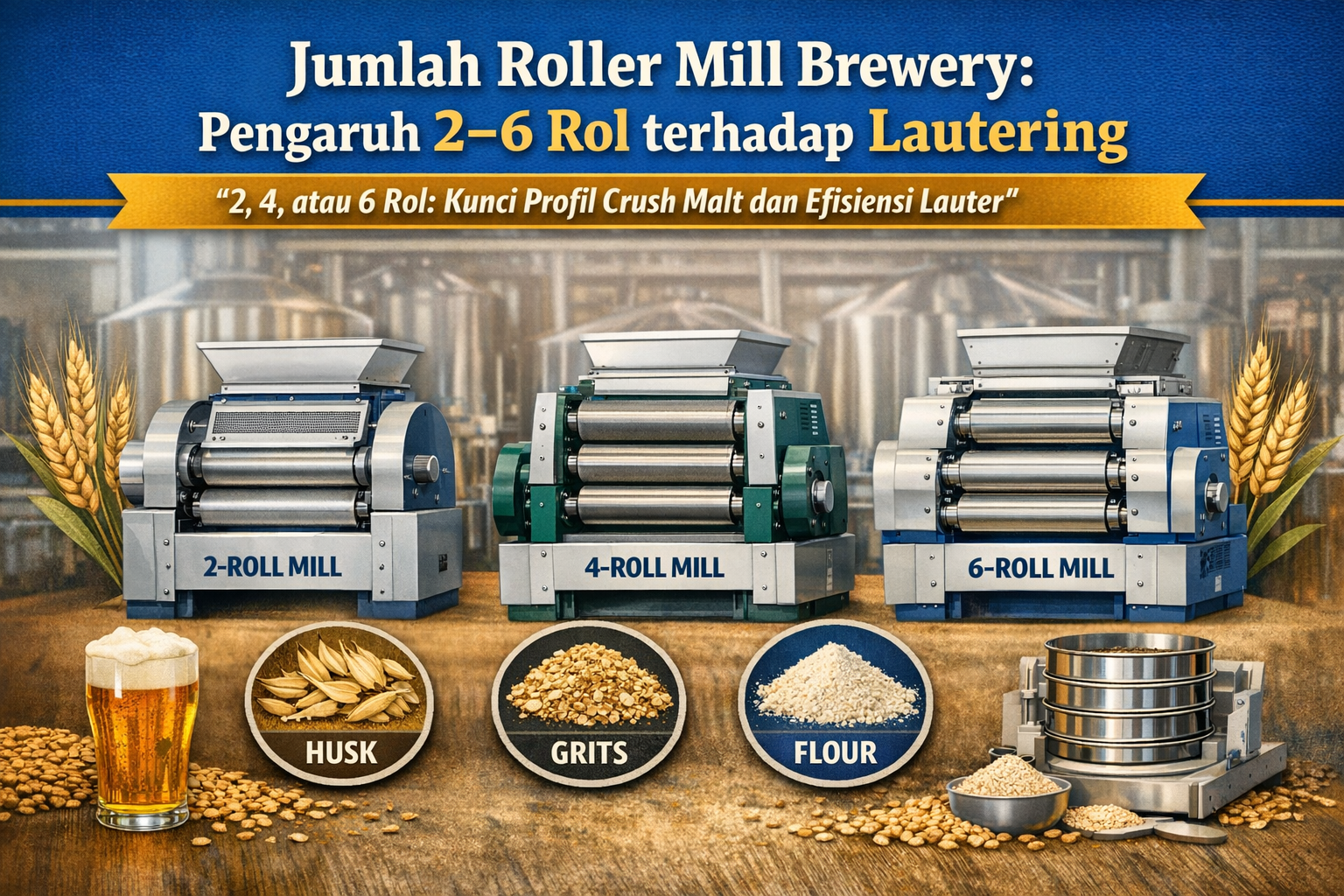
A two-roller mill (single pass) is simple and lower cost, commonly used by small breweries or with highly friable malt (friability: how easily a malt kernel crumbles) (crispmalt.com) (crispmalt.com). It delivers a coarser, less uniform grind and has to thread the needle between fully crushing all kernels and not pulverizing husks.
Four-roller mills introduce two stages: a roughing pair (often with wide flutes) and a fine-crush pair. The first stage does most of the breaking—often using a beater or sieve to divert fine particles—while the second pair finishes hard fragments, improving particle-size uniformity and allowing intact husks to “bypass” further damage (crispmalt.com) (crispmalt.com).
Six-roller mills add a third stage, often with automatic gap control, and commonly screen out flour after the first pass so only coarser pieces continue to later rollers. That sequencing maximizes husk protection and evens out the crush across malt types (crispmalt.com) (crispmalt.com) (crispmalt.com). In practice, two-roller mills suit small craft or infusion mash systems, four-roller mills suit mid-sized brewhouses, and six-roller mills (often with multiple sieves) are used by large or high‑throughput breweries (k-malt.com) (crispmalt.com).
Multi-roller designs, including three-roller variants, sometimes run rollers at different speeds to shear husks without shattering them—an approach shown to improve extract yield while reducing husk damage (brewingforward.com) (brewingforward.com).
Grist composition and practical targets
Numbers matter. Briess-guided targets include about 50–60% of crushed malt retained on a 1.4 mm sieve (U.S. #14, largely husk), about 25–32% on a 0.6 mm sieve (#30), and minimal flour—less than 10% through a 0.25 mm sieve (#60) (brewingforward.com). Coarsening the crush to 70–85% on #14 favors filtrability but sacrifices some extraction; a finer crush modestly raises extract yield (brewingforward.com).
Raw material differences matter too. Switching from a hard (low‑friability) malt to a soft (high‑friability) malt—without changing the mill—has produced visibly finer grinds and measurably higher extract, while increasing lautering risk (crispmalt.com). More rollers improve sizing consistency and husk/endosperm separation, but on well‑modified malt they do not automatically boost yield (crispmalt.com) (crispmalt.com). One manufacturer suggests 4/6‑roller designs can even cut malt usage by up to ~10% via improved efficiency (vendor‑supplied claim; results depend on system) (probrau.com).
Roller gap setting and maintenance
The roller gap—the distance between rolls—controls particle size. Tighter gaps yield smaller particles (more flour, higher predicted extract); wider gaps produce coarser grist (more intact husk, faster lautering) (brewingforward.com) (brewingforward.com). The compromise is explicit: the gap must be narrow enough to crack all kernels—no uncrushed grains—yet wide enough not to pulverize husks, which can slow or stick the lauter and contribute astringent, tannin‑derived flavors (brewingforward.com) (brewingforward.com).
For barley malt, common settings are 0.7–1.2 mm (0.025–0.050 inches). Brewers set this with feeler gauges or even stacked credit cards for ~0.76 mm, and then clamp both ends of each roller to keep the gap parallel across the roll width (brewingforward.com) (brewingforward.com) (rmsroller-grinder.com). Visual checks after a test grind confirm that all kernels are cracked and husks remain as porous flakes (brewingforward.com).
Maintenance locks that setting in place. Vendors recommend monthly “paralleling and zeroing” to reset the contact zero point and keep an even crush across the width (rmsroller-grinder.com). Progressive dulling of rolls pushes particles larger while also generating excessive fines; burnished or grooved rollers should be reconditioned or replaced to avoid efficiency losses (rmsroller-grinder.com). Bearings, belts, and adjustment screws require routine lubrication; worn or damaged belts cause downtime and must be addressed promptly (rmsroller-grinder.com) (rmsroller-grinder.com).
Safety and cleanliness are operational factors. Dust build‑up is a contamination risk and an explosion hazard; safety standards comparable to EU ATEX call for dust controls in milling areas (crispmalt.com). Many breweries install magnets or destoners ahead of the mill to remove metal and rocks. Without routine realignment and cleaning, teams often see “an inconsistent crush with larger pieces and excessive fines,” rising levels of flour (panash), and slowing lauter times (rmsroller-grinder.com).
Laboratory sieve analysis for QC
Breweries verify the crush profile by sieve analysis, following ASBC (American Society of Brewing Chemists) and MEBAK (German brewing analysis committees) practice. A stack typically includes U.S. #14 (1.4 mm), #30 (0.6 mm), #60 (0.25 mm), and a bottom pan. A 100–130 g sample is milled and shaken through the sieves—often with small balls to aid flow—for a set time, then each fraction is weighed to compute percentages (brewingforward.com).
Quality targets are quantitative: about 50–60% on #14 (good husk fraction), 25–32% on #30 (coarse grits), less than 10% on #60 (fine grits), and 5–10% retained in the pan (flour) (brewingforward.com). Raising #14 from 55% to ~75% improves lautering ease at some yield cost (brewingforward.com).
ASBC’s study work backs the method’s practicality: in Schwarz et al. (2002), ten analysts using #10–#100 sieves on four malt samples found repeatability CVs (coefficient of variation, a measure of precision) of 0.8–11.6% and reproducibility CVs of 2.0–16.3%—acceptable for routine monitoring (asbcnet.org). Manual versus mechanical shaking differences were statistically measurable but practically small (asbcnet.org).
In everyday use, even a hand‑shaken test reliably flags drift. If the #14 fraction moves ~5–10 points outside target, brewers suspect the gap or mill condition; periodic sieve checks are especially useful when malt specifications change because each malting lot can grind differently (brewingforward.com). When “burgundy mash times” or extraction efficiency slip, comparing current sieve results to past benchmarks can pinpoint a magnesium; falling husk% (low #14) or rising flour% often correlates with too‑tight gaps or worn flutes (brewingforward.com) (brewingforward.com). Breweries log sieve results and adjust gaps to keep each vessel’s crush within a “safe operating window.” In business terms, a proper crush versus too coarse can boost extract by about 1–2 percentage points; one vendor claims optimized milling saved up to ~10% malt for some breweries (system‑dependent) (probrau.com).
Operating window and process aim
The operational aim is consistent: preserve filtration aid in husks while liberating starch in the endosperm—avoiding stuck lauters and astringency—then quantify the result with sieves to steer settings (beer-brewing.com) (brewingforward.com). The architecture (two, four, six rollers), the gap (0.7–1.2 mm for barley), and the maintenance regime (from monthly zeroing to dust controls comparable to EU ATEX) combine to define that window—batch after batch (k-malt.com) (rmsroller-grinder.com) (crispmalt.com).