

Industry: Nickel_Mining | Process: Ore_Crushing_&_Grinding
Two ore families, two playbooks: sulfides feed flotation; laterites go pyrometallurgical (RKEF, rotary kiln electric furnace) or hydrometallurgical (acid leaching and SX‑EW, solvent extraction–electrowinning). That split means very different “ideal slurries” and very different grinding circuits, and the stakes are rising as Indonesia now holds ≈22% of world reserves and dominates refined supply (61% in 2024) (zoneding.com; researchgate.net; nbr.org; ft.com)).
Globally, laterites represent ~70% of nickel resources, yet simpler sulfide concentrates still deliver ≈60% of current output—a mismatch shaping comminution targets (researchgate.net). And with comminution alone burning through roughly half the mill’s operating spend and ~3% of global power, circuit selection and chemistry are board-level variables (ceecthefuture.org).
Ore types and processing routes
Nickel sulfides (pentlandite, vaesite) typically run through multi‑stage grinding and froth flotation (air bubbles attach to hydrophobic particles) to produce Ni–Cu concentrates. Laterites (silicate‑ or oxide‑bound Ni) head to RKEF/pyrometallic smelting or hydrometallurgy such as high‑pressure acid leaching (HPAL) and SX‑EW (zoneding.com; researchgate.net). Indonesia’s build‑out underscores the shift: PT Vale’s new Sulawesi HPAL will produce mixed hydroxide precipitate (MHP) at scale (reuters.com).
These routes drive different grind objectives: flotation needs fine, liberated particles (≪100 µm), while leaching often prefers coarse feed (≤1–10 mm) and set pulp densities to avoid sliming (researchgate.net; ceecthefuture.org). Identified nickel reserves exceed 100 Mt and grew ~5.3%/yr by 2022, pushing lower head grades and tighter plant controls (mdpi.com).
Grinding circuit selection and energy
Common flowsheets include SAG (semi‑autogenous grinding) or AG (autogenous grinding) followed by ball mills or rod mills; HPGRs (high‑pressure grinding rolls) increasingly substitute or augment SAG for competent ores, cutting energy ~10–30% in favorable cases (ceecthefuture.org). In the fine and ultrafine regimes, vertical stirred mills (e.g., Vertimill, HIGmill) are now standard regrind tools.
Classification is usually closed‑circuit with hydrocyclones to hit a target product size (P80, the 80th percentile passing size). Plants tune cyclone split and recirculating load via mass‑balance models (e.g., JKSimMet) to avoid over‑grinding. Best practice emphasizes pre‑concentration (e.g., ore sorting) and HPGR adoption, with CEEC flagging significant reductions in specific energy when replacing SAG with HPGR + ball mills—often ~10–20% under comparable conditions (ceecthefuture.org).
Scale and hardness drive sizing: very hard laterites may require more robust primary crushing; softer limonites can bypass SAG and go directly to ball mills. The largest SAGs exceed 12 m (44 ft) diameter; HPGR trains are reported for >30 Mt/y plants; vertical mills can shrink footprint in regrinds. Comminution’s burden—~50% of mill operating costs and ~3% of global electricity—keeps energy at the center of every decision (ceecthefuture.org).
Size–recovery trade‑offs in flotation
Flotation recovery is strongly size‑dependent: coarser particles are under‑liberated; ultrafines (<10–20 µm) suffer kinetic and surface‑chemistry penalties (researchgate.net). In a Brazilian pentlandite case, targeting P30 at 0.074 mm (i.e., 30% passing 74 µm) delivered ≈93% Ni recovery at ~26.8 kWh/t specific comminution energy—verified against 26.6 kWh/t plant data (scielo.br).
Serpentine (Mg‑silicate) is the classic spoiler in Ni sulfides. Often exceeding 70% of the ore and very soft (Mohs <2.5), it grinds to clay‑sized (<10 µm) ultrafines that coat valuable grains, consume reagents, increase entrainment, and complicate smelting (mdpi.com; mdpi.com). The result: the “just‑enough” grind—often P80 in the 50–100 µm range—maximizes liberation without triggering ultrafine penalties (researchgate.net).
Chemical additives and slurry conditioning
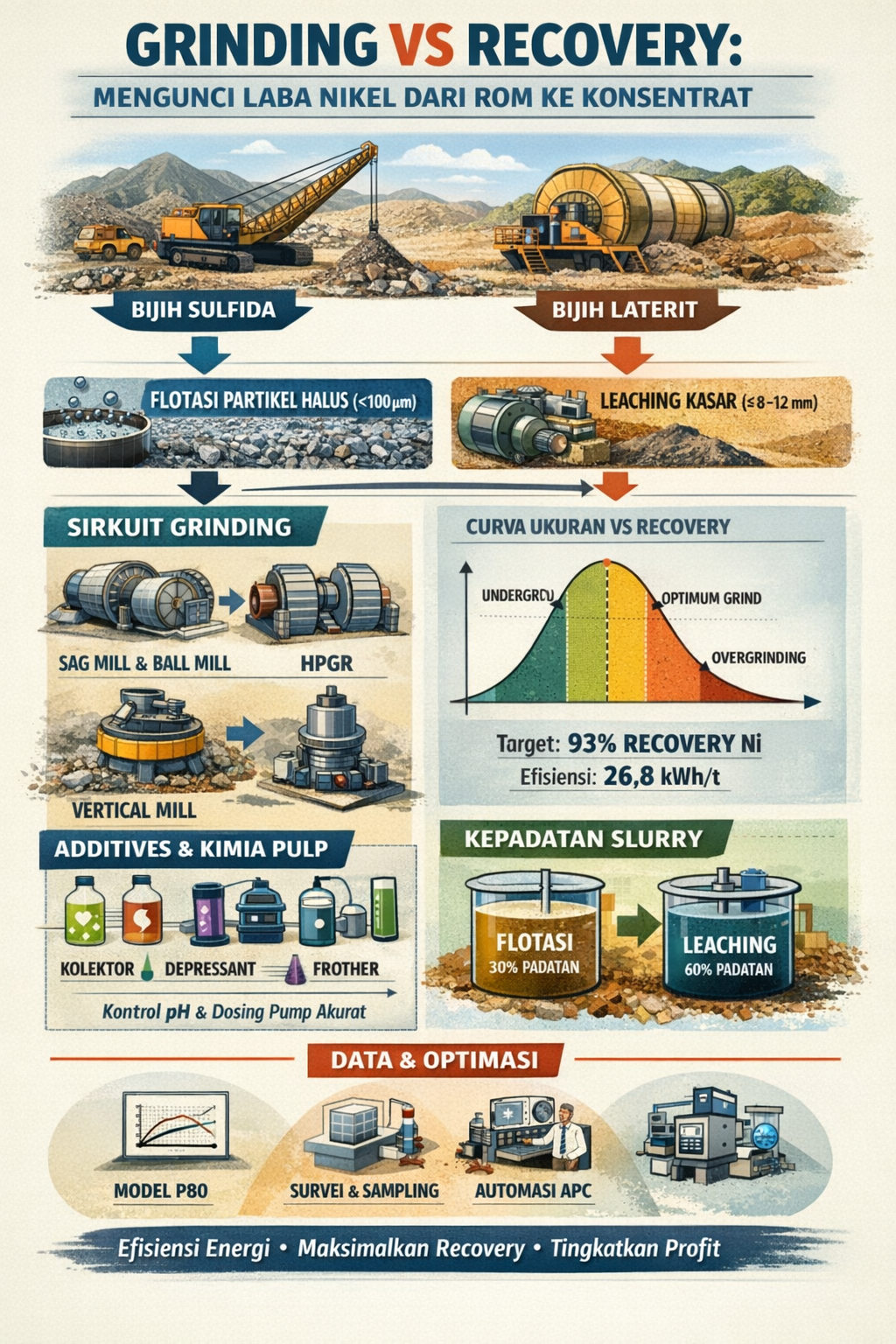
Grinding aids (e.g., glycols, amines) can reduce re‑agglomeration and energy demand; lignosulfonates or starch derivatives can sharpen P80 by limiting over‑grinding. Within mills and cyclone feeds, dispersants keep clays from gelling the pulp—polyacrylates are common, and comparable chemistries appear in industrial dispersant chemicals. The payoff is steadier cyclone cut size and transportable slurries.
pH control is central. In sulfide flotation, alkaline conditions (pH ~8–11) with lime are typical. But there’s a trap: above ~8, Ni²⁺ released by fresh grinding can precipitate as hydroxides onto serpentine, effectively “activating” it and worsening gangue capture (mdpi.com). Plants stage lime addition or temper alkalinity; small additions of calcium or magnesium compounds can also curb slimes frothing. Accurate metering supports these setpoints and reagent regimes, a domain for equipment like an industrial dosing pump.
Collectors (xanthates, dithiophosphates) and frothers (pine oil) shape bubble attachment and froth life, but depressants often decide grade. NaHS (sodium hydrosulfide) is widely used against pyrrhotite/pyrite. For serpentines, chelating organics such as citric acid bind Mg and render the gangue more hydrophilic: in one Ni–Cu rougher test, citric acid lifted Ni recovery from 16% to 95%—a 79‑point gain—by dissolving surface Mg/Fe and preventing serpentine–pentlandite coagulation (mdpi.com; mdpi.com). Sodium silicate and carbonate further push serpentine to “float last.”
Slurry properties are tuned to the route. Flotation plants typically run ~25–35% solids by weight; hydromet circuits often go much thicker (e.g., ~60% solids in HPAL). After grinding, thickeners and flocculants (polyacrylamides) prepare underflow feeds to reactors and tailings. In Indonesian HPAL practice cited alongside Vale’s build, flocculants target ~8% underflow solids for thickened tailings while autoclaves receive ~60% solids (reuters.com). Reagent selection in this step often leans on mineral‑processing flocculants to achieve target densities and settling rates.
Linking grind to recovery economics
Plants increasingly use size‑by‑assay models—assaying Ni across size fractions—to predict how recovery shifts with grind fineness. The business‑optimal grind maximizes (concentrate value – grinding cost). Pushing one stage finer might lift recovery from 90% to 93%, but with extra kWh/t; the question is whether the incremental metal pays for the power (researchgate.net; scielo.br). As one framework puts it, the process “maximizes profit, not recovery” (researchgate.net).
Advanced Process Control (APC) ties mill power draw, water addition, and ore feed to target P80 or throughput; online size analyzers, level controllers, and cyclone pressure sensors stabilize the circuit. CEEC points to digital twins and machine learning as long‑term levers for comminution optimization (ceecthefuture.org). Upstream, mine‑to‑mill integration—finer blasting, pre‑crushing, or ore sorting—can lift SAG throughput and trim energy; downstream, regrinds (to <20 µm) and modern cells (e.g., the Concorde Cell™) extend ultrafine recovery (metso.com).
Case metrics and operational benchmarks
Brazilian sulfide plant benchmark: P30 at 74 µm delivered ~93% Ni recovery at ~26.8 kWh/t (design) versus 26.6 kWh/t actual—clear evidence that grind–recovery–energy models can be predictive (scielo.br). Depressant uplift: a serpentine‑rich Ni–Cu ore jumped from 16% to 95% rougher Ni recovery using citric acid, demonstrating that chemistry can enable a coarser primary grind without sacrificing yield (mdpi.com).
Indonesian laterite HPAL note: Vale Indonesia’s Sulawesi plant design points to sub‑8 mm feeds for agitated leach, autoclave feeds at ~60% solids, and careful fines control to manage viscosity and recovery (reuters.com). Globally, adoption of very‑fine grinding plus columns or new cells is trending to capture “lost” ultrafines; Indonesia’s added HPAL capacity and quota management are reshaping supply dynamics (metso.com; reuters.com; ft.com)).
Operational guardrails and practice
Model before build: full‑flow simulations (JK models; DEM/FEA for novel units) stress‑test different circuit options, grinding targets, and recirculating loads to maximize NPV rather than any single KPI. Regular plant surveys validate P80 in cyclone overflow, track kWh/t, and quantify recirculating loads against the model.
Reagent programs benefit from continuous A/B testing. Bench flotation on alternative depressants or dispersants can reset the grind–recovery point; the citric‑acid example shows chemistry can, in effect, “buy” coarser grinds at constant or higher recovery (mdpi.com). Flowsheet steps that change pulp rheology or settling respond to formulation tweaks in mineral flocculants and to disciplined reagent control via a plant dosing pump.
APC keeps mills loaded without runaway fines; adaptive setpoints accommodate ore‑hardness swings. Core KPIs—kWh/t, recirculating load, Ni grade and recovery, grind size distribution, water usage, and reagent consumption—anchor trend analysis. According to CEEC, pre‑crushing/ore sorting, HPGR adoption, and digital control (including digital twins and machine learning) are now standard pathways to higher throughput with less energy and water (ceecthefuture.org).
Bottom line for senior metallurgists
Synchronized optimization of grinding and recovery is essential. The Brazilian benchmark (≈93% Ni at P30 at 0.074 mm and ~26.8 kWh/t; 26.6 kWh/t actual) and the 79‑point citric‑acid uplift (16% to 95% recovery) quantify what’s at stake (scielo.br; mdpi.com). In practice, that means grinding only as fine as liberation dictates, curbing serpentine ultrafines, conditioning pH without activating gangue, and ensuring slurry density stays fit for either flotation (~25–35% solids) or HPAL (~60%). As ore grades drift lower and Indonesia expands HPAL, every incremental kWh/t and percentage point of recovery remains material (reuters.com; ft.com)).