

Industry: Brewery | Process: Fermentation
Healthy beer fermentation depends on nutrients, not just sugars and yeast. In a nutrient‑deficient wort, yeast growth is inhibited, fermentations stall or become erratic, and attenuation turns inconsistent, according to Wyeast’s guidance for its Beer Nutrient Blend (wyeastlab.com).
All‑malt worts generally supply most macro‑ and micronutrients—sugars, malt‑derived amino nitrogen, vitamins, and minerals—except often zinc (braukaiser.com) (brewingforward.com). As one brewer put it: “Zinc may be the only yeast nutrient that barley malt is deficient of” (braukaiser.com).
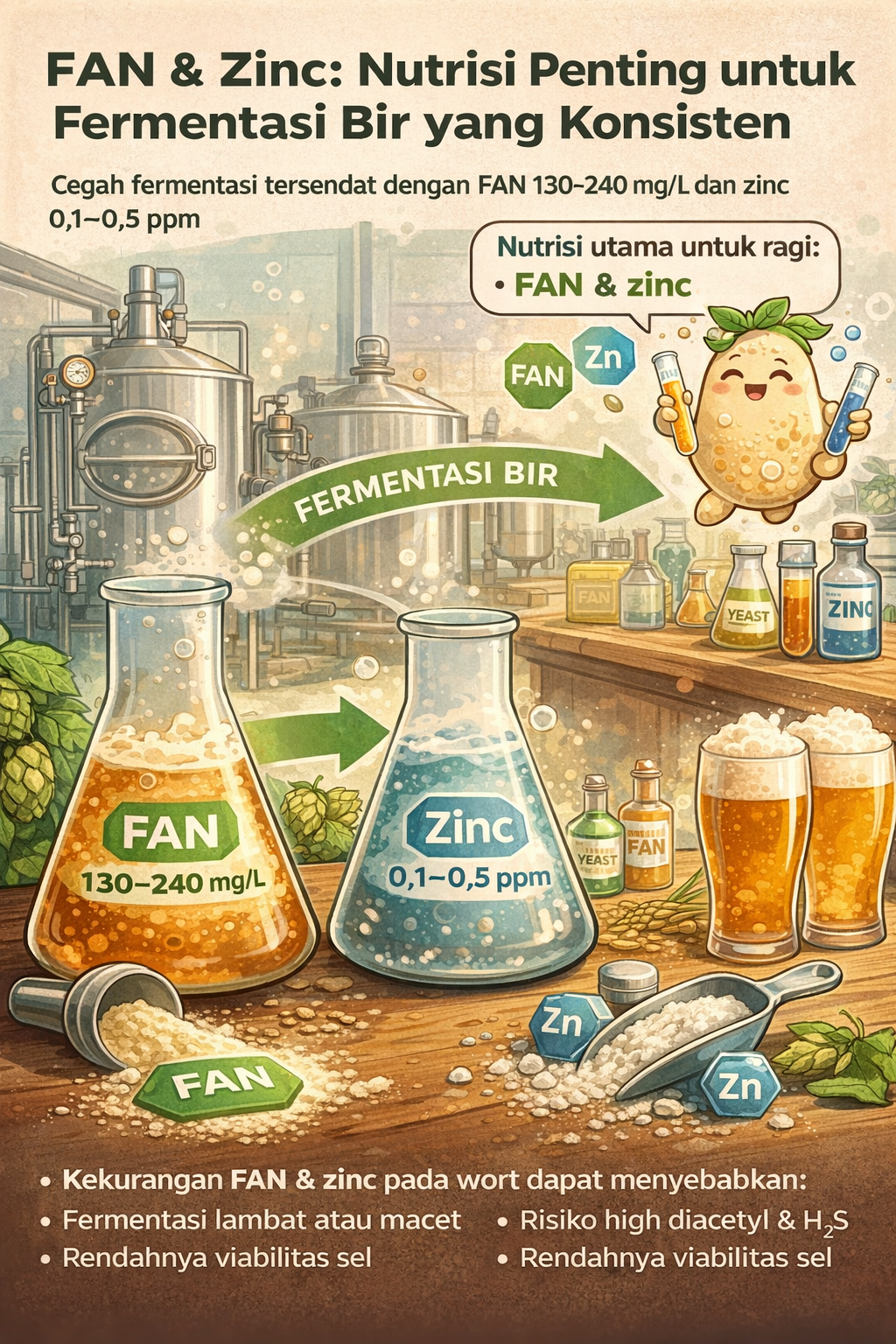
When nutrients are insufficient, fermentations slow or stick and off‑flavors creep in, including sluggish sugar attenuation and high diacetyl (brewingforward.com) (studyres.com).
Free amino nitrogen requirements
Nitrogen drives yeast growth and fermentation rate. Yeast assimilate nitrogen from free amino nitrogen (FAN, the pool of amino acids, small peptides, and ammonium available in wort) (mdpi.com) (mdpi.com). Reviews and experiments indicate that all‑malt worts typically supply enough FAN, but when FAN levels drop, outcomes suffer.
Hill et al. (2019) report that worts around 10–12°P (degrees Plato, a measure of wort sugar concentration) require on the order of 130 mg/L FAN (milligrams per liter, roughly equal to ppm) for reliable fermentation, and that below ~100 mg/L the yeast may stall, under‑attenuate, or produce H₂S (mdpi.com). Some researchers target higher FAN—200–250 mg/L—for full‑strength worts or special cases; a wort with ~200–240 mg/L FAN is often cited as “optimal” for a normal‑strength wort (researchgate.net) (mdpi.com).
Adjuncts dilute FAN: one analysis shows that using 25–50% sugar adjunct dropped wort FAN by ~20–50% compared to all‑malt, often necessitating supplements (mdpi.com). Higher FAN enables more rapid sugar consumption and a deeper pH drop during fermentation (mdpi.com), whereas nitrogen‑starved yeast skew toward off‑flavors such as diacetyl and H₂S (mdpi.com) (studyres.com).
Zinc as a trace mineral cofactor
Zinc (Zn) is critical as a cofactor for dozens of yeast enzymes, including alcohol dehydrogenase, and for cell division (brewingforward.com) (studyres.com). Typical worts contain only a few tens of µg/L Zn because malted barley yields only ~20% of its Zn into the wort (brewingforward.com), which is often below the ~0.1–0.2 mg/L yeast need.
Recommended wort Zn levels are ~0.1–0.5 mg/L (ppm) (brewingforward.com) (whitelabs.com). Supplementation in this range generally speeds fermentation and prevents stuck fermentations (studyres.com) (whitelabs.com).
Braukaiser’s trials found that adding ~0.2 mg/L Zn yielded the highest yeast growth, with no additional benefit at higher levels (braukaiser.com). Above about 0.5–0.6 mg/L Zn, yeast can be inhibited or produce off‑flavors, including astringency (braukaiser.com) (brewingforward.com).
Mineral balance and oxygenation
Beyond Zn, yeast need potassium, magnesium, calcium, phosphate, sulfur, and trace minerals for osmotic balance and as enzymatic cofactors (beer-brewing.com). Phosphate feeds energy metabolism and biomolecule synthesis; magnesium and potassium stabilize enzymes.
Malt usually provides sufficient magnesium and phosphate, but yeast can be drawn down in long or hot fermentations, making general mineral supplementation a consideration in stressful brews. Good practice includes aerating oxygen (for sterol synthesis) and ensuring sufficient magnesium and sulfate (SO₄²⁻) in the brewing water (beer-brewing.com).
Commercial nutrient blends and Servomyces
To meet broad nutritional needs, brewers use nutrient blends that combine vitamins, organic nitrogen (yeast extract, autolyzed protein), inorganic nitrogen (diammonium phosphate), and mineral salts. Wyeast’s Beer Nutrient Blend contains “vitamins, minerals, inorganic nitrogen, organic nitrogen, zinc, phosphates and other trace elements” (wyeastlab.com).
Servomyces—produced by growing brewer’s yeast in high Zn and Mg, then drying and inactivating it—supplies concentrated vitamins and trace minerals embedded in yeast hulls. White Labs reports that 1 g/hL Servomyces delivers roughly 0.5 ppm Zn to the wort (whitelabs.com), and “biological” delivery often drives faster fermentations than adding mineral Zn alone (studyres.com). Where precise g/hL dosing is required, accurate chemical dosing equipment such as a dosing pump supports consistent addition.
Measured impacts on kinetics and quality
With proper nutrients, fermentation kinetics accelerate and cell counts rise. In trials, worts with added Zn reached higher yeast dry weight—a proxy for viability—than controls (braukaiser.com).
Insufficient FAN or Zn correlates with higher residual gravity and longer fermentation. Adequate FAN yields 60–90% apparent attenuation for 12–15°P worts (typical lagers and ales). Excess nutrients do not speed fermentations further; high FAN can raise diacetyl and higher alcohols (mdpi.com), and too much Zn causes astringency (brewingforward.com).
Monitoring and repitching practice
Brewers track FAN (commonly via ninhydrin analysis) and adjust when using high adjuncts or unusual grains. They may also supplement regularly: if repeated yeast repitching shows lower viability or sluggish fermentations, nutrients can “protect” against banker losses (studyres.com).
Modern agriculture and malt practices can reduce malt micronutrients, prompting routine small doses to avoid outliers. Although difficult to cite Indonesian‑specific data on nutrient use, international studies support “insurance” use of nutrients whenever fermentation is at risk.
Nutrient addition timing and dosage
The biggest benefit comes when pitching yeast into challenging worts. Situations include high‑gravity brews (e.g., >1.060 OG), heavy use of adjuncts or unmalted grains, very old yeast or underpitching, or when a previous brew finished sluggishly.
Products like Servomyces or complete blends are typically added near the end of boil or at transfer, to dissolve and disperse. White Labs recommends adding nutrient 5–10 minutes before the end of boil or in the whirlpool (whitelabs.com); adding later, after fermentation onset, is less effective for uptake. Dosages vary: a common rate is ~0.5–1.0 g per hL (hectoliter) (0.05–0.1 g/L) of a complete nutrient, typically supplying a few hundred mg/L of FAN and ~0.3–0.5 ppm Zn.
For context, 1 g/100 L of Servomyces yields about 0.5 ppm Zn in the wort (whitelabs.com). For inorganic supplements, 0.5–1.0 g/hL of zinc sulfate (yielding ~0.2–0.4 ppm Zn) or equivalent DAP (diammonium phosphate) is sometimes used.
Bottom line metrics
Data‑backed practice is preventive: ensure FAN is adequate—generally ≥130–150 mg/L for normal worts (mdpi.com)—and include a trace‑mineral/vitamin nutrient when needed (wyeastlab.com) (whitelabs.com). Outcomes include more vigorous yeast growth, consistent attenuation, shorter fermentations, and fewer off‑flavors, with measurable improvements in viability, cell counts, and gravity drop (braukaiser.com) (mdpi.com).
Sources: Authoritative brewing research and industry references, including ASBC journals and malt analysis (researchgate.net) (mdpi.com), industry laboratories (White Labs, Wyeast) (wyeastlab.com) (studyres.com), and published experiments (braukaiser.com) (braukaiser.com). Quantitative guidance includes optimal FAN ≈200–240 mg/L (researchgate.net), Zn requirement ≈0.1–0.2 mg/L (braukaiser.com), and real‑world observations of fermentation performance.