

Industry: Brewery | Process: Milling_&_Mashing
Brew day chemistry is a tug-of-war. Barley malt brings weak acids to push pH down; brewing water brings carbonate alkalinity to push it up. The mash settles where those buffers meet, and that equilibrium makes or breaks enzyme performance and flavor.
In well-modified pale malts, a distilled-water mash naturally lands around ~5.6 — conveniently close to enzymatic sweet spots — thanks to malt’s inherent buffering (braukaiser.com ; byo.com). Most mixed-grain mashes end up in the 5.3–5.5 range, which is ideal for conversion (braukaiser.com ; byo.com).
But strong buffers cut both ways: shifting mash pH by just 0.1 can take several milliequivalents (mEq, a measure of reactive capacity) of acid or base per kilogram of grain. That math matters when the target range is tight — typically 5.2–5.6 at mash temperature (byo.com).
Malt–water buffering equilibrium
Malt contains weak acids — chiefly phosphate salts, proteins, and amino acids — that lower pH; brewing water’s carbonate/bicarbonate alkalinity raises it (braukaiser.com ; byo.com). When malt and liquor meet, pH settles between these buffers. Darker or roasted malts push lower; adjuncts like rice or corn dilute malt’s buffering (more drift) (braukaiser.com). Li et al. found rice adjuncts contribute only about half as much buffer substance as malt (www.researchgate.net).
Numerically, the mash is a strong buffer: roughly 3–5 mEq of acid or base are needed to shift the mash pH of 1 kg of grist by 0.1 pH unit (braukaiser.com). In practical terms, 1 mEq of 88% lactic acid is about 0.102 g (braukaiser.com), so 3–5 mEq is ~0.3–0.5 g lactic per kg to drop 0.1. A 10 kg grain bill might require ~3–5 g of 88% lactic (≈30–50 mEq) to lower mash pH by 0.2. The stronger the grain bill, the more acid or salt is needed for a given ΔpH.
Water chemistry and mineral effects
Alkalinity (carbonate/bicarbonate) steers mash pH upward; minerals counter. Calcium added as gypsum (CaSO₄·2H₂O) or calcium chloride (CaCl₂·2H₂O) removes alkalinity by precipitating carbonate. The reaction is: Ca²⁺ + 2 HCO₃⁻ → CaCO₃↓ + CO₂↑ + H₂O (www.microbrewerysystem.com). Soft water (low minerals) has little buffering, so small amounts of dark grain can push pH low.
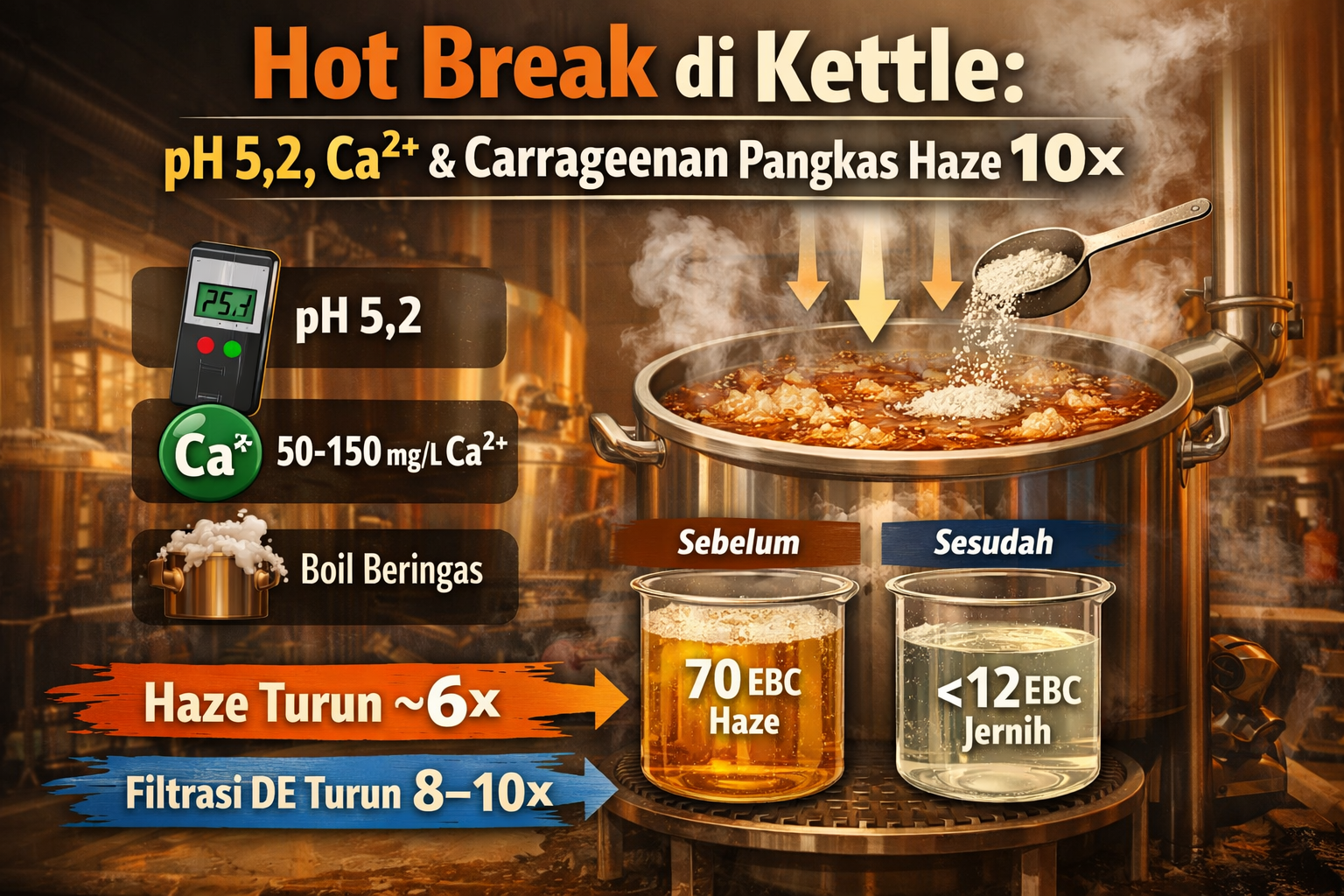
Calcium also acidifies the mash by reacting with malt-derived phosphates: Ca²⁺ converts soluble phosphate salts (e.g., K₂HPO₄) into insoluble Ca₃(PO₄)₂, releasing H⁺ (byo.com). If pH is stubbornly high, brewers raise non‑carbonate hardness via gypsum or CaCl₂. One guideline: to raise Ca from near 0 to ~50 mg/L, add about 24 g gypsum or 20 g CaCl₂ per 1000 L (www.microbrewerysystem.com). Calcium levels of ~50–150 ppm in mash water are typical to optimize enzyme performance and precipitate excess alkalinity (www.microbrewerysystem.com ; byo.com). Magnesium has a similar but weaker effect.
By contrast, carbonate builders raise pH. Calcium carbonate (chalk) and sodium bicarbonate push pH up; for example, 50 g of CaCO₃ can neutralize ~1 Eq (2 moles H⁺) (braukaiser.com). In most cases, brewers avoid bicarbonate additions unless pH is very low (<5.0).
Ideal mash pH and enzyme activity
The target mash pH is 5.2–5.6 (at mash temperature), balancing β‑amylase (~5.4–5.6) and α‑amylase (~5.6–5.8) (byo.com). Below ~5.2, α‑amylase activity declines; above ~5.6–5.8, β‑amylase falls and tannin extraction can increase (byo.com). Many mixed grists with moderate-hardness water naturally yield ~5.5, near ideal, and malt’s native buffering “just so happens” to give ~5.6 as a starting point (byo.com).
Flavor and yield track pH: high mash pH (>5.8) can bring astringent tannins and lower apparent extract; very low pH (<5.0) can slow enzymes and leave dextrins unconverted. Empirically, 5.2–5.6 maximizes enzyme efficiency and minimizes astringency, with pale beers often tuned to ~5.2–5.4 and very dark beers finishing closer to ~5.6 (byo.com ; byo.com).
Food‑grade acid additions
When water alkalinity overwhelms malt acidity — common in very pale beers — brewers acidify with food-grade acids: lactic acid (E270) and phosphoric acid (E338). Both are GRAS-listed and standard in breweries.
Lactic acid (88–90%) is widely used and highly effective: ~90 g of 100% lactic = 1.00 Eq (equivalent; 1 mole H⁺), so 88% lactic has 1 Eq ≈102 g; 1 mEq ≈0.102 g (braukaiser.com). A few milliliters can shift mash pH by tenths. It is flavor-neutral at low doses; sensory thresholds for lactate in finished beer are often cited around 300–400 ppm (brulosophy.com). Lactic is fast-acting and adds lactate, which yeast can metabolize.
Phosphoric acid is also common. It is somewhat weaker per weight (homebrew sources are often ~10–15% solutions) (brulosophy.com), adds phosphate anion, and precipitates with Ca²⁺ as calcium phosphate, reducing Ca available to yeast. Studies report lactic buffers stronger than phosphoric at mash pH, and comparative trials showed phosphoric’s mash-buffering notably lower than lactic or acetic acid (www.researchgate.net). Phosphoric is clean-tasting and often used for final small adjustments.
Acidulated (sour) malt is an “all-grain” alternative: typical 2–4% acidulated malt (mash-pH ~4.3) can be steeped (~100–200 g of 2% acidulated malt) to drop pH modestly. It is slower and less precise than liquid acids.
Adjustment practice is straightforward: estimate alkalinity and grist, add a small acid dose at dough-in, then measure pH after thorough mixing. As a rough guide, expect ~3–5 mEq (0.3–0.5 g of 88% lactic) per kg malt per 0.1 pH unit (braukaiser.com). For a 12 kg grist, lowering by 0.2 might take ~7–12 mEq (≈0.7–1.2 g) of 88% lactic — around 0.6–1.0 mL, since 1 mL ≈1.18 g. Overshoot risks sourness; many brewers keep lactate additions well below the 300–400 ppm sensory band (brulosophy.com).
Brewing salt additions
Instead of acids, brewers often reach for gypsum (CaSO₄·2H₂O) or calcium chloride (CaCl₂·2H₂O). Both deliver Ca²⁺, which lowers pH by binding phosphate, and simultaneously elevate wort calcium — a plus for yeast performance and clarity. In practice, adding 1–2 g/L of gypsum or CaCl₂ will noticeably lower mash pH (and add 200–500 ppm Ca²⁺). One equipment guide notes that adding 24 g gypsum or 20 g CaCl₂ to 1000 L water raises non‑carbonate hardness by ~0.18 mmol/L (≈7.2 mg/L Ca) and helps neutralize bicarbonate (www.microbrewerysystem.com). Brewers often target ~50–150 ppm Ca²⁺ in mash water (www.microbrewerysystem.com ; byo.com). In one example, each 1000 L required ~16–24 g gypsum to eliminate 100 ppm HCO₃⁻ (www.microbrewerysystem.com).
Chalk (CaCO₃) does the opposite and raises pH but dissolves slowly; brewers typically pre-dissolve it in hot water or use sodium bicarbonate for quick adjustment. These carbonate additions are rarely needed unless pH is very low (<5.0).
Mash pH control in practice
Measure pH at mash temperature or correct readings to 20 °C; pH shifts ~0.03–0.05 per 5 °C, so temperature compensation matters. Typical sequence: treat water first, dough-in, add the calculated small dose of acid or salts, then measure in the mash or first wort. Small incremental doses are safer than a single large addition (brulosophy.com); this aligns with using accurate chemical dosing during adjustments.
Check sparge water too. If run-off pH climbs above ~6.0 during sparging, tannins can extract; brewers use acid or carbon dioxide injection on sparge liquor to prevent that. As a rule of thumb, no acid is usually needed if base water has moderate hardness (Ca ~50–100 ppm) and alkalinity ~100 ppm as CaCO₃ with a typical grain bill; acid becomes necessary with very high alkalinity (e.g., >200 ppm as CaCO₃) or very light beers (byo.com).
Quant example: if mash pH is 5.8 but target is 5.4 with 20 L water + 4 kg malt, lowering by 0.4 requires roughly (4 kg × 4 mEq per 0.1) ≈16 mEq of H⁺ (0.4 units × 10 mEq). Using 88% lactic (0.102 g/mEq), that’s ~1.6 g (≈1.4 mL). It adds ~80 ppm lactate, well below sensory thresholds (brulosophy.com). A brewer would add ~1.5 mL, stir, and re-check pH.
Troubleshooting mash pH problems
- Mash pH too high (>5.6–5.8): Common with hard water or very light grists. Symptoms: slow conversion, poor extract, astringency. Check water report for high bicarbonate. Solutions: reduce alkalinity (e.g., boil water and degas or dilute with RO — dilution can be implemented with RO), or add acid/salts. Even a modest dose (tens of mL of 88% lactic, or a few grams gypsum) can drop pH. Ensure mashing rests are sufficient.
- Mash pH too low (<5.2): Often from lots of dark malts or very soft water. Symptoms: rapid conversion, high free amino nitrogen, poor lauter. Solutions: add chalk or navigation bicarbonate very sparingly; diluting sparge water often helps. Consider reducing dark malts if recurring.
- pH drifts during mash or reheating: After enzymes denature, acid production tapers. Slow continued drops can come from ongoing breakdown of glucans/proteins. Rarely a problem if the target is already reached.
- Measurement issues: Calibrate the pH meter (pH 7 and pH 4 buffers) and control sample temperature. Ideally measure a small wort sample cooled to 20 °C. If only strips are available, allow extra margin.
- Acid taste: Sharp or soapy notes can follow excess sulfate (from gypsum) or lactate. Switch partially to CaCl₂ or phosphoric acid, and ensure yeast fermentation goes to completion (yeast metabolize lactate slowly).
- Unexpected high pH despite acid: Check for miscalibrated meters, excessive carbonate in grains (calcium bound to phosphates acting as base, as in under‑modified malt), or cleaner/sanitizer residues. Rinse equipment well.
In every case, verify inputs: water chemistry and grist composition. Use known calcium and alkalinity (ppm) to predict outcomes with brewing software, then validate by measurement. Document how lactic or gypsum changes pH in your system to standardize results.
Notes and sources
Core mechanisms of mash buffering are detailed in brewing references and practitioner guides (braukaiser.com). Wort buffering at mash pH is dominated by organic acids, not just phosphates (Li et al. 2016) (onlinelibrary.wiley.com). Enzyme optima and practical pH targets are summarized by brewer-facing resources (byo.com ; byo.com). Acidulant comparisons and sensory context are discussed in trials and brewer write-ups (brulosophy.com). Practical mineral dosing and carbonate removal reactions are outlined in brewery equipment notes (www.microbrewerysystem.com). This guide synthesizes those data-backed insights.