

Senior engineers are driving seawater reverse osmosis (SWRO) performance by designing multi‑barrier pretreatment that holds Silt Density Index (SDI15) below 5—and often under 3. New data puts ultrafiltration out in front, consistently delivering SDI15 near 1–2 while conventional trains fight variability.
Industry: Desalination | Process: Pre
SDI targets and pretreatment objectives
Effective multi‑barrier pretreatment is critical to protect downstream seawater reverse osmosis (SWRO) membranes. The objective: remove particulates, colloids, organics and biota so the RO feed shows a very low, stable Silt Density Index measured at 15 minutes on a 0.45 µm disk (SDI15, a standard particulate fouling metric). Designers typically specify SDI15 well below 5—and often below 3—for SWRO feed (www.mdpi.com) (www.mdpi.com).
Manufacturers such as DuPont recommend SDI15 ≤5 %/min for traditional feeds and ≤2.5 %/min when ultrafiltration (UF) pretreatment is used (www.mdpi.com). Low, stable SDI translates directly into fewer RO cleanings, longer membrane life and higher plant availability (www.filtsep.com) (www.mdpi.com).
In practice, conventional coagulation–media filtration pretreatment can meet SDI targets in good source waters, but it is prone to spikes—especially at the start or end of filter cycles, or during flow surges (www.filtsep.com) (www.mdpi.com). Membrane‑based pretreatment (microfiltration, MF, or ultrafiltration, UF) produces essentially particle‑free permeate, yielding a tighter SDI distribution (www.filtsep.com) (www.mdpi.com). A recent study reported conventional sand filtration with SDI ≈2.8–6.3, microfiltration at 2.0–3.0, and ultrafiltration at only 1.0–2.0 (www.mdpi.com).
Conventional coagulation–flocculation–filtration
A classical SWRO pretreatment train starts with coarse screening, chemical coagulation/flocculation, clarification (or dissolved air flotation), and dual‑media filtration, often followed by a cartridge polisher. The goal is steady RO feed quality for sea‑water RO systems.
Screening/Straining: fixed‑bar and fine screens (mesh <1 mm) remove debris and coarse solids at intake; pre‑screens and microscreens prevent clogging of downstream units. Many plants opt for an automatic screen to continuously remove debris, while others use a manual screen depending on site risk.
Coagulation/Flocculation: ferric or aluminum coagulant—commonly FeCl₃—is dosed, often at 1–5 mg/L Fe³⁺, to destabilize colloids and dissolved organics. Inline or rapid‑mix units distribute the coagulant, followed by flocculators with minutes of contact. Ferric salts are generally preferred over alum for SWRO feed because they require less pH adjustment and produce more stable flocs (www.mdpi.com). Inline coagulation can remove a large fraction of natural organics; one pilot showed about 70% of dissolved organics (DOC/UV254, a UV absorbance surrogate for organics) removed when comparing coagulation+UF vs coagulation+sand pretreatment (www.researchgate.net). Notably, even small doses (≈1 mg/L Fe³⁺) can dramatically reduce SDI: one study reported SDI15 falling below about 3.3 after ultrafiltration when 1 mg/L FeCl₃ was added; without coagulant, SDI remained ≈5 or more (www.mdpi.com). Coagulant dosing is typically automated via a dosing pump and supported by jar testing.
Clarification/DAF: flocs are removed by settling or flotation. Traditional sedimentation or lamella clarifiers operate at overflow rates around 1–2 m³/m²·d; in waters prone to algae or light flocs, dissolved air flotation (DAF) is common (especially in the Middle East). Proper design with 60–120 minutes detention can remove >90% of coagulated solids. A full‑scale study showed adding a DAF stage before dual‑media filters boosted removal of biological/organic fouling potential by ~40% compared to clarifiers alone (www.mdpi.com). If neither DAF nor sedimentation is used, coagulation+flocculation must be followed immediately by media filters in high‑rate modes. Plants often integrate a clarifier or a compact lamella settler to control footprint; when algae surges, a DAF unit becomes the primary barrier.
Dual‑Media Filtration: after clarification, gravity or pressure filters—typically anthracite over sand, sometimes with lower‑layer garnet—run at loadings around 5–15 m/h. The graded bed captures coarse flocs up top and polishes the effluent below. Well‑operated dual‑media filters (DMF) can reduce turbidity to <0.1 NTU and remove most residual particles. In one pilot on open‑sea feed, coagulation+dual‑media filtration achieved SDI15 <5, meeting stable SWRO limits even from a high‑turbidity intake (www.researchgate.net). Advanced porous media (e.g., Filtralite expanded‑clay) have shown similar or better suspended‑solid and TOC removal versus conventional sand/anthracite, with slower headloss development and longer run‑times (www.researchgate.net) (www.researchgate.net). Plants commonly specify sand media and pair it with durable anthracite for depth filtration.
Polishing and disinfection: a cartridge filter (5–10 µm) is often placed just before the high‑pressure pumps to intercept any loose media. Pre‑chlorination is typically avoided to protect membranes; instead, shock chlorination of raw seawater (weekly or as needed) may be used to suppress biofouling in the intake system and clarification basins. After the final filter, dechlorination (e.g., sodium bisulfite) ensures no chlorine reaches the RO membranes; operators typically use a dechlorination agent for control. Antiscalant dosing or acid injection is done after pretreatment but just upstream of the RO train, with many plants standardizing on membrane antiscalants for mineral stabilization.
Conventional performance and variability
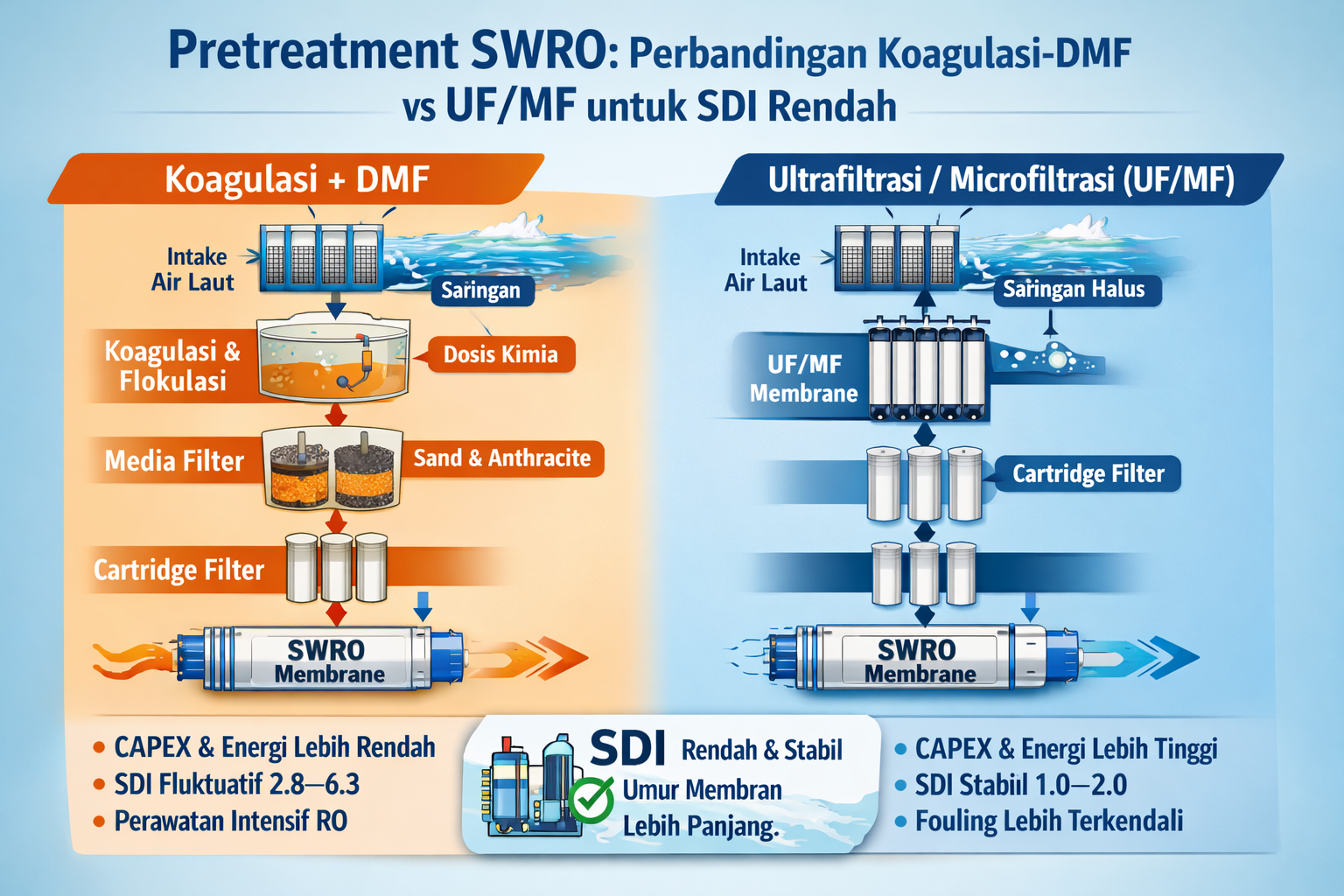
A well‑designed conventional train can produce relatively low SDI. One expert notes that optimally operated DMFs can yield only ~1–10 particles/mL >2 µm in the filtrate (www.filtsep.com). Field data, however, frequently shows much higher particulate breakthrough: Pearson (2010) observed that typical media‑filter effluent often has an order‑of‑magnitude more particulate load than that “ideal” range (www.filtsep.com).
Feedwater quality in media filters tends to degrade near the start and end of each run (after backwash or as depth is used up), and sharp flow spikes can push media breakthrough. As a result, although conventional pretreatment can meet design goals, it often yields more SDI variability and a higher baseline than membrane pretreatment.
Biological/organic fouling potential is another concern. Conventional pretreatment removes only a fraction of natural organics—on the order of 5–20% of assimilable organics (AOC) in some full‑scale cases (www.mdpi.com). Breakthrough of humic and algal material is common unless coagulant dosing is carefully optimized. For example, one SWRO study saw dual‑media filters remove merely ~12% of AOC (www.mdpi.com), and poor organics removal can raise biofilm growth potential downstream. Conventional schemes often rely on aggressive disinfection and antiscalants, but these added chemicals can themselves complicate RO fouling if not managed.
Membrane pretreatment train (UF/MF)
Low‑pressure membrane pretreatment—hollow‑fiber or plate‑and‑frame UF/MF—has become increasingly attractive for SWRO. A typical membrane pretreatment train includes fine screening, optional inline coagulation, UF/MF modules, chlorine removal, and a cartridge filter. Membrane units operate at fluxes around 50–150 LMH (liters per square meter per hour), with periodic backwash and regular chemical clean‑in‑place (CIP). They require high‑integrity feedwater—screens to 130–200 µm—to avoid rapid fouling, and robust controls for flux, pressure, and tank turnover.
Plants frequently standardize the core on ultrafiltration as pretreatment to RO, with upstream protection by an automatic screen. Where a full upgrade is planned, integrated membrane systems allow coordinated control of UF/MF with downstream RO.
UF/MF advantages and biological barrier
The defining benefit of membrane pretreatment is absolute particle removal. MF/UF membranes with pore sizes around 0.1–0.01 µm block essentially all suspended solids and most bacteria (www.filtsep.com) (www.mdpi.com). In practice, MF/UF produces extremely low turbidity (<0.02 NTU) and nearly zero SDI‑solids, leaving only dissolved or very colloidal fouling agents to challenge the RO. UF/MF can achieve SDI15 in the 1–2 range (www.researchgate.net) (www.mdpi.com).
One field trial reported UF pretreatment yielding SDI <2 (15 min) on Mediterranean seawater, compared to ~2.6–3.0 from conventional media filters tested in parallel (www.filtsep.com) (www.researchgate.net). Similarly, combined coagulation+UF pretreatment at a power plant produced SDI15 <2.5 with 98–99.5% turbidity removal (www.mdpi.com). Lower SDI directly translates into lower RO differential pressure rise and longer intervals between cleanings (www.filtsep.com).
Li et al. (2024) found that coagulation+UF had similar overall dissolved‑organic removal as coagulation+sand (about 70%), but the UF feed SDI was <2 versus >3 for sand filtration (www.researchgate.net). UF modules can eliminate >99% of bacteria and viruses, reducing biofouling potential without chlorination (www.mdpi.com). Large SWRO plants, including Fukuoka (Japan) and Addur (Bahrain), use UF as a principal barrier (www.filtsep.com). In hybrid designs, a small dose of coagulant before UF can floc out fine colloids, improving flux and allowing lower flux operation (www.mdpi.com) (www.researchgate.net).
UF/MF limitations and risk management
The downsides of membrane pretreatment are higher capital and energy costs, plus more intensive maintenance. UF/MF skids cost several times more than media filters of equivalent capacity and consume extra power for feed pumps. They also incur periodic chemical cleaning; for example, high‑flux UF may need acid cleans weekly or biocide cleans regularly. However, higher uptime and savings in RO chemicals often offset O&M in the long run (www.mdpi.com).
Careful design typically includes multiple parallel membrane trains and a backup skid to allow cleaning without production loss. Membrane modules—especially ceramic UF/MF—have long lifetimes (often >10 years) and consistent performance, giving lower lifecycle costs. Studies report membrane pretreatment can cut the overall facility carbon footprint by 30–60% and reduce chemical usage versus conventional plants (www.mdpi.com). One major concern is sudden clogging by algal blooms or jellyfish: facilities often install finer intake screens (e.g., 150–300 µm) upstream and robust SDI monitoring to trigger responses.
Head‑to‑head performance metrics
Particulate control: conventional coagulation+DMF can work well in most seasons. Fujairah II (185 Mm³/d SWRO) uses FeCl₃ + dual‑media gravity filters to produce SDI ≈2.7 (www.mdpi.com). In challenging conditions, conventional filters have reached SDI >5 (www.researchgate.net). Full‑scale UF pretreatment cases often report SDI well below 3 consistently; a “dual‑membrane” SWRO reported UF feed SDI ≈1.0–2.5 (www.mdpi.com). Across studies, UF pretreatment reduced average SDI by ~0.5–1.0 points compared to the best conventional trains (www.filtsep.com) (www.mdpi.com). MF tends to perform between the two: one trial found MF filtrate SDI ~2.2% with pre‑chlorination (www.mdpi.com).
Organic/chemical removal: conventional pretreatment primarily removes high‑molecular‑weight humics via coagulation, while both UF and MF remove colloidal organic matter by sieving but allow dissolved substances through unless coagulation flocculates them. In practice, coagulation plus either membrane or media filter has similar DOC removal: Li et al. (2024) found coagulation+UF and coagulation+sand removed about 70% of DOM (www.researchgate.net). Membrane trains allow in‑line dosing of smaller charges; UF enables much lower coagulant doses in‑flow because flocs do not need to settle (www.filtsep.com). Both options generally require antiscalant—e.g., polyphosphate or threshold inhibitors—after finishing pretreatment.
Fouling and cleaning: because membrane pretreatment yields cleaner water, RO systems using it can tolerate more aggressive operation (higher recovery or flux) or go longer between cleans. Pearce (2010) notes UF pretreatment “can reduce RO replacement costs, chemical costs, and cleaning frequency” (www.sciencedirect.com) (www.filtsep.com). Conversely, conventional pretreatment plants often need more frequent RO cleaning (weekly vs monthly) and membrane stack replacements. Membrane pretreatment must itself be cleaned periodically (e.g., backwash every few hours, CIP weekly/monthly). Modern UF systems with Automatic Specific Flux Maintenance (ASFM) can maintain high flux with minimal downtime, though they add some complexity.
Multi‑barrier design playbook
For a robust design, engineers layer barriers so that one unit’s shortfall is caught by the next. Even with UF pretreatment, a fine mechanical screen—such as wedgewire at 100–150 µm—ahead of the UF protects modules. Some plants combine approaches; one configuration applied coagulation/DAF → DMF → UF to polish pretreatment, capturing the union of conventional and membrane benefits.
For conventional trains, two‑stage media filtration (dual‑media followed by a polishing sand filter) plus a final cartridge filter is advisable. A cartridge filter in the 1–5 µm range provides an additional safety factor for RO feed. In areas prone to algal blooms, having a spare DMF train or switching to a second clarifier during blooms is prudent.
Design targets and instrumentation
SDI and turbidity: aim for post‑pretreatment SDI15 consistently ≤3–4—and even ≤2.5 with UF (www.mdpi.com) (www.mdpi.com). Design media filters for <0.2 NTU, and consider cartridge polishing to reach <0.05–0.1 NTU at RO feed.
Particle counts: ensure >90% removal of >5 µm particles. For conventional trains, <10 particles/mL >2 µm is achievable (www.filtsep.com); membrane pretreatment drives this to near zero.
Organics: optimize coagulant dose—via jar tests or a pilot—to remove most humics, e.g., 50–70% TOC removal. Inline coagulation with UF can use much lower doses—even <1 mg/L Fe—than conventional clarifiers (www.mdpi.com) (www.filtsep.com). Many plants manage dosing with a coagulant program supported by flocculants.
Biological control: avoid continuous chlorination before RO; use periodic shock chlorination of intake. Provide dechlorination and bio‑filters (if needed) to avoid adding oxidants upstream of RO. If using UF, membrane modules provide a significant disinfection step.
Hydraulics: include surge tanks or equalization to dampen flow fluctuations that can overload filters. Multi‑train filters with automatic backwash scheduling help maintain steady effluent.
Instrumentation: real‑time monitors for SDI15, turbidity, and particle counts at key locations (e.g., after media and before RO feed) allow quick detection of failures. Automated backwash initiation based on headloss or timer helps maintain quality. Plants commonly package these around ancillary water‑treatment equipment for reliability.
Indonesia context and standards
In Indonesian context, no specific SDI regulation exists, but final potable water standards (e.g., Permenkes 492/2010) require turbidity ≤0.1 NTU and absence of contaminants. Pretreatment should be designed to meet these standards post‑RO. Indonesia’s recent desalination plans—such as the Labuan 150 MLD plant—underscore the importance of reliable pretreatment as the country scales up to about 400–800 MLD of capacity (medium.com). In practice, design guidance will follow international best practice (e.g., SIRA guidelines, USBR, IDA).
Conclusions and sources
A robust multi‑barrier pretreatment train—combining screening, coagulation/flocculation, clarification/DAF, media filtration, and optionally UF/MF—is essential for SWRO success. Conventional coagulation + dual‑media filters can achieve modest SDI (≈3–5) and turbidity removal at relatively low capital cost, but they require careful operation to avoid breakthrough. Ultrafiltration/microfiltration pretreatment delivers much cleaner, more stable feed (SDI often <2) (www.mdpi.com) (www.researchgate.net), at the expense of higher capital and energy. Site water quality drives selection: highly variable or algal‑rich seawater often justifies membrane pretreatment despite cost, whereas very clear deep ocean intake may allow conventional systems.
In all cases, sufficient coagulant usage and proper maintenance—of media filters or UF CIP—are key. One study showed a two‑stage media filter removing >80% of SDI and 94% of MFI (Microfouling Index, another fouling potential measure) when properly managed (www.mdpi.com). By designing overlapping barriers and monitoring SDI/turbidity at each stage, operators can keep RO feed at the low SDI—ideally <3—needed for long‑term stable SWRO performance (www.filtsep.com) (www.mdpi.com).
Authoritative reviews and case studies underpin these figures and design numbers. Voutchkov et al. provide a comprehensive review of conventional vs. membrane pretreatment (www.sciencedirect.com). Field trials and pilot data—Pearce 2010 (www.filtsep.com), Li et al. 2024 (www.researchgate.net), and Abushaban et al. 2021 (www.mdpi.com)—give performance benchmarks on SDI, particle removal, and operations. For plants standardizing their pretreatment and RO blocks, integrated SWRO packages and upstream UF pretreatment remain the most direct path to predictable SDI.