

Industry: Coal_Mining | Process: Extraction
In coal mines, groundwater is a geotechnical variable with outsized consequences. Elevated pore pressure reduces effective stress (the stress actually carried by soil/rock skeletons), undercutting shear strength and slope or roof stability, according to Hydrogeology & Mineral Resource Development and field analyses in Indonesia’s pits (ResearchGate).
The numbers are sobering. One Indonesian open-pit model found seepage inflow reduced shear strength enough to push a slope’s factor-of-safety (FS; the ratio of resisting to driving forces) to roughly 0.65 — a clear sign of instability (ResearchGate). Laboratory evidence backs the trend: coal samples dried of water posted about 31% higher uniaxial strength than saturated ones (arXiv preprint).
Underground, roofs are just as sensitive. Modeling shows that long-term groundwater rise can deteriorate roof safety by elevating tensile stresses in strata, with conservative “phreatic line” (water table) assumptions yielding lower FS than steady-state seepage (MDPI Sustainability).
Groundwater mechanics and driving forces
Physically, groundwater undermines excavations in three reinforcing ways (books.gw-project.org; ResearchGate):
- Increases driving forces: hydrostatic uplift and added weight from rainfall/recharge load pit walls and pillars (ResearchGate).
- Reduces strength: saturation lowers effective cohesion and friction along fractures and bedding planes (books.gw-project.org; ResearchGate).
- Induces seepage erosion: flow through weak layers can pipe fines and create cavities that initiate sinkholes (MDPI Sustainability).
Field data line up with theory. In one pit, seepage coincided with roughly 2 cm of slope displacement and increased “material thrust” as airborne water cut the effective impermeable barrier volume (ResearchGate).
Underground paradoxes and roof behavior
Not all mine water is uniformly bad. In flooded, abandoned room‑and‑pillar workings (a layout that leaves coal “pillars” to support the roof), hydrostatic pressure in mine pools can partially support overburden. Sudden dewatering can transfer that load back to pillars and trigger collapses or sinkholes (ResearchGate; ResearchGate). In active coal mines, however, the dominant effect remains negative: rising groundwater heads have been modeled to deteriorate roof safety over time (MDPI Sustainability).
Quantifying stability gains from drawdown
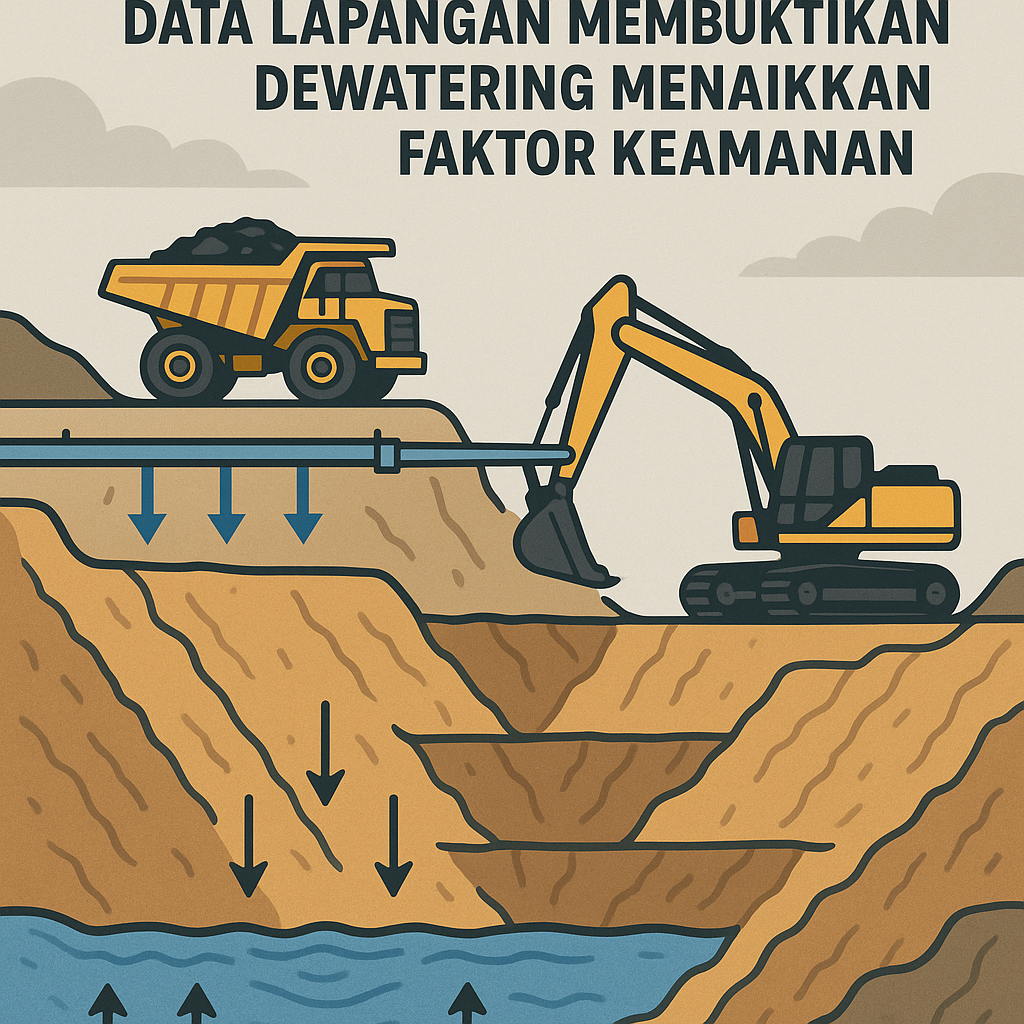
Designs target explicit stability metrics. Lowering the phreatic surface (the water table within a slope) directly raises FS; in practice, meter-level drawdowns correlate with significant FS gains (books.gw-project.org). One roof study found the “phreatic line” assumption more conservative than steady flow, underscoring why drained conditions should be the goal (MDPI Sustainability).
Real-world shifts are stark. In a Chinese face, water‑inrush risk fell from “high” to “low” after roof drainage via targeted drilling and pumping (ACS Omega). Back in Indonesia, one open‑pit analysis recommended a very high FS of 7.79 for an untreated slope — a finding that practically implies either significant dewatering or slope flattening would be required (ResearchGate).
Typical design thresholds sit around FS 1.3–1.5; controlled drainage in many cases shifts faces from <1.0 (unstable) to ≥1.3, as seen in combined modeling and field observations (MDPI Sustainability; ACS Omega).
Dewatering and depressurization toolkit
Effective dewatering is multi‑pronged: open sumps or collection ponds, perimeter drainage ditches, horizontal drains along benches, vertical pumping wells, and even tunnels/galleries that intercept inflows (books.gw-project.org; Scribd). Designers often aim to keep pit walls drawn down well below the excavation floor; in one example pit, the floor sat far beneath the pre‑development groundwater table with only minor seepage (books.gw-project.org).
Operations matter as much as design. Pumps, sumps, and clarifiers must run continuously or on demand; mines increasingly automate pontoons that trigger at rising water (Mining Weekly). Many operators specify clarifiers that remove suspended solids from pit water; in that role, a unit such as a clarifier provides the detention time needed to settle fines before discharge or reuse.
Monitoring closes the loop. Mines overlay inclinometers and piezometers with calibrated groundwater models to set adequate pump rates and update drawdown targets (SRK Consulting; Mining Weekly). One Chinese case installed 66 boreholes that penetrated all weathered‑fissure zones to within 1 m of the impermeable layer, dramatically lowering water abundance and inrush risk (ACS Omega). Dewatering must scale with the pit or panels; retrofits under production constraints are costly and risky (SRK Consulting; Mining Weekly).
Where ground is weak, cutoff walls or grout curtains further reduce seepage and uplift (books.gw-project.org).
Measured outcomes and subsidence risks
Quantitatively, controlled drawdown shows up as FS gains, lower inflow rates, and fewer subsidence events. In the ACS Omega case, risk ratings fell from “high” to “low” after roof drainage, matching observed inflows (ACS Omega). In abandoned room‑and‑pillar districts, literature warns that depressurizing mine pools increases pillar loads and can induce surface collapse if not staged (ResearchGate; ResearchGate).
Industry experience is blunt: with controlled drainage, pits reach design limits; without it, flooding and failures halt production (Mining Weekly; books.gw-project.org).
Licensing, monitoring, and sustainability
Regulators are folding groundwater control into mine planning. In Indonesia, Permen ESDM No.14/2024 streamlines permitting but requires technical data on drilling plans (“data teknis rencana pengeboran” and “gambar rencana konstruksi sumur bor/gali”) and commitments to build recharge or monitoring wells, reflecting a sustainable‑use stance (ESDM). Applications now require only three items instead of 13 while keeping monitoring obligations (ESDM).
Elsewhere (e.g., Australia’s coalfields), annual reports track water‑table positions against baseline and tie anomalies to management responses. Standards referenced by industry reviews require drawdown targets and pump capacities to be specified up front (books.gw-project.org).
Cost–risk calculus and bottom line
The physics is straightforward: each meter of water‑table reduction increases effective stress and stability. Case work shows water‑charged pit walls can approach failure, while drawdown restores margins (ResearchGate; ACS Omega). The costs of pumps, pumps, maintenance are typically minor compared with the production hit from slope failures or flooding (books.gw-project.org; Mining Weekly).
That is why modern operations combine pumping wells, drains, and sumps with live monitoring and explicit risk metrics (SRK Consulting; ACS Omega). Done well, dewatering can shift an excavation from FS <1 to ≥1.3 — in line with common design thresholds of 1.3–1.5 (MDPI Sustainability; ACS Omega).
Sources referenced include Devy et al. (2021) J. Geoscience Eng. Env. Tech. 6(4):192 (ResearchGate); Gao et al. (2022) ACS Omega 7:26437 (ACS Omega); Sustainability (2023) 15(1):529 (MDPI Sustainability); Mining Eng. (2018) 70(6):45; Leslie C. Smith (2021) Hydrogeology & Mineral Resource Development (books.gw-project.org); Xuekai Li et al. (2025, preprint) (arXiv preprint); and Indonesia’s ESDM Permen 14/2024 update (ESDM).