

The quiet fix for stuck fermentations: feed the yeast
Brewers chasing consistent fermentation are zeroing in on yeast nutrition: roughly 130 mg/L FAN and about 0.1–0.15 mg/L zinc in wort, backed by targeted nutrient blends and smart dosing. The data show faster, cleaner ferments—and fewer off-flavors—when these basics are met.
Industry: Brewery | Process: Fermentation_&_Maturation
Yeast nutrients—vitamins, minerals, amino acids and other compounds—sound like small details. They’re not. All‑malt worts usually supply a balanced set, but high‑gravity ferments, lots of sugar adjuncts, or reused yeast can leave worts nutrient‑poor and fermentations sluggish or stuck (beerandbrewing.com). The Oxford Companion’s summary, relayed via that source, is blunt: malted barley normally provides carbohydrates, amino acids, vitamins and minerals in balance; stressful conditions do not (beerandbrewing.com).
Two levers dominate: free amino nitrogen (FAN) and zinc. Scientific targets are clear, and so are the consequences when they’re missed: long lags, incomplete attenuation, sulfur and “green apple” notes—and batches that don’t behave (mdpi.com) (byo.com).
Yeast‑assimilable nitrogen (FAN) targets
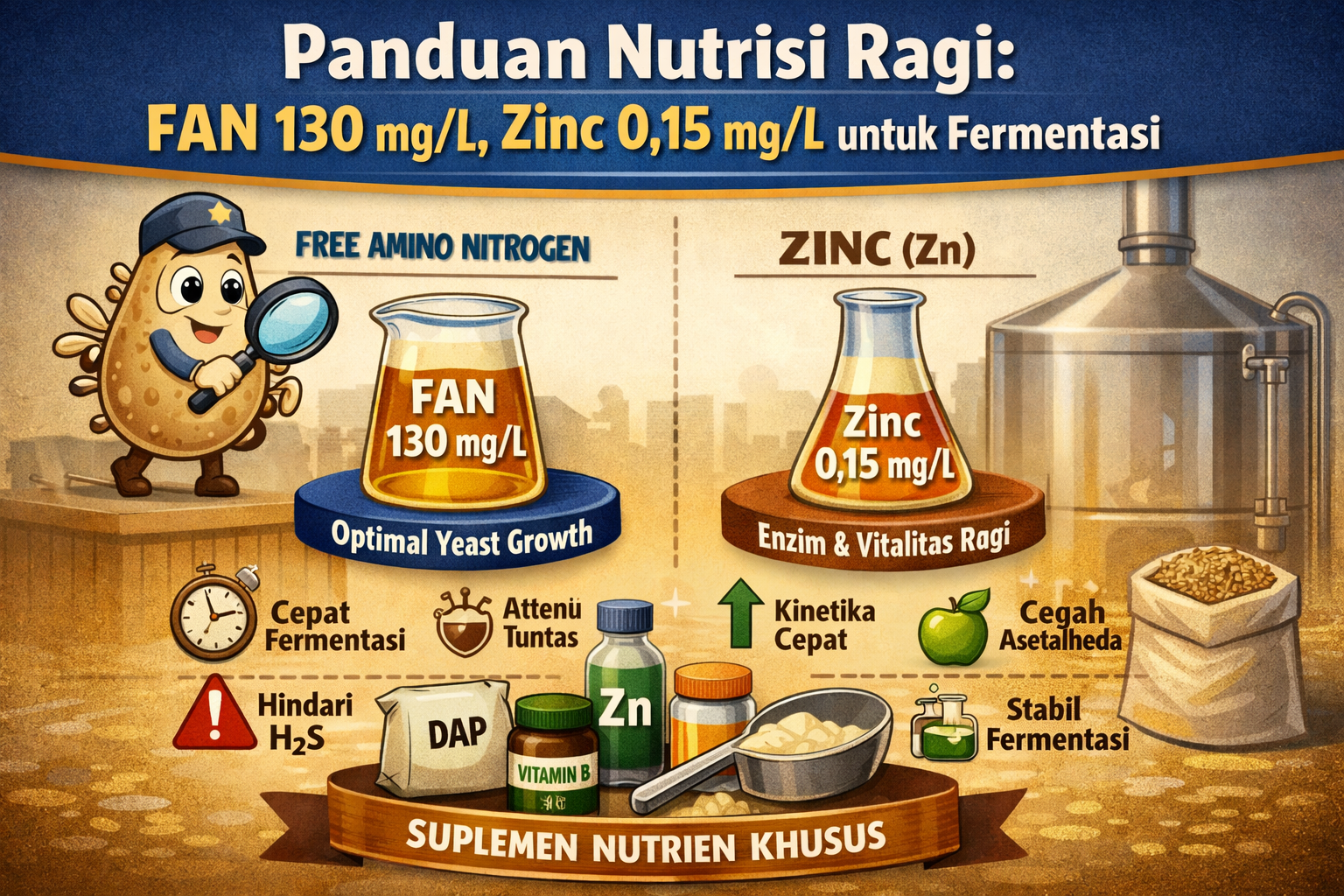
FAN (free amino nitrogen: yeast‑available amino acids, ammonia, and small peptides) is the core growth nutrient for brewing yeast. Normal‑gravity worts—10–12°P (degrees Plato, a wort gravity measure)—require roughly 130 mg/L FAN for healthy, complete fermentation (mdpi.com: “There has … 130 mg/L FAN”). Below about 100 mg/L, yeast becomes nitrogen‑limited, lag times lengthen, attenuation drops, and sulfides (H₂S) often show up (mdpi.com).
When FAN is ample, sugar use speeds up and worts acidify more quickly—pH falls faster and ferments finish sooner (mdpi.com). Overshooting has costs: very high FAN (greater than ~300 mg/L) is associated with elevated diacetyl and fusel alcohols—and very low levels of esters (mdpi.com). In practice, breweries aim for ≈130 mg/L in normal beers, increasing proportionally for high‑gravity worts (e.g., 16°P or more) or larger pitches (mdpi.com) (mdpi.com).
Most wort FAN (>70%) is created during malting, not mashing (mdpi.com). High‑nitrogen barley and well‑modified malts deliver richer FAN, while unmalted adjuncts—rice, corn, raw barley—keeping extract up but FAN down, can drag a 50% adjunct wort below 100 mg/L (mdpi.com). Predictable outcomes: without enough nutrient, fermentation may stall or produce sulfur compounds and higher aldehydes (mdpi.com) (byo.com).
Zinc cofactor and flavor stability
Zinc (Zn)—a trace mineral and cofactor for alcohol dehydrogenase (ADH, the enzyme that reduces acetaldehyde to ethanol)—is pivotal for fermentation rate and the yeast cell cycle. “Supplementation of zinc generally has the effect of speeding up fermentation, as well as preventing stuck fermentations,” notes one brewing analysis (brewingforward.com).
Peer‑reviewed work pegs a pitching‑wort target of about 0.10–0.15 mg/L Zn (link.springer.com) (link.springer.com). Typical malts barely deliver that: mash can start near ~0.5 mg/L Zn, but after boiling only ~0.1–0.13 mg/L remains in the cooled wort—and about 98% of malt zinc ends up in the spent grain (link.springer.com) (link.springer.com). That leaves a standard 10°P all‑malt beer flirting with deficiency.
Deficiency shows up fast: elevated acetaldehyde (“green apple”) indicates ADH is starved of its cofactor. “Zinc is a co‑factor for the enzyme that converts acetaldehyde to ethanol,” advises Brew Your Own, adding that many brewers target roughly 0.15 mg/L; the magazine also cautions, “Zinc can be added in tablet form but the desired level in wort is so low, about 0.15 mg/L… high levels of zinc can cause severe fermentation problems” (byo.com) (byo.com). Above ~0.5 mg/L, toxicity is a risk (link.springer.com) (byo.com).
Other cofactors matter too. Magnesium and phosphates support enzyme function and pH buffering, while B‑vitamins (thiamine/B₁, niacin/B₃, folic acid, biotin, calcium pantothenate/B₅) drive metabolism; wort thiamine is largely gone within hours—over 90% is taken up quickly—and added thiamine has been shown to enhance yeast viability under both normal and high‑gravity conditions (lallemandwine.com) (onlinelibrary.wiley.com) (onlinelibrary.wiley.com).
Complex blends and organic YAN
To cover nitrogen, minerals and vitamins in one move, brewers turn to complex blends. Fermaid K is a classic formulation: inorganic nitrogen (DAP, diammonium phosphate), organic nitrogen (alpha amino nitrogen), magnesium sulfate, thiamine, folic acid, niacin, biotin, calcium pantothenate, and inactivated yeast (yeast autolysate) (lallemandwine.com). Zytex (Lallemand’s brewing brand) captures the point: proper use reduces sluggish and/or stuck fermentations (zytex.com).
Organic nitrogen sources are especially efficient. Lallemand/Scott Labs data report that organic YAN is ~4× as effective for yeast as DAP: a 40 g/hL dose of Fermaid O (100% organic autolysate) yields only ~16 mg/L measured ammonia‑N, but functions as an effective 64 mg/L YAN for yeast metabolism (scottlab.com).
Example: A brewer with 15°P wort measures headroom for only 80 mg/L FAN and less than 0.1 mg/L Zn. Adding 20 g/hL of a complex blend (e.g., Fermaid K) contributes roughly 20–30 mg/L organic nitrogen and ~0.1 mg/L Zn, bringing the fermenter to about 100 mg/L FAN and ~0.2 mg/L Zn—and kicking off vigorous, low‑lag fermentation (lallemandwine.com).
Dosing strategy and process control
When and how much depends on gravity, grist and yeast load. Many brewers add a full recommended dose to normal‑gravity, all‑malt batches—around 10–25 g/hL, typically supplying ~10–20 mg/L additional YAN plus trace Zn. High‑adjunct or high‑gravity beers benefit from larger or split doses: for Fermaid K, a common two‑stage protocol is 12.5 g/hL at the end of lag phase and another 12.5 g/hL at about one‑third sugar depletion (lallemandwine.com). Another practice is late‑boil addition (≈10–15 minutes remaining) to preserve vitamins and ensure even mixing (lallemandwine.com).
Operational heuristics from industry and research align. Assess the wort—grist and adjunct percentages—to estimate if FAN is likely below 100–130 mg/L; high‑gravity worts (>15°P) or those with >25–30% simple‑sugar adjuncts almost always require supplementation (mdpi.com). Healthy pitches matter; older slurry depletes vitamins faster. Food‑grade fermentation nutrients (e.g., DAP, yeast hulls, zinc sulfate) that meet local food regulations are standard practice. Follow manufacturer guidance; a rough rule of thumb is that 0.5–1 g/L of a complex nutrient adds ~5–15 mg/L YAN. For zinc, a wort target of ~0.15–0.2 mg/L is cited in brewer guidance and literature (byo.com) (link.springer.com).
Process control completes the loop: monitor gravity drop and aroma; brisk kinetics and normal attenuation signal success. If stress signals persist (slow start, persistent sulfur), oxygenation or additional nutrition can help. Over‑supplementation is a known risk: YAN much greater than 200 mg/L correlates with higher diacetyl and fusel alcohols—and very low esters—while zinc much above ~0.5 mg/L can inhibit yeast (mdpi.com) (byo.com). For accurate chemical dosing during these additions, facilities often specify equipment designed for precision additions, such as an industrial dosing pump.
Regulatory context (Indonesia)
Indonesia’s 2023 BPOM food‑category update focuses on permissible microbes for fermented foods (e.g., allowed Lactobacillus and Bacillus in products like tapai or natto) and supply‑chain provisions; it does not specifically regulate yeast nutrients in brewing (foodnavigator-asia.com). In practice, nutrient additives such as DAP, yeast hulls and zinc sulfate are treated as processing aids or food ingredients; ensuring food‑grade status and general food‑safety compliance is the operative requirement, and no Indonesian rule expressly forbids their use in brewing. The regulation’s fermented‑beverage categories do not mention nutrient additives (foodnavigator-asia.com).
Data spotlight: zinc losses to grain
Brewing trials show spent grain sequesters about 98% of malt zinc during production, leaving the cooled wort at only ~0.1 mg/L Zn—under the ≈0.15 mg/L threshold many brewers target for healthy fermentation (link.springer.com) (link.springer.com) (byo.com). This is why even small zinc additions change outcomes measurably.
Bottom line: healthy yeast, reliable beer
Healthy fermentation underpins beer quality. Evidence‑based targets—≈130 mg/L FAN and ≈0.15 mg/L Zn—consistently deliver faster fermentations with fewer off‑aromas, and commercial blends such as Fermaid K are engineered to supply nitrogen, vitamins and trace elements in balance (mdpi.com) (byo.com) (lallemandwine.com) (zytex.com). Testing worts (or inferring from the grist), adding nutrients when indicated, and following good brewing practice yields vigorous, reliable fermentations with minimal batch losses.
Sources: Authoritative brewing research and industry sources have been cited throughout. Notable refs include Hill & Stewart 2019 on FAN (mdpi.com), Nobis et al. 2023 on zinc (link.springer.com) (link.springer.com), and Lallemand/Scott Labs on nutrient blends (lallemandwine.com) (scottlab.com). Indonesian BPOM guidelines on fermented foods were also consulted (foodnavigator-asia.com).