

Industry: Nickel_Mining | Process: Solvent_Extraction_&_Electrowinning_(SX
Modern nickel circuits are built on a simple truth: even when the big contaminants are gone, the small ones still matter. In SX–EW, solvent extraction (SX, selectively transferring metals between an organic and an aqueous phase) does the heavy lifting, and electrowinning (EW, plating dissolved metal onto a cathode with electric current) demands the finishing touch.
Plants now mix upstream precipitation, selective SX, ppm polishing and a nursed bleed stream to keep electrolytes within spec. The endgame is battery‑grade liquor, often with “<5 mg/L of most impurities” in the EW feed (Purolite).
Front‑end impurity removal (precipitation + SX)
Typical hydrometallurgical circuits first precipitate out base metals — iron as goethite or jarosite and aluminium as hydroxide — so the post‑leach liquor entering SX is mostly Ni+Co. Then SX selectively extracts the pay metals into an organic phase, leaving most residual contaminants behind. In one two‑stage flowsheet, the strip liquor reached 61.7 g/L Ni with only 0.007 g/L Co and 0.3 g/L Mg (>99.5% Ni purity) after first precipitating ~90% of Ca and then SX with Na‑D2EHPA and Na‑Cyanex 272 (Fang et al.).
SX extractants — phosphoric acids, oximes, and other organophosphorus or chelating reagents — are chosen to load Ni/Co while rejecting impurities like Mg, Ca, and Mn, which stay in the raffinate (study link; Minerals Engineering). After SX, the electrolyte heading to the EW cells contains almost exclusively Ni (and Co, if not separated earlier), with Fe, Cu, Al, and Mn greatly reduced.
Raffinate rejection in laterite HPAL circuits
In laterite HPAL (high‑pressure acid leach), the neutralized PLS (pregnant leach solution) still carries Ni+Co with significant Fe, Al, Mn, and very high Mg, so SX is tasked with stripping Ni while rejecting Fe/Al/Cr/Mn to tails (Nickel Institute).
Fang et al. report “>99% separation of Co and Mg from Ca” after two SX steps, yielding a Ni liquor of >99.5% purity (link), reinforcing SX’s role as the primary barrier to contaminants.
How trace ions sabotage EW quality
Even after major cleanup, trace ions can tank deposit quality. In nickel‑chloride EW, adding just ~0.001 g/L (1 mg/L) Cr³⁺ caused a large drop in cathode brightness, and at ≳0.1 g/L Cr the current efficiency fell sharply (Materials Transactions).
Tens of ppm of Cu or Zn in the electrolyte can codeposit or trigger defects. Historic tests that removed Cu to 0.003 g/L (3 mg/L) and Fe to 0.020 g/L improved nickel deposit purity to >83% in early trials (911Metallurgist).
Polishing to ppm and ppb levels
Because battery‑grade specs target “<5 mg/L of most impurities” in EW feed (Purolite), plants often add polishing beyond SX. Ion‑exchange (IX) and solvent‑impregnated resins can scavenge ions down to ppm or even ppb; typical IX polishing can push impurities to <2 mg/L — levels often needed for batteries (ALTA paper).
For operators standardizing hardware, cation/anion exchange trains such as Ion‑Exchange systems provide that polishing step, while specialized media options align with solvent‑impregnated resin units like ion‑exchange resins referenced by vendors (specs; application note).
Precipitation and cementation case data
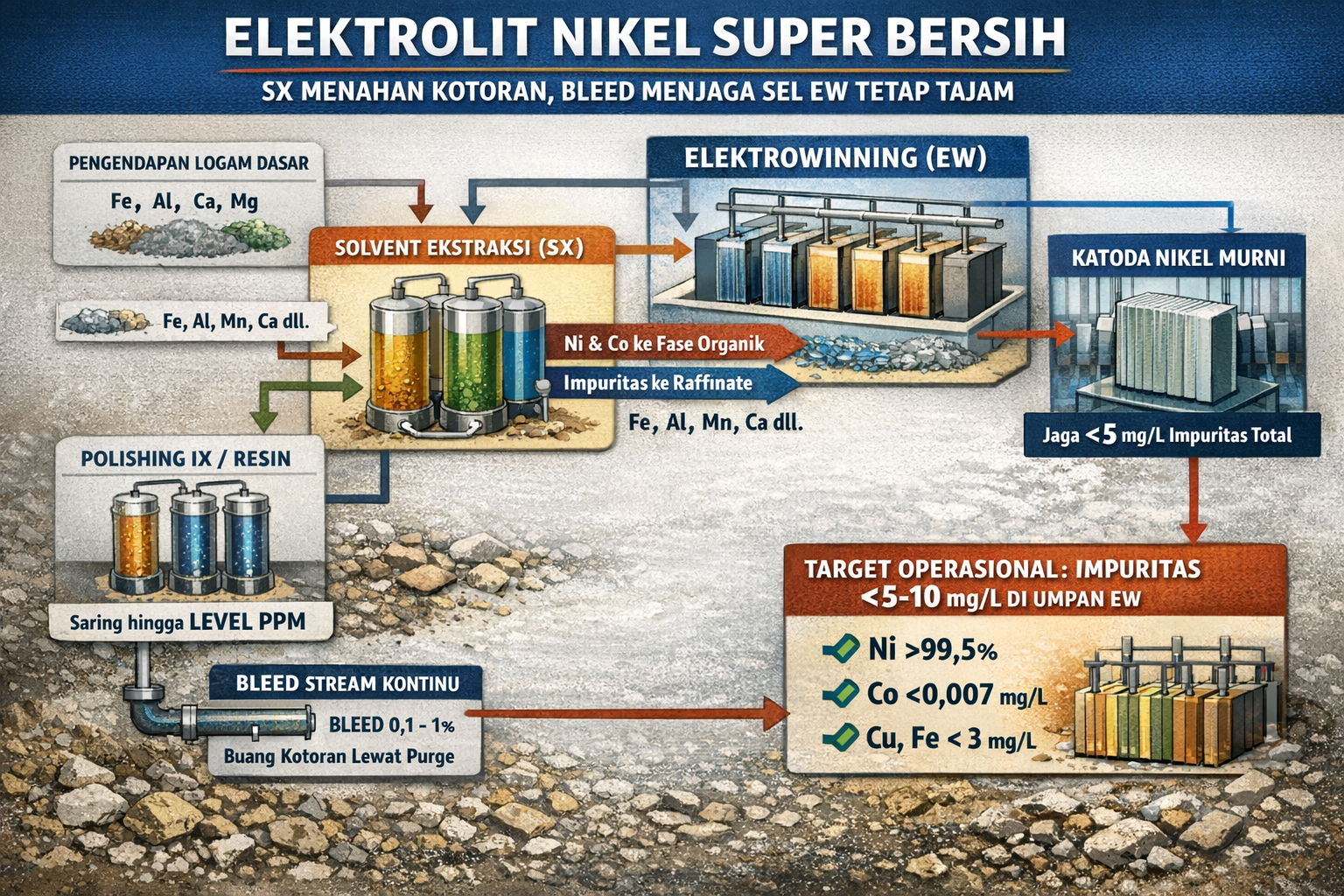
Polishing isn’t only IX. Precipitation or cementation can also cut residuals: Subagja et al. used nickel matte cementation and iron precipitation to remove Cu and Fe to only 3 mg/L and 20 mg/L, respectively, before EW (911Metallurgist). In early trials, those steps yielded 76–83% Ni cathode purity (same source).
Continuous electrolyte bleed design
Despite SX and polishing, a regular bleed (purge) is essential. As one patent puts it, “there is a small but constant influx of impurities into the circuit, and the impurity concentration steadily increases until it interferes with the production of high quality nickel cathode” (US 4,222,832).
Commercial circuits divert a small bleed — typically ~0.1–1% of flow — from the EW loop into a purge or recycle stage (patent link). In a classic Ni–Cu co‑extraction design, ~0.5–1% bleed from the Cu EW and ~0.1–0.4% from the Ni EW (liquor:bleed ~100:1) are routed back through the SX scrub/strip so metals are recovered and impurities concentrate into the raffinate (design detail; ratio). That cascading bleed keeps contaminants “below a predetermined level” while minimizing liquor losses (threshold note).
Why SX alone is not enough
Some species simply don’t vanish in SX. Magnesium, for instance, can persist at several grams per liter in Ni EW feed even after SX (Minerals Engineering)). Chloride in NiEW can also build up to affect deposition. A controlled bleed, replenished with fresh acid water or clean PLS, prevents such refractory ions from accumulating to harmful levels — an approach explicitly codified in the same commercial designs and guides that pair bleed flows with SX/resin polishing to maintain sub‑ppm impurities (bleed practice; guide note).
Scale, selectivity, and market context
Done right, SX strips out >99% of impurities before EW (Fang et al.; methods note). Targeted polishing (IX, precipitation, electropurification) pushes metals into the low‑ppm bracket (bench data; battery spec), and the bleed erases what’s left.
The outcomes are measurable: Ni solutions above 99.5% purity (pilot record) and high current efficiency — a discipline that matters as EW capacity scales. In China, EW is projected to deliver ~27.6% of refined nickel by 2024 (SMM; market note).
Key data points and sources
Purification routinely reaches ppm levels: copper and iron polished to ~3 mg/L and 20 mg/L, yielding 76–83% Ni cathode purity in early trials (911Metallurgist). In pilot SX, ~90% of Ca was precipitated and >99% of Co/Mg stripped, giving 61.7 g/L Ni strip with 0.007 g/L Co (Fang et al.). Industry practice aims for LiB‑battery standards — “<5 mg/L total metals” in the final liquor (Purolite).
Authors and sources include Fang Hu et al. in JOM 72(8):831–838 (2020) (methods; results), the Nickel Institute (Mar 7, 2025) (HPAL context), 911Metallurgist (EW data), Morikawa et al. in Materials Transactions 58(4):539–545 (2017) (impurity effects), Arshadi et al. in Minerals Engineering 185:107684 (2022) (Mg/Ca/Ni selectivity)), Hubred & Owen’s US 4,222,832 (bleed ratios; cascading design; impurity influx; threshold control), and Shanghai Metals Market (EW share; market framing).
Bottom line for plant design
The SX train keeps most contaminants out of the cells in the first place; polishing brings the rest to sub‑ppm; and a disciplined 0.1–1% electrolyte bleed stops the slow creep from organics carryover, anode dissolution, and make‑up chemicals (design quote). That combined regime is how circuits hit “invisible” impurity levels for most end uses — including Li‑battery standards — while recovering Ni back through SX and ejecting the problem to the raffinate (spec target; SX recycle).