

Recirculating aquaculture systems slash water use by ~90–99%—and they turn nitrate into the limiting factor. Designers are now weighing anaerobic denitrification reactors against simply opening the taps.
Industry: Aquaculture | Process: Recirculating_Aquaculture_Systems_(RAS)
Recirculating aquaculture systems (RAS) cut water consumption by roughly 90–99% compared with flow‑through farms (pubs.acs.org). The catch: nitrate (NO₃–N, nitrate measured as nitrogen)—the end‑product of nitrification—accumulates. In intensive RAS, long‑term NO₃–N levels of 100–1000 mg/L have been observed (pubs.acs.org).
Nitrate is less acutely toxic than ammonia or nitrite, but chronic exposure above about 100–200 mg/L can impair growth, feed conversion and health in many species (eurofish.dk) (onlinelibrary.wiley.com). Toxicology tests show fish mortality rising above 125 mg/L, and industry guidance recommends freshwater RAS keep NO₃–N below 50 mg/L, with saline systems below 100 mg/L (pubs.acs.org) (pubs.acs.org). Uncontrolled nitrate buildup risks suboptimal performance or regulatory non‑compliance.
Nitrate control options in RAS
Every RAS relies on biofilters to convert NH₄–N (ammonium‑nitrogen) into NO₃–N. Many operators use moving‑bed biofilm carriers; in that context, an aquaculture‑specific biofilm step can mirror the function of moving bed bioreactors (MBBR). Beyond that, the toolbox is four‑part.
Water exchange (dilution) holds nitrate in check by flushing and replacing a portion of system water. Moderate exchanges—think 5–20% volume/day—can work, and designers often target at least ~300 L of new water per kg feed to keep NO₃–N workable (eurofish.dk). Below that threshold, nitrate tends to stack up beyond 100 mg/L. It’s simple and equipment‑light, but it consumes water and energy (heating/cooling large volumes) and can clash with intake, treatment and discharge constraints (learn.farmhub.ag).
Biological denitrification removes nitrate rather than diluting it. In anoxic reactors (no free oxygen), facultative bacteria reduce NO₃ to N₂ gas when supplied a carbon source; this can be heterotrophic (organics like methanol or ethanol) or autotrophic (e.g., sulfur‑oxidizers on elemental sulfur) (learn.farmhub.ag) (eurofish.dk). Properly designed biofilters convert NO₃–N nearly completely to inert N₂.
Phytoremediation/aquaponics routes nitrate into plant biomass. One red tilapia study found aquatic plants removed ~50% of tank nitrate (journal.ipb.ac.id), supplementing or substituting engineered denitrification when a crop subsystem is viable.
Physical/chemical methods—reverse osmosis (RO) and ion exchange—can strip nitrate but are rarely used in RAS due to cost, brine disposal and energy demands (pubs.acs.org). Where very small, high‑value volumes justify it, an ion‑exchange unit or a brackish‑water RO system may be considered; RO generally runs best with an upstream pretreatment step such as ultrafiltration.
Inside an anaerobic denitrification reactor
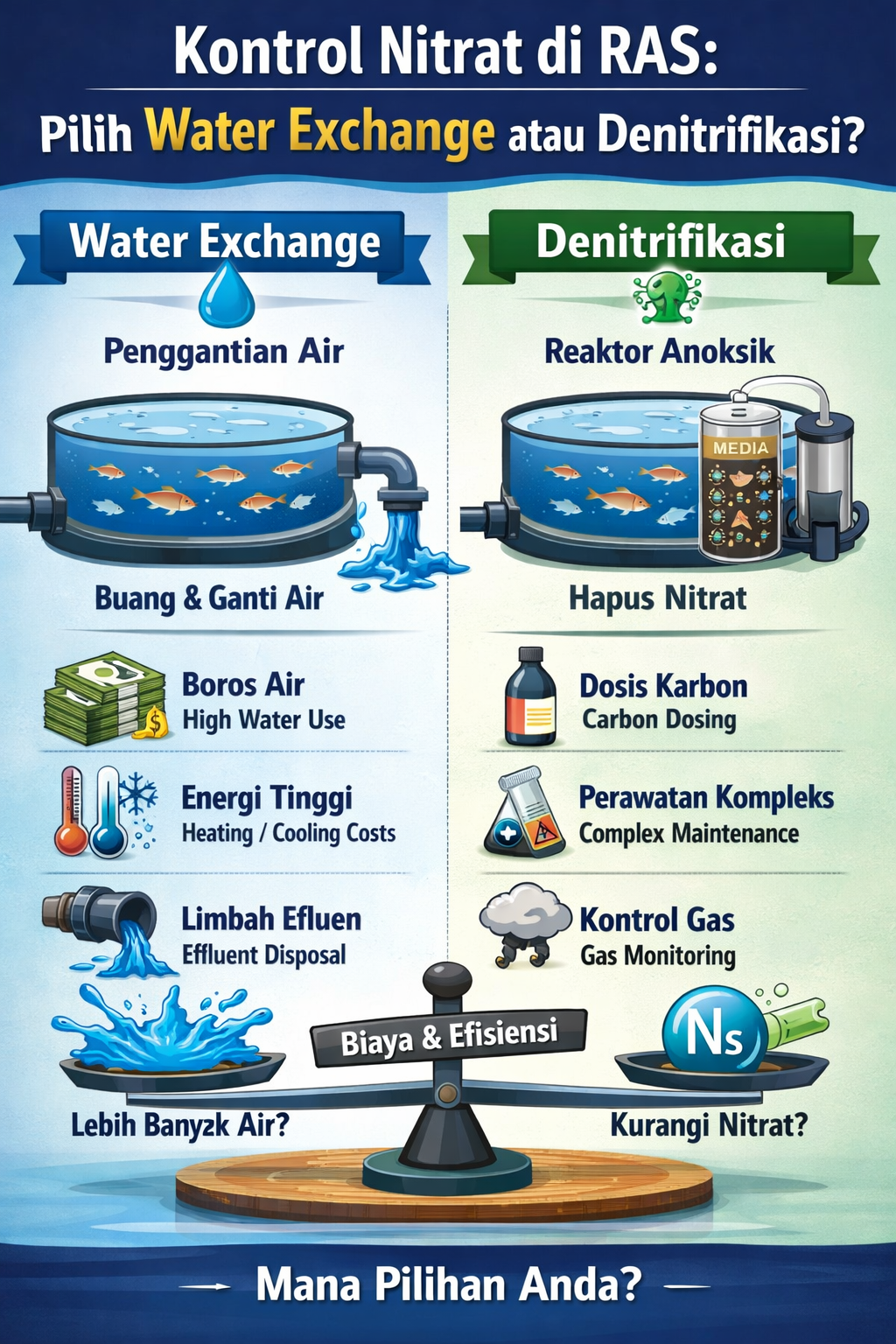
Dedicated “denitrifiers” sit in the RAS loop to remove nitrate. Configurations are typically packed‑bed or fluidized‑bed. Commercial units often use conical‑bottom tanks (around 500–2000 gal) packed with inert media in an upflow arrangement (patents.google.com); fluidized beds can employ coated granules or even activated carbon as a biofilm carrier, akin to the media offered under activated carbon. Low‑tech woodchip beds provide an “organic carbon” option, though most data come from treating outflows rather than recirculating loops (link.springer.com).
Placement matters. Denitrifiers typically follow solids removal to avoid clogging; many designs sit after fine screens so pump‑filtered water passes through the reactor before returning to nitrification/oxygenation or back to tanks (patents.google.com) (patents.google.com). Upstream solids capture can be as simple as a dedicated automatic screen filter. Some patented “single‑sludge” schemes mix digesting solids and nitrate in one unit; either way, settleable solids should be largely removed before denitrification.
Hydraulic retention time (HRT) is typically a few hours. A 2–4 hour HRT is common in practice (eurofish.dk), with reported volumetric capacities on the order of 0.5–1.2 kg NO₃–N per m³ per day; full‑scale upflow filters run with methanol have achieved ~0.67 kg N/(m³·d) (researchgate.net).
Oxygen control is critical. Denitrification is strictly anoxic, yet many operators maintain a low but nonzero dissolved oxygen near ~1 mg/L to prevent hydrogen sulfide (H₂S) formation—H₂S presents as rotten‑egg odor and fish toxicity (eurofish.dk). Some bleed in a small stream of reuse water or residual DO to keep H₂S in check (eurofish.dk).
Biomass management follows. Heterotrophic reactors generate biofilm and sludge, with backwash commonly required about once per week; “sludge production is quite high,” as industry guides note (eurofish.dk). Woodchip units slough less but can clog over years (link.springer.com). Autotrophic sulfur systems tend to produce less excess biomass.
Gas handling is usually simple: inert N₂ off‑gasses without capture. Still, operators monitor for H₂S and nitrous oxide (N₂O) under incomplete denitrification, and many designs include a headspace vent.
Carbon sources and dosing control
Heterotrophic denitrification needs a biodegradable carbon source. Common choices are methanol, ethanol, acetate, glycerol or sugar solutions (learn.farmhub.ag).
Stoichiometry drives the dose. Roughly 4–6 g of COD (chemical oxygen demand) per g of NO₃–N is required. In practice that equates to about 2.5 kg methanol per kg of NO₃–N removed (rule‑of‑thumb ranges ~2.1–2.5 kg); ethanol demand is roughly 4–5 kg per kg NO₃–N (eurofish.dk).
Onsite chemical storage and automation are standard. Bulk methanol tanks or drums of ethanol/acetate feed into the reactor under automatic control—typically via nitrate probes, oxidation‑reduction potential (ORP) setpoints, or fixed feed rates—to maintain a COD:NO₃–N ratio near 5:1 for complete denitrification (researchgate.net). Dosing hardware comparable to an industrial dosing pump is typical for precise chemical addition.
Bacteria must acclimate to the chosen carbon source; kinetics depend on temperature and pH, and advanced RAS often control temperature to sustain rates. Some “single‑sludge” designs ferment RAS biosolids into volatile fatty acids (VFA) to supply internal carbon, reducing purchased chemicals (learn.farmhub.ag).
Autotrophic pathways avoid organic carbon. Sulfur‑based denitrifiers use elemental sulfur with nitrate as the oxidant, generating N₂ and sulfate; these systems produce far less biomass and rely on cheap elemental sulfur (learn.farmhub.ag). Hydrogen‑based autotrophic denitrification is possible but rare due to safety concerns. Autotrophic designs acidify water and require buffering.
Cost and operational trade‑offs
Capital adders for denitrification include reactors, pumps, controls and carbon storage—ranging from a few thousand dollars for small modular units to tens of thousands at farm scale. A full‑scale woodchip reactor (tens of m³) has been estimated at ~$8,400 present value including initial capital and 10‑year maintenance (experts.umn.edu). Increased water exchange, by contrast, can demand larger intake/discharge piping and more filtration but no dedicated denitrifier.
Operating costs split differently. Denitrifiers pay for carbon, pumping and maintenance (backwashing, media). Woodchip systems are reported at $2.8–$13.4 per kg of N removed depending on media replacement frequency (experts.umn.edu). For a RAS feeding 1,000 kg/day (≈50 kg‑N/day), that implies on the order of $140–$670/day at $13.4/kg N (upper bound) (experts.umn.edu). Water exchange costs can look trivial by comparison—e.g., 30 m³/day at $0.20/m³ totals $6/day—yet that excludes intake treatment, heating/cooling and warm effluent handling (learn.farmhub.ag).
Operationally, denitrification adds complexity: chemical dosing safety, monitoring for DO, H₂S and potential N₂O, plus weekly backwashing (eurofish.dk). Water‑exchange strategies are simpler but force vigilance on incoming water quality to avoid contamination or disease (learn.farmhub.ag).
There are system‑level effects to weigh. High exchange rates can destabilize temperature or pH and require significant pumping energy, while denitrification keeps water—and heat—inside the loop, a benefit where water is scarce or tightly regulated (learn.farmhub.ag).
When to include denitrification
Nitrate load and targets set the first gate. Estimate NO₃–N produced from feed and species, then model concentration under the planned water exchange. If predicted NO₃–N exceeds ~50–100 mg/L (species tolerance and guidelines), removal beyond dilution is needed (eurofish.dk) (pubs.acs.org). Industry guidance explicitly notes that using less than 300 L/kg feed makes denitrification worth considering (eurofish.dk).
Water availability and quality are decisive. Where fresh water is scarce, expensive or brackish, denitrification gains appeal. If intake water itself demands treatment, that cost weighs against “just exchange more” (patents.google.com).
Effluent rules and market expectations matter. Some jurisdictions cap total nitrogen in aquaculture discharges; keeping nitrate below thresholds (e.g., <50 mg/L in freshwater discharge contexts) can require in‑line removal (pubs.acs.org).
Scale and intensity amplify the need. Large, high‑density systems (feed loads ~1–3 kg/m³/day) drive nitrate up quickly; literature notes denitrification is mainly suitable for intensive, large‑scale operations (link.springer.com).
Run the economics. Compare lifecycle cost per kg N removed via denitrification (capital + O&M + energy + chemicals) against the full cost of water exchange (pumping, heating/cooling, intake treatment and discharge). Passive woodchip reactors show ~98–100% N removal at roughly $2.8–$13.4/kg N (experts.umn.edu).
Match the approach to operator capacity and risk tolerance. Denitrifiers require technical oversight and carry risks (e.g., H₂S, N₂O, nitrite spikes if nitrification is incomplete). Simpler exchange can be safer for teams without dosing and anoxic biofilter experience (eurofish.dk).
Mind the value of water saving. Near‑zero discharge designs or aquaponics integrations (where plants “consume” nitrate) tilt the calculus toward denitrification or biological uptake. If no plant uptake is planned and >80–90% reuse is the target, a denitrifier is typically needed to close the loop.
One data point underlines the physics: at 300 L/kg feed, 1 kg feed (≈0.05–0.1 kg N) diluted into 0.3 m³ yields ~166–333 mg/L NO₃–N. To push that below 50–100 mg/L requires >600–1200 L/kg feed—impractical for most sites—explaining why high‑reuse systems almost always need denitrification (or plants) to meet nitrate targets (eurofish.dk).
Bottom line for RAS design
The rule‑of‑thumb break‑even is clear: above ~300 L/kg feed, flushing can keep nitrate manageable; below that, denitrification earns a place in the process flow (eurofish.dk) (learn.farmhub.ag). The decision ultimately tracks site water economics, species tolerance, regulatory limits and staffing—factors that determine whether to install an anoxic reactor or just open the valves a little wider.