
Desalination intakes are rewriting their playbook to keep marine life out of harm’s way. The data point to a simple truth: mesh/slot size matters, but approach velocity — the through‑slot speed at the screen face — decides the outcome.
Designers have two proven levers to curb fish losses at open‑ocean intakes: finer openings and slower water. Fine‑mesh traveling screens — active, moving belts, drums or baskets fitted with 0.5–1.0 mm mesh — have repeatedly intercepted the smallest life stages, while passive wedge‑wire screens — stainless slotted cylinders or panels — use hydrodynamics to sweep fish away rather than pin them. The difference shows up immediately in field numbers and survival rates.
In power‑plant tests, 0.5 mm fine‑mesh screens captured more than 95% of fish eggs and about 86% of larval fish, with 60–65% survival for those returned via fish‑return systems (nepis.epa.gov). Seasonal 0.5 mm installations at Big Bend (FL) and Brunswick (NC) cut entrainment — organisms drawn through the screen — by roughly 80–84% compared to conventional coarse screens (nepis.epa.gov) (nepis.epa.gov).
Active fine‑mesh traveling screens
Fine‑mesh traveling screens (fine woven wire of 0.5–1.0 mm) are active, moving systems that physically intercept eggs, larvae, and small juveniles and then carry them — often in water‑filled buckets — to a fish‑return system (studylib.net). As an automatic, continuous screening form akin to an automatic screen, their performance is data‑backed: power‑plant intake studies with 0.5 mm mesh captured >95% of eggs and ≈86% of larvae, with 60–65% survival among returned individuals (nepis.epa.gov).
In practice, seasonal 0.5 mm retrofits at Big Bend (FL) and Brunswick (NC) reduced entrainment by roughly 80–84% versus conventional coarse screens (nepis.epa.gov) (nepis.epa.gov). Those tests documented up to 95% removal of planktonic eggs (primarily Atlantic croaker and bay anchovy) and ~86% of larvae, dramatically cutting entrainment relative to unscreened intakes (nepis.epa.gov).
The trade‑offs are maintenance and fish handling. Small openings clog quickly with silt, algae, and debris, so frequent cleaning (often pressure sprays) and power for conveyors are part of the package. Without gentle fish‑return sluicing, impinged juveniles — those held against the screen surface — can suffer high stress or mortality; EPA studies warn that return systems must be carefully designed to avoid this (nepis.epa.gov). In short, fine‑mesh traveling screens deliver the highest entrainment reductions for eggs and larvae — 80–95% reductions have been documented (nepis.epa.gov) — at the cost of more complex equipment and intensive upkeep.
Passive wedge‑wire surface screening
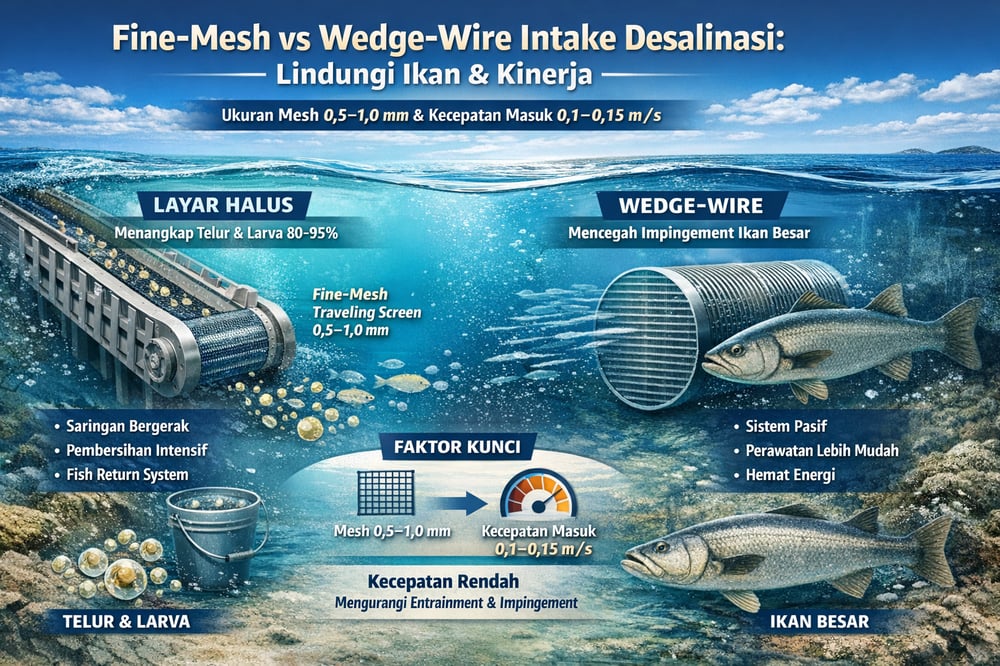
Passive wedge‑wire screens use narrow, stainless slotted elements (slot widths typically 0.5–3 mm) in cylindrical “V‑screens” or panels oriented parallel to the ambient flow. Their hydrodynamic principle is simple: maintain high cross‑flow at the screen face to sweep organisms off the surface while drawing water through the angled slots (nepis.epa.gov) (www.researchgate.net).
Field results are striking for larger fish. In Santa Cruz, a 13‑month evaluation of a submerged cylindrical wedge‑wire screen with 2.0 mm slots, operated at ~0.33 fps (0.10 m/s), reported zero fish impinged (www.researchgate.net). At the Eddystone Generating Station, retrofitting 9.5 mm wedge‑wire screens dropped fish impingement from millions per year to essentially zero (nepis.epa.gov).
Lab work helps frame the size thresholds: with 1 mm slots, wedge‑wire excluded >80% of ichthyoplankton (fish eggs and larvae) longer than 5 mm and virtually 100% above 10 mm, while fish under 5 mm passed through virtually unimpeded (www.tandfonline.com). Passive systems don’t physically remove plankton or eggs below the slot size; they also foul more slowly than fine mesh but still need periodic air‑burst back‑flushes (studylib.net). Compared with fine‑mesh traveling screens (and with conventional coarse, often manual, configurations such as a manual screen), passive wedge‑wire tends to have lower operating cost but demands careful siting and orientation; the equipment is usually submerged. EPA 316(b) guidance cites wedge‑wire as the most effective passive open‑intake screen form (studylib.net).
Mesh/slot size and approach velocity
Screen effectiveness hinges on both the opening size and approach velocity (the through‑slot speed at the screen surface). Smaller openings block smaller organisms but increase head loss and fouling risk; coarser openings allow higher velocity for a given area but let more organisms through. Industry guidance aims for very low approach velocities — on the order of 0.1–0.15 m/s — with mesh or slots selected for the target biota (studylib.net) (studylib.net). Both fine‑mesh traveling screens and narrow‑slot wedge‑wire systems are commonly designed with ~0.5–1.0 mm openings and a through‑slot velocity around 0.5 fps (~0.15 m/s), matching the U.S. EPA’s 0.5 fps (feet per second) recommended limit and default compliance criterion for fish protection (studylib.net) (studylib.net).
Field studies suggest even lower velocities better protect small fish. Boys et al. (2013) found mesh size had little effect on entrainment rates, whereas approach velocity was decisive: doubling velocity (0.1→0.2 m/s, or somewhat higher in their tests) sharply increased entrainment of small (<150 mm) fish; they recommended ≤0.1 m/s to minimize impacts across an entire fish assemblage (journals.plos.org). A Polish study showed that adding flow deflectors to equalize flow could reduce maximum inlet velocity to ~0.05–0.08 m/s — an extra margin of safety for ichthyoplankton (www.mdpi.com).
Design practice and field thresholds
Below ~0.15 m/s, impingement drops precipitously: one intake running at 0.33 fps (0.10 m/s) recorded zero fish impinged (www.researchgate.net). Exceeding those velocities leads to significant entrainment; EPA studies note that intake head flows of only a few tens of cm/s can be lethal to juveniles. In practical designs, very fine mesh (e.g., 0.5 mm to catch larvae) often means enlarging the total screen area or increasing cleaning frequency to keep approach velocity within ~0.1–0.15 m/s.
Accordingly, high‑value installations layer safeguards: multiple parallel screens enlarge area, air‑burst systems purge fouling, and fish‑return sluices recover impinged organisms. The data bear this out: fine‑mesh traveling screens can achieve ~80–95% entrainment reduction (nepis.epa.gov), while wedge‑wire screens in proper orientation have repeatedly eliminated impingement of large fish (www.researchgate.net) (nepis.epa.gov). Maintaining an approach velocity on the order of 0.1–0.15 m/s is the key to achieving those results (journals.plos.org) (studylib.net).
Sources and reference notes
EPA intake‑screening studies report 84–95% entrainment reduction with 0.5 mm traveling‑screen mesh (nepis.epa.gov) (nepis.epa.gov). A North American Journal of Fisheries Management study found that 1 mm wedge‑wire slots excluded virtually all fish >10 mm (www.tandfonline.com). The Water Research Foundation (2011) and EPA (2014) note 0.5–1.0 mm mesh and ≤0.15 m/s design velocity as industry standards (studylib.net) (studylib.net). Intake tests (e.g., Santa Cruz, Eddystone) have confirmed nearly 100% impingement elimination at these parameters (www.researchgate.net) (nepis.epa.gov). Collectively, the data are clear that mesh size and approach velocity must be chosen together.
References: Bauer et al. (2011); Boys et al. (2013); EPA 316(b) TDD (2002, 2014); Kaczmarski et al. (2023); Mackey et al. (2011); Weisberg et al. (1987); Voutchkov (2011) (nepis.epa.gov) (nepis.epa.gov) (www.tandfonline.com) (journals.plos.org) (nepis.epa.gov) (studylib.net) (studylib.net) (www.researchgate.net).
