

Industry: Fertilizer_(Ammonia_&_Urea) | Process: Boiler_Feedwater_&_Steam_Generation
When a 30 MW steam turbine lost more than 5% of its generating capacity, the culprit wasn’t blade fatigue or a gearbox fault — it was steam contaminated with boiler-water solids that quietly built up on nozzle and blade surfaces (Veolia Water Handbook). In another case, deposits forced a brand-new turbine offline in just three months (Veolia Water Handbook).
Ammonia and urea plants live on steam — for process heat and power — and they run large superheated steam turbines (steam heated above its saturation temperature) that are particularly susceptible to contamination (Veolia Water Handbook). The physics is unforgiving: deposits alter blade geometry and increase flow resistance, which cuts efficiency, while uneven fouling can unbalance the rotor and spike vibration (Veolia Water Handbook).
Worst case, steam-side valves can stick, turbines can overspeed, and damage follows (Veolia Water Handbook). That’s why modern practice demands ultra‑clean steam — total solids at the ppb (parts per billion) level — even though older ABMA/ASME codes once guaranteed only ~0.03% carryover (Veolia Water Handbook).
Carryover mechanisms and blade deposition
Contaminants reach the turbine two ways: mechanical entrainment (boiler water droplets carried over with steam) and vaporous carryover (volatile species dissolved in steam). Both routes foul blades and nozzles (Veolia Water Handbook; Veolia Water Handbook). Excessive carryover — from poor drum separation, high water levels, foaming or priming — delivers dissolved salts and suspended solids directly to the turbine (Veolia Water Handbook; Veolia Water Handbook).
As sticky films grow, passages roughen and occlude. More pressure is needed to push the same flow, so output falls; Fig.18‑1 in [16] documents the effect, with stage pressure rising up to 5% and that 30 MW turbine losing >5% output (Veolia Water Handbook). In saturated-steam service, high moisture can also induce erosion and thermal shocks; large water slugs create mechanical stresses and faults (Veolia Water Handbook).
Chemically, deposits concentrate corrosives: chloride or alkali in condensed films can pit rotors and disks (Veolia Water Handbook; Veolia Water Handbook). Sodium compounds and silicates are common findings; amorphous SiO₂ is the most prevalent deposit identified on blades (Veolia Water Handbook). Silica is especially insidious: it travels with the steam, then precipitates as the vapor expands and cools in low‑pressure stages, forming glassy scale (Veolia Water Handbook; Veolia Water Handbook).
The economic hit is real: deposits can cut efficiency by ~5% or more and throttle capacity by up to 20%, before forcing cleaning outages (Veolia Water Handbook). Water-wash or blowing can remove salt-rich fouling, but silica‑rich deposits require offline abrasive blasting — often many days — making the downtime costlier than upgrading water treatment and drum internals (Veolia Water Handbook).
Steam purity limits and silica control
For industrial turbines at 300–1500 psig (psig: pounds per square inch gauge), global guidance targets just 10–30 ppb (0.01–0.03 mg/L) total solids in the steam (Veolia Water Handbook). In practice, designers assume 99.97% or more of the circulating water must be mechanically removed in the drum to meet those requirements (Veolia Water Handbook).
Silica drives the strictest limits. While most salts don’t vaporize appreciably below ~2400 psig, silica (SiO₂) can volatilize at boiler pressures as low as ~400 psig, with its water/steam distribution ratio climbing steeply with pressure (Veolia Water Handbook; Veolia Water Handbook). Empirically, turbines tolerate up to ~0.02 ppm silica in steam, with many modern units requiring <0.01 ppm (Veolia Water Handbook).
Typical tabulations show that at 751–1000 psig drum pressure, the maximum expected total solids in steam (exclusive of silica) is only 0.1–0.5 ppm (Veolia Water Handbook). And when superheaters and turbines are in service, attemperating water (spray water used to control steam temperature) must meet steam purity — i.e., use volatile treatment only — to avoid injecting fresh solids (Veolia Water Handbook).
Steam drum separation hardware
Gravity separation suffices at low pressure, but above ~200 psig the water/steam density gap narrows and entrainment rises; at 1000 psig, water is only 20× denser than steam, so separation by gravity alone becomes prohibitive without very large drums (Veolia Water Handbook). Multi‑stage internals solve that constraint.
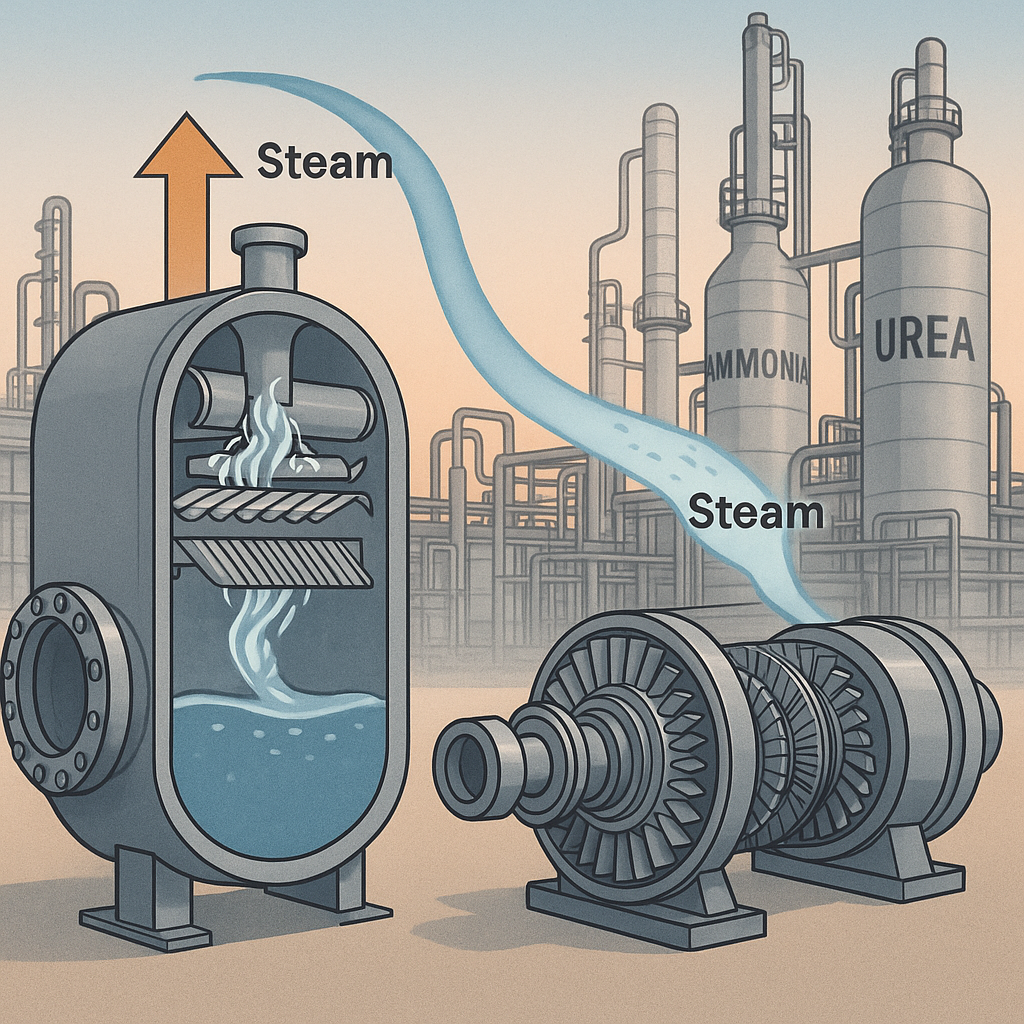
Primary separation occurs at the drum inlet. Directional baffles or cyclones spin or deflect the steam–water mixture (cyclone: a device using centrifugal force) so dense droplets impact walls and drain back to the water space (ResearchGate; Veolia Water Handbook). Kvaerner’s design manual details vertical cyclone units sized to the inlet nozzles to “rip” the phases apart (Kvaerner design manual; Kvaerner design manual).
A primary steam scrubber/coalescer follows: corrugated or louvered plates force rapid flow reversals; fine mist impinges and coalesces, draining via a perforated plate into the water well (Kvaerner design manual). Kvaerner describes a corrugated‑plate pyramid mounted above a stainless‑steel perforated plate for this duty (Kvaerner design manual).
Secondary scrubbers (steam purifiers) — stacks of thin corrugated sheets or wire mesh — intercept ultrafine droplets, again using repeated flow reversals to grow drops and shed them to drains (Veolia Water Handbook; Kvaerner design manual). Large drums often run parallel rows of purifiers on opposite sides to keep velocities low and re‑entrainment minimal (Kvaerner design manual).
Figure (schematic): an annotated drum would show inlet cyclones, corrugated scrubbers, and drains returning condensate to the water side (omitted here). In service, such internals routinely remove ≥99.9% of moisture. With good design, even multi‑thousand‑psig boilers can hold steam solids to <0.05 ppm (Veolia Water Handbook).
Feedwater treatment and chemistry control
Drum internals need chemistry discipline to work. Plants pair separation hardware with high‑purity makeup water — deaerated and low in dissolved/suspended solids — and tight blowdown control to suppress TDS and silica (Veolia Water Handbook). Reverse osmosis is widely used; examples include brackish-water RO systems for high‑TDS sources.
Softening (removing hardness ions that promote scaling) is a common upstream step; many units implement a dedicated softener before the boiler cycle. Where ion removal to very low levels is required, demineralization (cation/anion exchange) is standard; a packaged demineralizer supplies the low-salt makeup the turbine demands.
Oxygen is scavenged to curb corrosion and stress‑concentrating pits on steam path metals; typical programs dose oxygen scavengers to keep dissolved O₂ at trace levels. pH is tuned to protect ferrous alloys and limit corrosion‑product transport; plants dose a neutralizing amine accordingly.
Foam control matters because foaming can overwhelm separators; studies cited in handbooks note that doubling boiler solids roughly doubles carryover, and foaming (from organics or high alkalinity) can increase carryover even more (Veolia Water Handbook). Where needed, plants deploy targeted antifoam to steady the drum surface.
The dosing hardware behind those programs must be precise; a metering dosing pump enables the tight control operators need as loads and feedwater conditions swing.
Operations, monitoring, and attemperation water
Operators keep drum level low enough to maximize de‑entrainment volume (while maintaining separator flooding), watch conductivity, alkalinity, and silica continuously, and adjust blowdown — including temporary increases — to clamp spikes, particularly silica (Veolia Water Handbook). Condensate is sampled, especially at startup, because heater leaks or condensing loops can introduce surprise contaminants (Veolia Water Handbook).
Attemperation water (spray water used to adjust steam temperature) must be as pure as the steam it tempers; guidance is unequivocal that this water receive volatile treatment only, otherwise the turbine is fed a new solids source at the worst possible point (Veolia Water Handbook).
Regional practice and boiler criteria
In Indonesia, high‑pressure boiler criteria used by local vendors mirror international practice for ultra‑pure feedwater. One table for >20 bar service sets a conductivity target <3000 μS/cm (μS/cm: microsiemens per centimeter), iron (Fe) <0.1 mg/L, with other contaminants at ppb levels and silica listed as “pressure dependent” (Adika Tirta Daya). Elsewhere, the same guidance notes pH>9.2 and total hardness <0.01 mmol/L for similar service, underscoring that feedwater and drum chemistry must be pristine (Adika Tirta Daya).
While Indonesian K3 Boiler safety regulations do not explicitly set chemical limits, operators align to international standards (ASME/ABMA/EPRI) in practice, applying the same Veolia‑style tables and turbine maker limits referenced above (Adika Tirta Daya; Veolia Water Handbook).
What “non‑negotiable” looks like in numbers
For superheated service, steam total solids must be kept to ppb levels; industrial turbine specs typically sit from single‑digit ppb up to the tens of ppb (Veolia Water Handbook; Veolia Water Handbook). Handbooks also show that at 751–1000 psig, expected steam solids (exclusive of silica) are just 0.1–0.5 ppm, and that properly designed multi‑stage separation can hold steam solids below 0.05 ppm even at multi‑thousand‑psig conditions (Veolia Water Handbook; Veolia Water Handbook).
Silica control is even tighter: keep steam at ~0.02 ppm or less, and for many modern turbines <0.01 ppm (Veolia Water Handbook). The bottom line from the handbooks is blunt: carryover can never be eliminated, so the only defensible strategy is to reduce it to the ppb carryover that can be tolerated (Veolia Water Handbook). In ammonia/urea service, maintaining steam solids ~0.01 ppm with silica <0.02 ppm prevents the 5–20% performance penalties and the downtime cascades documented in case histories (Veolia Water Handbook; Veolia Water Handbook).
Across the literature and plant experience compiled here — Veolia’s chapters on steam purity and turbine deposition (chapter 18; chapter 16), Kvaerner’s steam‑drum internals manual (design manual; cyclone sizing; purifier drains; parallel rows), and separation device overviews (ResearchGate) — the consensus is consistent. Steam purity is non‑negotiable for turbine reliability, and properly designed drum separation plus chemistry control must drive carryover to the ppb range.