

Industry: Fertilizer_(Ammonia_&_Urea) | Process: Natural_Gas_Reforming
In modern ammonia‑urea sites, the steam that drives the natural‑gas reformer arrives at 1500–2000 psig (pounds per square inch gauge). The catch: that steam must be immaculate. Even trace ions and gases—salts, silica, iron, oxygen—concentrate in boilers and ride out with the vapor, fouling heat surfaces and, critically, poisoning reformer catalysts. Industry guidelines pin dissolved oxygen at <0.007 mg/L, iron and copper at <0.010 mg/L, zero hardness, and pH around 8.8–9.6 at 25 °C (slideshare.net). The practical response is multistep treatment—filtration, softening, reverse osmosis or ion exchange, mixed‑bed polishing—and thorough deaeration (slideshare.net) (studylib.net).
On the demineralization side, plants lean on RO (reverse osmosis) trains to strip dissolved solids before polishing; in brackish‑to‑low‑salinity feeds, that includes systems like brackish‑water RO. Hardness is knocked down upstream to “zero hardness” targets with ion exchange softening; applications typically use units such as a softener to prevent scale formation before the boiler.
ASME‑level purity at 1500–2000 psig
The ASME‑style consensus for 1500–2000 psig boilers requires nearly pure feedwater: undetectable Ca/Mg hardness, silica and sodium at the ppb (parts per billion) level, and oxygen scavenged to <0.007 mg/L before any chemical treatment (slideshare.net) (studylib.net). “Nearly pure” is operationalized with fine‑tuned demineralization and polishing: multi‑bed resin trains and mixed‑bed polishers scrub to <1 ppb of hardness and alkalinity, and condensate is polished before it rejoins the cycle to keep make‑up and recycle streams in spec.
When ammonia‑plant operators tightened their boiler feed chemistry—even modestly—the effect on metal ingress was stark. In one case study, raising feedwater pH from 8.4 to 9.1 (with deaeration) drove iron down from ~35–40 ppb to <10 ppb (studylib.net): Day 15, pH 8.4, Fe 40 ppb; Day 16, pH 8.5, Fe 35 ppb; Day 17, pH 9.1, Fe 11 ppb; Day 21, pH 9.0, Fe <5 ppb (ND). Above ~pH 9, dissolved iron fell below detection. The data illustrate how modest conductivity/alkalinity targets—achieved via careful demineralization and phosphate buffering—can cut corrosive iron ingress by ~75–85% (studylib.net).
To get there at scale, engineers specify cation/anion beds with strong/weak resins and mixed‑bed polishers; typical packaged lines include a demineralizer and replacement media such as ion‑exchange resin for tight silica and sodium control.
Silica, sodium and carryover limits
Guidelines commonly target feedwater conductivity at ≤0.1–0.2 μS/cm (microsiemens per centimeter), silica at ≤10 μg/L, and sodium at ≤2 ppb (chemtreat.com) (chemtreat.com) (studylib.net). Silica is notoriously insidious: at high pressure, some vaporous SiO₂ co‑distills with steam and hardens on metal surfaces (chemtreat.com). As one industry source notes, silica “will precipitate on turbine blades… reducing efficiency, hence the 10 ppb recommended limit” (chemtreat.com). Mixed‑bed polishing trains—such as a mixed‑bed unit—are selected to drive silica and sodium into single‑digit ppb territory.
The reason is catalyst protection. Metallic ions, halides, chloride or sulfate impurities—even at tens of ppb—can generate localized acids under deposits, attacking catalyst supports or reformer tubes. Any boiler water carryover is therefore considered unacceptable: dissolved or suspended solids in entrained droplets deposit in reformers and boilers. As a demister vendor notes, “liquid droplets entrained in the steam also contain dissolved solids, which impact the [steam] purity” (beggcousland.com).
Deaeration, scavengers and pH control
Dissolved oxygen is stripped in a deaerator (a vessel that removes dissolved gases) and by reducing scavengers to ppb levels, because residual O₂ can create corrosive H₂O₂ hotspots on metal surfaces. Chemical programs then hold boiler pH ~9–9.6 to passivate steel and control Ca/Mg via phosphate/phosphonate treatment (chemtreat.com) (slideshare.net). Plants dose these reagents with precision equipment like a dosing pump, and routinely adopt packaged scavenger programs such as oxygen scavengers alongside alkalinity adjusters (targets anchored to the same pH guidance).
In high‑purity systems, “minimizing feedwater iron entering the steam drum is key… even a very small amount of iron oxide over time can cause problems” (slideshare.net). That focus extends to condensate. Return streams are polished on the way back to the boiler to intercept any iron or copper ions; facilities specify a condensate polisher where process risks are known.
Steam drum separation and internals
Hardware design does the rest. Steam drums are fitted with steam separators and demister internals to deliver dry, clean steam. Modern high‑pressure units use cyclone‑type separators (multiple centrifugal stages) to fling out water, followed by chevron‑vane or mesh demister pads to capture residual mist (beggcousland.com) (beggcousland.com). A typical arrangement distributes water to form a film across tubes, then routes the rising steam–water mixture through a bank of cyclones; bulk liquid is thrown back to the drum and a downstream, usually two‑stage, mesh demister traps micro‑droplets (beggcousland.com) (scribd.com).
Industry guidance specifies physical clearances to prevent re‑entrainment: cyclone/demister packages sit well above the maximum water level—e.g., a ≥300 mm margin—so turbulent upflow cannot pull liquid into the steam outlet (scribd.com). Properly designed drums achieve steam purity on the order of 5–1000 ppb of residual particulates/dissolved solids (beggcousland.com).
Blowdown control and real‑time monitoring
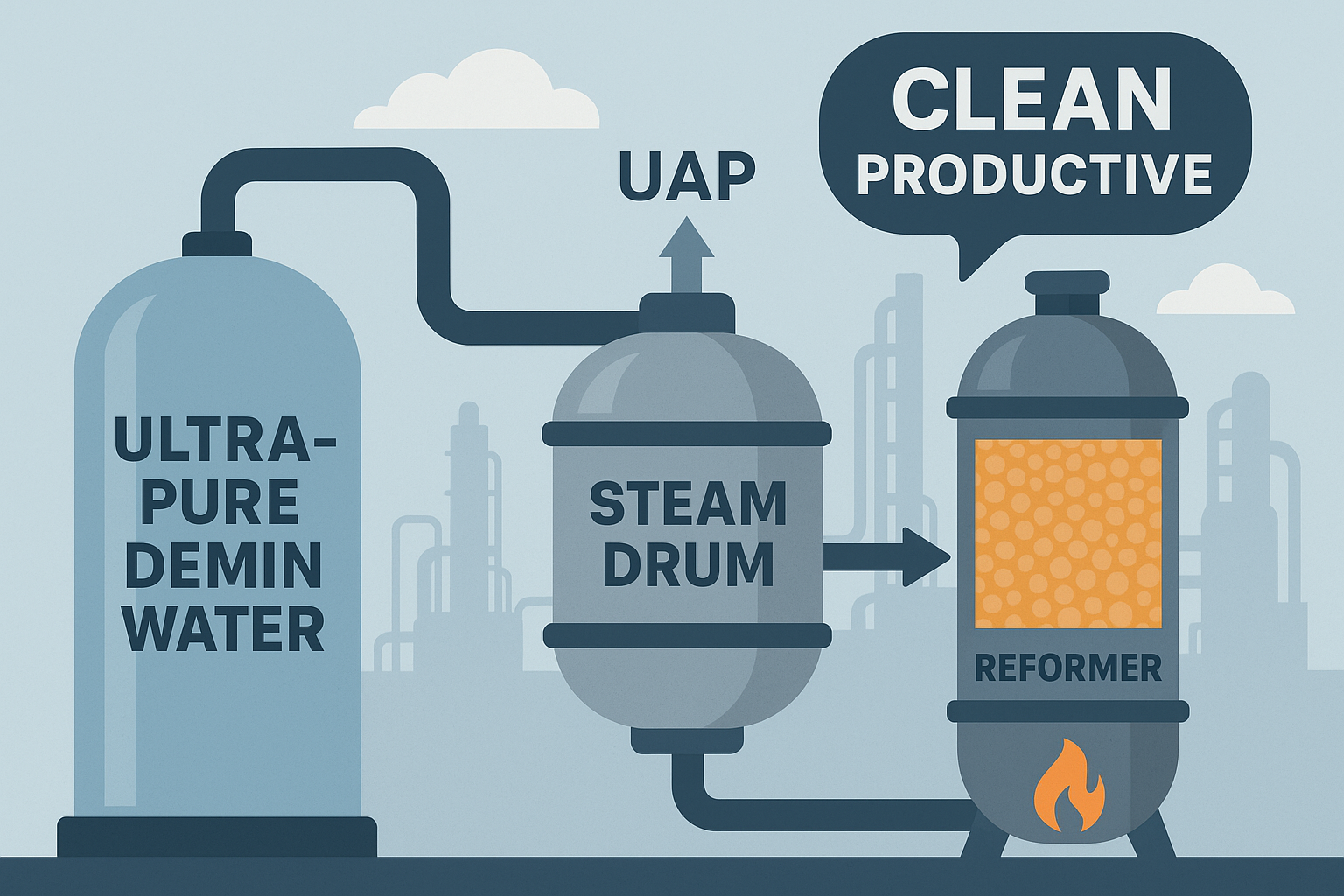
Operationally, blowdown control and monitoring complement the hardware. Automated blowdown valves purge the most concentrated boiler water—limiting silica or salt buildup—and continuous conductivity/TDS (total dissolved solids) monitors watch for any rise. Condensate return is polished as needed to prevent known ingress (for example, from cooling tower discharges). For pretreatment protection ahead of polishing steps, some facilities add fine filtration such as a cartridge filter to intercept 1–100 μm particulates before they complicate the boiler cycle.
Operating outcomes and sources
The operating picture is consistent: ultra‑pure boiler feedwater and well‑engineered steam drums are essential to protect reformer catalysts. The numbers cited by industry manuals and case studies are tight—conductivity ≤0.1–0.2 μS/cm, silica ≤10 μg/L, sodium ≤2 ppb, O₂ <0.007 mg/L, hardness ~0—and they are met with demineralized makeup water, strict blowdown, and high‑efficiency separation (chemtreat.com) (slideshare.net). Lapses—higher conductivity or residual salts—correlate with deposition and catalyst fouling; the ammonia‑plant study linking pH control (8.4→9.1) to iron reductions from 35–40 ppb to <10 ppb illustrates the leverage operators have (studylib.net) (slideshare.net). Those chemistry protocols translate to longer catalyst life, fewer unplanned outages, and steadier reformer efficiency—critical outcomes for high‑volume fertilizer operations.
Sources: International boiler‑chemistry guidelines and ammonia‑plant case studies were used. ASME consensus and industry manuals set feedwater specs (slideshare.net) (studylib.net). Vendor literature and water‑treatment handbooks detail steam‑separation internals (beggcousland.com) and the effects of silica, sodium, iron carryover on corrosion and deposits (chemtreat.com) (chemtreat.com).
References: Setaro D.M., “High Pressure Boiler Chemical Treatment in Ammonia Plants” (GE Water/Process Tech, 2006). (ASME/APC conference paper; see Table of recommended feedwater specs) (studylib.net) (studylib.net). ChemTreat Inc., “Minimizing Corrosion and Deposition in High‑Pressure, High‑Purity Steam Generators” (white paper, 2021) (chemtreat.com) (chemtreat.com). Chemtreat Water Essentials Handbook (Boiler/Steam chapter) – guidelines for purity (conductivity ≤0.1 μS, silica ≤10 ppb, Na ≤2 ppb) (chemtreat.com) (chemtreat.com). Begg Cousland Ltd., “Demisting/Droplet Separation – Boiler Steam Drums” – cyclones, chevrons and mesh pads delivering 5–1000 ppb steam purity (beggcousland.com) (beggcousland.com).