

Industry: Coal_Mining | Process: Mine_Dewatering
Pumping systems are quiet giants in a mine’s power bill. Globally 10% of all electricity is consumed by pumps (seaenergy.in), and two‑thirds of pump systems are thought to be grossly oversized, wasting up to 60% of their energy (seaenergy.in). Underground coal mines may need continuous high‑volume pumping to control inflows, representing a large steady load. When roughly 85% of a pump’s life‑cycle cost is the energy to run it (versus 5% initial cost) (seaenergy.in), tiny efficiency gains turn into big money.
Audits routinely find more than half of pump energy can be saved through optimization (seaenergy.in). The strategy is blunt: upgrade pump hydraulics, step up motor efficiency, and apply variable frequency drives (VFDs, electronic speed controllers) to match output to actual dewatering demand. The payoff is lower kWh and lower CO₂.
High‑efficiency pump hydraulics
Modern high‑efficiency centrifugal pumps—sized to actual duty—now use CFD (computational fluid dynamics) and refined wear‑ring designs to minimize internal recirculation. Case studies from FLSmidth indicate KREBS pump models with adjustable clearance rings and advanced impellers can cut power draw by 5–10% for the same flow and head versus older designs (engineeringnews.co.za). Over time, wet‑end life extended 1.5–2× longer in measured cases (engineeringnews.co.za), which also trims maintenance. Atlas Copco reports that pump redesigns since around 2018 using CFD improve hydraulic efficiency and cavitation resistance, yielding further savings (atlascopco.com).
System losses often start at the intake. Pre‑pump debris control with an automatic screen (continuous debris removal) stabilizes head loss and operating points; mines commonly deploy an automatic screen to keep flow paths clear. On suction lines, a strainer helps prevent recirculation‑inducing blockages that force pumps off their best efficiency point (BEP, the flow/head where a pump is most efficient).
Premium motors and standards
Motor efficiency is the other lever. Premium‑efficiency motors (IEC IE3/IE4) on pumps ≥7.5 kW are increasingly standard, and many regions mandate IE3 or better; the EU Ecodesign rules (2021) will require IE4 motors in many categories from 2023 (commission.europa.eu). Premium motors use more copper and steel to curb losses: a lab comparison found a 75 hp rewound motor (≈67% efficient) used 42% more energy to do the same work as a new premium‑efficiency motor (electronicdesign.com).
In the field, upgrading IE2→IE3 typically yields a few percentage points of efficiency gain at design load, yet long operating hours make that material. With electricity at ~$0.10/kWh, a 100 kW motor running 5,000 h/yr saves on the order of 250–500 MWh/yr going from IE2 to IE3. Modern motors also carry better bearings and thermal protection, limiting downtime.
Pump selection and duty matching
Matching pump curves to expected duty avoids throttling valves and running far from BEP. If dewatering demand varies—storm inflows or shifting pit stages—selecting a pump whose BEP range overlaps the typical operating region reduces wasted head. Where one large pump runs lightly loaded, many sites do better with multiple smaller pumps or trimmed impellers. Routine inspection and cleaning of lines reduce friction and partial blockages that otherwise bleed efficiency. Supporting components matter too; resilient housings and ancillaries that maintain clean hydraulics, such as compact water‑treatment ancillaries, help keep actual operating points close to design.
Variable frequency drives (speed control)
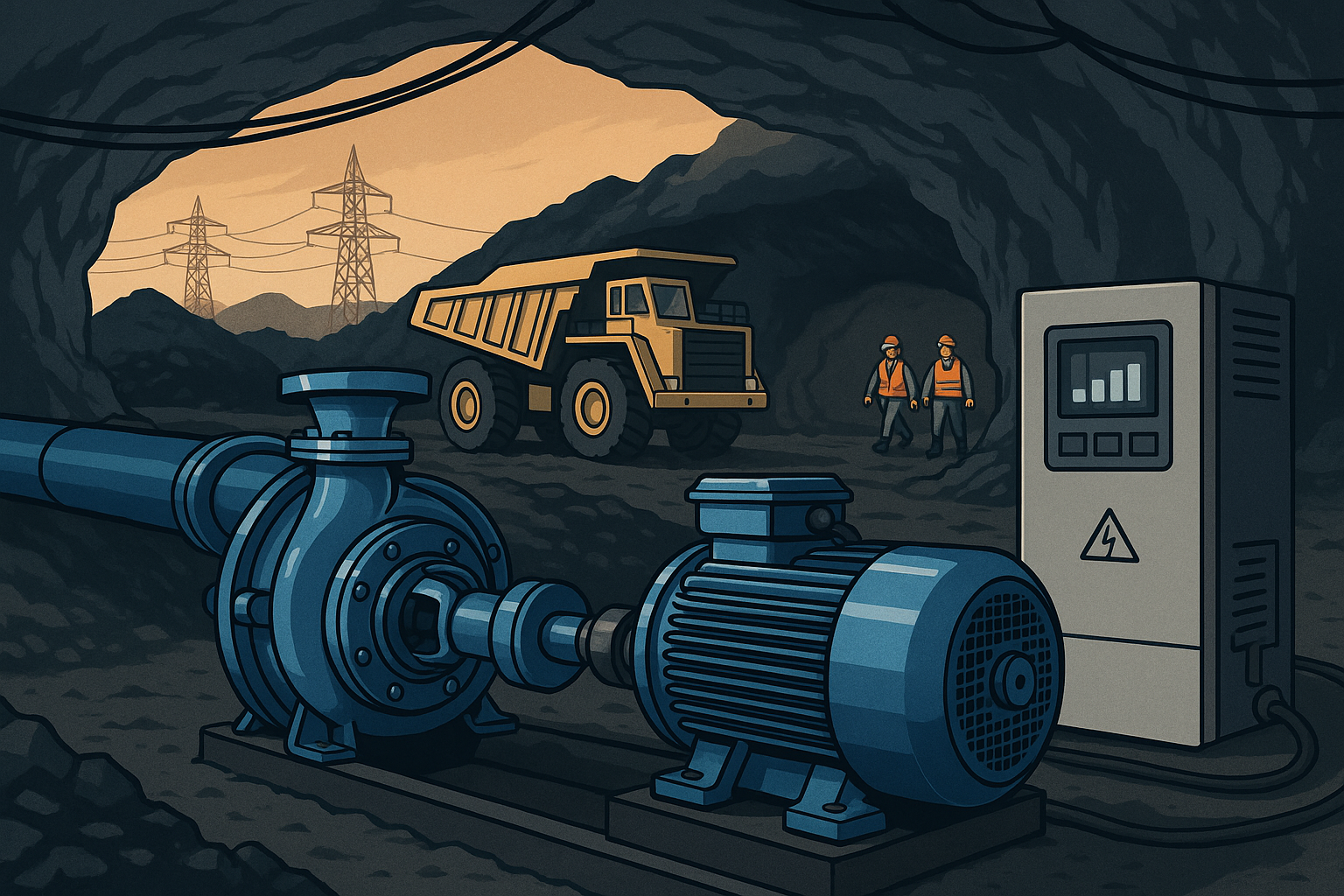
Dewatering rarely runs at a single set point. VFDs (variable frequency drives) adjust motor speed so flow and head match what’s needed in real time; a fixed‑speed pump instead throttles or dumps flow. Affinity laws govern the physics: Flow ∝ Speed, Head ∝ Speed², Power ∝ Speed³ (plantservices.com). Drop to 80% speed and power falls to about 51% (0.8³≈0.51) of full‑speed power; even slowing by 25% halves power use≈(0.75³≈0.42). VFDs do add a small conversion loss (~3% at full speed, plantservices.com), so if a pump never runs below 100% flow the benefit is minimal. In typical mines, the savings are large: a field study in Chinese coal mines showed switching from fixed‑speed pumps to VFDs cut energy use 10–20% (globalminingreview.com). Converting from one VFD per pump to full VFD control could save an additional ~12% (globalminingreview.com).
Part‑load conditions amplify the benefit. Tests show the greatest energy savings when replacing throttling valves with VFDs under light flow or low static head (static head is the elevation‑related pressure that must be overcome) (plantservices.com). Even at higher head, VFD control still beats throttling because, as speed drops, pressure requirements shift quickly toward the static minimum, preserving energy gains (plantservices.com) (plantservices.com). A broader industry review adds that electrification and VFD adoption make electric dewatering pumps up to 5× cheaper to run than diesel units, primarily via fuel/energy savings (miningmagazine.com).
Digital control tightens the loop. Modern VFDs with built‑in monitoring accept feedback from level sensors and pressure transducers to modulate speed, and variable‑torque modes improve part‑load efficiency. Linking drives to SCADA/HMI (supervisory control and data acquisition/human‑machine interface) enables real‑time dashboards and predictive ramping. The EU now requires drives to carry efficiency labels at several load points, steering engineers toward system‑level savings (commission.europa.eu). Where dosing is part of dewatering water handling, an accurate chemical dosing pump integrates cleanly with VFD‑controlled setups to keep water chemistry steady without overfeeding.
Pump energy audit framework
A measurement‑based energy audit separates guesswork from savings. Industry guidance (e.g., Grundfos and DOE/ANSI pump system assessment) typically follows this structure:
- Inventory & data collection: List all dewatering pumps, motors, VFDs, and control valves. Record nameplate data (flow, head, motor kW, speed) and duty. Pull operating logs (run hours, starts, flowrates) from SCADA or logbooks. Note age and condition.
- Field measurements: Measure actual flow and head at representative points (using flow meters and pressure transducers). Record motor power and current with power meters at both high‑ and low‑demand. An audit is measurement‑based; as one expert summarizes, it is a “diagnostic tool…based on specific pump performance measurements” (grundfos.com).
- Performance analysis: Compare measured points to the pump’s curve/BEP. Flag oversizing (operating far left) or undersizing (right). Calculate pump efficiency as water horsepower divided by electric input to spot mechanical losses or blockages. Review controls: throttled valves, unnecessary parallel operation, idling.
- Losses & opportunities: Common culprits include oversizing, throttling, continuous idling, leakage or open recirculation paths, and misalignment or wear. Simply operating a large pump at partial load or with a closed valve can burn 50%+ excess energy (seaenergy.in). Intake cleaning hardware like a compact automatic screen can remove debris that raises friction losses.
- Evaluate efficiency upgrades: For each pump, estimate the impact of a VFD, an IE2→IE3 motor swap, right‑sizing or adding a second pump. Use affinity laws (power ∝ speed³, plantservices.com) and motor curves to turn scenarios into kWh and cost. DOE’s Pumping System Assessment Tool (PSAT) or manufacturer software can assist. Consider operational strategies like scheduling run‑times and using gravity drainage where feasible.
- Cost–benefit analysis: If a VFD saves 100 MWh/yr at $0.10/kWh, that’s $10,000/yr; a medium‑voltage VFD may cost $10–20k including installation, implying 1–2 year payback. With energy ≈85% of pump costs (seaenergy.in), efficiency investments typically pay back well before end‑of‑life.
- Reporting & monitoring: Document baseline kWh/yr and targeted actions with expected savings (kWh and CO₂). After upgrades, re‑measure to verify. Continuous SCADA tracking ensures pumps stay optimized. Simple, robust hardware such as a corrosion‑resistant strainer helps maintain steady operating conditions between verifications.
Measured outcomes and governance
Bundled programs—new high‑efficiency pumps, IE3 motors, and VFDs on variable‑load duties—regularly deliver double‑digit savings. Measured results include: KREBS and similar modern pumps cutting power draw 5–10% for fixed duty (engineeringnews.co.za); VFD retrofits reducing energy costs 10–20% (globalminingreview.com); and premium motors avoiding losses on the order of 10–40% (per a small‑case test, electronicdesign.com). Altogether, a committed optimization effort can typically reduce dewatering energy use by 20–50%.
Regulatory momentum backs the shift. EU Ecodesign is pushing motors to IE3+ and drives to display efficiency labels at multiple load points (commission.europa.eu). Mining companies in Indonesia and worldwide are incorporating pump audits into energy management systems. Quantified in kWh/year and payback periods, these moves translate to lower power bills, reduced generator fuel for off‑grid sites, and smaller diesel consumption for backup pumps. Clean, simple components—like rugged supporting equipment that keeps hydraulics stable—help those gains persist.
Sources: Authoritative industry and research sources, including case studies and technical articles (engineeringnews.co.za) (seaenergy.in) (globalminingreview.com) (plantservices.com) (electronicdesign.com) (seaenergy.in) (commission.europa.eu) (atlascopco.com), support the above recommendations. All numerical claims are cited to published data or analyses.