

Industry: Coal_Mining | Process: Mine_Dewatering
Coal mine dewatering water typically arrives laden with suspended solids and often acidic, with elevated iron (Fe), manganese (Mn) and other metals. The emerging standard is modular: start with primary solids removal, push pH into the 8–10 range to precipitate metals, then clarify again. A lamella “Actiflo” clarifier (a high‑rate unit that uses microsand plus polymer) has treated about 5,455 m³/day (≈62 m³/hr), removing >90% total suspended solids (TSS) and fitting into a footprint ≈20× smaller than conventional clarifiers (veoliawatertech.com).
High‑rate clarification plus flocculation typically achieves >80–90% TSS removal, pushing turbidity to the low “tens of mg/L.” For context, U.S. EPA coal washery limits are TSS ≤70 mg/L, Fe ≤7 mg/L, Mn ≤4 mg/L (mdpi.com). Passive settling ponds alone may not cut it under tight limits—pond areas can run to hectares per ML of storage—while a containerized clarifier using polymer and microsand can achieve the same in a fraction of the space (veoliawatertech.com).
Three‑stage modular treatment train
The design brief is straightforward and scalable: (1) primary solids removal (settling or high‑rate clarification with flocculant), (2) pH adjustment and metal precipitation (commonly with lime), and (3) final clarification/polishing (another clarifier or filters). Modern plug‑and‑play units—skid‑mounted or containerized—span roughly 1–500 m³/hr each and can be ganged in parallel to reach the thousands of m³/hr when needed (veoliawatertech.com).
Packaged clarification stages are increasingly specified like any other kit: a primary clarifier or high‑rate unit (including lamella plates), followed by chemical dosing, and a second clarifier for the precipitated metals. Where land is constrained, compact plate settlers or a lamella settler help control footprint without changing the core chemistry.
Primary solids removal (settling and flocculation)
Stage one targets coarse suspended solids via a settling pond with flocculant dosing or a packaged clarifier. Chemical flocculants—polyacrylamide co‑polymers—accelerate the settling of fines; under good conditions, operators see >90% TSS removal and clarified water at <20 NTU (Nephelometric Turbidity Units) or <30 mg/L TSS, with post‑clarifier TSS commonly 10–50 mg/L. A combined settling–constructed wetland train at an Indonesian coal mine reported effluent TSS ≈18 mg/L (researchgate.net).
On the hardware side, packaged clarifiers from mobile fleets can be scaled linearly—~1–500 m³/hr per unit, paralleled to meet demand (veoliawatertech.com). Upstream debris screens make these systems behave better under load; at this node, a compact automatic screen or a manual screen cleans intake flows before coagulant and polymer hit the mixing zone. Dosing accuracy matters: a metered chemical dosing pump supports both coagulant and flocculant addition.
pH adjustment and metal precipitation (lime reactor)
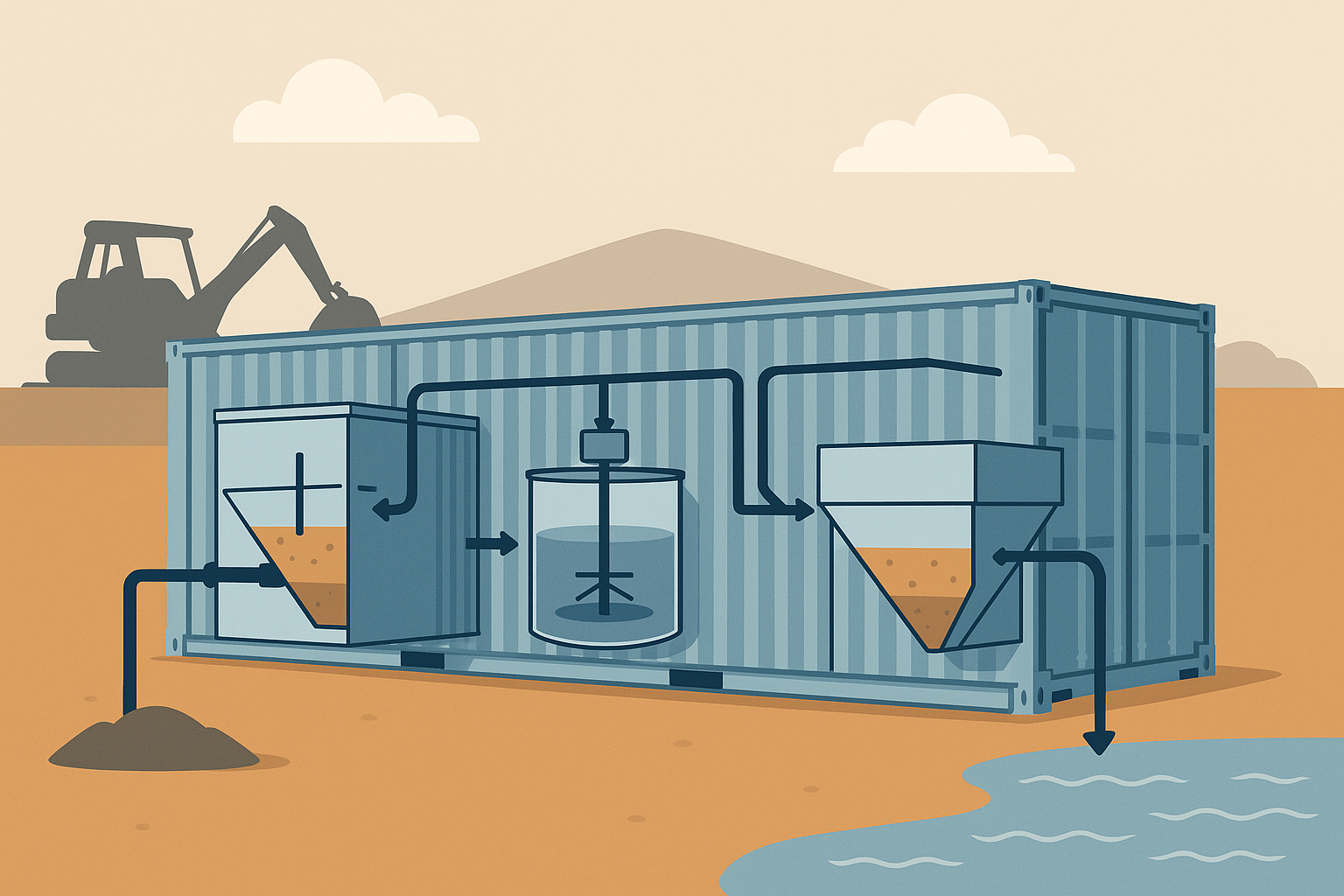
After solids removal, the reaction zone raises pH—typically to 8–10—to precipitate dissolved metals as hydroxides/oxides. Lime (Ca(OH)₂) is common; each kg of Ca(OH)₂ generates ~1110 mg/L as Ca²⁺ for neutralization and precipitation. As pH increases, Fe²⁺ oxidizes (aeration optional) to Fe(OH)₃; other metals (Cu, Zn, Mn, Al, etc.) similarly form insoluble hydroxides. Raising acid mine drainage (AMD) pH from ~4 to ~9 has removed >90–95% of dissolved Fe and Al in studies (mdpi.com).
At high calcium and pH, sulfate may partially precipitate as gypsum (CaSO₄·2H₂O) (mdpi.com). Lime dose tracks the acid and metal load (often tens to hundreds of mg/L), with a reactor/mixer sized for ~15–30 minutes retention before clarification. The trade‑off is sludge: lime treatment is fast and scalable but creates a voluminous metal‑rich sludge that requires dewatering/disposal (mdpi.com). Consumables and reagents in this step typically come from standard water and wastewater chemicals inventories.
Final clarification and polishing filters
The precipitated metals and remaining fines head to a final clarifier or polishing filter. In mobile systems, disc filters or pressure filters often finish the job. One common configuration uses a disc filtration unit (e.g., Hydrotech discs) after the lime clarifier to catch residual turbidity (veoliawatertech.com), pushing TSS to <5–10 mg/L and metals to sub‑ppb, comfortably inside typical discharge standards. An industry case combined an Actiflo clarifier with a disc filter at ~130 m³/h and achieved very low turbidity and metal content (veoliawatertech.com).
For packaged filtration blocks, a dual‑media bed anchors the polish; a plant may specify a sand/silica filter for fine particulates and an activated carbon unit for organics. In Côte d’Ivoire, Endeavour’s Lafigué gold mine installed a containerised filtration plant treating ~130 m³/hr in two ISO modules (12 m + 6 m containers), removing solids and organics with activated carbon and sand filters in a fully automated setup (engineeringnews.co.za).
Across the train, grab samples track performance: TSS removal >90%, heavy metals about ~90–99% (Fe and Al to sub‑1 mg/L), and pH neutralized to ~7–8. In Indonesia, a combined settling pond + wetland pilot reported effluent Fe ≈0.3 mg/L and Mn ≈2.8 mg/L (researchgate.net). After full treatment, clarified effluent typically meets local permits—Indonesian standards are pH ~6–9; one study showed pH ≈6.9 with Fe ≈0.31 mg/L, Mn ≈2.75 mg/L, and TSS ≈18 mg/L (researchgate.net).
Mobile and containerized units (deployment and scale)
For pit dewatering, exploration, or closure at remote sites, containerised systems get water to spec fast. These pre‑fabricated, plug‑and‑play units fit standard 10–20 m ISO containers or trailers and can be operating within days to weeks (veoliawatertech.com). Single‑container capacities range from 1–10 m³/hr into the hundreds of m³/hr, with ~1–500 m³/hr per unit typical for mobile fleets; scale‑up is achieved by paralleling identical trains (veoliawatertech.com).
Case in point: Endeavour’s Lafigué installation—~130 m³/hr split across two ISO modules (12 m + 6 m)—demonstrates how filtration can be containerised and automated (engineeringnews.co.za). For terrain where access is extreme, Pretium’s remote Brucejack mine deployed a containerized Actiflo clarifier to dewater a pit in glacier‑access terrain (veoliawatertech.com). Operators that prefer to avoid capex can source container packages through rental “water‑as‑a‑service” models; containerized options exist for temporary or emergency needs via rental units.
Commercial drivers and compliance outcomes
The draw is speed and flexibility. Discrete containerized units can be delivered and running in weeks; fixed plants may require ~1+ years, and in some cases much longer (veoliawatertech.com). WEC Projects reports a containerized mine water plant completed in ~6 months—significantly faster than a permanent build (engineeringnews.co.za).
OPEX financing is another lever: mobile water treatment makes an operating‑budget approach possible and helps de‑risk permanent investments; operators can prove water chemistry and permitting before committing to fixed plants (veoliawatertech.com). Industry analyses point to tightening regulatory requirements and a growing market for mine water and wastewater treatment, with flexible mobile treatment used as interim or long‑term solutions (veoliawatertech.com; prnewswire.com).
The performance envelope is proven: >90% removal of TSS and heavy metals, final TSS in the low tens of mg/L, and Fe/Mn approaching <1 mg/L, with pH held in the 6–9 regulatory window. A compact final stage might use a pressure vessel—industrial housings like a steel filter—or a fine cartridge filter to protect discharge or reuse points. Spares and polymers are standardised, making it straightforward to stock parts and consumables across sites.
Sources embedded in text: case studies and technical reviews from veoliawatertech.com, veoliawatertech.com, mdpi.com, mdpi.com, researchgate.net, prnewswire.com, and engineeringnews.co.za. Additional fragments cited: veoliawatertech.com, veoliawatertech.com, veoliawatertech.com, and veoliawatertech.com.