

Industry: Aquaculture | Process: Grow
Traditional pond aquaculture often relies on frequent water exchange (flushing) to remove wastes like ammonia and organics and to sustain dissolved oxygen (DO). Excessive exchange is costly, uses scarce water, and releases nutrients into the environment. A new generation of “in‑pond” intensive systems treats water inside the culture unit, drastically cutting external exchange. One commercial in‑pond raceway system (IPRS) pumped each raceway’s volume through a paddlewheel about every 4.9 minutes (≈12× per hour) (www.researchgate.net)—effectively recirculating pond water continuously.
Similar intensive recirculation enables “zero” or near‑zero net water exchange in biofloc‑based ponds (pmc.ncbi.nlm.nih.gov) (www.globalseafood.org). In these setups, only minimal make‑up water—mostly to compensate evaporation or sludge removal—is added.
Partitioned aquaculture systems (PAS) design
PAS (often called “split‑pond”) divides a pond into two linked zones: a smaller fish culture raceway and a larger biofilter or algal treatment basin. Effluent‑laden water from the fish raceway is pumped into the filter basin (often shallow, with microbubble aeration) where algae, filter‑feeders and bacteria consume wastes and generate oxygen; cleaned water then flows back to the fish area. This approach was pioneered for catfish at Clemson and expanded to catfish and shrimp in greenhouse systems.
Outcomes cited in trials include dramatically higher yields and minimal discharge. In Arkansas PAS trials, coculture of tilapia and catfish raised net catfish yield to ~19,382 kg/ha (43,000 lb/acre)—roughly four times the ~4,000–5,000 lb/acre of conventional ponds (thefishsite.com). A U.S. greenhouse PAS produced ~35 tons/ha of Pacific white shrimp (Litopenaeus vannamei) (www.researchgate.net), far above typical extensive yields (often <5 t/ha in earthen ponds). One PAS study underscores that “the PAS eliminates water discharge and reduces land usage and groundwater requirements” (www.researchgate.net).
Design notes include intensive aeration in the raceway and algal basin; one description specifies five micro‑porous aeration tubes in the algal basin to oxygenate and circulate water (www.researchgate.net). In practice PAS systems routinely double‑to‑quadruple conventional production while using a fraction of the water. Yields ~15–20 t/ha for catfish (three cycles/year) are reported vs. ~4–5 t/ha in conventional ponds (www.researchgate.net) (thefishsite.com), and one 0.8 ha PAS trial reached 19.6 t/ha catfish (www.slideshare.net).
Water turnover in PAS is on the order of days rather than hours—a Clemson PAS might recirculate raceway volume every few hours rather than exchanging the whole pond daily. Because of this, PAS can maintain high productivity while cutting water demand to ~1/8 (or less) of conventional use (www.researchgate.net).
In‑pond raceway systems (IPRS) operation
An IPRS embeds one or more raceways inside a pond. Fish are confined to long concrete or earthen raceways; water is pumped out of the pond, through the raceway (aerated by paddlewheels or blowers), then returned. The pond acts as a buffer/return basin. No new pond water is needed except top‑ups.
Yields are high. Hybrid catfish (channel × blue) yields in IPRS have reached 14–21 t/ha. Roy et al. (2019) reported net yields of 14,500–17,581 kg/ha from IPRS raceways—roughly 3–4× traditional earthen ponds (www.researchgate.net). In one commercial IPRS trial, harvest totaled 49,808 kg over a 2.43 ha pond (≈20,510 kg/ha) with 83.7% survival (www.globalseafood.org). Earlier work similarly found IPRS catfish yields ~20.5 t/ha (49,913 kg in 2.43 ha) (www.researchgate.net). These far exceed the 4–9 t/ha typical in conventionally aerated ponds. IPRS also support polyculture; in the Roy study an extra ~6,000 kg/ha of tilapia/paddlefish were co‑grown outside the raceways.
Water reuse depends on intense aeration and circulation. In Roy’s Alabama IPRS, each raceway had a 1.17 rpm paddlewheel generating ~0.026 m/s flow, recirculating 9.3 m³/min—about a full turnover every 4.9 minutes (≈12×/hour) (www.researchgate.net). The water, enriched in O₂, returns to the pond and is drawn again—effectively a continuous loop where only minor freshening is needed (e.g., for evaporation). This intense recirculation eliminates ammonia peaks.
Water quality and feed conversion (FCR) hold up at high biomass. In a shrimp biofloc raceway example, total ammonia nitrogen (TAN) never exceeded 0.6 mg/L (www.globalseafood.org) despite no exchange. Roy (2019) noted that aquarium oxygen and DO were very stable under aeration, and bacterial loads (Vibrio) were kept in check by the treatment regimen (www.researchgate.net). FCRs ranged ~1.25–2.5 across different cells (best cells ~1.3–1.6) with high survival (80–95%) typical. The confined setting also eases feeding and health management.
Probiotics and water conditioners (low exchange)
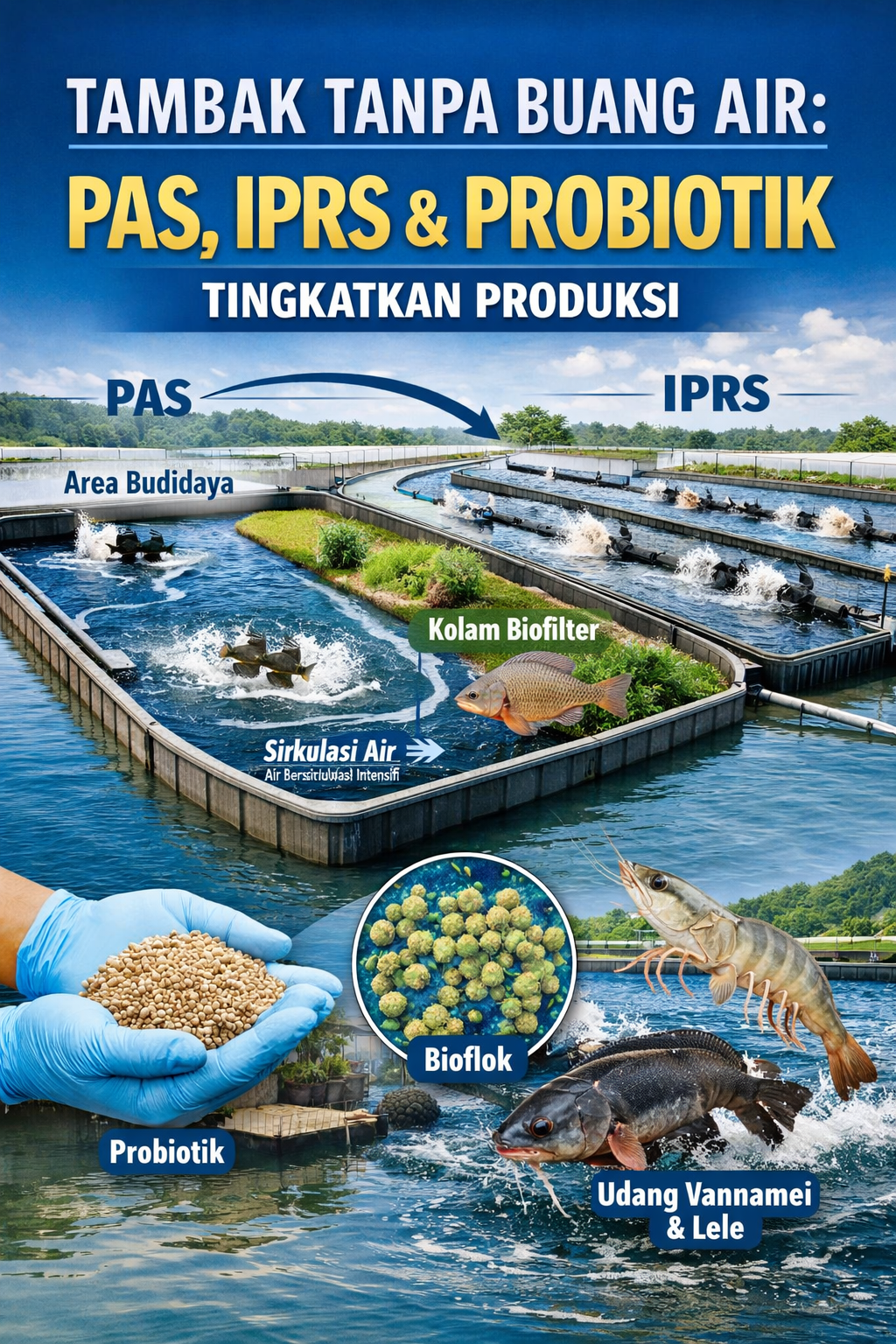
With exchange cut, agile water treatment is critical. Probiotics—beneficial microbes such as Bacillus spp., Nitrobacter, or Saccharomyces—are used to maintain water quality in zero/low‑exchange ponds by outcompeting pathogens, degrading organics/ammonia, and stabilizing microbial communities. Meta‑analyses find that probiotics often raise DO and pH and lower NH₃/NH₄⁺ and pathogens (pmc.ncbi.nlm.nih.gov) (pmc.ncbi.nlm.nih.gov).
In intensive L. vannamei ponds without fresh water exchange, Bacillus probiotics cut unionized ammonia dramatically while raising DO and greatly reducing Vibrio counts (pmc.ncbi.nlm.nih.gov) (pmc.ncbi.nlm.nih.gov). In that trial, untreated ponds had NH₃ ∼0.026 mg/L, whereas Bacillus‑treated ponds had ~0.005–0.006 mg/L (a ~76–81% drop) (pmc.ncbi.nlm.nih.gov). Dissolved oxygen in probiotic ponds climbed from ~4.1–4.6 mg/L up to ~6.0–6.5 mg/L, versus ~4.8 mg/L in controls (pmc.ncbi.nlm.nih.gov). Overall, “probiotics … improved water quality by lowering NH₃ and increasing DO” under minimal water exchange (pmc.ncbi.nlm.nih.gov), and reviews confirm probiotics’ “remarkable efficacy in … water quality management” across aquaculture species (pmc.ncbi.nlm.nih.gov).
Beyond microbes, other additives (“water conditioners”) are employed. Adding carbon sources (e.g., molasses) fosters biofloc—dense heterotrophic bacteria/particulate communities that assimilate nitrogen. Biofloc systems can produce high yields (e.g., 6–9 kg/m³ shrimp) with zero exchange (www.globalseafood.org). A zero‑exchange biofloc shrimp raceway trial reported that weekly salps were managed with no water outflow and TAN stayed <0.6 mg/L (www.globalseafood.org). Practical “conditioners” also include pH buffers (lime or sodium bicarbonate to maintain alkalinity), aeration enhancers (submersible pumps, fine diffusers), and solids‑removal units (settling tanks or foam fractionators)—a solids‑removal unit can be a compact clarifier. Carbon addition can be metered using a dosing pump for steady biofloc formation.
In shrimp raceways documented by Samocha (2013), high‑density production (8–9 kg/m³) was sustained by non‑venturi aerators and settling/foam‑filters and required only ~140 L of water per kg of shrimp produced (www.globalseafood.org) (mostly to offset evaporation)—orders of magnitude below open‑pond rates.
Output, water use, and quality trends
Yields: Catfish IPRS regularly exceed 15–20 t/ha (www.researchgate.net) (www.globalseafood.org); PAS catfish ~19 t/ha (thefishsite.com); intensive shrimp PAS ~35 t/ha (www.researchgate.net). These compare to ~4–5 t/ha in unsupplemented ponds.
Water use: In a zero‑exchange raceway example, water use was only 139 L/kg shrimp (www.globalseafood.org) (≈0.14 m³/kg). Traditional pond systems might flush hundreds of m³ per kg.
Water quality: Intensive in‑pond systems maintained TAN and nitrite at safe levels long‑term; in a lengthy shrimp biofloc trial, TAN never exceeded 0.6 mg/L and nitrite <1.5 mg/L (www.globalseafood.org) despite no exchange. Aeration maintained DO ~5–6 mg/L routinely.
Probiotics impact: Studies report up to ~75–80% reduction in ammonia and total Vibrio with probiotic additions (pmc.ncbi.nlm.nih.gov) (pmc.ncbi.nlm.nih.gov), along with 1–2 mg/L increases in DO in otherwise low‑oxygen ponds (pmc.ncbi.nlm.nih.gov).
Adoption: Research and use of probiotics is rising sharply worldwide (32% of probiotic‑aquaculture papers from China 2019–24) (pmc.ncbi.nlm.nih.gov). PAS and IPRS are commercially used in the U.S. and being tested worldwide. In Indonesia, the fisheries ministry is promoting modern ponds with built‑in water treatment—e.g., a new “Modern Shrimp” project includes wastewater treatment (IPAL) and holding tanks in each pond complex (www.kkp.go.id), aligning with low‑exchange strategies.
Economics and regulatory context
From a business perspective, these systems raise output dramatically. One bioeconomic risk analysis noted that IPRS’s high fixed costs can make them more sensitive to feed price and market fluctuations than simpler aerated ponds or PAS (www.researchgate.net). Combining IPRS with multiple harvests or niche markets can improve returns, and ongoing R&D (e.g., floating raceways) aims to reduce capital cost (www.researchgate.net) (www.researchgate.net).
Regulators increasingly require effluent control; Indonesia’s approach (KKP) explicitly requires waste treatment (e.g., IPAL) for intensive ponds (www.kkp.go.id). PAS/IPRS can help farms comply while remaining productive, and probiotics plus conditioners support stable water quality with reduced flushing.
Study sources and links
Sources include peer‑reviewed studies and industry reports on PAS, IPRS, and probiotics in aquaculture (cited inline). Clemson and Auburn University trials are summarized here (www.researchgate.net) (www.globalseafood.org); shrimp raceway demonstrations are detailed here (www.globalseafood.org) (www.globalseafood.org), and recent reviews of probiotics are here (pmc.ncbi.nlm.nih.gov). Indonesian regulatory context from KKP publications is here (www.kkp.go.id). All statistics above are drawn directly from these sources.