

Industry: Nickel_Mining | Process: Leaching
In nickel laterites, stronger acid dissolves more metal — but also more trouble. One study found nickel (Ni) yield jumped to about 96.4% when sulfuric acid rose to 1.0 M at 90 °C for five hours, yet virtually all iron (Fe) went into solution too (researchgate.net). Pull the other lever — pH — and the chemistry flips: raising pH even modestly above 1 slows Ni release but promotes Fe precipitation.
In oxidative hydrolysis tests at 90 °C, only about 49% of Fe(II) precipitated at pH 3.5 after five hours, whereas at pH 5.0 roughly 95% Fe fell out in 2.5 hours, leaving ≤0.7 g/L Fe in solution (g/L = grams per liter) (pubs.acs.org). That is why operators hit “low pH” (≈0.5–1.0) in the Ni‑leach stage to dissolve nickel, and “intermediate pH” (~2–4) in ensuing steps to drop out iron. Maintaining those setpoints demands precise reagent control; plants lean on accurate chemical dosing, often with equipment like an inline dosing pump, to avoid overshooting acidity.
Temperature compounds the effect. Pre‑reduced limonite yielded 88.2% Ni at 100 °C (acid 0.164 kg/kg ore) with about 5 mg/L Fe in solution, but at 180 °C Ni rose to 95.2% (acid 0.287 kg/kg) and Fe fell below 1 mg/L (mg/L = milligrams per liter) (aseestant.ceon.rs). Higher temperature also accelerates oxidants: adding H₂O₂ in 1 M H₂SO₄ at 90 °C (S/L 10% — solids‑to‑liquid ratio by mass) achieved about 94.5% Ni extraction; the milder oxidation then allowed CaCO₃ pH adjustment to remove nearly all Fe (pubs.aip.org). In short: high temperature and optimally low acidity dissolve Ni efficiently; raising pH later or adding oxidants selectively strips iron.
Jarosite and goethite precipitation tactics
Because 70–80%+ of Ni in limonites rides inside Fe oxides, separation rather than co‑dissolution is the move. A proven route is jarosite precipitation: after the initial acid leach, add alkali to reach pH ~1–2 under ~80–100 °C and precipitate Fe³⁺ as NaFe₃(SO₄)₂(OH)₆ (jarosite) — a basic ferric sulfate mineral (www.mdpi.com). Jarosite formation releases H⁺, which then dissolves Ni (and Mg) from the neutralizing ore. In limonite–saprolite combinations, sulfuric acid use fell from ~0.6–0.8 kg/kg ore (direct leach) to ~0.37–0.42 kg/kg (www.mdpi.com) (www.mdpi.com). Fe in the pregnant liquor (the Ni‑bearing solution) dropped from about 10 g/L to ~2–3 g/L (www.mdpi.com), while Ni recoveries (60–73%) were maintained or improved and Fe dissolution fell from tens of percent to 1–3% (www.mdpi.com).
Goethite precipitation (oxidative hydrolysis — oxygen‑driven Fe removal) offers another lever. Bench tests with synthetic laterite liquor showed raising pH to ~4 and aerating can remove ~96–97% of Fe (residual ~1 g/L) within hours (pubs.acs.org), with only small Ni/Co losses (Ni ≤8% even at 97 °C) (pubs.acs.org). Conversely, at pH 3.5 only about 50% Fe fell out after five hours (pubs.acs.org). Flowsheets frequently employ staged limestone/CaCO₃ neutralization — ramping pH to ~4.5–5.0 to drop most Fe, Al and Cr (www.researchgate.net). The precipitated Fe‑oxyhydroxides are then thickened and washed, a job typically handled by sedimentation units such as a clarifier, before Ni/Co move downstream in solution.
Selective reagents and redox control
Other chemistries “lock out” iron while liberating nickel. Phosphate leaching with 70–85% H₃PO₄ has dissolved about 98% of Ni while precipitating ≈98% of Fe as FePO₄·2H₂O (on calcined limonite) (www.researchgate.net). A two‑step ferric‑chloride route leaches Ni/Co in dilute acid (60–95% Ni extraction), then treats the pregnant liquor at 180 °C with FeCl₃; iron removal hits ~89–90% while ~90% Ni/Co remain in solution, as Fe³⁺ hydrolysis generates extra H⁺ that sustains Ni leaching (pmc.ncbi.nlm.nih.gov). Reductive additives (SO₂ or bisulfite) tend to keep iron soluble as Fe²⁺; in one atmospheric leach with sodium sulfite, Ni and Fe extraction were tightly correlated — Ni could only be leached if Fe was dissolved (www.researchgate.net). Redox choice must match the intended Fe removal pathway.
Pre‑leach and mineralogical pre‑treatments
Many flowsheets stage a preliminary step to strip “reactive gangue” before the main Ni extraction. Thermal pretreatment is classic: Caron‑style reductive roasting pre‑reduces laterite calcine to magnetite (>93%) before HPAL (high‑pressure acid leach). Chang et al. showed goethite (carrying most Ni) transforms to hematite under mild heating, enabling 88.2% Ni extraction at just 100 °C (acid 0.164 kg/kg ore) with ~5 mg/L Fe; after heating to 180 °C, Ni reached 95.2% and Fe fell below 1 mg/L (aseestant.ceon.rs).
Ore can double as neutralizer in a quasi pre‑leach. In the jarosite approach above, adding saprolitic ore at low pH pre‑leaches iron (as jarosite) and then re‑dissolves Ni. Patents cited in industry literature call for leaching limonite with sulfuric acid, then “pre‑neutralizing” with saprolite or MgO‑containing material to precipitate Fe before finishing the Ni leach. Heap‑leach flowsheets likewise use stepwise pH increases; raising a Ni‑laterite liquor from ~1.5 to ~4.5–5.0 precipitates virtually all Fe, Cr and most Al (www.researchgate.net). The thickened solids are washed (recovering any adsorbed Ni/Co (www.researchgate.net)) and discarded, while the wash liquor carries Ni/Co onward — a place where acid‑resistant filtration hardware such as an SS cartridge housing can be a practical fit.
Simpler operations use a mild carbonate or alkali wash: a quick lime or Na₂CO₃ rinse at ambient temperature dissolves Mg/Al oxides and consumes free acidity, leaving a more Ni‑rich feed for the main acid leach. In one two‑stage CaCO₃ neutralization, pH was raised to ≈4.3 (90 °C) and then ≈7 (70 °C) to strip out iron and aluminium after the acidic leach (pubs.aip.org). Fine precipitates at this stage often benefit from a compact thickener like a lamella settler to reduce footprint while maintaining solids capture.
Measured trade‑offs and operating windows
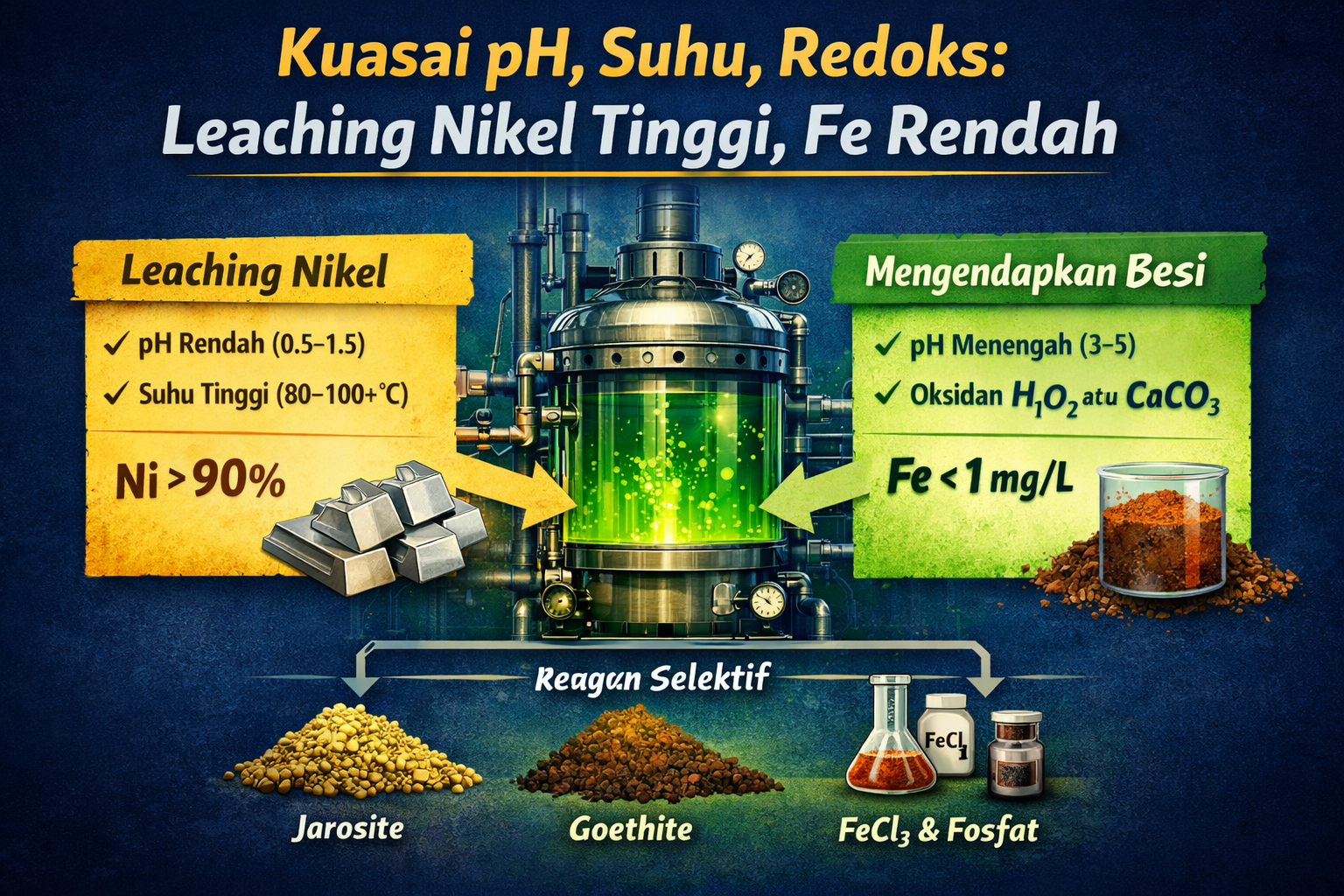
Nickel yield vs. acid consumption is the core cost curve. Direct atmospheric leaching of Greek limonite at low pH (≈0.25–0.5) consumed ≈0.6–0.8 kg H₂SO₄/kg ore and recovered up to ~70% of Ni (www.mdpi.com). Adding saprolite neutralization (jarosite) kept Ni leaching high (60–73%) while acid use dropped to ≈0.37–0.42 kg/kg (www.mdpi.com) (www.mdpi.com). Jarosite‑assisted leach at 90 °C used ~0.4 kg/kg acid (versus 0.6–0.8 kg/kg direct) (www.mdpi.com). Trade‑off plots show Ni recovery climbs above 90% only with ≥1 M H₂SO₄ and high temperature, whereas operating at pH≈1–1.5 (Ni ~65–90%) consumes ~50% less acid (www.researchgate.net) (www.mdpi.com).
Iron removal can be equally aggressive. Under optimal precipitation conditions, Fe in the pregnant leach solution (PLS) can be driven to single‑digit mg/L — for example, pre‑reduced limonite gave ~5 mg/L at 100 °C and <1 mg/L at 180 °C (aseestant.ceon.rs). In combined leach–jarosite circuits, Fe commonly sits at ~2–3 g/L (versus 10+ g/L otherwise) (www.mdpi.com). Oxidative hydrolysis at pH ≈4–5 removes 94–97% of Fe (leaving <1 g/L) (pubs.acs.org) (pubs.acs.org). The Fe‑vs‑pH curve is steep: at pH 3.5 only ~50% Fe drops out after five hours; by pH 5, it is nearly 100% (pubs.acs.org). Temperature helps too; raising from 70 to 90 °C lifted Fe precipitation from ~80% to ~97% at fixed pH (pubs.acs.org) (pubs.acs.org). Even so, Ni losses stayed below ~8% at 90–97 °C (pubs.acs.org). Where ultrafine solids complicate separation, plants often add a membrane polishing step; an ultrafiltration unit can serve as pretreatment to downstream recovery by cutting carryover of Fe hydroxides.
Compliance targets and discharge polishing
In Indonesia — a powerhouse for laterite — effluent standards are tight. Ministry of Environment Regulation No. 09/2006 caps Ni at 0.5 mg/L and Fe at 5 mg/L in mining/processing discharges (nikel.co.id). The impurity control strategies above directly support this: combined leach‑jarosite or high‑pH precipitation routinely cut Fe to single mg/L. Data‑driven process design can ensure Ni recoveries approach these legal thresholds without incurring excessive acid or co‑precipitation penalties. For end‑of‑pipe refinements — metering neutralizers, antiscalants or oxidants — plant teams lean on water‑treatment ancillaries to stabilize dosing and hydraulics.
Operating economics and unit costs
The economics are clear. Halving acid use from 0.8 to 0.4 kg/kg ore cuts reagent bills significantly (www.mdpi.com) (www.mdpi.com). Lowering Fe in solution from tens of g/L to a few g/L shrinks downstream neutralization (lime) costs by orders of magnitude. Minimizing Ni coprecipitation — keeping ≥90% Ni yield while precipitating Fe — maximizes saleable output. Data back it up: Fig. 4 of Das et al. shows acid consumption nearly flat above ~0.5% Ni at pH 0.25–1.5 for 90 °C leaches — i.e., acid use is driven by impurities, not Ni (www.mdpi.com). Independent tests show that optimized jarosite steps, FeCl₃ treatment, and staged pH can capture ~90–95% of Ni while removing ~90–97% of Fe (pmc.ncbi.nlm.nih.gov) (pubs.acs.org) (www.researchgate.net).
Data‑backed flowsheet control
The through‑line is consistent: tight control of pH, temperature and redox governs impurities. A low‑pH, high‑T leach maximizes Ni but dissolves Fe; one then selectively precipitates Fe (via jarosite, goethite, phosphate, or FeCl₃ hydrolysis) to protect downstream recovery. Pre‑treatments — from modest pre‑leach to reductive roasting — push impurity burdens out of the main leach. Each tweak shows up in the numbers: dropping Fe from ~10 g/L to ~1 g/L corresponds to under 3% Fe left in solution (from ~80% originally) while preserving Ni above 90% (www.mdpi.com) (pubs.acs.org). In the plant, those setpoints are only as good as the monitoring and separations behind them; adding a compact polishing step such as ultrafiltration upstream of Ni/Co recovery helps keep Fe hydroxide fines from bleeding forward.
Sources: Chang et al., 2016 (aseestant.ceon.rs); Miettinen et al., 2019 (www.mdpi.com); Das et al., 2023 (pubs.acs.org) (pubs.acs.org); Li et al., 2025 (pmc.ncbi.nlm.nih.gov); Setiawan et al., 2024 (pubs.aip.org) (pubs.aip.org); Hidayat et al., 2021 (www.researchgate.net); national regulations (nikel.co.id).