
Automotive wastewater is loaded with oils, surfactants, and metals that refuse to separate. A multi‑stage design—API gravity, DAF, and data‑driven chemistry—gets oil-and-grease to permit levels, even when emulsions are chemically stabilized.
Automotive manufacturing and service plants discharge wastewater rich in mineral oils and lubricants, surfactants, and metals like Zn, Cu, and Ni. Oil concentrations vary wildly: manual car‑wash effluent commonly runs at 10–50 mg/L oil‑and‑grease, with localized spikes >500 mg/L (mdpi.com). Detergents and stabilizers push oil droplets below 10 µm, creating stubborn oil‑in‑water emulsions.
Regulators set tight limits. The U.S. EPA has proposed an O&G effluent standard of 17 mg/L monthly average for metal‑products/machinery industries (researchgate.net). Indonesian rules (Permen LH 5/2014 et seq.) likewise require low oil/grease and heavy‑metal discharges. In practice, treatment must remove roughly 90–99% of oil—often to below 20–30 mg/L—and precipitate dissolved metals to ppb–ppm levels.
Kondensat LFG TPA: Desain Trap, Material Tahan Korosi, dan Drainase
Influent profile and permit targetsHere’s the problem statement for environmental engineers: emulsified oil droplets (<10 µm), surfactant‑stabilized, with Zn, Cu, Ni from machining or plating, and permit targets that look like 17 mg/L O&G monthly average in some sectors (researchgate.net). The job is to design a train that consistently strips 90–99% of oil and knocks metals down to the low mg/L or below.
Pre‑treatment screening and grit removal
Start with primary defense: coarse screening or grit tanks using 3–6 mm bar screens to intercept debris. This step protects downstream units and yields negligible oil removal but prevents clogging. Facilities commonly deploy modular systems such as primary wastewater physical separation and select either a manual screen or an automatic screen depending on labor and load variability.
API gravity separation design criteria
The first formal oil removal stage is an API separator (American Petroleum Institute gravity separator). Design targets include a length:width ratio ≥5:1 and horizontal velocity ≤3 ft/min (~0.015 m/s), with depth:width 0.3–0.5 (parsianfarab.com) (parsianfarab.com). The unit establishes three‑layer stratification—sludge bottom, oil top, clarified middle—before skimming oil for reprocessing and mechanically removing settled sludge (parsianfarab.com).
Typical API separators remove the majority of free (unenclosed) oil—industry sources cite 60–80% removal in this step (parsianfarab.com). Many plants complement gravity traps with engineered skimming systems akin to oil removal equipment to reliably capture floating hydrocarbons.
High‑area plate packs (CPI/lamella)
Where footprint is at a premium, a corrugated‑plate interceptor (CPI) or lamella pack can replace or supplement API tanks. By adding high‑area plates, CPI devices enhance gravity separation and improve capture of smaller droplets; design assumptions often reference 150 µm versus 60 µm for standard API sizing (parsianfarab.com). Compact modules such as a lamella settler can increase effective settling area within the same plan view.
DAF with coagulation and flocculation
The API/CPI effluent—still rich in emulsified and fine‑dispersed oil—moves to dissolved‑air flotation (DAF). DAF saturates a recycle stream at high pressure, then releases microbubbles (~100–1000 µm) that attach to flocs and droplets, floating them into a skimmable layer (a typical pesticide‑flotation process description). When paired with the right chemistry, DAF removes 70–90% of remaining oil (scielo.org.za), with detention commonly 10–20 minutes.
In jar‑test optimization, a cationic polyacrylamide—Zetag FS/A50 at 50 mg/L—achieved 83% oil/soluble oil‑and‑grease (SOG) removal and 82% COD removal after DAF processing (scielo.org.za). Plants often specify packaged DAF units, then translate jar‑test doses to full‑scale via metered injection using a dosing pump for day‑to‑day control.
Emulsion breakers and polymer chemistry
Breaking chemically stabilized emulsions hinges on demulsifiers and the right polymers. Demulsifiers are typically cationic, oil‑soluble polymers or surfactant‑like agents that adsorb at the oil–water interface; they replace natural surfactants, reduce interfacial tension, neutralize zeta potential, and weaken the interfacial film so droplets coalesce (mdpi.com). Oil‑soluble demulsifiers often work better for oil‑in‑water emulsions because they migrate into the oil droplet and displace asphaltenes/resins (mdpi.com). Typical practice is a low dose—tens to hundreds of ppm—added before any flocculant. Vendors package these as demulsifiers for industrial wastewater applications.
Once the emulsion film is weakened, high‑MW cationic polyacrylamides bridge droplets and solids into large flocs. In jars, a cationic PAA at 50 mg/L (Zetag FS/A50) delivered 80–90% removal of COD and SOG and 70–85% TSS removal after DAF (scielo.org.za). Increasing polymer concentration strongly increased removal in the cited tests; the polymer dose was the dominant factor, and flocculants were effective across a broad pH range (scielo.org.za) (scielo.org.za). Plants routinely pair inorganic coagulants with organic polymers: metal salts help break emulsions and co‑precipitate metals, while polymers form robust flocs—commercial lines include coagulants and flocculants.
Jar‑testing protocol for chemical programs
Jar testing is the decision engine for chemistry. A typical approach (adapted from industry guides) starts with a representative sample (3–4 L), split into 500 mL beakers stirred at ~120 rpm to keep oil in suspension (dober.com).
Step 1: add a small dose of candidate demulsifier or coagulant to each jar (e.g., 0.1 mL of a stock solution for a 500 mL sample). Mix at high speed for 1–2 minutes and watch for “microflocs” (opalescence or tiny floc) indicating the emulsion film is breaking (dober.com). Increase dose stepwise if needed—but avoid impractical additions; a rule of thumb is to stay below ~1000 mg/L inorganic coagulant to limit sludge (dober.com). Record the dose at first microflocculation.
Step 2: drop the stir speed to ~30–40 rpm and add flocculant—say, 1 mL of 0.5% polymer solution—mixing gently for ~1 minute. Titrate in increments until macroflocs form and the water clears rapidly, with solids settling or ready to float in DAF (dober.com). Let jars settle 5–10 minutes, then measure turbidity and oil/grease (e.g., IR OG method) or total petroleum hydrocarbons. The optimal dose is the lowest chemical addition that meets target clarity, such as <20 mg/L oil; plotting residual oil versus dose usually shows a sharp improvement past a threshold (dober.com).
Step 3: if emulsions resist breaking, repeat at pH ~4–5; if flocs are weak, try pH ~8–10. A first‑stage coagulant like FeCl₃ or HCl at low pH can shock the emulsion and form microflocs; raising pH before polymer addition can improve bridging (dober.com). Iterate across multiple demulsifiers and flocculant grades. In one study, model‑predicted removal reached ~96% for COD and 96% for oil/gres at optimal doses, closely matching experimental ~82–83% (scielo.org.za).
Heavy‑metal precipitation and chelant effects
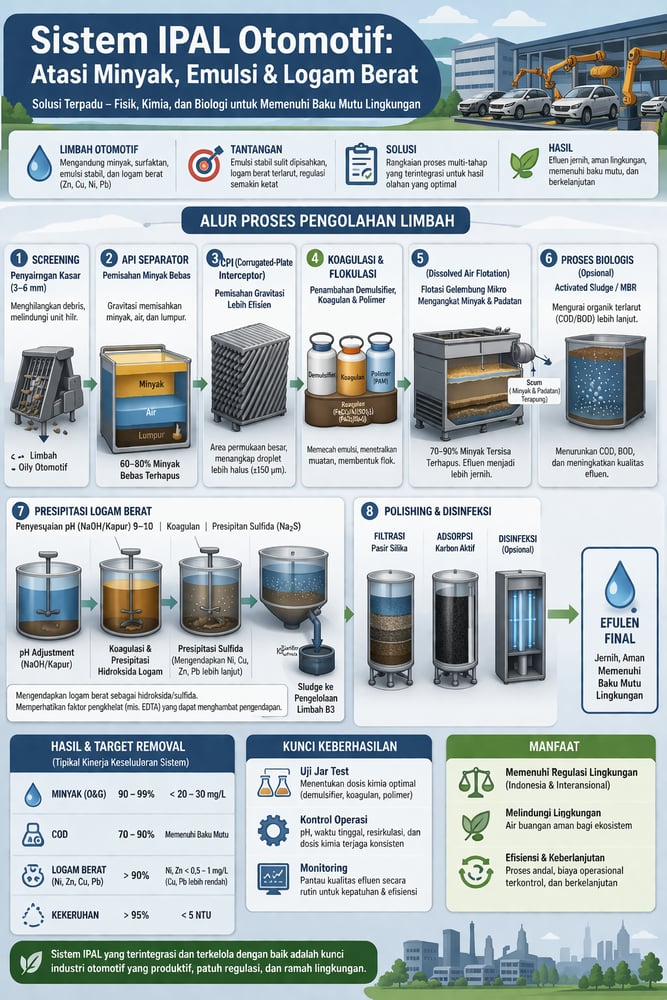
After oil removal, dissolved metals are precipitated chemically. Raising pH to ~9–10 with lime or NaOH forms metal hydroxides (chrome, Al, Fe), aided by coagulants such as FeCl₃ or Al₂(SO₄)₃. For Ni, Cu, Zn, and Pb, sulfide addition (e.g., Na₂S) can drive solubility lower, with studies showing sulfide precipitation can achieve lower residuals than hydroxide alone (ascelibrary.org).
There’s a catch: chelating agents like EDTA (a common cleaner additive) can prevent Ni, Zn, and Pb from precipitating, even at concentrations below 1 mg/L (ascelibrary.org). In practice, Cu is usually removed effectively by hydroxide/sulfide, but Ni and Zn may require aggressive dosing; one study found >90% Cu removal while Ni/Zn remained above limits in EDTA‑bearing samples (ascelibrary.org). Precipitates proceed to solid–liquid separation in a clarifier, and final effluent is checked against targets (e.g., Ni, Zn <0.5–1 mg/L). Costs are modest: even aggressive treatments were estimated at less than $5 per 1000 gallons of wastewater (ascelibrary.org). Plants source reagents from broad lines of water and wastewater chemicals to adapt to chelants.
Flare Tertutup di TPA: Suhu 1.000°C Penentu Izin Emisi
Tertiary polishing and biological options
If clarified effluent still carries COD/BOD (chemical/biochemical oxygen demand), activated‑sludge or MBR (membrane bioreactor) can oxidize dissolved organics; packaged activated‑sludge systems or MBR units are common choices. Filtration or adsorption—think sand filtration and activated carbon—can polish residual oil and organics.
There’s also membrane polishing. Ultrafiltration (UF) has treated car‑wash effluent to achieve ~100% oil removal and permeate turbidity below 0.5 NTU, with performance sustained across repeated washing (mdpi.com). These advanced units are high‑capex and fouling‑prone without robust pretreatment, so they’re often deployed after DAF; OEM lines include ultrafiltration systems as pretreatment and polishing modules.
Performance metrics across the train
What success looks like: oil & grease removal of 70–90% in the DAF stage when properly dosed (scielo.org.za). In a cited trial, 50 mg/L polymer delivered 82–83% oil removal, dropping an influent of 100 mg/L to roughly 18 mg/L (scielo.org.za). With secondary polishing—UF or activated carbon—O&G can be pushed below 10 mg/L.
COD removal of 80–90% in chemical–DAF reduces load on biology (scielo.org.za). TSS (total suspended solids) removal typically hits 80–90% across API + DAF + sedimentation, with 70–85% TSS removal reported in the polymer jar tests and effluent TSS often ending below 30–50 mg/L (scielo.org.za).
For metals, correct chemistry yields >95% Cu and major chromium/hydroxides removal. Very high Cu removal is routine, but Zn/Ni remain >90% removed only if chelators are absent (ascelibrary.org). Facilities often target Ni <0.5 mg/L by adjusting sulfide dose and verifying whether EDTA is present.
Sludge handling and solids management
Expect sludge from each stage: oily sludge from API/air‑scoop (~10–30% dry substance), float sludge from DAF, and hydroxide sludge from metal precipitation. These are typically dewatered (e.g., belt press or filter press) and disposed according to local classification; for design, assume dry solids of roughly 0.5–1% of flow. Upstream choices like adding a tube settler or specifying wastewater ancillaries can streamline thickening and removal logistics.
Data‑driven sizing and operating setpoints
Retention times matter: API separators typically hold 30–60 minutes to allow oil rise (parsianfarab.com), while DAF units run 10–20 minutes, consistent with jar‑test observations that flotation happens within minutes once chemistry is on point (dober.com).
Chemical dosing is anchored in jar tests: in the cited work, 50 mg/L polymer approached maximal removal, with higher doses returning diminishing gains (scielo.org.za). Effluent goals back‑solve the train: if the target is <20 mg/L O&G and raw wastewater is 200 mg/L, the chain (API + DAF + chem) must remove >90%. Compliance is validated by simulating or testing representative samples as shown in the referenced studies (scielo.org.za) (scielo.org.za). Automated control with a calibrated dosing pump helps keep doses locked to the jar‑tested optimum.
Desain Sumur Gas TPA, Kolektor, dan Vakum untuk Tangkap Metana
Source notes and technical referencesDesign criteria, performance data, and mechanisms referenced in this report draw from API‑style separator guidance and descriptions (parsianfarab.com) (parsianfarab.com) (parsianfarab.com); polymer/demulsifier mechanisms and jar‑test outcomes (mdpi.com) (scielo.org.za) (scielo.org.za); jar‑testing procedures (dober.com) (dober.com) (dober.com) (dober.com) (dober.com); metals precipitation and chelant effects (ascelibrary.org) (ascelibrary.org) (ascelibrary.org); car‑wash influent and UF polishing performance (mdpi.com) (mdpi.com); and O&G permit context (researchgate.net).
