
Landfill leachate volumes can run into the millions of cubic meters a year, and regulators want hard numbers, not estimates. A monitoring plan built on flow meters, sump level sensors, and routine reporting is fast becoming the baseline.
One year, nine landfills, roughly 1.8 × 10^6 m³ (cubic meters) of liquid sent to treatment. That’s the scale operators are wrestling with, according to a multi-site review that tallied volumes in Hong Kong (Scribd). The lesson is blunt: leachate (highly polluted liquid formed as water percolates through waste) is driven largely by rainfall, especially in humid climates (ResearchGate) (ResearchGate).
The operational response is equally blunt: “leachate production…cannot be projected or estimated; it has to be directly measured on a continuous basis” (Waste Today Magazine). Monitoring failures have real consequences; treatment trains can miss discharge standards when inputs are not tracked (ResearchGate).
Permits in many jurisdictions now demand a structured plan that states what to measure, where, how often, and how quality will be assured (GOV.UK). That plan is expected to match the site’s conceptual model—rainfall inputs, drainage layout, sump locations—and to include QA/QC (quality assurance/quality control) for instrument calibration and data management, with triggers if results exceed assessment levels (GOV.UK) (GOV.UK) (GOV.UK).
Monitoring objectives and compliance design
Three objectives set the tone: quantify total leachate collected, detect abnormal buildup in sumps, and demonstrate compliance to regulators (ResearchGate) (GOV.UK). The resulting emissions monitoring plan—a formal document required in permitting—spells out measurement points, frequency, quality control, and actions if assessment levels are exceeded (GOV.UK) (GOV.UK) (GOV.UK).
Flow meters in discharge lines
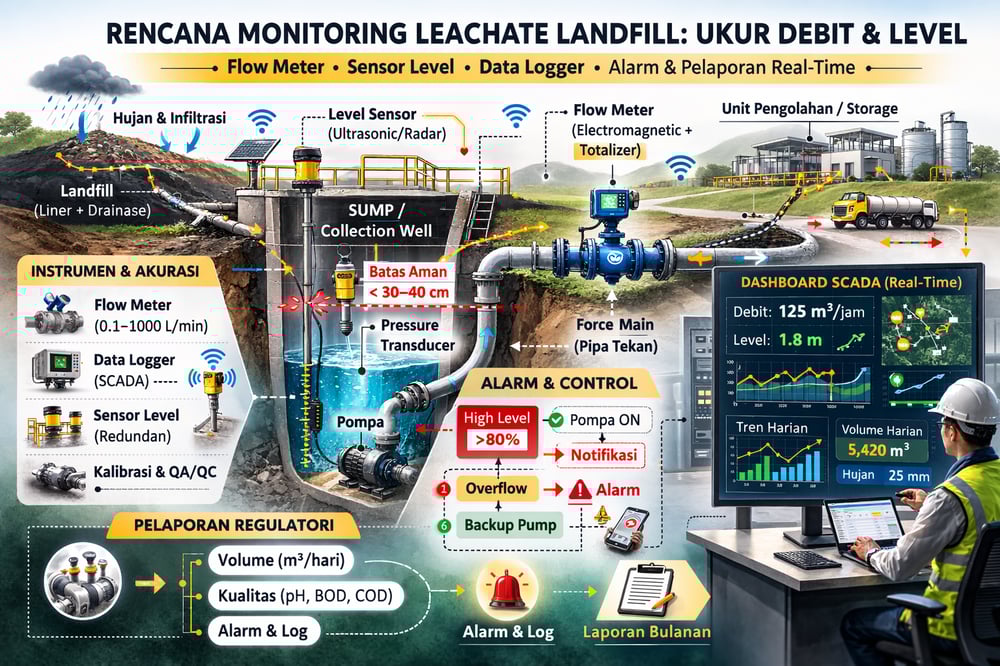
Objective: quantify volume removed over time. In practice, flow meters are installed in the discharge (force main) line from each sump to storage or treatment, logging both instantaneous flow (e.g., L/min, liters per minute) and total volume (e.g., m³/day, cubic meters per day). Accurate metering supports treatment planning, cost allocation, and environmental reporting, and it surfaces patterns such as rainfall-driven spikes.
Devices for corrosive, solids-laden leachate
Because leachate is corrosive and can carry solids, meter materials and form factors matter. Operators commonly deploy open-channel primary devices (flumes) or in-line electromagnetic meters with non-reactive liners—think stainless steel or PTFE (polytetrafluoroethylene) lining (Open Channel Flow) (Open Channel Flow). Fiberglass metering manholes often integrate trapezoidal or H‑type flumes made of vinyl‑ester/316SS (316‑grade stainless steel) or electromagnetic meters with PTFE liners (Open Channel Flow) (Open Channel Flow). Trapezoidal flumes provide better resolution at low, variable flows (Open Channel Flow).
Data capture and rainfall linkage
Meters should record time‑stamped totalizer readings and aggregate them hourly or daily for comparison against rainfall and historical patterns. In rainy seasons, facilities often see higher flow; one study found leachate yield was “proportionally linked to the precipitation level” (ResearchGate). With those data, sites compute average and peak m³/day and monthly totals—numbers that, at multi‑site scale, have reached ~1.8 million m³/year (Scribd). Even when treatment costs per gallon are low, the totals add up to “a significant monthly fee” (Waste Today Magazine).
Non‑uniform drainage and operational signals
Continuous flow traces highlight seasonal behavior, cap effectiveness (flows often drop post‑capping), and equipment issues (a sudden zero can indicate a pump failure). They also reveal that drainage can be non‑uniform—some pipes carry no flow due to settling—so measuring at the sump is more reliable than inferring from sub‑drains (PubMed). In practice, the dataset supports decisions on pump schedules and treatment sizing and tracks metrics like m³/year, peak m³/day, and MLSS (mixed liquor suspended solids; a solids concentration indicator) or pollutant loading per volume.
Sump level monitoring and liner head limits
Objective: prevent excess leachate head on the liner and avoid overflow. Sumps (collection wells) are designed to pool leachate before pumping; level sensors keep levels below design thresholds such as <30–40 cm of head on the liner, with 12 in. (inches) often cited as a rule‑of‑thumb maximum (Waste Today Magazine).
Sensor types and installation constraints
Common options are submersible pressure transducers (measuring hydrostatic head) and non‑contact ultrasonic or radar sensors. Pressure devices—vented or otherwise pressure‑compensated—are installed via stilling wells or cables, but vented instruments struggle in sealed, methane‑rich sumps unless pressure‑equalized or paired with a reference sensor (SensorsONE). Radar units mounted above the liquid avoid contact and corrosion in aggressive leachate (SensorsONE) (ABM Sensor).
Hazardous area ratings and materials
Regardless of the sensing principle, landfill sumps are explosive‑danger zones. Instruments should carry appropriate ATEX (explosive atmosphere) ratings, and wetted materials should be 316SS (316‑grade stainless steel) or specialty polymers to resist H₂S, ammonia, and VOCs (SensorsONE) (SensorsONE). One field experience: generic submersible transmitters failed in ~6 months, while explosion‑proof radar units kept tracking levels (SensorsONE) (ABM Sensor).
Alarm logic and cross‑checks
Monitoring plans typically include alarm setpoints: “high‑level” triggers pump on; “high‑high” alerts personnel via the control system or mobile notifications. Pumps usually switch automatically at set levels with manual backup; if a sump exceeds ~80% of its volume, a tiered response initiates. Trend reviews matter too: a steadily rising baseline can signal under‑capacity pumping or excessive inflow.
Logged level data—often at 15‑minute averages—also validate performance. If the level falls 1 m in a 6 m² (square meter) sump, that implies 6 m³ removed; that should match the flow meter log. Discrepancies can indicate leaks or meter drift. Data often stream to loggers or SCADA (supervisory control and data acquisition) for archiving.
Data handling and QA/QC procedures
All flow and level data should be recorded electronically and backed up, with clear routines for daily/weekly/monthly summaries and outlier checks. QA/QC includes periodic flow‑meter calibration, survey checks on sump geometry (to confirm volume calculations), and maintenance logs—supported by calibration certificates and drift checks (GOV.UK).
Regulatory reporting requirements
Many jurisdictions legally require regular reporting of monitoring data. In the UK, permits demand an “emissions monitoring plan” and periodic submissions to demonstrate compliance (GOV.UK) (GOV.UK) and explicitly state what you need to report (GOV.UK). In Indonesia, officials have announced a phase‑out of open dumping at existing sites—an update that “reveals that 343 landfills across” the country are in transition—which implies stricter standards ahead (ANTARA News) (ANTARA News).
Practically, facilities should package daily/monthly volumes, pollutant loads, and alarm events into regulator‑ready reports, including total volume removed per period, pollutant concentrations/totals, and any excursions above permit limits.
Trend analysis for decision‑making
Reporting is not just compliance; it drives operations. Trending leachate volume versus rainfall—shown in one study to be closely linked (ResearchGate)—can indicate cover infiltration performance. Unexpected increases may suggest cover damage or effects from leachate recirculation. If cumulative discharge limits are being approached, treatment capacity or recycle schemes must be adjusted. Exceedances can trigger enforcement; exceeding compliance limits is a breach with potential penalties (GOV.UK).
Measurable outcomes and example metrics
A data‑driven plan enables targets like “maintain sump head <12 inches at 95% of readings” or “keep daily flow ≤ forecast by water‑balance model within ±20%.” Example documentation might read: “In Year 1 of monitoring, average monthly leachate was 5,000 m³; peak flow was 300 m³ on 12/2024 after a storm, matching 25 mm rainfall; both were within design capacity.” Those statistics, backed by meter logs and graphs, become evidence in reports. The throughline: continuous flow meters and level sensors—properly corrosion‑ and explosion‑proofed—plus systematic logging and reporting help optimize leachate management and demonstrate compliance (Waste Today Magazine) (GOV.UK).
Sources and further reading
Authoritative industry and scientific sources underpin this plan: Waste Today Magazine; Open Channel Flow and Open Channel Flow; SensorsONE and SensorsONE; GOV.UK (including related sections here, here, here, and here); ResearchGate and ResearchGate; ANTARA News; ABM Sensor; PubMed; Scribd.
