

Industry: Aquaculture | Process: Disinfection_&_Water_Quality_Management
In intensive aquaculture, clarity is currency. Foam fractionators (protein skimmers), rotary drum filters, and targeted chemical coagulation are stacking up to strip out organics and fine solids that once evaded routine treatment.
The results are measurable. In saline recirculating aquaculture systems (RAS, closed-loop fish/shrimp farms), foam fractionation has removed >96% of particles >60 µm and 100% of particles 0.22–1.2 µm, while cutting heterotrophic bacteria 32–88% (researchgate.net).
Rotary drum filters commonly remove ~40–45% of total suspended solids (TSS), rising to roughly 63–68% when paired with a pre-settler/swirl separator (link.springer.com), and specialty coagulants like PAC (polyaluminum chloride) have posted 99.4% turbidity and 97.7% suspended solids removal at ~32 mg/L dose in RAS sludge—plus 98.2% phosphate removal (researchgate.net).
Protein skimming (foam fractionation)
Protein skimmers—also called foam fractionators—use a column of fine bubbles (often via a Venturi injector, an air‑drawing nozzle) to strip surface‑active dissolved and colloidal organics before they decompose. Organics and microorganisms adsorb to rising bubbles, concentrate in foam, and are removed as sludge.
Skimmers are most effective in marine systems (salts and surfactants aid foam) but can be used in freshwater RAS (sometimes with added salt, ozone or oxygen). Designs include counter‑current Venturi skimmers or large‑diameter foam columns with overflow collection.
Performance has been striking: studies in saline RAS reported >96% removal of particles >60 µm and 100% removal of 0.22–1.2 µm particles, though those size classes comprised only ~25% of total solids (researchgate.net). Heterotrophic bacterial counts (organisms that consume organic carbon) often drop 32–88% under foam fractionation (researchgate.net).
In a marine abalone RAS, foam skimming yielded 2.6× lower heterotrophic bacteria and a 7% increase in dissolved oxygen (DO) due to reduced microbial respiration (researchgate.net). Skimmers reduce organic load and off‑flavor compounds; world aquaculture sources note consistent cuts in labile carbon and often 10–20% higher oxygen saturation in RAS water.
By removing dissolved organic compounds before mineralization, foam fractionation also supports nitrification. In one abalone system, dissolved inorganic nitrogen (DIN) fell 13–35% as nitrification was stimulated after heterotrophs were suppressed (researchgate.net).
This clarity pays off downstream. Cleaner water reduces fish stress and removes attachment sites and food sources for pathogens; any drop in water quality (ammonia, BOD, turbidity, pollutants) is known to reduce fish resistance and spike disease outbreaks (fao.org). With fewer suspended solids shielding microbes, ultraviolet or ozone disinfection steps can inactivate pathogens more completely—much like pre‑filtration in drinking‑water systems.
Typical metrics: Brambilla et al. (2008) reported foam skimming routinely removed ~97–100% of very large (>60 µm) and very small (<1.2 µm) particles, with 32–88% reductions in heterotrophic microbes (researchgate.net). Other case studies (e.g., Rahman et al. 2012) echo large drops in ammonia‑associated organics and heterotrophs, consistent with improved nitrification. In short, foam fractionators deliver a 30–70% reduction in problematic organics, dramatically lowering biochemical and chemical oxygen demand (BOD/COD).
Drum filters (rotary microscreen filters)
Drum filters are rotating cylindrical sieves (typically 60–200 µm mesh) that continuously filter culture water. Solids deposit on the inner drum surface as water passes through; differential pressure or float sensors trigger periodic backwash with high‑pressure sprays that flush waste into a trough.
Systems can be sized from a few to hundreds of cubic meters per hour. Mesh sizes are commonly 100–200 µm for fish farms (to capture fecal strings), or as fine as 50 µm for shrimp. Side‑stream configurations treat a fraction of flow; in‑line units treat all flow. Backwash water use is moderate—often several percent of flow—and produces concentrated sludge for disposal or on‑farm use.
Solids removal is robust. Without upstream settling, a single microscreen stage typically removes ~40–45% of TSS (link.springer.com). With a pre‑settler or swirl separator (pre‑filter catches ~23% TSS per Timmons 2002), the drum filter removes an additional ~40–45%, yielding ~63–68% TSS reduction across both stages (link.springer.com).
Where drums run alone, capture is still roughly 30–50% of incoming particulates. A Turkish trout case study found ~18–32% TSS removal by drum filters alone, rising to ~28–40% when considering only farm‑derived solids (researchgate.net).
This mechanical interception trims turbidity and organic loading. Lower TSS reduces light attenuation and increases transparency—critical for UV/ozone steps downstream—and prevents pore‑clogging in biofilters. Over‑accumulation of fine biosolids can “serve as substrate for heterotrophic bacteria,” driving up oxygen demand and impairing nitrifiers (learn.farmhub.ag).
On measurable outcomes, effluent TSS of 5–20 mg/L often falls to ~3–10 mg/L after a drum‑driven flush (load and mesh dependent) (researchgate.net). Even a modest 30% TSS drop correlates to ~20–30% lower nitrogenous BOD, ~10–15% faster nitrification rates, and up to 30% less periodic biofilter backwashing—translating to more stable DO and pH (link.springer.com).
Design notes: modern drums use engineered meshes or cloths with “apertures.” They are heavy‑duty and handle wear well, though rotating backspray uses more wash water. Industry tests indicate a disc filter can use ~45% less wash water than a drum for the same solids load (fishfarmingexpert.com).
Many facilities pair drums with a pre‑settler or swirl separator; in practice this role is often handled by a clarifier, which removes suspended solids ahead of microscreening to lighten the load.
Coagulants and flocculants (chemical solids treatment)
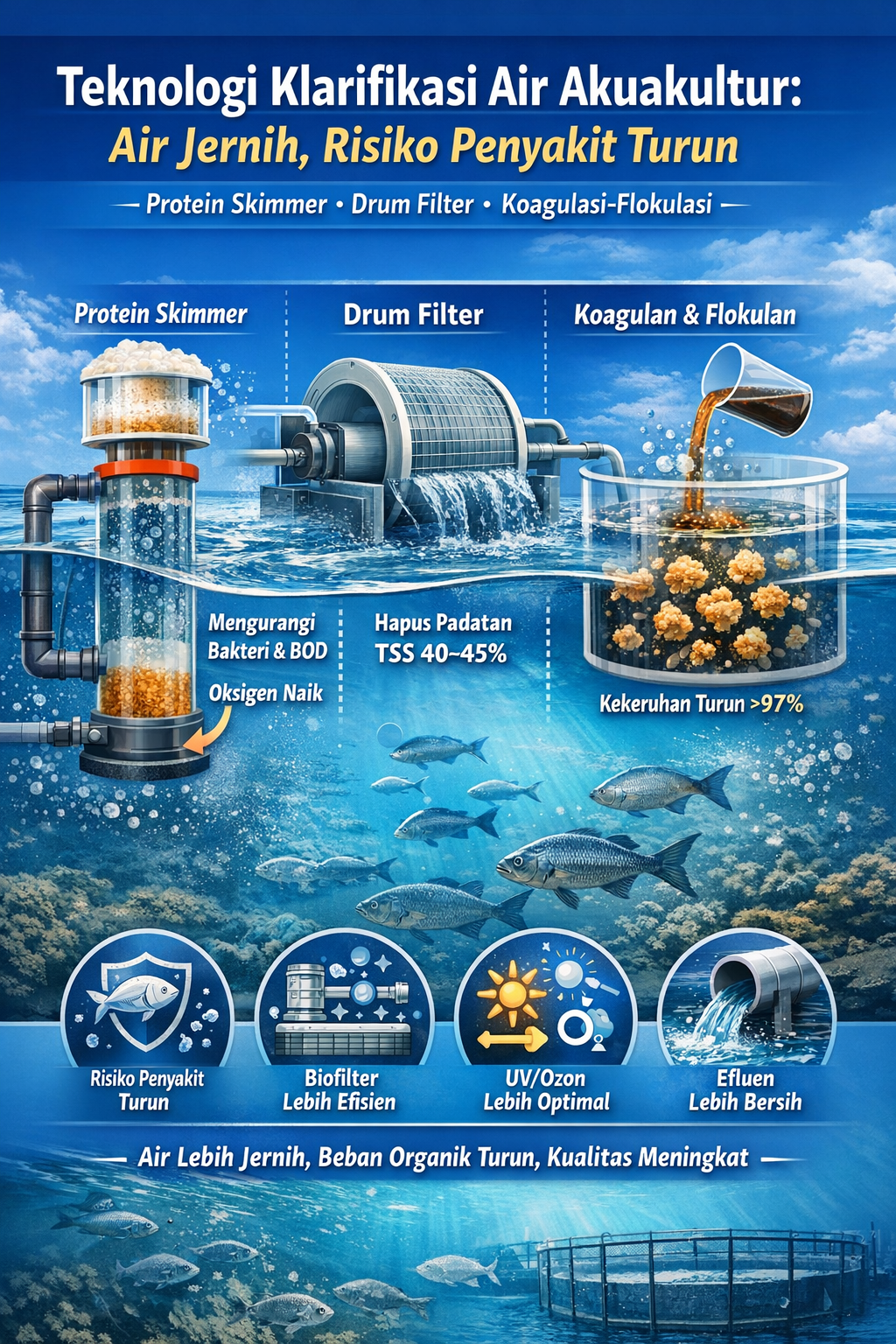
Chemical coagulation and flocculation aggregate fine and colloidal particles that resist settling or sieving. Inorganic coagulants (e.g., alum and PAC) neutralize particle charges, while organic flocculants (e.g., polyacrylamide or chitosan) bridge particles into settleable flocs. These are typically dosed into sludge or effluent slurry and allowed to settle rapidly.
Common choices include alum (aluminum sulfate) and PAC (polyaluminum chloride). Operators also use organic polyelectrolytes, such as high‑molecular‑weight polyamines or natural biopolymers (chitosan, starch derivatives). In some hatcheries, a two‑stage program adds PAC first to capture phosphate and organics, then polyacrylamide to consolidate flocs.
Performance can be extreme: in freshwater RAS sludge, an optimal PAC dose (~32 mg/L) removed 99.4% turbidity, 97.7% suspended solids, and 98.2% phosphate (researchgate.net). A comparable dose of a high‑MW polyamine removed 82.8% turbidity and 73.6% suspended solids (65.4% phosphate) (researchgate.net). Small‑scale trials with 20–50 mg/L chitosan have similarly reported >80% turbidity removal in pond and RAS effluents.
The flocs settle quickly (often 5–15 minutes), yielding concentrated sludge and clarified supernatant. Tests show >90% of nutrients (nitrogen and phosphorus) shift into settled solids; PAC at optimal dose cut nitrate and ammonium in overflow by ~90% as ions co‑precipitated with metal hydroxides. Untreated RAS backwash may carry 200–500 mg/L TSS and >50 mg/L ammonia; after coagulation‑flocculation, effluent TSS often drops below 5–10 mg/L.
Coagulants are particularly valuable for the ultra‑fine fraction (<10 µm) that drums and skimmers miss; particles under ~30 µm resist settling and sieving and generally require chemical aggregation (learn.farmhub.ag). In shrimp ponds, flocculants similarly clear greenwater; biofloc systems can form natural flocs, but chemical flocculants act faster.
Implementation is sensitive to dose and pH; excess polymer can re‑stabilize colloids, so jar tests are recommended. Typical reactors are simple basins with gentle mixing and short settling time (often <30 minutes), after which sludge is drawn off or dewatered. Costs vary; PAC is inexpensive (~$1–2/kg), so a few cents can treat a ton of solids. Natural flocculants cost more but leave no metal residues.
On compliance, intensive farms (including in Indonesia) often need this polishing to meet effluent standards (Permen LHK) for low turbidity and nutrients. Facilities using chemical flocculation routinely achieve >90% removal of suspended solids and phosphates—far beyond what screens alone can do.
In practice, operators rely on dosing pumps for accurate chemical addition. When programs specify PAC, many select polyaluminum chloride; where very high basicity is required, aluminum chlorohydrate (ACH) for difficult, low‑pH sources is provided via ACH water‑treatment grades. For broader programs, suppliers offer dedicated coagulants and flocculants tailored to aquaculture solids.
System synergy and downstream gains
Layering skimmers, drums, and chemistry has multiplicative effects. Lower organic loading means lower heterotrophic respiration; one trial measured a 7% DO increase after foam fractionation (researchgate.net). Poor water (high organics, ammonia or low DO) is known to weaken fish immune function and raise disease outbreaks (fao.org; learn.farmhub.ag), so cleaner water also improves welfare by removing gill and skin irritants.
Biofilters benefit directly. With settleable and colloidal wastes stripped upstream, biofilters receive steadier dissolved loads, boosting nitrification efficiency. Foam‑treated RAS biofilters showed increased Nitrospira comammox populations (bacteria that oxidize ammonia to nitrate in one step), indicating more complete ammonia removal (research.wur.nl). In practice this can shorten nitrification lag by ~10–20% and raise total ammonia conversion capacity.
Disinfection also runs leaner. Even trace turbidity can shield microbes from ultraviolet light, so reducing TSS to a few mg/L increases UV dose effectiveness; in shrimp farms, <5 NTU turbidity helps ensure >4‑log microbial kill. Operators across drinking‑water and aquaculture domains recommend pre‑filtration before UV; aquaculture facilities that clarify mechanically and chemically often standardize on ultraviolet systems at lower dose for the same kill.
Combined trains also cut discharge pollution. Pilot RAS work shows swirl+drum+foam setups lowered total suspended BOD by ~40% and COD by ~27% versus drum‑only (orbit.dtu.dk), and cut microbial activity >55% (in non‑published pilot trials). Each layer (settling, microscreen, skimmer, coagulant, ozone) multiplicatively improves the next; farms report reduced water exchange and the ability to use smaller UV systems once glues/flocculants are installed.
Operational snapshot and evidence base
Across RAS, these interventions are pushing water toward “crystal‑clear” standards—quantified by NTU (nephelometric turbidity units) ≤5, BOD/COD hundreds of mg↓, and near‑zero suspended N/P. Data from peer‑reviewed RAS trials confirm these gains: ≥30% reductions in pathogenic microbes and nutrient loads (researchgate.net), tens‑of‑percent faster nitrification, and much higher UV transparency in treated water.
Authoritative aquaculture engineering studies and reviews underpin the figures cited here: foam fractionation removing >96% of targeted particle classes and up to 88% of bacteria (researchgate.net; researchgate.net); drum filters removing ~40–45% of TSS (~63–68% with a swirl separator) (link.springer.com); and coagulant dosing achieving >97% turbidity/suspended‑solids removal (researchgate.net). RAS water‑quality texts further detail the mechanisms and operational controls (learn.farmhub.ag; fao.org).