
Unpaved haul roads drive 78–97% of fugitive dust at open‑pit coal mines. A build‑maintain‑treat playbook—then the right chemical—can push suppression to 95–100% and keep sites within tight PM10 limits.
Across open‑pit coal mines, the dirtiest culprit isn’t a stack or a shovel—it’s the road under the trucks. Unpaved haul roads account for roughly 78–97% of total fugitive dust emissions (www.researchgate.net). That’s a direct compliance headache where ambient standards are strict; Indonesia’s 24‑hour PM10 (particulate matter 10 micrometers and smaller, inhalable) limit is 150 µg/m³ (id.scribd.com).
Best practice is to design out dust, maintain the surface, and only then layer on chemical suppressants. Mines increasingly package that strategy with commercial programs, including a dedicated hauling‑road dust suppressant, to move the needle on visibility, machine wear, and ambient compliance while trucks keep rolling.
Road construction specifications
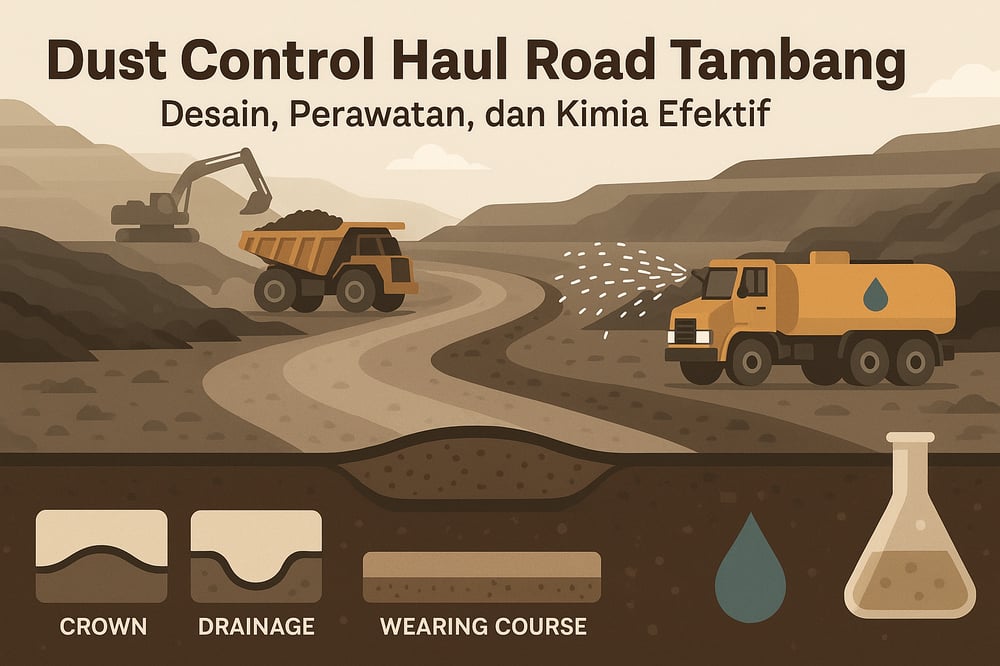
Dust is dramatically lower when the road prism is stable, well‑drained, and tightly compacted. Wearing courses for large trucks should be thick, well‑graded, and dense—commonly at least 150–200 mm of crushed or sub‑angular gravel placed in two or more lifts (often 100–150 mm each) and compacted to ≥95% of Modified Proctor dry density (a standard lab compaction benchmark) (studylib.net). “Sheathing” with sufficient fines matters: without a cohesive fine matrix, coarse gravel scatters and spawns dust. As one guide puts it, the wearing course must meet specification and be compacted correctly—if not, the road will perform poorly (studylib.net).
Cross‑section and drainage are equally critical: crown the surface about 2–3% so water sheds to side ditches, and size the ditching to evacuate storm runoff. Weak spots (soft subgrade, unbonded layers) must be stabilized or removed; inadequate base compaction leads to rutting that cracks fines and undermines any surface treatment (globalroadtechnology.com). The design decisions made at build time ultimately dictate operational efficiency (globalroadtechnology.com).
Road maintenance practices
Even a good road needs constant attention to keep dust at bay. Routine grading restores the crown/profile, relocates displaced aggregate, and works fines back into the surface. Best practice is to rip or loosen the top 75–100 mm, remix across the width, and re‑compact in lifts (studylib.net; studylib.net). If the wearing course falls below ~75 mm, grading will mix base into sheeting; it’s better to loosen, place fresh sheeting to the design width, and re‑compact (studylib.net).
Fines management is a linchpin. Under traffic, even high‑quality aggregate deteriorates and the clay fraction grows, which leads to dustiness when dry (globalroadtechnology.com). When the top ~50 mm becomes “bony” (mostly gravel), deep rip and remix—excavating 50–100 mm, mixing in fresher subgrade, and re‑compacting—brings fines to the surface and cuts dust (globalroadtechnology.com). On high‑volume roads, full resheeting is typically needed every 6–12 months (news.dustaside.com.au).
Moisture conditioning helps treatments penetrate and hold; dampen the surface prior to application (www.fs.usda.gov). Watering must be even—spray‑bar trucks are standard—and many operations run scheduled water trucks, recognizing that plain water is transient (see performance data below). To control dose consistency when blending brines or polymers into spray trucks, many sites rely on a simple dosing pump. Speed control, load management, tire carry‑over reduction, and wheel wash practices also cut scatter and fines loss.
Chemical suppressant classes and mechanisms
Straight water, hygroscopic salts, oils, organics, enzymes/ionic agents, synthetic polymers, and clay additives all play a role—each with tradeoffs in longevity, cost, and environmental profile (classification per USDA dust‑control guidance: www.fs.usda.gov; www.fs.usda.gov). Applications are typically topical sprays with water carry; “concentration” refers to solids content in solution.
Water‑only: Plain water wets fines for immediate but very short effect.
Hygroscopic salts (deliquescents): Magnesium chloride (MgCl₂) and calcium chloride (CaCl₂) brines are water‑attracting salts that absorb atmospheric and soil moisture and “cement” fines (www.researchgate.net). Lab work shows MgCl₂ can deliver near‑100% PM10 elimination under cross‑wind conditions (www.mdpi.com), while wind‑tunnel and field studies report ≥94% reductions even 2–6 weeks after application; ultra‑saline “Dead Sea” brine has demonstrated effectively 100% suppression (www.researchgate.net). Typical use is flake or liquid brine at ~15–30% concentration, ~1–3 L/m² (~150–300 g/m² salt), lasting weeks to months unless leached (www.researchgate.net; www.researchgate.net). Drawbacks: corrosion, soil salinity, and wash‑off in heavy rain. Sodium chloride (rock salt) is least effective—only slightly hygroscopic and requires higher application.
Asphaltic/petroleum oils: Cut‑back asphalt, dust oils, and bituminous emulsions coat particles; as water evaporates, a film binds fines. Immediate reductions are typical but vary widely; one estimate showed ~70% TSP reduction for a standard dust oil versus ~95% for MgCl₂ under similar conditions (www.researchgate.net). Rates run ~2–5 L/m². They resist short rains but can create slick surfaces and require periodic reapplication.
Lignosulfonates and other organics: Lignosulfonates (pulp‑industry byproducts) are natural polymers that form a glue‑like film on drying, binding soil particles through film formation (globalroadtechnology.com). They are not hygroscopic; once cured they hold fines mechanically, performing well in dry climates. Typical application is ~20–30% solids, ~2–4 L/m², with 1–2 treatments per season (globalroadtechnology.com). Field performance often shows 70–80%+ reductions in dry weather, but LS can be ineffective on very coarse, low‑fines roads and readily re‑dissolves in rain, sometimes leaving slick surfaces (globalroadtechnology.com; globalroadtechnology.com). Other organics—molasses/sugar emulsions, tall oil, vegetable oils—act similarly as film‑forming binders; they last in dry weather but lose efficacy when oversaturated by rain.
Synthetic polymers: Modern acrylics, vinyl acetates, polyacrylamides, and related binders can outperform simpler agents. Polyvinyl acetate has shown near‑complete wind‑blown PM10 elimination on loess soils in lab trials (www.mdpi.com). Field coatings form semi‑permanent crusts that resist wash‑off; typical rates are ~0.5–2 L/m² of concentrated product, diluted 1:5–1:10 with water. These “24/7” solutions have kept roads open in rain and drastically reduced conventional maintenance (globalroadtechnology.com). Caveats: higher cost and a need to match the formulation to the material; heavy blading can destroy the crust, so maintenance shifts to brushing or light raking (globalroadtechnology.com).
Miscellaneous: Enzymatic/ionic solutions and clay additives (e.g., bentonite/montmorillonite) are niche tools with mixed results, often used in combination and slower to act.
Relative performance and field data
Water: Alone, sprayed water suppresses dust briefly, with no binding effect. US EPA field tests found 2.08 L/m² delivered ~74% TSP (total suspended particulate) reduction for 3–4 hours, while 0.59 L/m² achieved ~95% but only for 30 minutes (www.researchgate.net).
Salt brines: In lab and wind‑tunnel work, hydrated MgCl₂ produced essentially zero new PM10 across tested wind speeds (www.mdpi.com). On contaminated desert soil, CaCl₂ and MgCl₂ each gave ≥94% PM10 suppression six weeks post‑application; highly concentrated brine achieved 100% suppression under all winds (www.researchgate.net). Katra (2019) also observed that reducing applied MgCl₂ concentration still kept emissions “low” (his Figure 7) (www.mdpi.com). The effect is due to the salts themselves, which cement fines until leached or exhausted (www.researchgate.net).
Lignosulfonates: Controlled tests report strong reductions (often 70–90%) on gravelly surfaces in dry climates. Limitations appear on very coarse, low‑fines roads and when humidity rises, as LS may wash off (globalroadtechnology.com; globalroadtechnology.com).
Oils/asphalts: Immediate reductions of ~60–80% are common post‑drying, but UV and traffic weather films; a field trial reported ~70% TSP reduction for a standard dust oil versus 95% for MgCl₂ under similar conditions (www.researchgate.net).
Synthetic polymers: Lab data show polymer binders can approach the efficacy of salts (www.mdpi.com). In practice, polymer emulsions have enabled “permanent” (>1‑year) stabilization of high‑traffic haul roads at some mines (globalroadtechnology.com). One site reported haul‑truck operator dust exposure dropped by 41–52% after treatment compared with water trucks or no treatment (www.researchgate.net). In a Chinese open‑pit, a polymer‑surfactant “SSC” in water spray achieved ~89% suppression of both total and respirable dust—~45% more effective than water alone (www.researchgate.net; www.researchgate.net). Polyacrylamide‑type polymers have also delivered 30–60% additional reduction under wind conditions (www.researchgate.net).
Other organics: Emerging data from a semi‑arid Chinese mine shows a molasses‑based suppressant delivering “superior efficiency versus water,” often reported as >80% reduction in field trials (pmc.ncbi.nlm.nih.gov).
Selection framework: material, climate, traffic
Road material: Fines content is the first filter. Coarse gravel or hardpan with <10% passing 75 µm offers little “native binder,” so a chemical that bonds coarse particles—often a polymer emulsion, a polymer+oil blend, or repeated heavy watering—may be required. Where fines are abundant (sandy‑silt mixes), hygroscopic salts or lignosulfonate can clump the matrix effectively. If fines are <10%, application rates must rise or fine material should be added (www.fs.usda.gov). High clay content can crack when dry, favoring flexible polymer seals.
Climate: In arid/dry climates with infrequent rain, chlorides and organics excel—MgCl₂, CaCl₂, and lignosulfonates remain in place and retain moisture. Lignin is valued in deserts because it is not hygroscopic and creates long‑lasting protection (globalroadtechnology.com). In humid or rainy climates, water‑soluble products leach quickly; oils, polymer emulsions, or paving are favored, with heavy rainfall still dictating reapplication schedules. Temperature matters: heat can speed curing/volatilization; cold can slow film formation.
Traffic volume/use: Higher traffic and speed demand more durable palliatives and higher application rates/frequencies (www.fs.usda.gov). Long‑haul, 24‑hour roads with Class‑A trucks often justify premium stabilizers (polymers or soil‑cement) to achieve constant uptime (globalroadtechnology.com). Lower‑traffic or seasonal roads can be served by cheaper intermittent fixes (water trucks or salts). Where operator exposure is critical, full elimination (favoring polymers) may be prioritized; where only off‑site fugitive dust matters, simpler suppressants can suffice.
Management/cost: Repeated watering consumes labor and scarce water; polymers carry higher product costs but can cut watering frequency and road wear. Total‑cost analyses (Thompson & Visser 2007) show that at sufficiently high traffic, or when water is scarce, chemical suppressants can beat watering on economics (journals.co.za). Maintenance compatibility (e.g., minimal blading after polymer treatment), safety (slipperiness), and corrosion (for salts) must be weighed (globalroadtechnology.com).
Illustrative selection examples
Coarse rocky road, arid, light traffic: CaCl₂ brine or CaCl₂ salt, or moderate lignin.
Coarse road, high rain: Polymer emulsion or bituminous seal (salts wash out).
Fine‑grained (silty) road, moderate traffic, seasonal: Lignosulfonate or MgCl₂, or polymer if budget allows.
Fine‑grained, heavy traffic: Moisture‑stable polymer or triple‑thick compaction with occasional salt.
Wet tropics: Bitumen‑seal sheets or constant watering (salt corrodes and washes out).
High‑cost‑of‑water site: Polymers or lignosulfonate; salts use water too but lock it in.
Measurable outcomes and monitoring
Single, appropriate chemical applications often deliver 80–100% suppression for days to weeks; MgCl₂ has kept PM10 emissions near zero for weeks in comparative tests (www.mdpi.com; www.researchgate.net). By contrast, water spraying typically achieves ≈50–75% reduction and only for minutes to hours (www.researchgate.net). Liao et al. (2018) documented an 89% reduction in total dust and 88% in respirable dust using a surfactant suppressant in a coal‑mine roadway (www.researchgate.net). These inputs are directly useful in dust modeling, including AP‑42 equations (emission‑factor equations).
Quantitative verification matters. Many operators deploy portable PM10 samplers before and after treatment, then adjust application rates or switch chemistries. Around conveyors and transfer points, a coal dust suppressant can complement the haul‑road program to keep ambient levels stable while improving near‑field visibility.
Market trend and procurement
Demand for dust‑control chemicals—hygroscopic salts, lignins, polymers, oils—is expected to grow ~5–6% per year globally on stricter regulations and expanding mining and construction (www.sphericalinsights.com). Indonesian coal companies, aiming to meet regulatory limits and minimize downtime, are adopting commercial dust‑control systems, often polymer‑ or chloride‑based, along haul roads and conveyors. Sustainability concerns are pushing “greener” options (bio‑polymers, molasses) into research and pilots. Procurement is increasingly bundled under broader chemicals for mining applications to standardize formulations and service across pits.
Implementation notes and product integration
Applications are typically topical sprays carried in water, with concentration referring to solids content. Where blending accuracy is essential—especially when stepping down MgCl₂ concentrations as Katra (2019) did while keeping emissions low (www.mdpi.com)—operators commonly fit spray bars with a dosing pump. On the haul network, mines standardize a core hauling‑road dust suppressant and supplement with lignin or chlorides by season and pit geology.
Conclusions and site‑specific recommendations
Integrated programs work. Build to spec (thick, dense sheeting; good drainage), maintain aggressively (grading, compaction, moisture), then match a suppressant to material, climate, and traffic. Matched to conditions, advanced binders can eliminate ~95–100% of dust, far outperforming water alone (www.mdpi.com; www.researchgate.net). In humid southern Kalimantan, polymer stabilization may outperform lignin (to avoid wash‑out); in inland arid Sumatra, a hygroscopic salt may suffice. Verify with PM10 samplers, then document measures in the dust‑control plan to meet Indonesia’s air‑quality and mining regulations. Around fixed plant, complement road programs with a targeted coal dust suppressant where needed.
References used throughout include Katra (2019) on haul‑road suppressants (www.mdpi.com; www.mdpi.com), Raveh‑Amit et al. (2022) on chloride efficacy (www.researchgate.net), US EPA/Forest Service guides (www.researchgate.net; www.fs.usda.gov), and industry reports (globalroadtechnology.com; globalroadtechnology.com), as cited above.
