

Industry: Coal_Mining | Process: Dewatering
Coal preparation and mine-water treatment throw off vast amounts of fine, water‑rich sludge. Typical coal washery tailings run ~20–35% solids by weight—on the order of 75–120 kg of slurry per tonne of raw coal (mdpi.com). After chemical treatment (e.g., ferric sulfate or lime dosing), the sludge is usually >90% water by volume.
Dewatering is where the economics flip. Raising solids from <10% toward ~30% or more can cut sludge volume by well over half, slashing haulage and disposal costs (nepis.epa.gov) (mdpi.com). Indonesian regulations require that treated effluent meet quality standards and that sludge sent to landfill meet prescribed solids content. In practice, coal-slurry sludge is conditioned with polymers and run through either passive or mechanical dewatering.
Sludge origins and conditioning chemistry
Upstream chemical treatment often relies on iron or aluminum salts (coagulants) and polymers (flocculants). In coal mining slurries, polyacrylamide‑based polymers—cationic or partially hydrolyzed anionic PAM—are most common; these high‑molecular‑weight chains adsorb onto fines and bridge them into large flocs, accelerating settling/filtration and clarifying filtrate (mdpi.com). For dosing and control, plants typically pair flocculants with accurate chemical feed equipment such as a dosing pump and rely on jar tests to tune the recipe.
Cost-wise, polymers are small line items with outsized impact. Benchmarks show optimized dosing can double or triple cake solids versus untreated sludge; an EPA case documented belt-press cake at ~31–33% solids with proper polymer dosing versus ~15% untreated, with polymer cost at ~$9 per ton of sludge solids (nepis.epa.gov). For procurement and inventory, mines commonly source flocculants and mineral-salt coagulants as part of routine consumables.
Geotextile tube dewatering (passive filtration)
Principle: geotextile dewatering—“geobag” or “geotube”—uses UV‑stable woven polypropylene tubes set on an impervious pad. Slurry is pumped in; fine solids (clays, coal fines) accumulate inside while water filtrates through the fabric. A filter cake builds on the interior, creating a quasi two‑stage filter that retains >98% of fine solids (miningweekly.com). Over days to weeks, the mass consolidates and dries under gravity.
Dryness: field trials show geotubes can deliver higher final solids than many mechanical systems; one study reports geotubes producing solids significantly above the ~20% level often seen in belt presses (mdpi.com). Operators target ≥20–30% solids, with 95–98% solids retention—enough for landfill or reuse classification. In a gold mill trial, 34%‑solids feed went to geotubes; after 4 weeks of standing, the trapped material reached very low moisture content (data not fully published, but reported as a dramatic solids increase) (zebratube.co.za) (zebratube.co.za). A water‑treatment sludge test showed >93% solids capture and solids increases of 20×–30× over a week (researchgate.net) (researchgate.net).
Costs and operation: geobags are billed as “the most efficient and economical” desludging method globally (miningweekly.com). CAPEX is low—fabric tubes and pumps (often a few USD per square meter of bag) and site prep. There’s no heavy machinery or high power: mild pumping to fill, then gravity consolidation; labor and maintenance are minimal. As one vendor frames it, geobags require “minimal skilled labour… low energy usage… simple auxiliary equipment… [and] lower up‑front capital expense” (zebratube.co.za). Filtrate can be collected for reuse, and the footprint is compact enough to stack (zebratube.co.za).
Trade‑offs: drainage is slow (days/weeks). Sites need space and a plan for the final cake. Very fine colloids can clog pores; overfilling risks bag bursts. Yet the approach eliminates costly equipment and energy: geotextile tubes work under gravity and simple hydrostatic pressure, appealing where time and space exist and budgets are limited (miningweekly.com) (zebratube.co.za).
Belt filter press dewatering (mechanical squeezing)
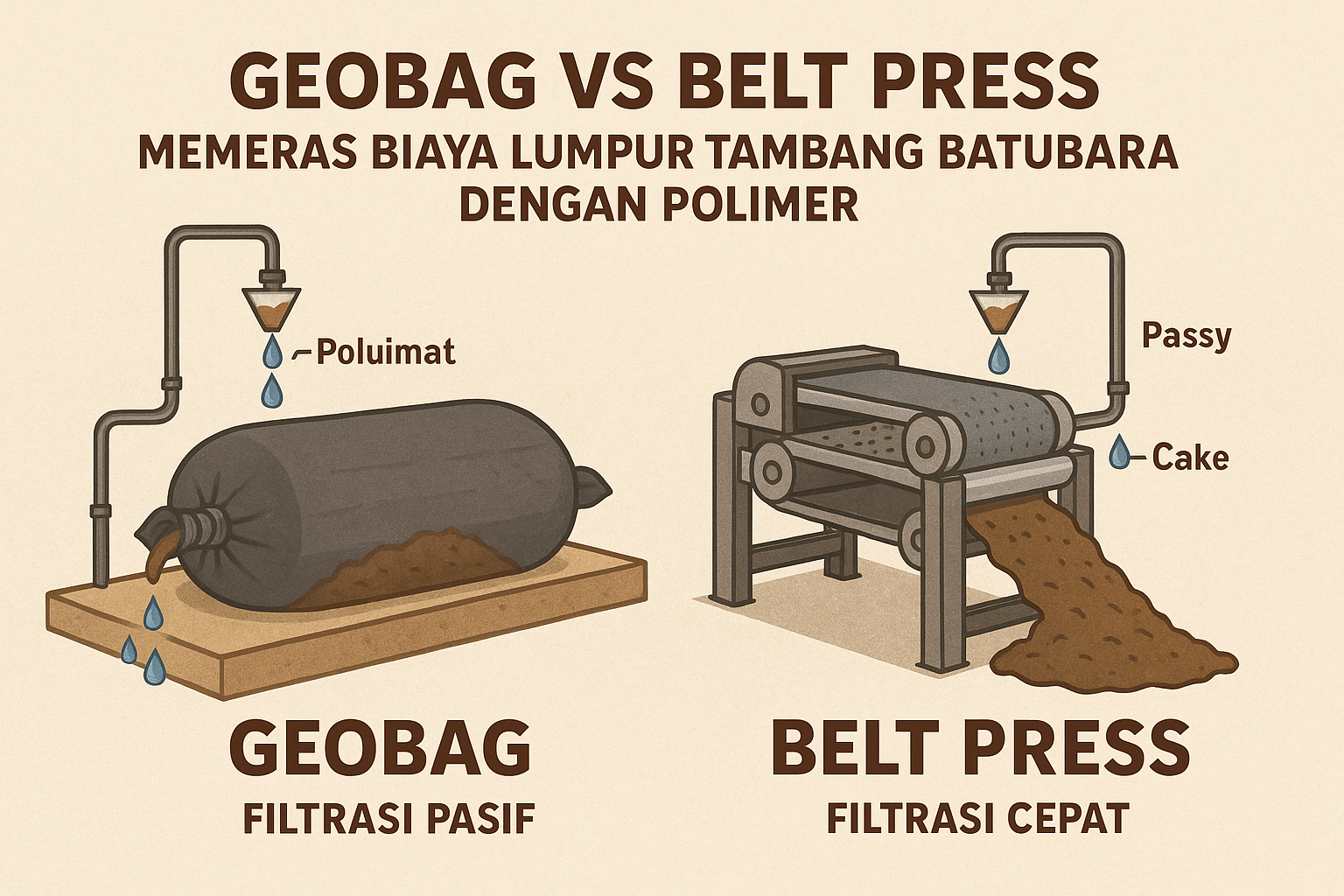
Principle: belt filter presses run continuously through gravity drainage and pressure zones. Polymer‑flocculated slurry is laid onto a moving belt; water first drains under gravity, then rolls apply increasing pressure before a scraper releases the cake.
Performance: belt presses handle varied sludges but typically deliver ~10–30% cake solids; in municipal trials, difficult wastes hit only ~10–15% dryness (intechopen.com). With polymer conditioning, bench tests have reached 30–35% solids (nepis.epa.gov), though full‑scale often falls short. Throughput can be high—hundreds of kg dry solids per hour per meter of belt—with steady performance once tuned.
Costs: these units are capital‑intensive. A full installation adds pumps, polymer‑mixing skids, the belt assembly with rollers/scrapers/drives, and automation—equipment can run into the millions of USD for large plants. Energy runs about 1–3 kWh per ton of sludge; belts need washing and periodic replacement. OPEX includes polymer (a few USD per ton of dry solids) and maintenance. A classic U.S. survey (1979) logged a 250 t/day belt press at ~$32/ton dewatering cost, beating vacuum filters (nepis.epa.gov). Today, belt presses remain among the lower‑cost mechanical options per ton—but only at scale. Accurate chemical dosing and control are pivotal, which is why polymer skids are commonly paired with a dosing pump as standard.
Trade‑offs: the upside is speed, control, and enclosure for odor control—vital for high‑volume sites that need rapid processing. The downside is continuous staffing, skilled operators, and the reality that modest cake dryness leaves meaningful disposal volume on the table.
Polymer flocculants and coagulants (chemical conditioning)
Role: flocculants/coagulants—iron or aluminum salts, or polymers—are universal in sludge conditioning. In coal slurries, polyacrylamide (PAM) variants dominate; they build large, robust flocs at low dosage, boosting capture and filtration (mdpi.com) (mdpi.com). Mines procure these chemistries as standard flocculants and coagulants, integrating them with supporting equipment such as water-treatment ancillaries for mixing and control.
Benefits: with optimized dosing, polymers can double or triple cake solids versus untreated sludge. In EPA testing, proper polymer feed yielded ~31–33% cake on a belt press (vs ~15% untreated) and >90–95% solids capture, at ~$9 per ton of sludge solids in polymer cost (nepis.epa.gov). In coal slurry reviews, polymers “improve flocculation efficiency significantly,” delivering large, robust flocs at low dosage (mdpi.com).
Dosage and caveats: typical doses run 1–5 kg per tonne of dry solids (often 0.05–0.2% of slurry volume). The volume savings usually dwarf reagent spend—well‑dosed polymer can halve truck trips or landfill area by halving cake moisture. But overdosing risks too‑dense sludge or residual toxicity; residual polymer can affect reuse, and petroleum‑based products raise environmental concerns. Jar tests are standard to lock in the right type and dose for each slurry.
Comparative outcomes and decision factors
Dewatering efficiency: geotextile tubes, with or without polymer, often deliver higher final solids than belt presses on the same feed; a comparative study reported geotubes above the ~20% benchmark often seen on belts. The timeline differs: bags need days to reach those solids, while belt presses deliver immediate—if typically lower—dryness. Both can clear the >20% solids target for landfill, with geobags relying on gravity (mdpi.com).
Cost and scale: geotextile systems have very low CAPEX and OPEX and scale by adding bags. Belt presses demand big investment and only pencil out at high, continuous flows. For small/medium or temporary operations, geotextile dewatering is far cheaper; for very large volumes or time‑critical duty, belts may win on productivity. One EPA analysis projected multi‑million‑dollar annual savings for belt presses over vacuum filters at 250 tpd (nepis.epa.gov).
Operations: geobags need space, drying time, and eventual bag/cake handling (including consolidation or recycling), but essentially no electricity. Belt presses run 24/7 and require maintenance (belts, bearings, pumps), power, and skilled operators to manage polymer feed, belt speed, and wash cycles.
Polymer use: both methods benefit. Belt presses generally require polymers to form a filterable floc; geobags see faster drainage and higher solids with polymer addition. In a geotube case, polymer dosing delivered >90% solids capture and a >20× increase in cake solids within 1–10 days (researchgate.net). Polymer typically runs a few USD per ton of sludge—small versus the disposal savings.
Compliance: geobags passively isolate contaminants in the cake, with filtrate turbidity often low enough to meet Class 1/2 discharge limits (mdpi.com). Mechanical presses concentrate contaminants as well but may require precoat/polishing; geobags also avoid mechanical failure spill risks. For Indonesian coal mines under strict rules, ≥98% solids retention supports treated‑water quality assurance (miningweekly.com), while belt presses likewise depend on polymers/coagulants to clean filtrate.
What the data says and how to choose
Geotextile dewatering is a low‑tech, high‑effect solution: >20–30% solids over days, minimal energy, and easy scaling by bag count (miningweekly.com) (zebratube.co.za). Belt filter presses are engineering‑intensive—best where continuous throughput justifies CAPEX—producing ~15–30% cake quickly but with polymer, power, and maintenance dependencies.
Benchmarks: geotubes routinely exceed 20% solids, often >30%, after consolidation (mdpi.com), with >90% solids capture (filtrate turbidity ≪100 NTU). Belt presses, well‑tuned with polymers, can reach ~30% but often run ~10–20% in practice. Operational costs for geotubes are typically a few USD/m³ of sludge (mainly bag and polymer), versus tens of USD/m³ for belt presses once capital recovery is counted. In one comparison, mechanical belt pressing plus disposal cost ~$102/ton of sludge (with composting) versus ~$155/ton for an alternative (late‑1970s data, illustrating scale) (nepis.epa.gov). Optimized polymers can halve transport costs by doubling cake dryness.
Recommendation: for Indonesian coal‑mine effluent plants, geotextile tubes with polymer conditioning are a proven, low‑energy option that meets regulatory sludge quality targets and cuts sludge disposal volumes (mdpi.com) (miningweekly.com). Choose belt presses when investment and power are available and high‑cycle throughput is essential; in that case, tighten polymer feed control—often via a dosing pump—to maximize dryness and minimize organic load in the filtrate. Many sites blend approaches: flocculate and send to a bank of geotubes, reserving belt presses for overflow or critical streams. In all cases, pilot work—jar tests and small‑scale dewatering—quantifies the polymer dose and the dryness realistically achievable for the site’s specific sludge.
Sources embedded above include technical reports and peer‑reviewed studies: geobags cited as “most efficient and economical” for pond desludging (miningweekly.com), geotubes outperforming mechanical presses in final solids (mdpi.com), and polyacrylamide flocculants delivering “high efficiency at low dosage” in coal‑slurry dewatering (mdpi.com).