

A stubborn emulsion at the mixer–settler interface can trap expensive extractants and stall production. Plants are fighting back with aggressive solids control, chemical discipline, and three‑phase centrifuges that recover up to 60% of lost organic.
Industry: Nickel_Mining | Process: Solvent_Extraction_&_Electrowinning_(SX
Crud—an unlovely but accurate term—describes a persistent, stable multi‑phase emulsion that forms at the mixer‑settler interface in solvent extraction (SX; liquid–liquid separation) circuits, entraining valuable extractant (the organic phase) and hindering phase separation. It’s “formed when organic species adsorb onto solids and a solid‑organic‑water phase forms,” notes one SX guide (Scribd), with literature documenting mineral fines—often under 0.5–1 µm—acting as the scaffold for these emulsions (ResearchGate).
In practice, the fines suspended in the pregnant leach solution (PLS; metal‑bearing aqueous feed) are the dominant seed for crud (ResearchGate; Scribd). Other contributors include airborne dust, precipitates generated by chemistry shifts (e.g., metal hydroxides as pH rises), or contaminants in reagents (ResearchGate). A study of copper SX crud, for example, found particle sizes in stable crud averaged 0.16–0.37 µm and were composed of Si, Al, and Fe typical of quartz and clays (ResearchGate).
Crud stabilization by fine mineral solids
Fine mineral particles—silica, clays, and Fe/Al hydroxides—provide vast surface area for extractant adsorption, making crud emulsions unusually stable (Scribd; ResearchGate). Without these solids, emulsions are far more tenuous.
Five main paths bring “crud particles” into SX: particles already suspended in the PLS, wind‑blown dust, precipitates from chemistry shifts (e.g., metal hydroxides), impurities in reagents, and carried‑over solids from spent organics (ResearchGate). Too high solids in the PLS almost guarantees crud.
Operational impacts and entrainment losses
Crud causes carry‑over (entrainment) into downstream circuits, organic loss, increased settler carry‑under, and periodic shutdowns for manual cleaning. Even a few dozen mg/L (milligrams per liter; often synonymous with ppm in dilute aqueous systems) of fines can lock up grams per liter of organic.
In copper SX, processing crud via centrifuge can recover as much as 60% of the organic bound up in crud (Flottweg)—implying losses of similar magnitude if crud is left untreated.
PLS clarification and pinned‑bed performance
Removing fines before SX drastically reduces crud. Clarification (settling/thickening) is typically the first barrier; in high‑throughput plants, advanced clarifiers handle heavy solids. A pinned‑bed clarifier pilot at Mt. Gordon, for instance, treated PLS feeds of 5,000–50,000 mg/L suspended solids and produced overflow with under 40 mg/L (Scribd), often even under 20 mg/L in steady operation (Scribd). SpinTek markets similar units with typical under‑10 mg/L TSS (total suspended solids) performance (SpinTek).
Low doses of coagulant and flocculant markedly improve clarity; pilot work found about 20 ppm polyethylene glycol with about 20 ppm nonionic polymer gave the best results (Scribd). Plants typically meter these with an accurate dosing pump, pairing selected coagulants with tailored flocculants. Continuous backwash and cleaning keep the pinned bed fresh. In practice, a clarified PLS virtually eliminates solids‑driven crud.
For SX front ends, conventional equipment such as a clarifier remains a mainstay, especially when paired with targeted polymer programs.
Multi‑stage filtration trains (bag, media, cartridge)
Beyond bulk settling, multi‑stage filter trains are common. A coarse bag or cartridge filter at 5–20 µm traps fibers and grit, followed by finer cartridges at 1–5 µm for polishing. Media filters—sand or diatomite—provide bulk TSS removal; multi‑layer beds with sand media are widely used.
These systems routinely achieve 90–99% suspended solids removal. After belt‑pressing or countercurrent decantation (CCD) washing of heap‑leach streams, bag filters can reduce residual solids to low mg/L. In practice, well‑designed trains drop TSS from hundreds of mg/L in raw PLS to single‑digit mg/L before SX.
Centrifugation for PLS and crud streams
High‑speed clarifiers and decanter centrifuges can treat PLS to under about 50 mg/L in some designs, though this is less common in the main SX tanks. Specialized three‑phase centrifuges (“Tricanters”) are widely used to process crud emulsions directly (Flottweg).
Operators pump the emulsion to the centrifuge, which separates four layers: a solid cake, an aqueous effluent, a separate organic effluent, and a fourth “interface” phase (Flottweg). Manufacturer reports claim up to 60% of the entrained organic can be recovered, with majority‑recovery narratives repeated across case examples (Flottweg; Flottweg). Cleaned solids are dewatered and returned to tailings or disposed; recovered solvent is recycled.
Preventive operating practices (source and mixing control)
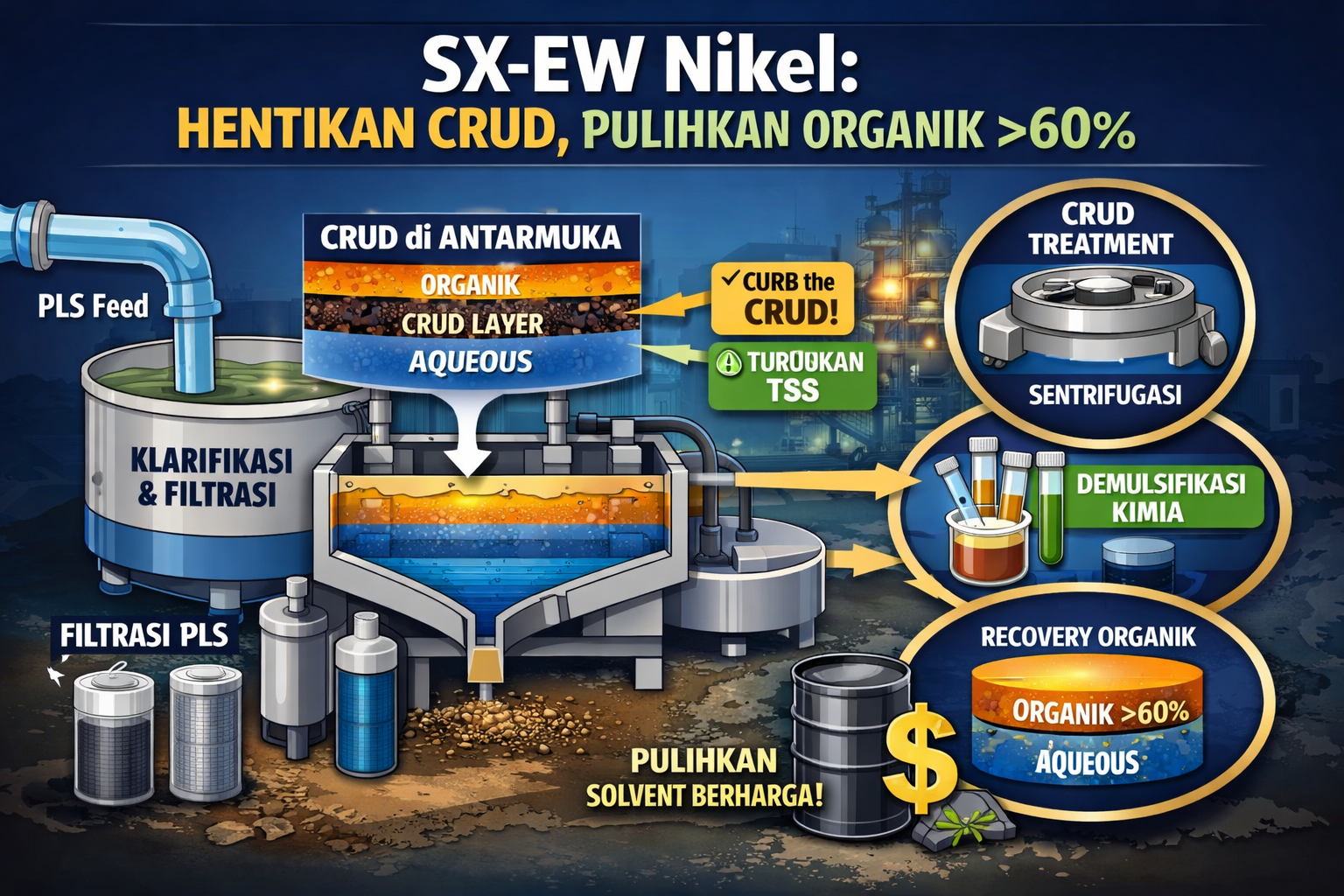
PLS source control matters: well‑settled, thinned feeds from HPAL (high‑pressure acid leach) circuits and efficient iron/aluminum removal minimize solids carryover. Maintaining thickeners and settling ponds prevents excursions.
Dust and moisture management—covering solution storage, limiting agitation of damp soil near ponds, blocking runoff—reduces airborne solids. Reagent purity also counts; extractants and diluents should be free of particulate suspensions and high‑viscosity contaminants. Mixer design and phasing matter too: most SX mixers operate near O/A = 1 (organic/aqueous) in spray mixing to reduce entrainment; proper vanes and draft tubes limit foaming and crud adhesion. Some plants periodically reverse the continuous phase (“flip the mixers”) to dislodge crud to the settler for vacuum removal (Scribd).
Chemical demulsification and settling protocol
Even with prevention, crud forms. Settlers are typically fitted with crud taps or wands to skim the layer into a crud tank for gentle agitation and breakup (Scribd). Demulsification employs fresh diluent, strong electrolyte, mineral acid, or staged contact with PLS; bench “bushel tests” are used to identify the best crud‑breaker reagent (Scribd).
Nickel SX case work shows how base choice and pH control are pivotal: pre‑saponifying the strip solution and avoiding hydroxide precipitates minimized crud. Direct NaOH injection caused much crud, whereas sodium carbonate or ammonia produced little (ResearchGate). Saponifying about 90% of the loaded organic and then injecting 5% base (Na₂CO₃ or NaOH) “reduced the crud formation significantly” (NaOH) or “almost completely” (Na₂CO₃) (ResearchGate).
After agitation, the crud tank is allowed to settle into a clear aqueous layer, a clear organic layer, and residual solids/emulsion. Side ports draw off clean phases; low outlets and careful decanting preserve nearly all free organic and water, leaving solids behind (Scribd).
Filter polishing and clay beds
Dispersed crud is often run through a clay or diatomaceous‑earth filter to polish out solids and recover dissolved organics; a filter (plate or cartridge) is precoated with bentonite or similar media, and the slurry is filtered slowly (Scribd). The filtrate is allowed to settle in a separate tank so solids drop out and the clarified, organic‑bearing filtrate can be decanted.
Industry practice notes clay beds can be very effective for oxime‑type extractants; cationic extractants are more challenging but can sometimes be filtered similarly (Scribd). Plants that polish with cartridge filters typically pair them with upstream solids removal to extend run times.
Other methods and biocide control
Heat or vacuum stripping of crud sludge is sometimes considered. Vacuum distillation or low‑temperature evaporation can pull off diluent for reuse, leaving dry solids (ResearchGate). Strong oxidants (permanganate) will destroy organics—caution: this generates MnO₂—but such methods are seldom used industrially due to reagent cost and safety (ResearchGate).
Controlling microbial growth with biocide in feed water helps prevent sticky biofilms that exacerbate crud formation. Plants frequently integrate chemical programs with solids control, using a clarifier up front and polymer programs downstream for stability.
Outcomes, thresholds, and economics
Filtration cuts crud risk sharply. In the pinned‑bed pilot cited above, solids dropped from 5,000–50,000 mg/L to under 40 mg/L (Scribd), with mature operation achieving under 20 mg/L and even 10–12 mg/L (Scribd). SpinTek cites under‑10 mg/L as typical (SpinTek).
Low‑dose polymer programs—about 20 mg/L of a high‑mass coagulant plus about 20 mg/L of flocculant—reduce required filter area and improve throughputs (Scribd). Industries have found that even 1 mg/L of fines can measurably increase emulsion formation, so the under‑10–40 mg/L levels above represent greater than 99.9% removal.
On the recovery side, treating crud by tank/filters or centrifuge routinely returns over 50–60% of the entrained organic (Flottweg). If 1 ton of organic enters crud per month, recovering 60% saves 0.6 tons of solvent. In one case study, substituting 5% Na₂CO₃ for NaOH in the protocol nearly eliminated crud (ResearchGate).
Economically, even small losses add up: 0.1% of a 3,000 tpa organic inventory is 3 tpa lost. Recovering these volumes through filtration and crud treatment can save millions in lost reagent and downtime.
Implementation priorities for SX‑EW plants
Rigorous front‑end solids removal—thickeners, filters, and clarifiers that push TSS to single‑digit mg/L before SX—anchors crud prevention. Plants pair clarification with polishing via cartridge filtration to intercept fines that seed emulsions.
Continuous monitoring of PLS solids/turbidity and pH, careful reagent choice and mixing (including O/A = 1 spray mixing), and regular “flip” routines help maintain stable hydrodynamics (Scribd). A dedicated crud tank with daily or per‑shift skimming, bench testing to select demulsifiers, and equipment upgrades—pinned‑bed clarifiers with under‑10–40 mg/L results (Scribd; SpinTek) or in‑line Tricanters to salvage solvent (Flottweg)—round out the playbook.
Recovering and recycling treated crud through filtration or centrifugation is standard; only dried solids are discarded. For stable operation, polymer programs are delivered via a dosing pump with tuned flocculant chemistry and upstream settling in a clarifier.
Bottom line: proper solids filtration can cut SX feed turbidity from roughly 10⁴ ppm to under 20 ppm (Scribd), and effective crud treatment can recover most of the solvent—often over 50–60%—that would otherwise be lost (Flottweg; Scribd). Those data‑backed approaches translate directly into lower downtime and reagent costs.
Sources used throughout include W.‑C. Wang (2005) on crud causes (ResearchGate; ResearchGate), nickel/cobalt SX conditions by Cheng et al. (ResearchGate; ResearchGate), pinned‑bed clarifier pilots (Scribd; Scribd) and vendor specs (SpinTek), along with SX references on demulsification and separation approaches (ResearchGate).