

Industry: Semiconductor | Process: Specialty_Gas_Delivery
Specialty gases in chipmaking have to be ultra–high purity (UHP, an extremely low‑contaminant standard) because a stray molecule can scrap a lot. Unfiltered or under‑filtered streams “will lower the yield of die per wafer, decrease system productivity, [and] increase scrap,” as Valin Corp puts it (valin.com).
That’s why fabs now layer filters from the bulk source to the process chamber and, crucially, place point‑of‑use (POU) purifiers immediately upstream of each tool. They are the last barrier before the wafer sees the gas (valin.com).
Point‑of‑use filtration at the tool
POU units combine fine particle filters with chemical media to strip molecules to sub‑ppb (parts per billion) levels. Aeronex’s GateKeeper 35K, for example, couples a 316L stainless steel filter with getter media to handle ~1 slm (a flow‑rate unit, “standard liters per minute); it retains 99.9999999% of particles ≥0.01 µm and drives moisture, O₂, CO₂, CO, and hydrocarbons below 1 ppb (sst.semiconductor-digest.com).
Industry standards now call for “9‑log” particle filtration at 0.003 µm—essentially one‑in‑a‑billion retention—to protect 5 nm+ features (valin.com). In practice, fabs deploy a filter at every stage—bulk supply, distribution panels, tool drops, gas boxes, and the process chamber itself (valin.com).
Sintered‑metal or ceramic elements deliver >99.999999% retention for sub‑0.01 µm particles (sst.semiconductor-digest.com; valin.com), while adsorbents and getters remove molecular impurities to sub‑ppb. Field tests show chemical POU filters can push basic, acidic, and organic contaminants below detection limits of ~0.1 ppb in exhaust streams (cleanroomtechnology.com).
Downstream of POU purifiers, inert gases like nitrogen or argon routinely meet sub‑ppb O₂ and H₂O; Air Products’ Burned‑in‑Place (BIP®) tech in hydrogen generation, for instance, achieves <10 ppb O₂ and <20 ppb H₂O (jewellok.com).
The market reflects the shift: global semiconductor gas purifier sales reached about US$239 M in 2024, growing ~5.8% per year, with over 65% of value in point‑of‑use units versus bulk purifiers (semiconductorinsight.com; semiconductorinsight.com). Leading suppliers—Entegris, Pall, Taiyo Nippon Sanso—are investing in low‑maintenance, high‑capacity POU designs.
Material choices matter at the component level too. Purifiers that specify 316L stainless steel filters underscore why fabs standardize on high‑purity alloys; when housings are needed in similar service, 316L stainless steel housings are a common baseline (ss‑cartridge‑housing).
Delivery system integrity and containment
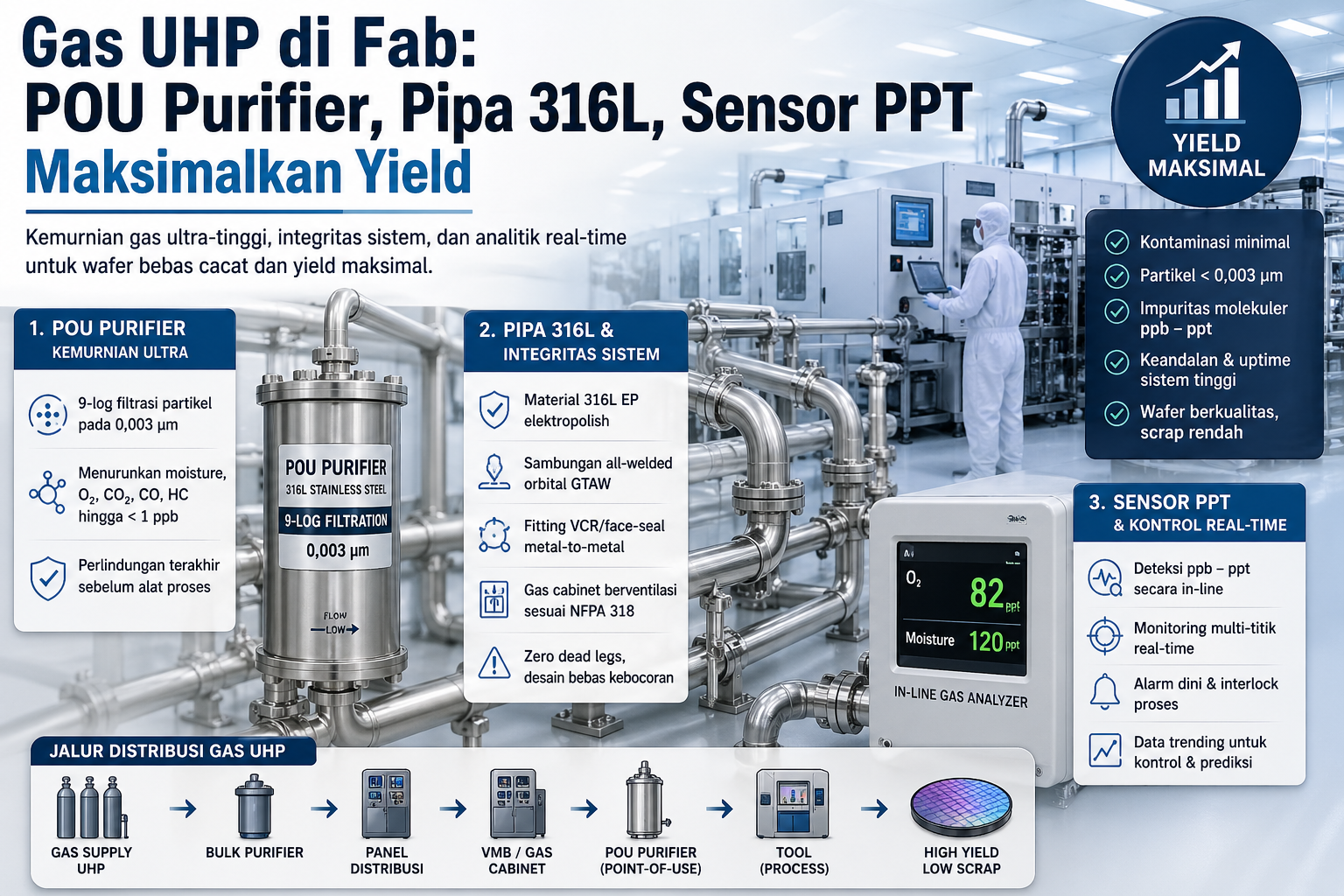
POU units are only as good as the lines feeding them. Maintaining the upstream gas delivery system means high‑purity materials such as 316L stainless steel with electropolished inner walls and all‑welded joints (orbital GTAW) to curb particle shedding and leaks (jewellok.com). VCR/face‑seal fittings and diaphragm or bellows valves replace threaded seals to prevent ingress.
Distribution piping is frequently double‑walled or routed through ventilated gas cabinets so any leak is captured and signaled before ambient air contacts the gas—an approach aligned with NFPA 318 for fabs and guidance from SEMI and FM Global (hallam-ics.com; hallam-ics.com). Some fabs pressurize secondary containment or evacuate it into scrubbers so any loss of primary line pressure alarms immediately; over 30 gas drops into a tool may each be double‑blocked with bleed to prevent backflow.
Integrity also means eliminating dead legs (stagnant pockets) and checking material compatibility. Poor design—unused bifurcations, loose fittings, outgassing sealants—seeds the gas with particles or vapors (sst.semiconductor-digest.com). Some gases react with materials: tungsten hexafluoride (WF₆) will pull H₂O off stainless steel and displace chromium into the gas path, risking chromium contamination downstream (sst.semiconductor-digest.com). Even trace moisture can degrade reactive gases or form corrosive by‑products (e.g., HF in WCVD processes). Hence the routine: purge and bake out lines before use, and continuously monitor pressure or moisture to catch leaks.
The systems view is blunt: every segment of the gas train must be ultra‑clean and leak‑proof, because contamination can enter via the gas supply, cylinder, distribution system, process tool, chamber, or the wafer itself (sst.semiconductor-digest.com). Selecting appropriate housings for high‑pressure service is part of that mindset (steel filter housings).
Online monitoring at ppb–ppt sensitivity
Verification is now continuous. Fabs deploy in‑situ analyzers that see trace impurities from ppb down to ppt (parts per trillion). Cavity‑ring‑down spectrometers—such as Tiger Optics’ LaserTrace O₂—and catalytic conversion approaches can detect O₂ to ~100 ppt by internally converting oxygen to H₂O (studylib.net). Tunable laser systems target H₂O and other gases at similar ranges.
Gas chromatographs with plasma emission or mass‑spec detectors (e.g., APIMS) continuously sample process gas to flag hydrocarbons, industrial chemicals, or metal‑organic dopants below 1 ppb (thermofisher.com; processsensing.com). Process Sensing’s MultiDetek GC devices cite limits of 85–100 ppt for analytes like CH₄, CO, and CO₂ in inert backgrounds (processsensing.com). Simpler inline sensors—zirconia O₂ probes, dew‑point meters, IR photometers—cover ppm to ppb for moisture or flammable leaks.
The stakes are high: even parts‑per‑trillion contamination can cause whole‑batch losses (processsensing.com). No surprise, then, that the gas‑analyzer market was about $615 M in 2023 and is projected to roughly double to ~$1.15 B by 2030, a ~9.4% CAGR (semiconductorinsight.com). Suppliers now bundle networked O₂/moisture sensors (<100 ppt detection) with multi‑gas GC/MS into “quality control” platforms that log purifier status and purity data—moving fabs from static specs to dynamic process control (Industry 4.0).
Sources and data points
Peer‑reviewed and industry sources underpin these numbers. Key data include purifier efficiencies—e.g., 9‑log at 0.003 µm (valin.com)—and achieved impurity levels (<0.1 ppb, cleanroomtechnology.com). Market sizes: purifiers ~US$239 M (semiconductorinsight.com); analyzers ~$615 M in 2023 rising to ~$1.15 B by 2030 (semiconductorinsight.com). Best‑practice references span 316L piping with orbital welds (jewellok.com), layered POU filters per gas drop (valin.com), and analyzers down to ppt sensitivity (processsensing.com; processsensing.com). The throughline from these sources is consistent: full contamination control spans particles, organics, and materials degradation—from supply to wafer—not just fresh gas specs (sst.semiconductor-digest.com; sst.semiconductor-digest.com).