
A multi-stage plant—equalization, high-rate biology, and deep polishing—can push toxic landfill leachate to the strictest discharge limits. The evidence spans UASB biogas wins, MBBR shock tolerance, and RO/NF finishes.
Landfill leachate isn’t just dirty water; it’s a moving target. Fresh “young” leachate carries sky‑high biodegradable organics, while “mature” leachate sheds BOD (biochemical oxygen demand) but packs ammonia and refractory organics that refuse to budge. Studies from Indonesian landfills clock raw leachate around ~4,000 mg/L COD (chemical oxygen demand) and ~6,000 mg/L BOD—orders of magnitude above typical limits (researchgate.net) (researchgate.net).
Metals (Pb, Cd, Zn, and others), sulfates, chlorides, and trace organics (including PFAS and phenols) ride along. With waste volumes rising (e.g., Indonesia may generate tens of millions of tons/year by 2045), flows and strengths are only heading up. Rainfall infiltration amplifies volumes; normalized leachate generation sits around ~1–2 m³/ha·day and rising, which is why equalization is non‑negotiable (pmc.ncbi.nlm.nih.gov).
The fix is no single silver bullet but a resilient treatment train that adapts as leachate evolves—smoothing hydraulic shocks, stripping bulk organics and ammonia, then polishing to near‑pristine.
Regulatory discharge limits (Indonesia)
Indonesia’s Ministerial Regulation P.59/MENLHK/2016 pegs pH at 6–9, BOD ≤150 mg/L, COD ≤300 mg/L, TSS ≤100 mg/L, and total nitrogen ≤60 mg/L (legalcentric.com) (legalcentric.com). For comparison, many countries permit much lower suspended solids or nitrogen, so deep polishing is standard to comfortably clear these thresholds.
Equalization and pre‑treatment architecture
Equalization tanks—typically 1–3 days of flow—blunt storm surges and diurnal swings so downstream biology sees a steady diet. EPA analyses note raw leachate equalization “is a valuable aid in dampening peak” pollutant loads (nepis.epa.gov).
Front-end gear is straightforward: coarse screening or grit removal, pH adjustment, and chemical precipitation. Many sites deploy an automated headworks such as an automatic screen for debris >1 mm before chemistry.
A lime (NaOH/Ca(OH)₂) coagulation step—often dosing to pH ~9–10—removes heavy metals and a portion of the organic load; EPA reports that lime precipitation followed by sedimentation “has been successful in removing the heavy metals and a portion of the organic” fraction (nepis.epa.gov). pH correction is typically handled with a dosing pump for tight control.
Settling is compact and predictable with a lamella settler or conventional clarifier, which readies the clarified leachate for high‑rate biology. Where headworks standardization is needed, packaged physical separation systems help lock in performance.
Anaerobic digestion performance (UASB/EGSB)
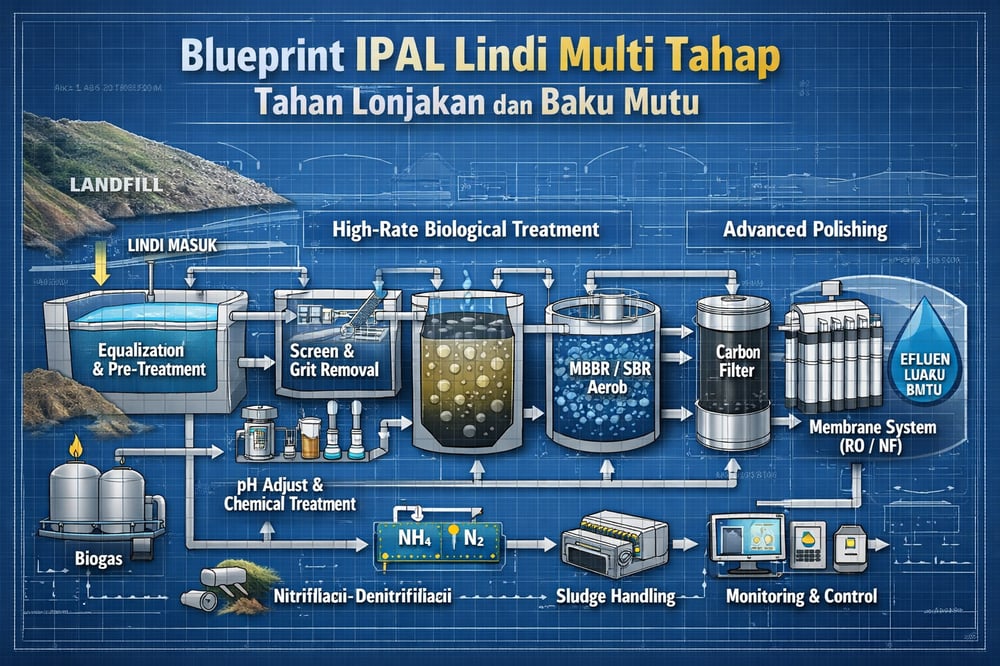
Anaerobic digestion tolerates punishing organics and generates biogas. A Hong Kong landfill study ran a mesophilic (30–35°C) UASB (upflow anaerobic sludge blanket) for 5–6 days HRT (hydraulic retention time), removing 66–90% of COD—cutting ~12,900 mg/L down to 1,440–1,910 mg/L at 1–2.4 gCOD/L·d OLR (organic loading rate) (pubmed.ncbi.nlm.nih.gov). About ~92.5% of the removed COD became methane, with a net biomass yield near 0.053 gVSS/gCOD (pubmed.ncbi.nlm.nih.gov). Post‑UASB, effluent still held ~1,500 mg/L COD and high NH₄ (ammonium), so polishing remained essential.
Pros: low energy and biogas recovery. Trade‑offs: longer HRT and ammonia inhibition risk at very high NH₄ (free NH₃ >2,000 mg/L can slow methanogens). Many operators consider modular anaerobic digestion systems to capture these benefits while phasing capacity.
High‑rate aerobic systems (MBBR/SBR)
Biofilm‑based aerobic systems remove organics fast and, with sufficient oxygen, nitrify ammonia. A two‑stage anaerobic (or anoxic) plus aerobic MBBR (moving bed biofilm reactor) treating 4–16 kgCOD/m³·d achieved ~92–94% total COD removal; at 4–8 kg/m³·d, the anaerobic MBBR alone removed ~88–93% COD, and at 10–16 kg/m³·d the combined system still reached ~92.6% (pubmed.ncbi.nlm.nih.gov).
Ammonia behavior followed hydraulic residence: with ≥1.25 days in the aerobic reactor, NH₄‑N removal exceeded 97%; at 0.75 days, nitrification slumped to ~20% (pubmed.ncbi.nlm.nih.gov). Sequencing batch reactors mirrored those results: one SBR (sequencing batch reactor) reported ~97.3% BOD and 95.4% NH₃‑N removal (link.springer.com). Robustness matters: the cited MBBR tolerated a 4× COD spike with only ~7% efficiency drop, rebounding in ~3 days (pubmed.ncbi.nlm.nih.gov). For biofilm flexibility, engineered MBBR systems are a common choice.
Low‑complexity options exist, too. Trickling filters and aerated lagoons are simpler and cheaper; a solar‑powered stabilization pond in Indonesia achieved >90% BOD and >80% COD removal thanks to long retention and simple aeration (sib3pop.menlhk.go.id). Lagoons need large footprints and struggle to nitrify without additional carbon. Where batch flexibility is preferred, packaged SBR units are deployed for 90%+ BOD removal.
Nitrogen removal sequencing
With ammonia often in the hundreds to thousands mg/L, nitrification–denitrification is pivotal once bulk COD is down. In many cases, conventional aerobic nitrification followed by anoxic denitrification carries the day; denitrification can proceed on residual carbon or endogenous decay. In very mature leachate (high N, low residual COD), partial nitritation–Anammox is considered, though it remains an emerging option in practice.
Tertiary polishing to the strictest limits
Adsorptive polishing pulls out color, odor, and refractory organics. Both GAC (granular activated carbon) and PAC (powdered activated carbon) are standard; sufficiently dosed GAC can strip 70–90% of remaining COD, and studies show PAC reduced residual COD by up to ~89% while GAC reached ~75% under test conditions (pmc.ncbi.nlm.nih.gov). Carbon beds are widely used as a final polish; engineered media such as activated carbon are common in these stages.
Membranes can finish to near‑zero dissolved solids. UF (ultrafiltration) or MF removes suspended fines, with NF (nanofiltration) or RO (reverse osmosis) rejecting >95% dissolved organics and salts. In one lab setup, a submerged MBR (membrane bioreactor) with PAC followed by NF reached ~99% total COD removal (pubmed.ncbi.nlm.nih.gov). Plants often pair pretreatment UF like an ultrafiltration module with downstream NF/RO, selecting from integrated RO, NF, and UF systems designed for industrial and municipal duty.
For high-rejection stages, engineers turn to nanofiltration for lower‑pressure hardness and color control or brackish‑water RO when dissolved solids are elevated. Where biology and membranes are merged, packaged MBR systems produce reuse‑grade effluent.
Advanced oxidation (AOP) enters when refractory organics resist. Ozone and Fenton chemistry pushed the Hong Kong UASB effluent to 99.3% total COD removal, ending at ~85 mg/L COD (pubmed.ncbi.nlm.nih.gov). UV/H₂O₂ is another AOP pathway; in multi‑barrier designs, ultraviolet units such as UV reactors can be incorporated upstream of membranes. The cost–benefit tradeoff is site‑specific: biological plus carbon and/or membranes is often sufficient, with AOP as the contingency for very recalcitrant cases.
Documented performance and sizing rules
Stacked stages deliver outsized gains. In the Hong Kong case, anaerobic biology plus oxidation brought raw COD (~12,900 mg/L) down to ~85 mg/L (pubmed.ncbi.nlm.nih.gov). Two‑stage anaerobic–aerobic biofilm trains routinely cross >90% COD removal and >97% ammonium removal under appropriate HRTs (pubmed.ncbi.nlm.nih.gov) (pubmed.ncbi.nlm.nih.gov), and simpler pond‑based designs with polishing have logged >90% BOD and >80% COD reductions (sib3pop.menlhk.go.id).
As a rule of thumb, expect ~80–90% removal in each primary biological stage (anaerobic or aerobic) plus ~90% of the remainder in polishing (adsorption/membrane), yielding <100–300 mg/L final COD and <20–50 mg/L BOD under typical loads. Designs must size for worst‑case leachate so effluent consistently stays within BOD ≤150 mg/L, COD ≤300 mg/L, TSS ≤100 mg/L, and total nitrogen ≤60 mg/L (legalcentric.com) (legalcentric.com).
Operations, energy, and residuals
Shock loads happen. Equalization softens the blow, and high‑rate biofilm reactors have documented resilience—a 4× sudden COD spike cost only ~7% removal efficiency and recovered in ~3 days in one MBBR study (pubmed.ncbi.nlm.nih.gov). DO, NH₄, and pH controls fine‑tune aeration and recirculation; plants often bundle instrumentation within supporting ancillaries.
Sludge and concentrates need plans: anaerobic systems produce little sludge and biogas (~0.35 m³ CH₄ per kg COD treated), while aerobic steps yield more waste biomass; polishing creates spent carbon and membrane brine. Where spare parts matter, operators lean on water treatment consumables to keep uptime high. If denitrification carbon is limited after deep COD removal, external carbon is sometimes added. Regulators expect regular monitoring; periodic lab tests and online sensors are common in Indonesia, and remote data logging helps flag upsets early.
Bottom line and sources
A multi‑stage plant—equalization → bulk biological removal → nitrification (if needed) → advanced polishing—repeatedly meets strict discharge limits. Real‑world and pilot data back this: >90% COD/BOD in primary stages (pubmed.ncbi.nlm.nih.gov) (pubmed.ncbi.nlm.nih.gov), ~70–90% of the remainder in polishing (pmc.ncbi.nlm.nih.gov) (pubmed.ncbi.nlm.nih.gov). Design choices—anaerobic vs. aerobic, reactor volumes and HRTs—should be tied to site leachate data over time. All claimed figures and regulatory limits are documented across peer‑reviewed and government sources: (pubmed.ncbi.nlm.nih.gov) (link.springer.com) (pmc.ncbi.nlm.nih.gov) (pubmed.ncbi.nlm.nih.gov) and Indonesian limits (legalcentric.com) (legalcentric.com).
