

Industry: Landfill | Process: Stormwater_Management
Landfill operators know the stakes: keep rain out of the waste, keep leachate (liquid that percolates through waste and can carry contaminants) out of water. U.S. closure standards require a low‑permeability clay or geomembrane (synthetic liner) layer of ≤1×10⁻⁵ cm/s under a soil drain and vegetated cover, expressly to prevent infiltration and leachate escape (epa.gov).
In practice, nature keeps testing that design. Weather and time create rills (small erosion channels), settlement, cracks, and animal burrows that can route runoff toward waste (stormwater.com). That’s why regulators from Hong Kong to Indonesia hard‑wire inspections into post‑closure: Hong Kong mandates “regular inspection of the capping system…to ensure its integrity” and to confirm no leachate seepage through the cap (epd.gov.hk); Indonesian guidance calls for long‑term (often ≥20 years) inspection and monitoring with measurable indicators logged at set intervals (123dok.com).
Cap monitoring frequency and scope
Set the tempo early. Schedule visual inspections at least monthly during the first post‑closure year and at least quarterly thereafter, with ad hoc checks after any extreme rainfall event (e.g., >50 mm in 24 h). Indonesian practice advises quarterly “perubahan kualitas air permukaan” checks for 20 years (123dok.com), implying similar rhythms for cover conditions. Alternately, annual inspections augmented by targeted post‑storm surveys can ensure no damage is missed.
A pragmatic program also adds weekly drives during wet seasons, quarterly formal audits with photos and instrument data, and an annual report that trends any surface changes.
Topography, instruments, and triggers
Quantify movement. Conduct an annual topographic and subsidence survey (GPS or drones) to track slope and elevation change; the UK requires yearly topographic mapping of closed landfills for settlement detection (gov.uk). If soil loss exceeds design tolerances—e.g., >0.5 m reduction over >5% of a slope—trigger remedial grading and revegetation.
On steeper grades or critical zones, simple instruments sharpen the picture: inclinometers for slope movement, settlement plates, or piezometers (groundwater pressure gauges) with alarm triggers (e.g., >2 cm movement in a month). At minimum, maintain survey benchmarks so any cover deflection is detectable (gov.uk).
Visual checks and erosion control
Inspect slopes, summits, and drainage channels for rills/gullies in the top 10 cm, cracks or slumping, exposed liner/drainage blanket, animal burrows, undermined vegetation, and sediment deposition in ditches (epd.gov.hk). Record rill depth, bare‑soil area, and compare to erosion standards; if exposed area exceeds 2% of the cover or rills exceed 5 cm depth, repair immediately (regrading, reseeding, or geotextile armoring).
Maintenance matters: keep vegetation and drainage at design standards, clear ditch blockages, repair concrete/riprap linings, and ensure downchutes/culverts are intact. Manage woody species (deep roots can penetrate covers) and favor shallow‑rooted grasses. Case studies show advanced covers can withstand extreme storms—one Florida site handled 22–26 in of rain in 24 h without failure (stormwater.com)—but only with vigilant maintenance. High total suspended solids (TSS) in runoff can flag vegetation or soil failure (waste360.com; stormwater.com).
Why inspections protect water
Small breaks can have big hydraulic consequences. A breach in 6 in of topsoil can locally raise infiltration by orders of magnitude—even if the primary clay liner remains intact (epa.gov). Unaddressed erosion effectively invalidates design permeability, creating a “bathtub effect” of ponding and leachate pressure on the liner (epa.gov).
Regular inspections—and quantified checkpoints—keep total infiltration negligible, with a target of <1–2% of rainfall (epa.gov). A robust program pairs weekly wet‑season drive‑bys with quarterly audits (photographic and instrumented), and an annual comprehensive trend report.
Stormwater monitoring stations and events
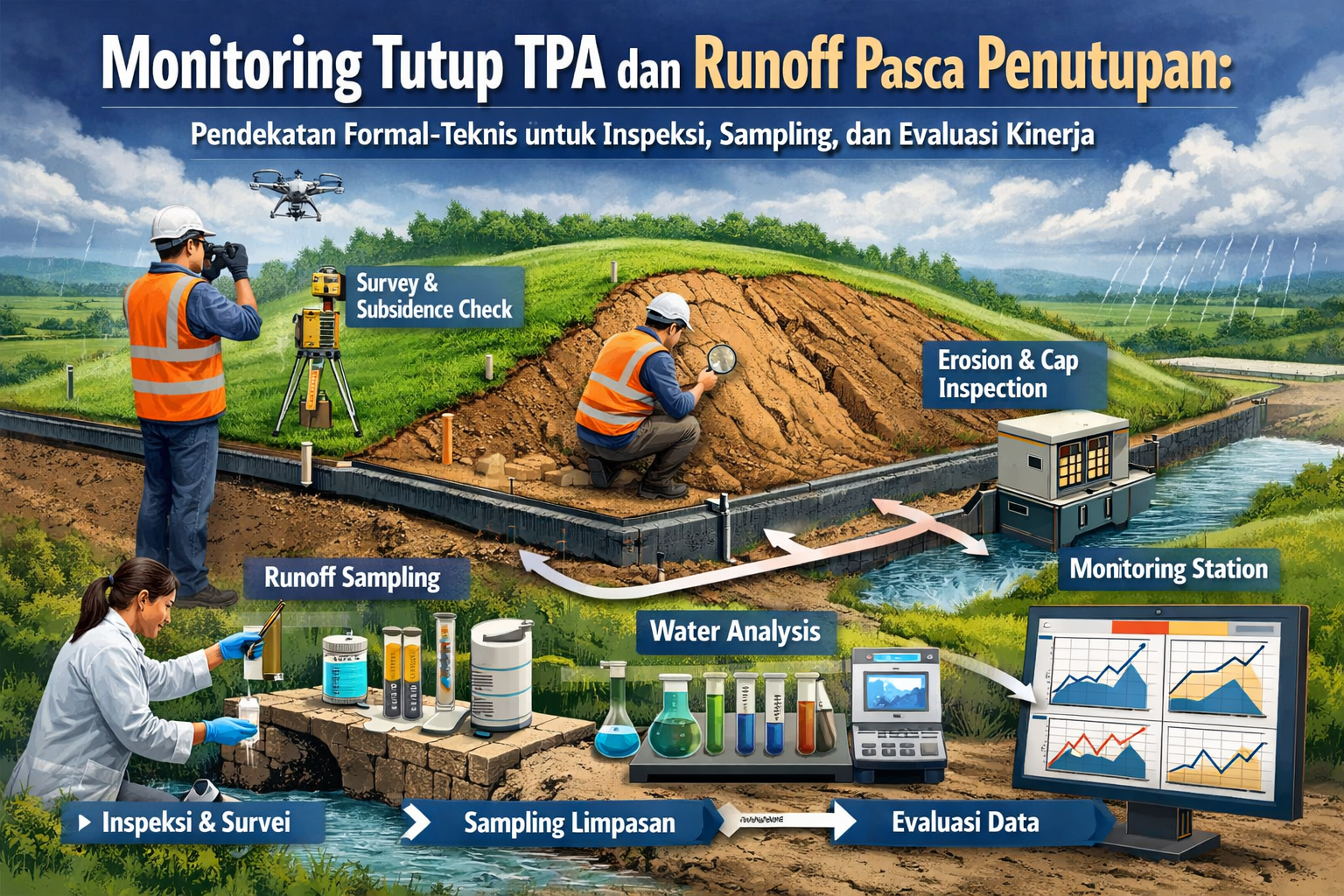
Runoff must prove it stays “clean.” Install sampling points at all stormwater discharge outlets (end‑of‑pipe, detention basins) and in receiving waters upstream/downstream. U.S. guidance notes “several monitoring stations are necessary… [located] in areas of high potential risk and where landfill drainage discharges runoff off‑site” (waste360.com). At a minimum, sample the first flush (the initial runoff when contaminants spike) and another point mid‑event or at peak flow. Automatic samplers or flow‑normalized composite samples capture fluctuating loads (waste360.com).
Keeping sampling points free of debris helps data quality; at outfalls, an automatic screen can prevent clogging that disrupts first‑flush collection.
Sampling frequency and low‑flow checks
Adopt at least quarterly storm‑event sampling. Because high flows can dilute pollutant signals, sampling in dry or low‑flow periods—such as after a week without rain—can maximize detection probability (waste360.com). Indonesian post‑closure guidance explicitly calls for 4 surface‑water samples per year (up/downstream) for 20 years (123dok.com). Critically, collect within the first one hour of runoff—the first flush—when concentrations often peak (waste360.com).
Parameters and regulatory comparators
Analyze for leachate indicators: pH (acidity/alkalinity), electrical conductivity (EC), total dissolved and suspended solids (TDS/TSS), chemical oxygen demand (COD), biological oxygen demand (BOD), ammonia‑nitrogen (NH₃‑N), nitrate‑nitrogen (NO₃‑N), heavy metals (Pb, Cd, Cu, Zn), and any landfill‑specific toxics (e.g., phenols or chloride). Indonesian guidance recommends pH, BOD, COD, chloride, and conductivity, with accredited laboratory analysis (123dok.com).
Compare to legal standards, e.g., Indonesian PP No.82/2001 for surface water quality and Permen LH P.59/2016 for leachate releases (123dok.com). COD/BOD limits are typically 50–100 mg/L and pH 6–9 in this context. If monitoring wells or effluent systems are present, analyze them routinely against permit limits.
Background comparisons, action levels, and trends
Use a “background vs. compliance” frame: establish upstream/background concentrations and compare landfill runoff. A statistically significant rise—e.g., >2× background of a leaching indicator—should trigger investigation. Set early‑warning assessment levels to detect negative trends (gov.uk). Track parameters over time with control charts or regression tests (waste360.com).
Many facilities define automatic actions: if three consecutive samples exceed a TSS or COD action level (similar to UK practice; waste360.com), immediately stabilize the cover and re‑test.
Outcome metrics and corrective measures
Report measurable outcomes: success can be “zero exceedances” of regulatory standards (or <10% exceedance rate) over a 12‑month rolling period. Seek a stable baseline or declining trend in TDS/EC and nutrients. If first‑flush TSS stays under ~50 mg/L (typical for rural runoff), the cover is likely performing; 150–200 mg/L warrants concern (waste360.com). Turbidity and COD spikes should be <20% above background; persistent differences demand remedial action such as regrading or water treatment.
When flows are temporarily routed to treatment during investigations, sediment control in basins can include a lamella settler for compact settling capacity. For finer particulate polishing, operators can add sand/silica filtration downstream of detention. If dissolved organics are implicated, adsorption with activated carbon can be applied prior to discharge assessment.
The proof is in the record
A sound plan pairs cover inspections (monthly/quarterly with annual surveys) and routine runoff sampling (multiple stations, quarterly plus event‑based) into one dataset. Log every inspection and analyte in a database to generate statistical evidence—e.g., “no significant increase in conductivity was observed at any station for 3 years.” Where measurements deviate, act quickly—erosion repair or diverting faulty drainage flows to treatment—then re‑test. By quantifying cover condition and runoff chemistry against design standards (≤1×10⁻⁵ cm/s permeability; low pollutant levels) (epa.gov; 123dok.com), operators can demonstrate that closed landfills are protecting water resources.
Sources: EPA 40 CFR 258 cap standards (epa.gov); HK landfill EIA requirements (epd.gov.hk); industry guides and case studies (waste360.com; stormwater.com); Indonesian technical guidelines (123dok.com).