

Industry: Semiconductor | Process: Specialty_Gas_Delivery
Acute hazards and injury patterns
Specialty gases such as silane, phosphine, arsine, diborane, and boron trifluoride—core to semiconductor fabrication—bring acute hazards: flammability, toxicity, pyrophoricity (spontaneous ignition on air contact), and pressure risks (gasdetection.com) (keengas.com). Even inert gases like nitrogen (N₂) and argon (Ar) can cause asphyxiation in confined spaces.
Improper handling turns cylinders into missiles or crushing hazards: high‑pressure releases can eject fragments, and falling cylinders frequently cause crush or fracture injuries to feet and limbs (ilt.safetynow.com). A review of 223 gas‑cylinder handling incidents found slips, trips, and overexertion during manual lifting are leading causes of injury (researchgate.net).
Regulators mandate stringent controls: OSHA’s CFR 1910.101 incorporates Compressed Gas Association (CGA) standards—visual inspection, proper pressure relief devices, and handling per CGA Pamphlet P‑1 (osha.gov) alongside DOT specifications in 49 CFR 173.301 (law.cornell.edu).
Code‑driven storage controls
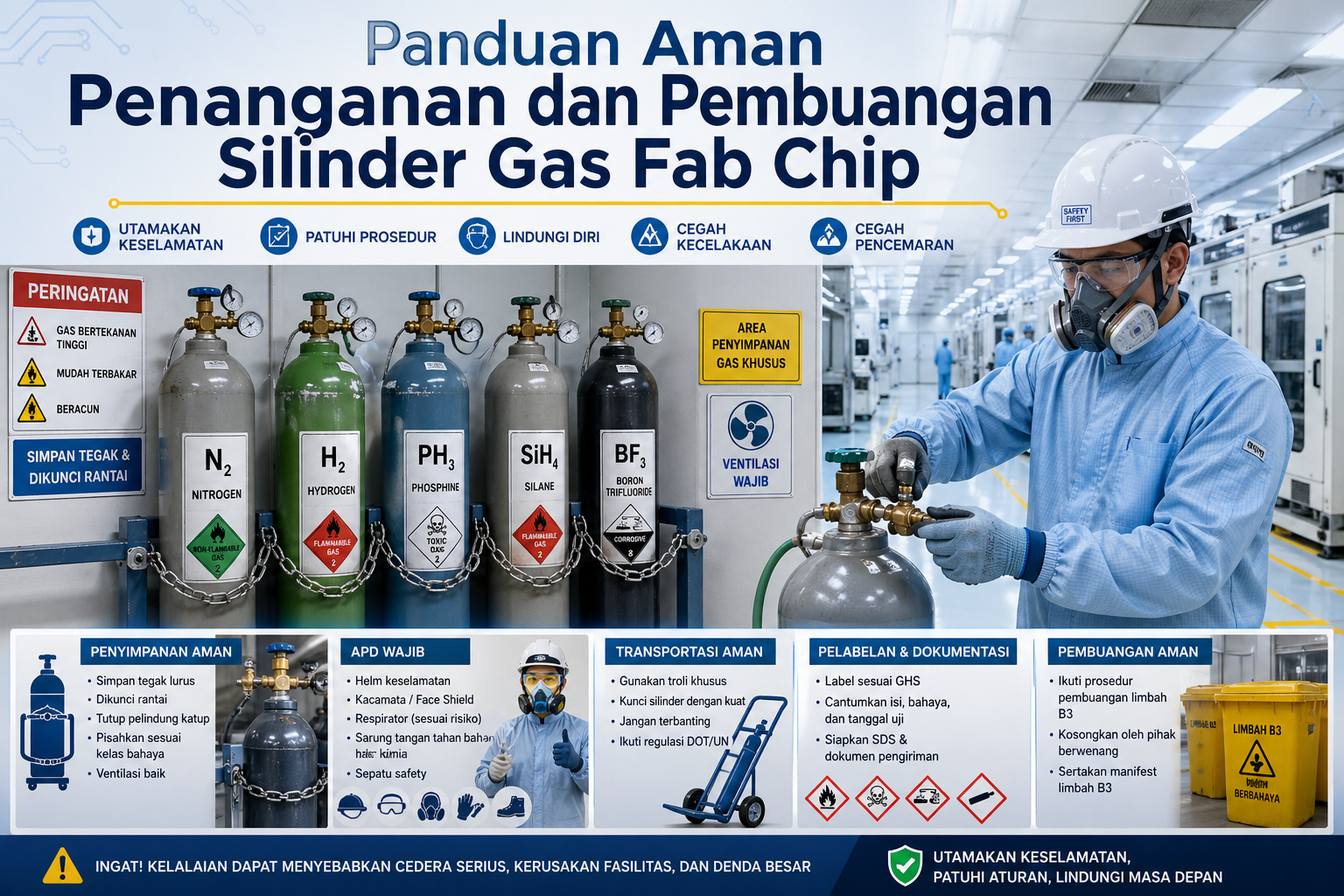
Upright, secured storage is foundational. Cylinders must be stored vertically, with valve protection caps fitted on unused cylinders, regulators removed, and cylinders chained or bolted to fixed supports to prevent tipping and valve damage or leaks (osha.gov). Storage areas should be well‑ventilated, segregated by hazard class (e.g., flammables vs. oxidizers), posted with appropriate signage, and kept away from heat sources above 130°F, open flames, and electrical equipment. Inadequate securing is a recurring failure mode in incident surveys (ilt.safetynow.com).
Quantity limits and segregation apply. Fire codes (NFPA 55) and local rules often cap aggregate volumes (for example, less than 12,000 ft³ of flammable gas in one control area) and require non‑combustible barriers between incompatibles. Storage must allow emergency responder access; outdoor locations are typically fenced or caged.
Labeling and inventory control reduce unknowns. Each cylinder requires clear content and hazard labels (GHS and CGA), routine barcoded inventory, and daily visual checks—cracked paint, bulging seams, or frost‑colored deposits can signal leaks. Any cylinder with dents, bulges, corrosion, or faulty valves must be removed from service and handled by specialist salvage teams. DOT forbids filling or shipping damaged cylinders (law.cornell.edu).
PPE for toxic, pyrophoric, and pressurized gases
Minimum protection includes safety glasses or full‑face shields (ANSI Z87.1) and heavy‑duty, chemically compatible gloves; ordinary glasses are insufficient, as high‑pressure discharges can eject particulates (usasafety.com). Thick leather or insulated gloves protect during regulator changes and against cold burns. Steel‑toed safety boots are mandatory to mitigate crush risks from 100–300 kg cylinders (usasafety.com).
For toxic or corrosive gases (e.g., arsine, boron trifluoride), PPE escalates to chemical splash goggles or full respirators and, where inhalation risk exists, air‑purifying or supplied‑air respiratory protection. Handling arsine (TLV 0.05 ppm) triggers immediate evacuation procedures and emergency decontamination per CDC guidance—implying respirators and chemical‑resistant suits are critical controls (cdc.gov) (storemasta.com.au). Many institutions require full encapsulating suits and SCBA for pyrophoric or highly toxic gases.
Training is non‑negotiable. Employers must provide PPE at no cost (OSHA requirement), conduct respirator fit testing, and drill on leak response. PPE selection follows each gas’s Safety Data Sheet (SDS) and standards such as AS/NZS 1715/1716; reassess as inventories change (usasafety.com) (storemasta.com.au).
Transport compliance under 49 CFR
For shipping, cylinders must be UN/DOT‑approved for the gas and pressure, marked with the specification, requalification dates, and owner information (law.cornell.edu). Once filled, they are hazardous materials and must meet 49 CFR Part 173 Subpart E packaging requirements.
Integrity rules are strict: no shipping if a cylinder leaks, bulges, is corroded, fire‑damaged, has faulty valves, or is past requalification/expiration; over‑aged cylinders may only move to a retest or disposal facility before condemnation (law.cornell.edu) (law.cornell.edu). Pressure relief devices must function per CGA; DOT mandates testing before ship‑out and forbids shipping a leaking fusible plug except by replacement (law.cornell.edu).
Labeling and documentation include proper shipping name and UN number, hazard class labels (e.g., “Non‑Flammable Gas” 2.2 or “Toxic Gas” 2.3), and—if disposed—a hazardous waste manifest and SDS/MSDS; drivers must be Hazmat‑trained with shipping papers onboard. Vehicles must segregate incompatibles, secure cylinders upright or in approved racks, and placard for flammables. Air moves face ICAO/IATA prohibitions or tight limits for many toxic gases; rail and road follow ADR/49 CFR with few restrictions beyond marking.
Training, documentation, and adherence to DOT/UN rules are mandatory. A single violation (such as shipping a defective cylinder) invites enforcement and increases accident risk; OSHA and EPA cite these rules to prevent equipment mishaps from cascading into catastrophic releases.
Waste determination and “empty” status
Disposal starts with status. Cylinders returned to suppliers for reuse are not discarded wastes (dtsc.ca.gov). Once the owner decides to discard any residual gas or the cylinder itself, it becomes waste subject to RCRA (U.S.) or equivalent regimes. In Indonesia, MOEF Reg. 9/2024 explicitly classifies empty chemical containers and industrial gas emissions as B3 (hazardous) wastes; spent cylinders holding B3 substances follow hazardous‑waste protocols (arma-law.com).
“Empty” has a specific meaning. Under RCRA, a compressed‑gas cylinder is empty only when the internal pressure is at or near atmospheric with the valve open; a closed‑valve cylinder with any residual pressure remains hazardous waste if discarded. Practically, “emptying” means carefully opening the valve in a controlled environment and venting or capturing the remaining gas (dtsc.ca.gov).
Residue treatment and destruction options
Reclaim or reuse is preferred when feasible: high‑value or pure gases may be transferred or used in‑process; suppliers often run take‑back programs for calibration gases or inerts. Recycling contents as industrial feedstocks “reduces waste disposal volumes for significant overall cost savings” (hazchem.com).
Neutralization or treatment applies to corrosive/reactive gases. Ammonia can be scrubbed with acid; halogens with alcohol; oxidizers diluted safely—by trained personnel or at permitted treatment facilities (dtsc.ca.gov). Accurate chemical feed matters in these scrubbing steps; facilities typically rely on dosing pumps to meter neutralizing agents precisely.
Flaring or controlled venting is acceptable for flammable or benign gases (e.g., methane, nitrogen) via controlled burners, but toxic gases must not be freely vented. EPA interprets gaseous residues vented to atmosphere as not a “solid waste” in itself, but only where the gas is non‑hazardous and dispersion is assured; venting toxic or greenhouse gases is environmentally unacceptable and often illegal without controls (dtsc.ca.gov).
Incineration is used for certain pyrophoric gases. Silane and diborane, for example, may be burned off; on‑site flares or dedicated cylinder burnout systems convert gases to non‑hazardous products (e.g., silane to silica). CGA P‑63 recommends such treatments for qualified teams only.
Cylinder end‑of‑life pathways
Return for refill keeps containers out of the waste stream—most suppliers accept in‑spec cylinders for reuse, in which case the cylinder itself is not waste (dtsc.ca.gov).
Sale to scrap or recycling is possible for empty steel or aluminum cylinders. Recyclers often require valve removal or proof of emptiness by cutting/puncture—only after safe venting; OSHA warns against puncturing pressurized containers (dtsc.ca.gov).
Hazardous‑waste disposal firms are necessary for damaged, out‑of‑date, or acutely toxic cylinders. These services neutralize residuals, crush cylinders in confined furnaces, or otherwise render them non‑hazardous; modern facilities use automated depressurization and rinse systems and capture residues for permitted treatment (hazchem.com) (hazchem.com).
Industry guidance is unambiguous: never discard cylinders in general trash or recycling bins (keengas.com). In the U.S., household hazardous‑waste centers collect spent cylinders; in Indonesia, such waste must go to authorized B3 facilities (“FPSS‑B3”) or TSDFs, and non‑recyclable B3 waste must be delivered to licensed facilities per MOEF (arma-law.com). A rule of thumb from industry: “Treat every cylinder as if it’s still full.” As one guidance states, “Compressed Gas Cylinders Shall Always Be Disposed of Properly… Do Not Throw Cylinders in General Waste… Cylinders Shall Always Be Treated as Full” (keengas.com).
Disposal documentation requirements
Generators must characterize contents (toxicology, ignitability, reactivity) to determine RCRA categories, then label, manifest, and count the waste toward generator status once contents or container are discarded, per EPA and California DTSC guidance (dtsc.ca.gov). In California, any compressed‑gas cylinder not opened to atmospheric pressure is counted as hazardous waste until proven empty (dtsc.ca.gov) (dtsc.ca.gov).
Regulatory frameworks and standards
In the U.S., OSHA 29 CFR 1910.101 adopts CGA P‑1 for in‑plant storage/handling (osha.gov). Transportation is governed by DOT’s 49 CFR Parts 171–180 (law.cornell.edu) (law.cornell.edu), and disposal by RCRA (40 CFR 260–279). EPA letters from 1980–84 classify discarded compressed gases as hazardous wastes when they exhibit hazardous characteristics (dtsc.ca.gov), requiring records, licensed TSDFs, and, when thresholds are exceeded, hazardous‑waste generator status.
Internationally, UN GHS sets classification and SDS norms; transport aligns with UN Recommendations (ADR for road, IMDG for sea, ICAO for air) that mirror U.S. DOT. IEC/ISO standards (ISO 13769, ISO 9809, and ISO/FDIS 20100 for semiconductor gases) guide cylinder design and handling; many jurisdictions adopt NFPA 55 or local fire codes for storage.
Indonesia treats spent specialty gas cylinders as B3 waste under Government Regulation No. 101/2014 and MOEF regulations (e.g., PermenLHK 05/2014 on B3 labeling, superseded by Reg 9/2024). Under MOEF Reg. 9/2024, empty containers that held B3 materials are “sampah B3,” and industrial gas emissions are “limbah B3.” The regime mandates waste minimization and routing non‑reusable B3 waste to authorized facilities; firms must classify spent cylinders, keep manifests, and use licensed B3 handlers or take‑back programs, with local environmental offices enforcing and penalizing violations (arma-law.com) (arma-law.com).
Trends, penalties, and measurable outcomes
Waste reduction and circularity are ascendant. “With global trends towards reuse and recycling,” compressed‑gas cylinder remediation services are expanding (gasworld.com). Companies that implement return programs see purchasing and waste‑fee benefits; HazChem reports that recycling cylinder contents into industrial feedstocks can significantly cut annual disposal volumes and costs (hazchem.com).
The downside of neglect is stark: mishandling drives thousands of injuries and multiple fatalities annually; one estimate cites about 10 U.S. deaths and roughly 4,000 injuries in a single year (ilt.safetynow.com). Hazardous‑waste violations can cost tens of thousands per incident. Indonesia’s enforcement is tightening: MOEF has publicized recent B3 dumping prosecutions, including July 2022 arrests (ppid.menlhk.go.id).
Well‑run programs track clear KPIs: zero lost‑time injuries from gas handling (with slip‑and‑fall or crush events the most common threat, per incident analyses) (researchgate.net); near‑100% inventory accountability; kilograms of spent B3 gas and cylinder counts trending down as return/recycling programs take hold—often showing more than 50% reductions in waste volume and cost compared with outright disposal; and audit readiness via current manifests and safety audits.
Program design and controls
Training and procedures: written SOPs for storage, transfer, leak response, and disposal; documented training with annual refreshers and emergency drills (toxic‑gas alarms, muster points).
Engineering controls: fire‑rated gas cabinets/shelters for specialty gases, fixed and portable gas detection, and dedicated vent lines for purge operations. CO₂ suppression is commonly used for flammables.
Maintenance: periodic testing of relief valves and regulators, calibrated pressure transducers to confirm emptying, and preventive maintenance for leak‑prone fittings (swivel joints, flex lines).
Disposal contracts and oversight: relationships with reputable hazardous‑waste vendors or cylinder savers, periodic certification reviews (ISO 14001, DOT licenses), and certificates of destruction for discarded assets.
Continuous improvement: monitor incidents, waste volumes, and return rates; set targets (e.g., 100% cylinder returns by a defined year); investigate near misses (dropped cylinders, minor leaks); and audit suppliers to ensure best practices extend across the delivery chain.
Key takeaway: Safe handling and disposal of specialty gas cylinders rely on strict engineering controls and regulatory mandates. Following the rules prevents explosions, poisonings, and mechanical injuries while avoiding compliance penalties. With rigorous storage, transportation, PPE, and disposal measures—plus supplier return programs—companies can shrink their hazardous‑waste footprint and capture measurable safety and cost gains (hazchem.com) (keengas.com) (arma-law.com).