

Industry: Brewery | Process: Lautering_&_Wort_Boiling
Beerstone is the mineral‑organic scale that creeps across stainless, then sticks around. The buildup, chiefly calcium oxalate bound with proteins, “leaves an unsanitary surface” that harbors microbes, drives off‑flavors and haze, shortens shelf life, and “can ruin an entire batch,” according to Solenis. In practice, nearly all wort‑boiling kettles and fermenters will accumulate some beerstone, especially with hard water or heavy hopping.
The chemistry is simple and stubborn. Calcium in brewing water reacts with oxalate compounds from malt or hops to form insoluble calcium oxalate (CaOx) scale (GoodBeer Solutions).
Beerstone formation and prevention
Prevention starts upstream. Adjusting water chemistry (reducing excess calcium or bicarbonate) and acidulating (using acidulated malts) can minimize CaOx precipitation. Thorough grain‑bed/lauter rinses and prompt kettle‑round rinsing after each brew flush out solids before they dry. Frequent cleaning (daily or between batches) prevents thick buildup. In soft or low‑ash water the risk is lower; in very hard water (>100 mg/L Ca), chelants or softer water are considered.
Some breweries address hardness with ion exchange. A dedicated softener removes calcium and magnesium ions to prevent scale formation. Others migrate to nano‑filtration, which removes hardness with lower pressure than RO, when re‑tuning the brewhouse water train.
Traditional caustic CIP parameters
Most breweries rely on sodium hydroxide (NaOH, “caustic soda”) as the primary cleaning‑in‑place (CIP) agent—a closed‑loop method that cleans fixed piping and vessels without disassembly. Typical practice: 1–4% NaOH (w/v) at 50–70 °C for 15–30 minutes (Asian Beer Network). Built caustic formulations include surfactants and chelators to emulsify oils and sequester hardness (Asian Beer Network).
Pre‑rinses matter. Residual beer and yeast are flushed first, and vessels are vented of CO₂—CO₂ reacts with NaOH to form sodium carbonate, neutralizing alkali, smearing soils, and even risking implosion in sealed vessels (Asian Beer Network).
A representative cycle, based on industry surveys: recirculate ~100 L of hot (60–70 °C) 2–3% NaOH through a 1000–1200 L kettle (about 0.1 BV) for ~30 minutes (Asian Beer Network; J. Brewing & Distilling). A UK microbrewery study found 2% NaOH for 35 minutes at ambient (~20–25 °C) achieved a clean vessel (ATP RLU <10–30; ATP swabs are rapid hygiene tests), suggesting excessively high temperatures aren’t always needed (J. Brewing & Distilling). After caustic, rinse thoroughly until near neutral; one pass of ≈0.1–0.2 BV water is generally sufficient (J. Brewing & Distilling).
Caustic excels on proteins, sugars, and hop residues but does not remove the mineral fraction of beerstone. Even “built” caustics with chelators (e.g., EDTA, phosphonates) can leave calcium salts; complete scale removal requires acid (Asian Beer Network).
Caustic optimization and CO₂ purging
CIP optimization studies show lower concentrations and temperatures are often sufficient. One trial cleared a bright beer tank in ~10 minutes using 1.0% NaOH at 20–50 °C, provided CO₂ was purged (J. Brewing & Distilling). Larger fermenters (>450 L) typically required ~2% or higher to hit cleanliness targets (J. Brewing & Distilling).
Historically, breweries used 3–4% NaOH, but a re‑evaluation (e.g., Heineken data) indicated 1–2% is usually adequate for stainless tanks. In short, an aggressive 3–4% boil is not necessary for routine cleaning, and lowering to 1–2% can save chemical and energy without losing effectiveness (J. Brewing & Distilling; J. Brewing & Distilling).
Enzymatic and multi‑enzyme cleaners
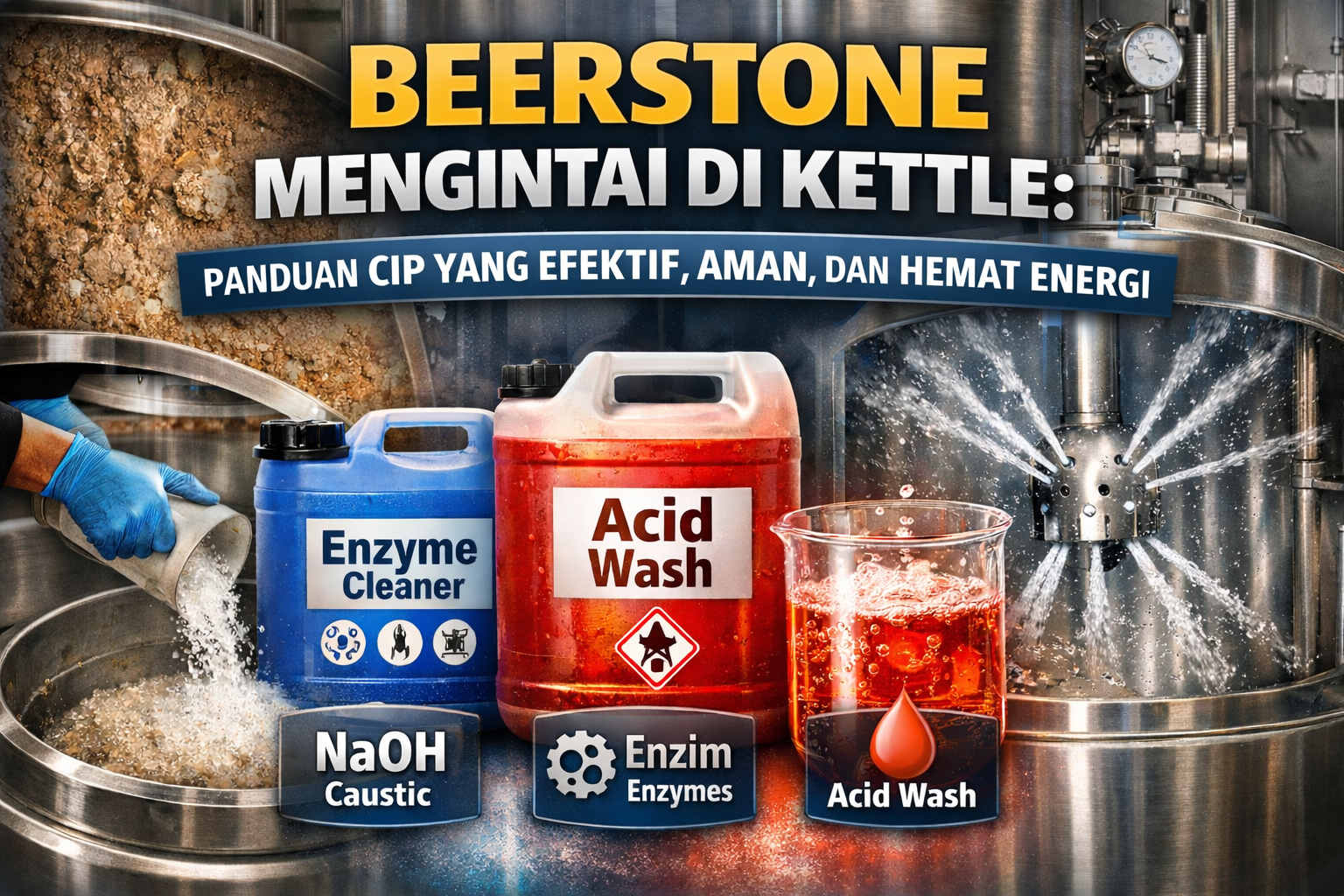
“Non‑caustic” alkaline cleaners with enzymes (proteases, amylases, lipases) are gaining ground. These operate at milder pH (~9–10) and moderate temperatures (~40–60 °C), specifically breaking down proteins, starches, and biofilms. A practical cycle: 0.5–1.0% multi‑enzyme detergent (per supplier), recirculated for 20–30 minutes. Analyses in dairy and beverage processing suggest enzyme‑based CIP can reduce chemical use and energy needs; one review estimated ~7% lower chemical costs and roughly halved energy/waste costs due to lower wash temperatures and reusable enzymes (Comprehensive Reviews in Food Science and Food Safety).
In brewing, specialty products (“PBW,” “Enzybrew,” Birko’s CIP‑erior) combine enzymes with surfactants and sequestrants for daily cleanup. Limitation: enzymes remove the organic “binder” in beerstone but cannot dissolve calcium oxalate minerals. A subsequent acid CIP remains mandatory to dissolve the inorganic residue.
Acid wash for mineral dissolution
Even with optimized alkaline cleaning, the residual calcium component of beerstone must be removed by acid. Standard practice is a post‑alkali acid CIP cycle every brew or at least regularly (e.g., weekly/monthly) for tanks prone to scaling. Common mixtures: phosphoric plus nitric (or phosphoric alone), typically 0.5–1.5%. One schedule recommends 1–2 oz/gal (≈0.8–1.6% v/v) phosphoric/nitric at ≤60 °C for 15–30 minutes, followed by an alkali wash (Solenis). Birko/CIP‑erior guidance suggests doing acid before a non‑caustic alkali wash for maximal scale removal (Solenis). Phosphoric acid is particularly effective on beerstone; nitric helps on browning or metal oxides (Asian Beer Network). After acid, rinse with ambient water until neutral.
In dry terms: acid reacts with insoluble calcium oxalate, converting it to soluble calcium phosphate or nitrate and carbon dioxide. Empirical tables confirm acid is the primary scale‑dissolver: the alkaline wash removes organics first, and the following acid wash “primarily removes mineral impurities” (Journal of the Institute of Brewing). As one brewer quipped, if acid CIP is skipped for too long, the kettle will literally become cemented by beerstone.
Kettle CIP program protocol
Step 1: Pre‑Rinse. Drain the kettle of wort and solids. Open valves/vents to purge steam and CO₂ (venting outdoors if needed). Perform a warm water rinse (~20–30 minutes, or ~0.1–0.2 BV recirculated) to flush out bulk debris.
Step 2: Caustic CIP. Prepare 2% w/v NaOH from ~30–33% stock at ~50–60 °C. Recirculate via the sprayball for 20–35 minutes (Asian Beer Network; J. Brewing & Distilling). If using enzymatic cleaner, follow supplier dilution (~0.5–1.0%) with similar time/temperature. Many teams specify an in‑line dosing pump for accurate chemical dosing.
Step 3: Intermediate Rinse. Drain and rinse with fresh hot water (~40–50 °C) for ~5–10 minutes (≈0.1 BV) until the effluent pH equals the inlet water. Conductivity or ORP probes commonly alarm when caustic is cleared. A single 100–150 L flush cleared NaOH in a 1200 L tank in one study (J. Brewing & Distilling).
Step 4: Acid CIP. Circulate ~1% v/v H₃PO₄ + HNO₃ at ambient–50 °C for 10–15 minutes (Asian Beer Network; Solenis). Drain and rinse to neutral.
Step 5: Sanitize (Final). Apply peracetic acid (PAA) at 0.5–1.0% v/v of ~5% stock for ~5–10 minutes at room or slightly elevated temperature (J. Brewing & Distilling). Alternatively, a hot water rinse at 85–90 °C or a steam purge can sanitize the kettle.
Step 6: Validation. Verify via ATP swabs on kettle walls aiming for RLU <10–30, or via conductivity to confirm no lingering chemicals. Document chemical, time, and temperature; replace CIP solutions daily; dispose of effluent per regulations.
In practice, smaller breweries may acid‑wash daily or every other brew, whereas large brewhouses often schedule the full alkali + cold rinse + acid cycle for each tank after fermentation batches. The throughline is consistency—skipping acid invites accumulation.
Economics and efficiency
Optimization pays. In a UK microbrewery study, switching to 2% NaOH at ambient and avoiding excess heating delivered savings >£1000/year in a ~500 L setup (J. Brewing & Distilling). Built‑formula cleaning (with chelants) reduces repeated rinses or extra acid neutralization, and enzyme‑based CIP can cut energy use: one analysis estimated roughly a 50% reduction in CIP energy and wastewater costs because of lower wash temperatures and reusable solutions (Comprehensive Reviews in Food Science and Food Safety).
Tracking water and chemical consumption is now standard; many breweries aim for <5 L of cleaning water per 1 L of beer produced. Where hardness drives recurring beerstone, plants often look beyond chemistry to the water train—some pair nanofiltration with softening for steady incoming water quality via systems such as nano‑filtration and a downstream softener.
Sources and further reading
Laing, H. et al., “Investigating cleaning in place (CIP) chemical, water, and energy use: A comparative study of SOPs for UK microbreweries,” J. Brewing & Distilling 10(1):17–28 (2021): link 1, link 2, link 3, link 4, link 5, link 6, link 7.
Piepiórka‑Stepuk, J. et al., “Analysis of physical impurities in regenerated solutions used in cleaning brewing systems,” Journal of the Institute of Brewing 125(1):83–91 (2019): link.
Johnson, D. (Birko/Solenis), “Removing Beerstone: A look at alternative cleaning methods,” Solenis/Birko (blog): link 1, link 2; “Superior Brewery Cleaning with CIP‑erior,” Solenis (blog): link.
Miller, N., “Brewery Chemical Cleaning Quick Guide,” Asian Beer Network (blog): link 1, link 2, link 3, link 4, link 5.
Pant, R. et al., “Towards sustainable cleaning‑in‑place (CIP) in dairy processing: enzyme‑based approaches to cleaning,” Comprehensive Reviews in Food Science and Food Safety 22(5) (2023): link.
GoodBeer Solutions, “Waters & Wort: Calcium”: link.